in New Jersey Virginia KopKash Assistant Commissioner for Land Use - - PowerPoint PPT Presentation

in new jersey
SMART_READER_LITE
LIVE PREVIEW

in New Jersey Virginia KopKash Assistant Commissioner for Land Use - - PowerPoint PPT Presentation

Coastal Resiliency in New Jersey Virginia KopKash Assistant Commissioner for Land Use Management New Jersey Department of Environmental Protection How Did We Get Here? ? How Did We Get Here? How Did We Get Here? New Jerseys


slide-1
SLIDE 1

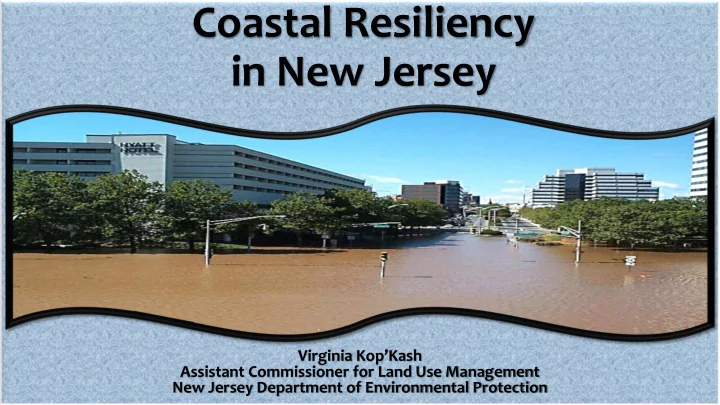
Coastal Resiliency in New Jersey

Virginia Kop’Kash Assistant Commissioner for Land Use Management New Jersey Department of Environmental Protection
slide-2
SLIDE 2

? How Did We Get Here?

slide-3
SLIDE 3

How Did We Get Here?

slide-4
SLIDE 4

How Did We Get Here?

slide-5
SLIDE 5
  • New Jersey’s
  • riginal

settlements were along navigable waterways

  • As a result,

many of the State’s population centers are within flood hazard areas today

slide-6
SLIDE 6
slide-7
SLIDE 7

How Did We Get Here?

slide-8
SLIDE 8

How Did We Get Here?

slide-9
SLIDE 9

How Did We Get Here?

slide-10
SLIDE 10

How Did We Get Here?

slide-11
SLIDE 11

What is Resiliency?

slide-12
SLIDE 12

What is Resiliency?

*from Disaster Resilience: A National Imperative, National Academy of Science, 2012

Resiliency The ability to prepare and plan for, absorb, recover from, and more successfully adapt to adverse events*

❖Enhanced resiliency = effectively anticipating disasters and planning in advance to reduce disaster losses instead of merely coping with the aftermath of an event

$ Complicated and expensive – requiring the

investment of time and resources prior to an event

slide-13
SLIDE 13

Two million households in the state lost power 346,000 homes were damaged or destroyed Economic losses to businesses of up to $30 billion 37 people in NJ were killed

Impacts of Superstorm Sandy

slide-14
SLIDE 14
  • Building Beaches and Dunes

What is Resiliency?

slide-15
SLIDE 15
  • Building Sea Walls
  • Elevating Houses
slide-16
SLIDE 16
  • Retreating from Vulnerable Areas

Blue Acres Program:

  • 935 offers made on homes in 14

municipalities

  • 714 offers accepted
  • 632 closings on homes in 14

municipalities

  • 531 demolitions completed
slide-17
SLIDE 17

What are the Costs?

  • $375 million is currently committed for Blue Acres projects.
  • $185 million from FEMA Hazard Mitigation Grant Program
  • $175 million from HUD Community Disaster Block Grant –

Disaster Recovery

  • $15 million from State bond funds

Blue Acres has spent more than $172 million

  • n acquisitions to date.
  • $647 million spent on completed projects
  • Federal contribution = $605 million
  • New Jersey’s contribution = $42 million
  • $569 million spent on projects currently under construction
  • Federal contribution = $490 million
  • New Jersey’s contribution = $79 million

Since Superstorm Sandy, $1.216 billion have been spent on shore protection projects in New Jersey.

slide-18
SLIDE 18
slide-19
SLIDE 19

New Jersey’s Coast

  • 1,800 Miles of Tidal Coastline
  • 239 Municipalities
  • Inland, Seaward, Interstate
  • $16 Billion Annual Tourism
  • 1.5 Million Migratory Shorebirds
  • 50-Species Commercial Fishing
slide-20
SLIDE 20

42% of New Jersey’s municipalities are coastal municipalities.

http://www.nj.gov/dep/cmp/docs/new

  • detailed-cafra-map.pdf
slide-21
SLIDE 21

Coastal Development

slide-22
SLIDE 22

Coastal Hazards

Coastal hazards include:

  • Chronic flooding
  • Storm events of increasing

intensity and frequency

  • Sea level rise
  • Erosion

These hazards threaten

  • ur coast, including the

population, infrastructure, and habitat within our coastal areas

slide-23
SLIDE 23

Flooding

❖ New Jersey endures severe and chronic flooding due to its:

1. Geography

  • 2. Location along the eastern seaboard
  • 3. High level of development
  • New Jersey is the most densely populated state in the nation.
  • Proximity to New York and Philadelphia increases the demand for

development.

  • Development increases flooding.
slide-24
SLIDE 24

Climate Change

❖ Flooding and storm events have been getting worse due to climate change.

  • The atmosphere is getting warmer.

Warmer air holds more moisture, which results in increased flooding and larger storm events, such as Superstorm Sandy.

  • Sea levels are rising.
  • Land is subsiding.
slide-25
SLIDE 25
  • A sea level rise of 2 feet

would affect or submerge about 1% of New Jersey’s land along the coastline.

  • This is projected to occur by

2100.

Sea Level Rise