
SLIDE 1
C O U N T Y D U R H A M R A I S I N G A W A R E N E S S O F I S S U E S R E L A T I N G T O H O A R D I N G A N D S E L F N E G L E C T
Multi-Agency Conference C O U N T Y D U R H A M R A I S I N G A W - - PowerPoint PPT Presentation
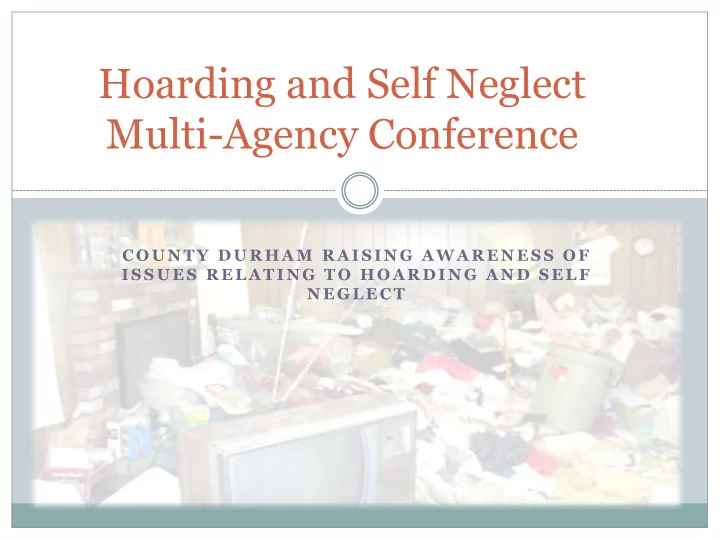
Hoarding and Self Neglect Multi-Agency Conference C O U N T Y D U R H A M R A I S I N G A W A R E N E S S O F I S S U E S R E L A T I N G T O H O A R D I N G A N D S E L F N E G L E C T Welcome Agenda Welcome Colin Steel
C O U N T Y D U R H A M R A I S I N G A W A R E N E S S O F I S S U E S R E L A T I N G T O H O A R D I N G A N D S E L F N E G L E C T
Welcome – Colin Steel Introduction – Deborah Barnett What is hoarding? – Deborah Barnett Assessment tools Psychiatric perspective of hoarding – Dr Paul Walker Case studies Health Trainer
Workshops:
1.
Supporting a person who hoards
2.
Fire and fire safety
3.
Legal support for those who hoard
4.
Housing providers – Practical solutions
To raise awareness of issues relating to hoarding
To ensure early intervention in supporting people who hoard and / or self neglect Objectives For staff to:
To prevent the escalation of
hoarding
To support the hoarder to
address underlying cases of hoarding
To support the person to
change hoarding behaviours
To address risk To recognise legal
frameworks
To understand the
psychological / mental health issues associated with hoarding
Hoarding is the excessive collection and retention of any material to the point that it impedes day to day functioning (Frost & Gross, 1993). Pathological or compulsive hoarding is a specific type of behaviour characterised by:
Acquiring and failing to throw out a large number of items that would appear to hold little or no value and would be considered rubbish by other people.
Severe ‘cluttering’ of the person's home so that it is no longer able to function as a viable living space;
Significant distress or impairment of work or social life (Kelly 2010).
Fear and anxiety Long term behaviour pattern Excessive attachment to
Unrelenting standards Socially isolated Large number of pets Mentally competent Extreme clutter Self-Care Poor insight
Vulnerability factors Beliefs/attachment Emotional reactions Hoarding behaviour Perception Attention Memory Categorisation Decision-making Early experiences Core beliefs: unworthy unlovable, helpless Personality traits Perfectionism Dependency Anxiety, sensitivity Paranoia Mood Depression Anxiety Comorbidity Social phobia Trauma Information processing Beliefs about possessions Instrumental value Intrinsic beauty Sentimental beauty Beliefs about vulnerability Safety/comfort Loss Beliefs about responsibility Waste Lost opportunity Beliefs about memory Mistakes Lost information Beliefs about control Positive emotions Pleasure Pride Negative emotions Sadness/grief Anxiety/fear Guilt/shame Clutter Acquiring Difficulty discarding saved items FIG 6 A model of compulsive hoarding (from Steketee 2007, reprinted by permission of Oxford University Press, Inc.)
Using the toolkit Process Mental Health – psychiatric
issues and referral to Mental Health Services
Legal frameworks Communicating and engaging
with someone who hoards
Services available – fire
service
Housing assessment Good practice Now it is down to you to
change your practice