mtDNAmanager: A Forensic Mitochondrial DNA Database Aimed at - - PDF document

mtdnamanager
SMART_READER_LITE
LIVE PREVIEW

mtDNAmanager: A Forensic Mitochondrial DNA Database Aimed at - - PDF document

mtDNAmanager: A Forensic Mitochondrial DNA Database Aimed at Supporting Data Quality Control and Generating Reliable Frequency Estimates Hwan Young Lee 1 , Injee Song 2 , Eunho Ha 3 , Sung-Bae Cho 2 , Woo Ick Yang 1 , Kyoung-Jin Shin 1 (1)


slide-1
SLIDE 1

1

A Forensic Mitochondrial DNA Database Aimed at Supporting Data Quality Control and Generating Reliable Frequency Estimates

Hwan Young Lee1, Injee Song2, Eunho Ha3, Sung-Bae Cho2, Woo Ick Yang1, Kyoung-Jin Shin1

(1) Department of Forensic Medicine, Yonsei University College of Medicine, Seoul, Korea (2) Department of Computer Science, Yonsei University, Seoul, Korea (3) Department of Information and Statistics, Yonsei University at Wonju, Gangwon-do, Korea

mtDNAmanager:

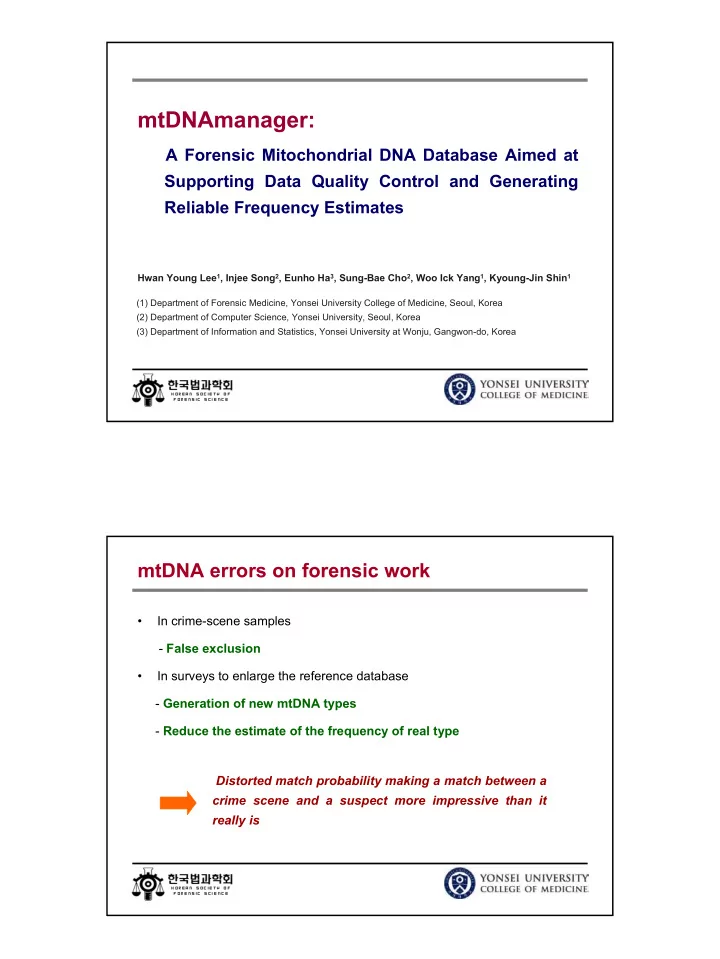
mtDNA errors on forensic work

  • In crime-scene samples
  • False exclusion
  • In surveys to enlarge the reference database
  • Generation of new mtDNA types
  • Reduce the estimate of the frequency of real type

Distorted match probability making a match between a crime scene and a suspect more impressive than it really is

slide-2
SLIDE 2

2

Can we tell from a single entry of an mtDNA data table whether it is authentic?

mtDNA data quality control Errors in mtDNA data can be detected

slide-3
SLIDE 3

3

Phylogenetic analysis is the key tool

How can we estimate mtDNA data quality mtDNA evolves along a tree

slide-4
SLIDE 4

4

  • Haplotype -- the mtDNA sequence

variations within an individual (e.g. your HV1/HV2 type)

  • Haplogroup (coined by Torroni et al)
  • - a group of related haplotypes.

These form monophyletic clade on a phylogenetic tree. The member of a haplogroup carry a specific sequence motif as a consequence

  • f sharing a common ancestor

A skeleton phylogeny of human mtDNA

  • The sequence matches a type already found – Allocation of a sequence to

an appropriate haplogrouop (1)

  • It is located at a previously unsampled interior node of the tree (2)
  • It creates a new tip of the tree by an unusual mutation (3)
  • Haplogroup determination failure due to artificial recombination (4)

If artefacts occurred in the data set, then they are normally manifest in those seeming #2, #3 and #4

(1) (2) (3) : haplogroup

A single entry of an mtDNA data

slide-5
SLIDE 5

5

Kong, Q.-P. et al. Hum. Mol. Genet. 2006 15:2076-2086

East Asian macrohaplogroup M

Kong, Q.-P. et al. Hum. Mol. Genet. 2006 15:2076-2086

East Asian macrohaplogroup N

slide-6
SLIDE 6

6

  • Attempts to localize the sequence to a part of phylogeny (haplogroup). If

the haplogroup motif is not fully represented, recheck the relevant positions in the sequence

  • Have in mind the relative mutability of sites. Be sensitive to rare

mutations on different sequence backgrounds in one batch of sequencing

  • Look out for incongruence between parts of the sequences which have

been obtained in different PCR or sequencing reactions (artificial recombinants)

Need to establish a big reliable database with mtDNAs having appropriate haplogroup designation

Self-help guide to avoid errors

  • The goal of mtDNAmanager

is to provide a Web-based forensic mitochondrial DNA bioinformatics resource for supporting data quality control and generating reliable frequency estimates using a new approach based on haplogroup estimation and data comparison with the contents of a given database.

  • mtDNAmanager

consists of previously reported high quality mtDNA sequences, and a set of bioinformatics tools, able to automatically characterize newly submitted data by estimating its haplogroup according to the haplogroup-specific control region mutation motif.

mtDNAmanager (http://mtmanager.yonsei.ac.kr)

slide-7
SLIDE 7

7

  • The database is of relational type, designed and implemented using the multithreaded,

multi-user SQL database management system (DBMS), MySQL.

  • Web interfaces have all been implemented using Asynchronous JavaScript and XML

(AJAX) technique based on Javascript and PHP.

  • The system is optimized with internet explorer v. 6.0 or more.

mtDNAmanager structure

http://mtmanager.yonsei.ac.kr

slide-8
SLIDE 8

8

mtDNAmanager Database

  • The mtDNAmanager's open database contains 6597 mtDNA control region sequences and

they are grouped in the following five subsets: African (1248), West Eurasian (2857), East Asian (1557), Oceanian, and Admixed (935).

Database search

  • By default but with an exchangeable setting, a query system retrieves sequences which

include the queried nucleotide polymorphisms therein from a user-selected database. Include option Estimated mtDNA haplogroup affiliations using the bioinformatics resources of the mtDNAmanager Target database

slide-9
SLIDE 9

9

Database search and statistics

  • A query system of the mtDNAmanager also searches sequences which show a match with

the queried sequence data from the database. Frequency estimates = (x+2)/(n+2) Match options Target database

My mtDNA

  • Upon registration, the mtDNAmanager provides web interfaces where users can submit

and store their own data with batch mode and search sequences which show a match or include the queried nucleotide polymorphisms from their own database as well as the mtDNAmanager database. Import sequences with batch mode Export as an excel file Batch input files

slide-10
SLIDE 10

10

Cross-match between data groups

  • Upon registration, a match system permits cross match of all sequence data between

two selected groups as well as retrieval of matched sequences for one of the data of a user-created data group from their own database or from the mtDNAmanager database.

Control region haplogroups Coding region haplogroups

mtDNA haplogroup estimation

Using the bioinformatics tools of mtDNAmanager, more than 98% of mtDNAs of high quality datasets can be allocated to the same mtDNA haplogroups as those confirmed with the coding region SNP information. Data from EMPOP

slide-11
SLIDE 11

11

Control Region Mutation motif for more than 380 mtDNA haplogroups

mtDNA data quality control

16362C? 150?

N9a1: 16129-16223-16257A-16261-150

16319 missed

  • ut?

A5a: 16187-16223-16290-16319-235-523d-524d

16311 missed

  • ut M10b?

B5b?

Artificial recombination?

slide-12
SLIDE 12

12

Artificial recombination?

16311 missed

  • ut M10b?

B5b?

Detection of errors in mtDNA sequence

Option to search sequences

16311 missed

  • ut M10b?

HV1 sequence

Artificial recombination?

16311 missed

  • ut M10b?

B5b?

Detection of errors in mtDNA sequence

Option to search sequences

16311 missed

  • ut M10b?

HV1 sequence HV2 sequence B5b?

slide-13
SLIDE 13

13

http://mtmanager.yonsei.ac.kr

Please click here to see the demo of personal data !

A sample system

slide-14
SLIDE 14

14

A match system A query system

slide-15
SLIDE 15

15

Killed in action recovery and identification Excavation on the finding spot

slide-16
SLIDE 16

16

Cryogenic grinding with Spex 6750 Freezer/Mill DNA extraction using Qiagen kit

DNA extraction from skeletal remains

Y-STR profile (Match Probability = 0.0017)

MATCH

(Match Probability = 0.0035) On the air on June 6

slide-17
SLIDE 17

17

Concluding remarks

  • The mtDNAmanager is a forensic mitochondrial DNA database aimed at

supporting data quality control and generating reliable frequency estimates using an approach based on haplogroup estimation and data comparison.

  • The mtDNAmanager provides a convenient Web interface for analysis,

query and storage of human mtDNA control region sequences.

  • For comments, bug reports, suggestions for improvement, please contact

us through the website (http://mtmanager.yonsei.ac.kr).