Ms. Audrey A. Brown, Community Member Ms. Melinda Brunner, Alaska - - PDF document

ms audrey a brown community member ms melinda brunner
SMART_READER_LITE
LIVE PREVIEW

Ms. Audrey A. Brown, Community Member Ms. Melinda Brunner, Alaska - - PDF document

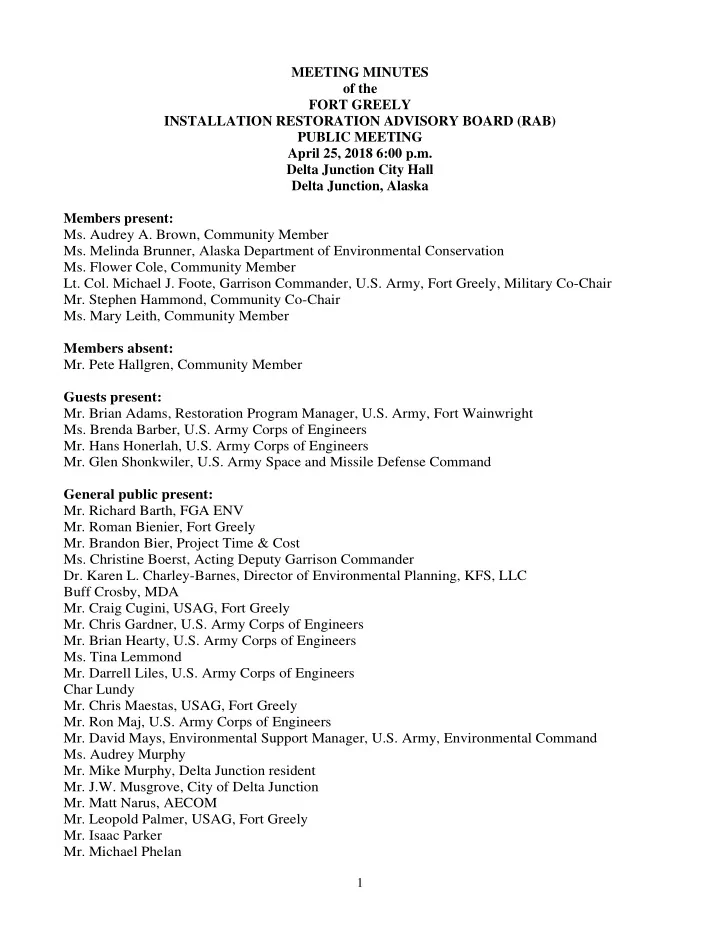
MEETING MINUTES of the FORT GREELY INSTALLATION RESTORATION ADVISORY BOARD (RAB) PUBLIC MEETING April 25, 2018 6:00 p.m. Delta Junction City Hall Delta Junction, Alaska Members present: Ms. Audrey A. Brown, Community Member Ms. Melinda


slide-1
SLIDE 1

1

MEETING MINUTES

  • f the

FORT GREELY INSTALLATION RESTORATION ADVISORY BOARD (RAB) PUBLIC MEETING April 25, 2018 6:00 p.m. Delta Junction City Hall Delta Junction, Alaska Members present:

  • Ms. Audrey A. Brown, Community Member
  • Ms. Melinda Brunner, Alaska Department of Environmental Conservation
  • Ms. Flower Cole, Community Member
  • Lt. Col. Michael J. Foote, Garrison Commander, U.S. Army, Fort Greely, Military Co-Chair
  • Mr. Stephen Hammond, Community Co-Chair
  • Ms. Mary Leith, Community Member

Members absent:

  • Mr. Pete Hallgren, Community Member

Guests present:

  • Mr. Brian Adams, Restoration Program Manager, U.S. Army, Fort Wainwright
  • Ms. Brenda Barber, U.S. Army Corps of Engineers
  • Mr. Hans Honerlah, U.S. Army Corps of Engineers
  • Mr. Glen Shonkwiler, U.S. Army Space and Missile Defense Command

General public present:

  • Mr. Richard Barth, FGA ENV
  • Mr. Roman Bienier, Fort Greely
  • Mr. Brandon Bier, Project Time & Cost
  • Ms. Christine Boerst, Acting Deputy Garrison Commander
  • Dr. Karen L. Charley-Barnes, Director of Environmental Planning, KFS, LLC

Buff Crosby, MDA

  • Mr. Craig Cugini, USAG, Fort Greely
  • Mr. Chris Gardner, U.S. Army Corps of Engineers
  • Mr. Brian Hearty, U.S. Army Corps of Engineers
  • Ms. Tina Lemmond
  • Mr. Darrell Liles, U.S. Army Corps of Engineers

Char Lundy

  • Mr. Chris Maestas, USAG, Fort Greely
  • Mr. Ron Maj, U.S. Army Corps of Engineers
  • Mr. David Mays, Environmental Support Manager, U.S. Army, Environmental Command
  • Ms. Audrey Murphy
  • Mr. Mike Murphy, Delta Junction resident
  • Mr. J.W. Musgrove, City of Delta Junction
  • Mr. Matt Narus, AECOM
  • Mr. Leopold Palmer, USAG, Fort Greely
  • Mr. Isaac Parker
  • Mr. Michael Phelan
slide-2
SLIDE 2

2

  • Ms. Leslie Reed, U.S. Army Corps of Engineers
  • Mr. Martin Roberts, Environmental Support Manager, U.S. Army, Environmental Command
  • Mr. Stephen B. Shafer, AECOM
  • Mr. Dave Watters, U.S. Army Corps of Engineers
  • Ms. Patricia White, City of Delta Junction
  • Mr. Michael Paschall
  • Mr. Ryan A. Skaw, Delta Junction resident

Welcome, Purpose, and Introductions

  • Mr. Hammond called the Fort Greely Restoration Advisory Board meeting to order just after 6:00

p.m. and welcomed everyone. He expressed that the purpose of the meeting was to share with the public information about the environmental restoration, cleanup, and environmental activities

  • ccurring on Fort Greely. He requested that everyone use the sign-in sheet to identify themselves

and who they represent. Mr. Hammond then requested that the people conducting the meeting introduce themselves, beginning with the court reporter, Mary Vavrick. The rest of the members, and Mr. Shonkwiler, then briefly introduced themselves. Agenda Review

  • Mr. Hammond asked if there were any changes or comments to the draft agenda. Mr. Shonkwiler

requested that the order of items of new business be reversed so that the Fort Wainwright team could get back on the road. After clarification, the amended agenda was unanimously adopted. Review and Approval of the Minutes from the April 26, 2017 Meeting

  • Mr. Hammond asked if there were any changes or comments to the April 26, 2017 meeting
  • minutes. Ms. Brown asked if there was such a thing as an “excused absence,” to indicate that an

absent member did not ignore a meeting. Mr. Hammond indicated that this was probably unnecessary, but offered to have the subject researched. After additional discussion, Ms. Brown made a motion that “Excused” be added to her name in the 2017 minutes. The minutes were adopted, as amended.

  • Ms. Brown noted for the record that the meeting planners coordinated with the RAB members

regarding their availability to reduce absences due to travel. Mr. Hammond commented on the

  • rganizers’ proficiency and efficiency over the years in encouraging attendance.

Comments or Questions from the Public

  • Mr. Murphy had the following question: “It looks like -- the impression I get is it looks like the

Army is trying to make the SM-1A power plant disappear. And if that's true, I'd like to know why, if anybody has an answer.” Mr. Shonkwiler deferred the question for the Corps of Engineers to answer after their presentation, and asked that Mr. Murphy’s question be kept verbatim. At this point Mr. Gardner of the Corps indicated to Ms. Leith that their presentation was ready to print, and

  • Ms. Leith left to do so.
  • Mr. Hammond then closed the public comment portion of the meeting and called for the agency

reports. Agency Reports

  • Ms. Brunner, the Alaska Department of Environmental Conservation (DEC) project manager for

Fort Greely, said that DEC was waiting for revised proposed plans, and that Mr. Shonkwiler would

slide-3
SLIDE 3

3

be discussing some of those later. She indicated that several meetings would occur in the next few days to discuss a path forward. She said that she is new to Fort Greely, but has lived in Fairbanks for about 20 years. Mr. Paschall asked about the “plans” to which Ms. Brunner had referred. Ms. Brunner clarified that she meant some proposed plans for moving forward on contaminated sites, not having to do with the power plant.

  • Mr. Hammond thanked Ms. Brunner and moved to old business, starting with Mr. Shonkwiler’s

Fort Greely Installation Restoration Program schedule and status update. Mr. Shonkwiler reintroduced himself as the Army cleanup manager working from the US Army Space and Missile Defense Command (SMDC) in Huntsville, Alabama since 2004.

  • Mr. Shonkwiler said that many of the cleanup activities on Fort Greely were wrapping up. He

indicated that SMDC is currently working to establish closeout documentation for field work that has already been accomplished. He said that little field work is ongoing, but that he would talk about the sites with remaining activities. He mentioned that the RAB website has a lot of documents that document the history of the cleanup program, the investigations, and the remediations that have been completed. He reiterated that a number of documents are currently in draft, which SMDC is trying to complete to close out some of the remaining sites. Mr. Shonkwiler presented a slide listing some of the documents added to the website since the April 2017 RAB meeting.

slide-4
SLIDE 4

4

  • Mr. Shonkwiler reported that last summer's field work was very simple. The post-wide semi-annual

groundwater sampling was completed to make sure contaminant concentrations continue to degrade where there are contaminants in the groundwater, which is very limited. Maintenance of warning signs around the sites and close-out a few of unused monitoring wells were also completed.

slide-5
SLIDE 5

5

  • Mr. Shonkwiler said that he would talk briefly about four of the sites that do have some actions that are

left that are being discussed with the State. As Ms. Brunner mentioned earlier, Mr. Shonkwiler said there would be meetings tomorrow and Friday in Fairbanks to discuss a lot of these sites and how to resolve a path forward. He stated that one of the sites is a former metal scrap yard located in the middle of the

  • post. It has a lot of metal burial pits that the State is concerned could contain unexploded ordnance, thus

they are working through how to resolve this site.

  • Mr. Shonkwiler mentioned another site, which is on the airfield at the former tar and asphalt disposal

area for airfield renovation in the 1950s. This site has a burial pit that consists of debris and drums left

  • ver from that project. The State has concerns that there could be solvents in those drums. Some limited

investigative data shows there are no contaminants migrating from the burial pit, so they are proposing not to dig it up as the State has asked. This will be discussed with DEC in the next few days.

slide-6
SLIDE 6

6

  • Mr. Shonkwiler stated that two sites with groundwater contamination include an old underground tank

farm near the airfield that has fuel contaminants in the groundwater. He said that the groundwater plume extends about a quarter of a mile at this site to the northeast. He said that the Army has been monitoring, and the contaminants levels are reducing in groundwater, so the Army is proposing to monitor this site until the groundwater contamination is below the safe drinking water limits.

slide-7
SLIDE 7

7

  • Ms. Brown asked for an example of some of the contaminants. Mr. Shonkwiler replied that some of

the contaminants at this site include benzene, methylnaphthalene, ethylene dibromide and diesel, all related to the storage of diesel fuel at the underground storage tanks that leaked during their

  • peration.
  • Mr. Shonkwiler then discussed the final site, the South Tank Farm, which has some groundwater

contamination by the missile field. This fuel farm had aboveground tanks and has ethylene dibromide in the groundwater. It is being monitored because there are a couple of supply wells on the missile field undergoing wellhead treatment to make sure the water is safe to drink. He said the Army is continuing to monitor this plume until those wells are below the safe drinking water limits.

  • Mr. Shonkwiler said that the plan for this year is to finish the closeout plans for many of about 48

sites – only a few of which require action – and also to continue the groundwater monitoring

  • program. An emerging contaminants program is looking this year at a contaminant that is a

component of aircraft fire fighting foam – per- or polyfluoroalkyl substances, also called PFAS or PFOA and PFOS. All of these contaminants will be examined in a historical records search later this year and probably some field work next year to see whether they are at Fort Greely and whether it is an issue for groundwater located at this site. He said this contaminant is a major concern at Eielson Air Force Base where more than 180 residences have unusable wells because of this contaminant. Fort Greely is not expected to have the same issues because groundwater is so deep, 185 feet below ground surface at the airfield, and there are no drinking water wells near the

  • airfield. So although the same level of issue is not expected, the investigation will be followed-

through to make sure.

slide-8
SLIDE 8

8

  • Mr. Shonkwiler mentioned that the Corps of Engineers was at the RAB meeting to do a briefing on

the SM-1A planned decommissioning.

slide-9
SLIDE 9

9

  • Mr. Shonkwiler presented a slide showing his calendar for this fiscal year.
  • Mr. Shonkwiler presented his final slide, which contained information pertaining to the RAB website.

He discussed aspects of the website, solicited comments and feedback on how to improve it, and mentioned that there are methods of submitting questions and getting answers back on the website.

slide-10
SLIDE 10

10

  • Mr. Shonkwiler concluded his presentation and asked if there were comments or questions. Ms.

Brown asked whether all the slides were on the website. Mr. Shonkwiler responded that the current presentation would be posted on the website within the next month, and that all previous RAB meetings' presentations are already on the website.

  • Mr. Musgrove asked what happens if a contaminated site is closed out and then the safe drinking

water limits go up. He said that had occurred quite often in the last few years. He described how

  • ver time, people develop internal injuries and trauma, which result in revision to the limits. Mr.

Musgrove reiterated his question, asking what the property owners, such as SMDC, do when the safe water drinking limits change, especially if that site has already been closed out. Mr. Shonkwiler responded that the Army has a five-year review process for every site that is closed out. Every five years any closed site is looked at to see if regulations have changed, whether events on the site, like land use changes, or anything that could affect the remedy, to make sure that it is still

  • protective. So even if drinking water standards change, that would be caught by the five-year

review process to make sure that it was still a protective remedy, or it would be reopened to figure

  • ut how to make it a protective remedy.
  • Mr. Hammond asked if that was what was happening right now with the PFCSs. Mr. Shonkwiler

responded that no, what is happening with PFAS and PFOA and PFOS type compounds is an initial investigation for this emerging contaminant at sites that are not yet technically closed. Once any site is closed that could have PFAS or PFOA contamination, it would fall under the five-year review process.

  • Mr. Hammond then inquired about the former firefighter training area. Mr. Shonkwiler responded

that they are in the list of 48 sites that have not yet been closed, and that it is possible that those sites will not be closed until the historical records review and the initial site investigation is completed to show that there are no real issues with these new emerging contaminants.

  • Ms. Brown said she knew that Moose Creek, the town down the road from Eielson, is getting

bottled water delivered because their wells are contaminated from the fire fighting components. She asked if there has been any local testing of local wells within several miles of Fort Greely, and where the PFAS, PFOS etc. was used. Mr. Shonkwiler responded that drinking water wells on Fort Greely have been tested. He asked if Rick or Leo had any information as to whether there has been any testing done off site/off post. Mr. Barth replied “Not off site. All the on-site testing came back no trace elements.”

  • Mr. Hammond asked if there were any other comments or questions, then thanked Mr. Shonkwiler.
slide-11
SLIDE 11

11

New Business Fort Wainwright

  • Mr. Hammond stated that the meeting would move to New Business and reminded everyone that

Fort Wainwright would have the first presentation, as the meeting agenda was amended. He requested that the Fort Wainwright speaker introduce himself. The Fort Wainwright speaker introduced himself as Brian Adams of the DERA office at Fort Wainwright, Alaska. He is responsible for the contaminated sites program at Fort Wainwright, and also for some of the contaminated source areas at Donnelly Training Area (DTA). He stated that one of the areas they are looking at closing is the DTA range, a rifle range, in the keyhole. Mr. Adams defined the term “keyhole” as an area near the missile complex and further south, off of Meadows Road near the CRTC facility. He said the rifle range operated from about 1956 to 1960, and he understood through interviews etc. that the community and hunters also used that range.

  • Mr. Adams said that there was an SI investigation in 2006-2007, including historical records review,

map review, and interviews with people in the area. He said the firing points were on community property, and the back berm was located on Army property. As a result, further investigation was

  • recommended. That further investigation was a remedial investigation done in the 2012-2014 time
  • frame. Jacobs Engineering investigated, did soil sampling, walked the area, and did Schonstedt, a

magnetic probe for ferrous metals. As a result, no further action was recommended because no contamination was found, only trash. Mr. Adams said that result took it out of his purview because it is not a contaminated site, but just a landfill or trash. At this point, Mr. Adams noted that the plan – which was available in the room and which some people had obtained1 – recommended no further action of that closure, and that the State of Alaska had already submitted letters accepting and approving that

  • recommendation. Mr. Adams stated that as part of the closure process he was speaking to the RAB,

taking questions, and providing a 30-day public comment period from April 25 until May 23. Mr. Adams concluded his presentation.

  • Ms. Brown asked if they were looking for lead in the berm. Mr. Adams responded that they were

looking for everything: constituents of MEC (munitions explosives), which is anything. He said there was an exceedance of 2, 4-dinitrotoluene, a chemical compound within gunpowder, but it was found nowhere else, including duplicate samples. He said they concluded it was a false positive reading and eliminated it from the process. Arsenic and chromium were high, but based upon the naturally occurring constituents in the areas, they considered that at the impact ground level and eliminated that as a process, and that the firing range did not contribute to that exceedance.

  • Ms. Brown indicated they had to deal with the lead issue in more than one place, even the local

sportsmans club, but that it was cleaned up successfully. Mr. Adams responded that lead is a “two-step process,” not only finding lead, but leachable leads that cause problems in groundwater and drinking

  • water. Nothing exceeded any of the constituent values for EPA – or for DEC.
  • Ms. Leith asked whether a certain document in the room was the “proposed plan”. Mr. Adams said that

it was, and that he would leave a copy and some of the background information at the post library. He had also brought disks containing the proposed plan, as well as the SI and the RI investigations specific

1 This document is provided separately, entitled “Proposed Plan – Military Munitions Response Program Site, Donnelly

Training Area, Fort Wainwright, Alaska. July 2017. Pages 1–11, plus Public Notice and Notice for Public Comment Period.

slide-12
SLIDE 12

12

to DTA. He explained that the RI encompassed several ranges (and several hundred pages), so for ease

  • f use he had provided only the pages specifically pertaining to the DTA range.
  • Ms. Leith questioned an apparent mislabeling of a map showing the Delta River as the Tanana River.
  • Mr. Adams agreed that her interpretation was correct. Mr. Adams said that this particular error was a

common one. Ms. Leith expressed misgivings on whether to believe other information in the report, and

  • Mr. Adams acknowledged her concern.
  • Mr. Hammond called for other questions or comments. Ryan Skaw identified himself as a local resident

and contractor on Fort Greely and asked if there were any plans for remediation after the range is closed

  • down. Mr. Adams responded that they had visited the site that day and found it overgrown. He reiterated

that there is no plan for remediation because nothing was found in the previous investigations, thus it is not within his purview, and not on his land. USACE Presentation – Decommissioning Planning Activities for SM-1A Nuclear Power Plant

  • Mr. Hammond called for any other questions, then resumed the agenda, giving the floor to Lt. Col Foote

to make introductions for the USACE presentation.

  • Lt. Col. Foote began by saying that experts from the Corps of Engineers had been working with his team

to start the long planning process. He said that there were three planning pieces, the first and primary being safety. He likened the process to a surgery to remove the nuclear facility from the community. He continued, saying that the second piece is communication, that this will be a very open process, no sneaking things in or out. He said that the planning process is beginning five years before the physical process so that people have the ability to ask questions, the experts have the ability to address those questions, and everyone can work together to get to the proper solution. Lt. Col. Foote noted that the Corps would give examples of how an organization or individual stakeholder could get more information throughout the process. Returning to his narrative, Lt. Col. Foote said that the last piece of the planning process is expertise. He said that Fort Greely often tends to be the “guinea pig”, but not in this instance. He added that this will be the third reactor of this type that these experts have done – that

slide-13
SLIDE 13

13

  • ther reactors have varied, but they bring the expertise to do this and are even hiring more expertise to

make sure this goes appropriately and safely.

  • Lt. Col. Foote concluded by saying that his team would be local for this process, and then the Corps

would continue to work with his team as the process progresses. Mr. Hammond thanked Lt. Col. Foote.

  • Ms. Barber thanked Lt. Col. Foote and introduced herself as Brenda Barber with the Baltimore District

Corps of Engineers. She stated that the Corp’s purpose was to present an overview of the SM-1A nuclear reactor at Fort Greely and to share historical information with respect to the Army's nuclear power plant program and how it transitioned to become the deactivated nuclear power plant program. They would also discuss some initial decommissioning planning.

  • Ms. Barber stated that the U.S. Army nuclear power program supported the fielding of six DOD power

reactors from 1957 to '67 [sic]: Four for the Army, one for the Air Force, and one for the Navy. Two were also located at the National Reactor Testing Station. She stated that three of the facilities remain, and are in the Corps of Engineers' possession.

slide-14
SLIDE 14

14

  • Ms. Barber said all the facilities have been decommissioned, fuel was removed, control rods were

returned to the Atomic Energy Commission, and the remaining facilities placed in safe storage. She stated that the Corps holds decommissioning possession permits through the Army Reactor Office, and they work to deactivate those facilities so that they can monitor them and ensure a safe shutdown while ensuring the safety of the community, soldiers and civilians located near these facilities.

  • Ms. Barber continued with a summary of the remaining reactors, beginning with the MH-1A Sturgis

barge being decommissioned in Galveston, Texas. She stated that the decommission effort for the Sturgis is about 99 percent complete. Once it is confirmed that all the radioactivity has been removed, the Sturgis will be taken to Brownsville, Texas, for shipbreaking and recycling.

slide-15
SLIDE 15

15

  • Ms. Barber said decommissioning planning is underway for the SM-1 sister plant at Fort Belvoir, the

first nuclear reactor brought online as part of this program, as well as for the SM-1A at Fort Greely.

  • Ms. Barber stated that at some of these other locations they want to start the planning process early and

apply lessons learned at the other facilities. She said that once the power plants were decommissioned, they transitioned from a nuclear power plant program to a deactivated nuclear power plant program, where the mission is to ensure security of any remaining radioactivity, including performing structural integrity inspections. She said there is a very robust environmental monitoring program for all of the sites, and the monitoring reports are posted annually for SM-1A on the Fort Greely website and available to the public. She stated that they perform and plan all of the final decommissioning. She stated that the SM-1A at Fort Greely was a prototype medium power, stationary plant. The first pressure suppression containment and the first steam generator replacement in the U.S. were performed at Fort Greely. It was deactivated, and the major reactor components were encased. The secondary systems were converted to fuel boilers, which are still in use by the facility.

slide-16
SLIDE 16

16

  • Ms. Barber then discussed the timeline for SM-1A, saying that construction began in 1958, and the

reactor started in March 1962. The core was replaced several times, and then the pressure vessel was annealed in August 1967. The reactor was shut down in March 1972 and decommissioned in 1973. The decommissioning involved deactivation, entombment and encasement of the main reactor, and then the secondary sides were converted. Since the initial decommissioning, several studies have been performed by various organizations within the Army, as well as the Corps. Due to BRAC at Fort Greely from 1997 to 2000, Ms. Barber said they removed the wastewater discharge pipeline, and removed the dilution well, in coordination with Alaska DEC.

slide-17
SLIDE 17

17

Some of the decommissioning activities were performed in the '70s: the primary and secondary systems were decommissioned, and the vapor container, the spent fuel pit, all the hot waste tanks, the pipe pit, dilution station, condenser deck, the fuel storage vault, and the floor of the storage building (building J5) were encased. The Corps plans to recover two time capsules (one under the floor and one in the vapor containment) and return them to Fort Greely as part of mitigation and historical preservation. All of the fuel elements and control rods were shipped off site, all the calibration sources were transferred, and any radioactive waste was disposed of at that time. The wastewater pipeline and dilution station were removed as part of the BRAC efforts.

  • Ms. Barber then discussed the upcoming decommissioning planning process. A decommissioning

planning contract has been awarded. The goal is to complete the planning by 2021. The efforts involved include a review of all of the historical documentation associated with the plant’s operation. The Corps will prepare all of the planning documents to present to the Army Reactor Office to obtain a decommissioning permit for the reactor. The Corps will comply with all federal and state regulations for the long-term decommissioning planning and will adhere to Nuclear Regulatory Commission guidelines, even though the Corps is self-regulated. The Corps implements those guidelines during

  • decommissioning. Additionally, the Corps will follow the National Environmental Policy Act (NEPA)

to perform an environmental assessment, and will complete the cultural and historical mitigation required under Section 106 of NEPA. Some of the major documents that the team will be working on

  • ver the next several years are a disposal plan for all the items associated with the plant, a very

comprehensive schedule and cost estimate, a waste management plan, and an environmental assessment. Section 106 is the historical mitigation prepared for the facility – as part of that process –the Corps solicits interested parties to participate so that there is collaboration with the local community and interested parties. The most important part is the decommissioning plan, which will allow application for the necessary permits to complete the work. Contract acquisition is a long process for the team.

slide-18
SLIDE 18

18

  • Ms. Barber continued with a discussion of the upcoming process notional timeline. Because of the

complexity of the site and anticipated challenges, the Corps will solicit bids. A short synopsis of the planned activities will be issued in early May to request interested bidders to provide information and their qualifications, which will allow the Corps to prepare market research and finalize the acquisition

  • approach. The Corps hopes to have that done this year so that we can run some of these efforts

concurrent with other reactor sites. A formal request for proposal is expected in 2021 and will allow ample time for bidders to provide proposals. The team will spend the rest of that year in the complex process of evaluating proposals. The target for the first award is currently fiscal year 2022. Dates will be refined over time, and a much more detailed schedule will be provided. This will likely be a cost reimbursable contract because of the work’s complexity, and additional funding is planned in '23 and '24 [note: FY22 on slide is a typo]. Based on preliminary planning, work is anticipated to take approximately five years once the field efforts begin.

slide-19
SLIDE 19

19

  • Ms. Barber said requests for proposals will likely include some very important key elements, and that

this process has already been undertaken for the Sturgis. She stated that the Corps has spent considerable time and effort addressing the complexities of implementing such a project and has learned lessons to incorporate into current planning. Ms. Barber said certain key areas of expertise are necessary, and that they anticipate a combination of large and small businesses, and are hopeful some small businesses in the area will be interested in participating. She discussed many of the requirements needed, including companies with strength in project management, scheduling, cost estimating, risk assessment and analysis, and radiological expertise, health and safety, decommissioning expertise, demolition expertise, regulatory compliance for permitting under local and federal and state laws, and waste transportation and disposal. She added that once they remove the radioactivity, they need to properly prepare it for shipment and get it to a proper disposal location.

  • Ms. Barber said project stakeholder engagement will be crucial. She said the Corps has put together a

robust Corps of Engineers' team with components from the Baltimore District, which is a radiological center of expertise, as well as partnering with the local Alaska District, to assist with this project. She indicated that the Corps will work closely with Fort Greely staff and other associated Army agencies to implement the project successfully, and that a key part of success is stakeholder engagement. She stated that the Corps believes in very transparent communications, and to that end the Corps has set up a website with historical information on the project, as well as updates and important documentation for the process. She added that people without access to the website could email the public affairs office to be added to a stakeholder list to receive email updates. Ms. Barber said that will be crucial during the environmental assessment and historical mitigation because that is when the Corps will start to seek local community involvement and comments. She stated that the USACE headquarters website for the program as a whole includes information and progress on all of the reactors.

slide-20
SLIDE 20

20

  • Ms. Barber asked if there were any questions.
  • Ms. Brown stated that when it was initially decommissioned, she had seen the SM-1A, the head of the

reactor, 20 years ago, when they were still in the same room using it – using a large drum filled with something that burned to keep the place warm. She restated that was 20 years ago before they were shut

  • ut of Fort Greely. Ms. Brown stated that documents that somebody said would be at the library at Fort

Greely cannot be accessed unless you work there or are a military member / retired military. She said the town is basically closed out of Fort Greely. Ms. Brown said she wondered, when it was originally decommissioned, what happened to the spent fuel rods, the most radioactive parts. Ms. Barber replied that the rods were returned to the Atomic Energy Commission, but she passed the question to Hans Honerlah, the senior health physicist. Mr. Honerlah said that Ms. Barber was correct, and all that was

slide-21
SLIDE 21

21

returned to the fuel owner, the Atomic Energy Commission (now the Department of Energy). Mr. Hammond asked if that was the Hanford site. Mr. Honerlah said they went to the Savannah River site.

  • Ms. Brown asked if they shipped them in the borated water. Mr. Honerlah replied that he was not

completely familiar with how they shipped them.

  • Ms. Brown then asked what happened to the spent fuel pool. Ms. Barber replied that it all was returned

and properly disposed of. Mr. Honerlah clarified that the pool, now encased, is still there. Ms. Brown asked if it was encased in cement. Mr. Honerlah affirmed and said that it was a grout-cement mix. Ms. Barber added that the liquid is gone.

  • Ms. Brown said that she worked at a nuclear plant built in the same era and was familiar with the
  • peration of the older nuclear plants. She asked how many steam generators this one had. Mr. Honerlah

responded that it had one steam generator, which is currently encased in the bottom of the containment

  • vessel. Ms. Brown asked whether that would need to be transported. Ms. Barber said that was correct,

and as part of planning, they will develop and design a method to go into the vapor containment area and remove those items from the encased concrete, and then it will be properly packaged and shipped to a proper disposal facility. Ms. Brown questioned whether everybody anywhere near the materials would have film badges. Ms. Barber assured her that there would be a comprehensive radiation safety protection program in addition to a health and safety program.

  • Mr. Hammond asked if the report is substituting for the normal SM-1A report, or acting as it. He also

noted that the other reports are located on the RAB website and asked if this report would also be linked

  • there. Mr. Shonkwiler responded that a link could be set up to the site. Mr. Hammond said that he

thought everybody would appreciate that. Ms. Brown and Ms. Cole requested a printed version of the report (slides).

  • Mr. Hammond then asked if the RAB members had any other questions for the presenter. He indicated

that they had let Fort Wainwright take public questions after their presentation, and asked if Mr. Murphy wanted to offer his. Mr. Murphy replied that he wondered if anyone had come up with any impact on human health and safety of SM-1A as it sits now.

  • Ms. Barber reiterated that they have a robust environmental monitoring program, and since the power

plant has been in safe store, they monitor the radiation quarterly. She indicated that the information is posted on the Fort Greely RAB website. She stated that to date nothing has been detected external to the

  • facility. Mr. Honerlah indicated that this was correct.
  • Mr. Hammond informed Ms. Barber that Mr. Murphy had been the DPW for Fort Greely, so he was
  • ver the reactor for many years Mr. Murphy added that at one point, he was assigned to be the radiation

authority because they needed one. Mr. Hammond affirmed Mr. Murphy’s statement, and attempted to clarify Mr. Murphy’s question of whether all those surveys haven't presented an issue of the public being exposed to excessive levels of radiation. Mr. Murphy added that he was trying to visualize the benefits of getting rid of SM-1A and would like the planning group to come up with a list of benefits of doing that.

  • Mr. Honerlah answered that the Nuclear Regulatory Commission decommissioning guidelines have a

60-year-from-shutdown requirement to decommission nuclear power plants. As SM-1A was shut down in 1972, decommissioning would need to be completed by 2032. He stated that is their primary rationale, as well as long-term risks – the longer certain parts of that area sit, they have to make repairs to the spent fuel pit, walls and continue to maintain and monitor the facility and the structure.

slide-22
SLIDE 22

22

  • Mr. Murphy asked what happened to Trinity site. Mr. Honerlah responded that the 60-year period is

specific to nuclear power plants. Mr. Honerlah said they will go through historical mitigation in accordance with the National Historic Preservation Act and identify entrusted stakeholders to assist with an appropriate way to mitigate and document historical activities associated with the SM-1A.

  • Mr. Murphy said, “In other words, because it's law, we are going to throw out the cost/benefit criteria.”
  • Ms. Barber replied that as part of the environmental assessment, they are required to evaluate and

present alternatives, and that one of the alternatives they will look at is the plant remaining in its current entombed state. She said it is the team’s responsibility to look at alternatives and come up with the recommended alternative for the site. She said the full process would be laid out in the environmental assessment, and there will be opportunity to comment on that process. She reiterated Mr. Honerlah’s statement that because of the magnitude of trying to maintain and preserve the power plant structurally, as well as the associated risks with keeping nuclear reactors on the Corps of Engineers' environmental liabilities, it is a directive from headquarters to pursue decommissioning of these three reactors.

  • Mr. Murphy stated “so the only way to stop this is to get Trump to do it.” Mr. Hammond encouraged
  • Mr. Murphy to let his voice be heard during the EA process.
  • Ms. Brown said that sometime within the last 20 years, dirt was found that had higher levels of

radioactivity than was appropriate for human health around one particular building, and the dirt was

  • removed. She wondered why it suddenly showed up, or if they could provide any history of the dirt that

was removed. Mr. Hammond said that removal of the SM-1A wastewater about 20 years ago from the reactor to the dilution well was discharged to Jarvis Creek. Ms. Barber stated that clean up of that portion of the site was done as part of the potential for the site to be placed on the BRAC list.

  • Ms. Brown prompted for the reason the dirt was dug up. Ms. Barber clarified it was all the dirt and the

pipeline associated with the discharge line associated with activities that occurred in the late '90s and early 2000s, if that was what Ms. Brown was referring to. Ms. Brown thanked Ms. Barber.

  • Mr. Paschall asked for clarification of whether they were citing a Regulatory Commission regulation

pertaining to decommissioning of 60 years. Mr. Honerlah said that was correct. Mr. Paschall stated that the Army is only voluntarily subject to the Regulatory Commission, and at the time the reactor was put into place, the regulation was not in place. He questioned the reasoning for following that regulation simply as it exists. Mr. Honerlah responded that it is a push from the “big Army”; the regulator has indicated that the Corps will comply with the NRC guidelines just because they don't want to write an entire set of regulations for a few deactivated power plants; so they would like the current regulations and guidance implemented as written by the Nuclear Regulatory Commission.

  • Mr. Paschall then asked what company was awarded the planning contract. Ms. Barber replied that it

was AECOM Tidewater, a JV with offices locally in Alaska, that the Corps thought would be a great benefit to understanding some of the regional concerns with respect to working in this area. Mr. Paschall asked if they were based out of Virginia. Ms. Barber agreed and added that they are also doing the planning for the sister facility at SM-1, so the Corps is taking advantage of lessons learned for both sites to make sure the sites are implemented as consistently as possible.

  • Mr. Paschall asked what role they would play in the planning. Ms. Barber stated that as the planning

contractor, they are assisting the Corps of Engineers team in preparing all of the associated planning documents, the environmental assessment, Section 106 historical mitigation, cost estimating, scheduling, and preparation of the decommissioning plan. Ms. Barber stated that this will allow the Corps team to

slide-23
SLIDE 23

23

present those documents to the Army Reactor Office and obtain their permit. Then the Corps team would prepare the request for proposal, the scope of work, documentation for the proposal, and then the Corps will solicit for interested bidders based on that information. As the planning is revved up, their role on the project will be finished.

  • Mr. Paschall asked whether the joint venture was a bid project or awarded under some other program.
  • Ms. Barber responded that it was awarded under a base ID/IQ contract, in which the Baltimore District

solicited multiple parties to participate, issued proposals against that, evaluated those proposals, and selected them as the successful winner. Ms. Baber added that it is a small pool of prequalified bidders who have qualifications doing this type of work. Mr. Paschall thanked Ms. Barber.

  • Mr. Hammond recognized a question from Ms. Brown, who asked the Corps about whether the design
  • f the steam generator allowed or prevented mixture of radioactive water with uncontaminated water.
  • Mr. Honerlah replied that as he understood it, the steam generator had two separate systems: a primary

loop and a secondary loop. The primary loop went through the reactor, was superheated, came into the steam generator, transferred heat to the secondary loop and made steam, and that steam went to the transformer, spun the transformer, and generated electricity. He said the goal of the two systems is to be completely sealed in separate systems so that they do not cross-talk and do not have contaminated water getting into the other side.

  • Ms. Brown said she had read something about radioactivity in the tunnels and wondered how it would

get there. Mr. Hammond suggested the term utilidors, and Ms. Brown agreed. Mr. Honerlah responded that he had not read that and was not completely clear on the reference or the specific type of

  • radioactivity. Ms. Brown replied that it was in an email from Alaska Toxics to various community
  • members. Ms. Brown indicated uncertainty of the details, as her email had been down for two weeks and

she had been out of town. Mr. Honerlah asked Ms. Brown to share the email, if possible, so that they could attempt to better answer the question. Mr. Hammond said that he had not heard of the utilidors being contaminated with radiation. He said the off-site discharge from the reactor was primarily through the SM-1A waste line that went to the dilution well that discharged into Jarvis Creek. He said most of the previous discussion from these meetings revolved around Jarvis Creek and any contamination that

  • ccurred there. He asked if Mr. Murphy had heard of it. Mr. Murphy said no. Mr. Honerlah guessed that

it was probably radon, as that would be the only likely radioactive material occurring in a small space, coming from naturally occurring radioactive materials in the soils, concrete, etc.

  • Mr. Shonkwiler then asked Mr. Honerlah to give a quick overview of the all-hazards assessment that

was completed. Mr. Honerlah responded that around 2011/2012 the Corps performed an all-hazards assessment, which included sampling completely throughout the reactor building, the property immediately adjacent and inside the fence, and then down towards the pipeline where the pipeline was removed in the '90s, out towards the discharge area at Jarvis Creek where it discharged to the island, and then even around some of the landfills and sledge drying beds that were open at the time the facility

  • perated. He stated that the Corps is confident that the issues or concerns to address as part of

decommissioning planning are specific to what is inside the fence line and primarily what is inside the encasement of the SM-1A.

  • Ms. Brown indicated that she appreciated Mr. Honerlah’s feedback. She recalled that the Corps and

everyone had worked well together during the nerve gas cleanup in the '90s. Mr. Honerlah affirmed that was also the goal this time.

slide-24
SLIDE 24

24

  • Mr. Hammond asked for any other questions, thanked Ms. Barber for her presentation, and announced

the conclusion of New Business. Public Comments and/or Questions (Phase II)

  • Mr. Hammond asked if there were any other questions and expressed appreciation for the attendees. At

this time, he opened discussion on future meetings. He asked whether the members wanted to continue the meetings. Ms. Brown affirmed and requested an annual meeting. Mr. Hammond agreed and added that they appreciate the Army’s efforts and monetary commitment to share information with the

  • community. Ms. Brown requested advance coordination to prevent conflict with other meetings. Mr.

Hammond agreed and inquired about her availability. Ms. Brown indicated the date of the next spring emergency planning meeting was unknown.

  • Mr. Hammond then summarized the work cycle, saying typically they discuss the publication of

documents or the conclusions of field work – plans come out in the spring, work occurs all summer, reports and regulator discussions occur in the fall, then a status is shared with the RAB. He stated that they have had them twice in the past, a year, but that it seems like the big SM-1A would award a contract; that would be reported in the spring. He indicated that the field reports were becoming minimal and asked Mr. Shonkwiler when the report of sample results from the active site would be available. Mr. Shonkwiler said that no definitive work was yet planned for summer and advised against planning the next meeting date based on field work reports. He stated that the RAB meeting had been held the last Wednesday of April for a few years, and proposed that date for next year, if amenable to the RAB, and suggested contacting the RAB members in December or January to check for conflicts. After more discussion and clarification among the members, Mr. Hammond proposed the last Wednesday in April. After a vote, the 2019 meeting date was unanimously accepted.

  • Mr. Hammond called for comments before closing. Ms. Brown thanked everyone for attending. Mr.

Hammond also thanked everyone, asked for any final comments, then adjourned the meeting at 7:15 p.m.