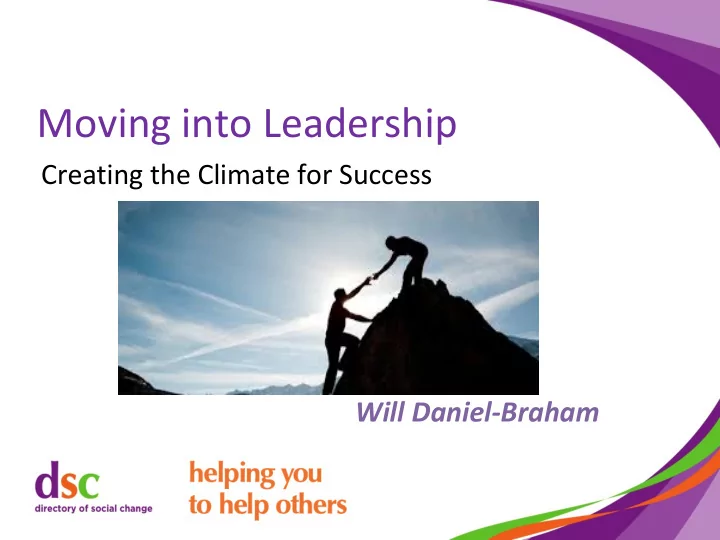
SLIDE 1
Moving into Leadership
Creating the Climate for Success Will Daniel-Braham
SLIDE 2 Purpose of the Training
- 1. To engage in a conversation, which gives a new
context to hold my employment, out of which, I then will have a new choice as to who I am being
- 2. To create a new level of thinking through which I can
realise results beyond what I previously considered predictable, as an individual, team or service.
- 3. To give participants ways that will strengthen their
Leadership style and approach to support themselves and their teams in both ‘calm and choppy waters’.
SLIDE 3
“The world we have made as a result of the level of thinking we have done thus far creates problems we cannot solve at the same level of thinking at which we created them.”
Albert Einstein
SLIDE 4 Introductions
s is m is my frie friend ……. …….
e thing they w want fro from t the day ay is … is ……
to do at the weekend is ……
SLIDE 5
Managing Expectations
What is the difference between the menu and the meal?
SLIDE 6
Managing Expectations
Menu
Words Symbols Pictures
Meal
Is what it Is Reality
SLIDE 7 Managing Expectations
People are not upset with what is; rather that it does not meet their
- expectation. You are not ever disappointed with the thing or person; you
are disappointed with your expectation that it/they would be anything
- ther than what it is/who they are.
Your ability to handle ‘the way it is’ will directly impact your ability to produce results. Things do not always fit our picture. How you are about that can either get in the way of you producing results or support you to manage your teams. When one has the ability to determine that the source of your upset, dissatisfaction, unhappiness, disgruntlement, etc. is in fact of your own doing, you then have the ability to transform your relationship to it. You are therefore able to transform your relationship to both yourself and the people you manage, are managed by and work alongside.
SLIDE 8
Already Know
What are the Leadership Qualities you already know?
SLIDE 9
Paradigms What is a Paradigm?
SLIDE 10
Ontology
(from the Greek ὄν, genitive ὄντος: "of being" (neuter participle of εἶναι: "to be") and –logia: science, study, theory)
is the philosophical study of the nature of being, existence or reality as such, as well as the basic categories of being and their relations.
SLIDE 11
‘Being’ versus ‘Doing’
What’s the Difference between Being and Doing?
SLIDE 12
‘Being’ versus ‘Doing’
SLIDE 13
‘Being’ versus ‘Doing’
SLIDE 14
Leadership Creating the Climate for Success
SLIDE 15
Break
SLIDE 16 Situational Leadership Leadership Styles
- S1 Directing/Telling
- S2 Guiding/Coaching/Selling
- S3 Supporting/Participating
- S4 Delegating
SLIDE 17 Situational Leadership Developmental Levels
- D1 Low Developmental
- D2 Medium Developmental, Limited Skills
- D3 Medium Developmental, Higher Skills but Lacking
Confidence
SLIDE 18
Situational Leadership
SLIDE 19
Leadership Style Example
You are about to leave for an extended holiday, and your tasks will be handled by an experienced colleague. They are very familiar with your responsibilities, and they are excited to do the job. (What is their Developmental Level?)
SLIDE 20
Instead of trusting thier knowledge and skills to do the work, you spend hours creating a detailed list of tasks for which they’ll be responsible, and instructions on how to do them. (What leadership style did you use?)
SLIDE 21 Result
Your work gets done, but you’ve damaged the relationship with your colleague by your lack
- f trust. They were a D4 in Developmental,
and yet you used an S1 Leadership style instead of an S4, which would have been more appropriate
SLIDE 22 Leadership Style Example
You’ve just been put in charge of leading a new
- team. It’s your first time working with these
- people. As far as you can tell, they have some
- f the necessary skills to reach the
department’s goals, but not all of them. The good news is that they’re excited and willing to do the work.
SLIDE 23 You estimate they’re at a D3 Developmental level, so you use the matching S3 leadership
- style. You coach them through the projects
goals, encouraging and teaching where necessary, but largely leaving them to make their own decisions.
SLIDE 24
Result
As a result, their relationship with you is strengthened, and the team’s efforts are a success.
SLIDE 25
Lunch
SLIDE 26
Re Responsib ibilit lity start rts wit ith a willin illingness to cons nsider the he situa uation from and and wi with h the he po point nt of vi view, w, whe whether in n the he mo mome ment real alised or no not, , that hat yo you u ar are the he caus ause of what what yo you u do do, , what what yo you u hav have and and who who yo you u ar are.
Responsibility
SLIDE 27 Responsibility
Not Responsible Responsible Being a Reaction Ability to Respond No Thinking – Automatic Think Before Act No Choice – Decided Choice doesn’t show up Choices show up (or ask others) No Power – Force Power Others, Situations, Circumstances Self-Determining Reasons, Excuses, Justifications Un-reasonable Extra-Ordinary
Be Victim Be Cause
Story Why Not Creates Space for the Possibility
SLIDE 28 WHAT IS CONTEXT?
Leadership as Context
SLIDE 29 EVERYTHING EXISTS FOR YOU AND I, ONLY IN CONVERSATION
What does this mean?
SLIDE 30
Break
SLIDE 31
Contribution Coaching
SLIDE 32
What is Effective Coaching? What does it mean to be a contribution?
Contribution Coaching Model
SLIDE 33
Coachee
SLIDE 34 What’s the job of the Coachee? What is it that he or she is supposed to do?
Coachee
SLIDE 35
Coach
SLIDE 36 What’s the job of the Coach? What is it that he or she is supposed to do?
Coach
SLIDE 37
Highly influential on the results of the Coachee.
Critic
SLIDE 38
What’s the job of the Critic? What is it that the Critic is committed to? Where is the Critic?
Critic
SLIDE 39
The inner Game of Tennis
“There is always an inner game being played in your mind no matter what outer game you are playing. How aware you are of this game can make the difference between success and failure.” Timothy Galwey
SLIDE 40
Critic
SLIDE 41
Contribution Coaching Model
Critic Coachee Coach
SLIDE 42
“The world we have made as a result of the level of thinking we have done thus far creates problems we cannot solve at the same level of thinking at which we created them.”
Albert Einstein
SLIDE 43
Closing
SLIDE 44
‘Be’ Passion
Will Daniel-Braham
Facebook: facebook.com/willdanielbraham Mobile: 079 5626 6416 Email: will@personalpoweruk.com Web: www.personalpoweruk.com Twitter: WillAWay