
SLIDE 1
Moving Beyond Burning in Ukraine
INTERNATIONAL CRYOSPHERE CLIMATE INITIATIVE www.iccinet.org
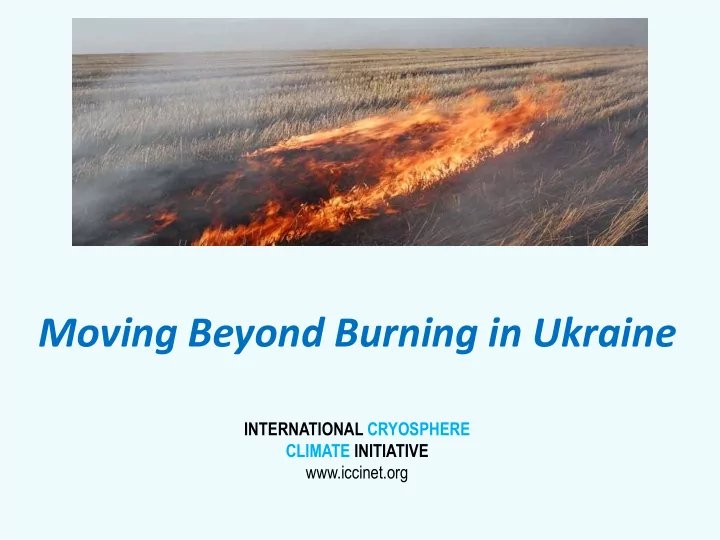
Moving Beyond Burning in Ukraine INTERNATIONAL CRYOSPHERE CLIMATE - - PowerPoint PPT Presentation
Moving Beyond Burning in Ukraine INTERNATIONAL CRYOSPHERE CLIMATE INITIATIVE www.iccinet.org Basics of Open Burning Significant source of black carbon (BC); largest BC source (36%) Especially when close to cryosphere (snow and ice)
INTERNATIONAL CRYOSPHERE CLIMATE INITIATIVE www.iccinet.org
➢ Significant source of black carbon (BC); largest BC source (36%) ➢ Especially when close to cryosphere (snow and ice) regions, significant impact on regional warming/glacier and snowpack melt. ➢ Wildfires spread from set agricultural fires (stubble, clearing for planting, forestry) release additional BC, as well as methane, CO, CO2. ➢ Emissions, and therefore climate impacts travel great distances. ➢ Burning harms soil quality and decreases crop yields. ➢ Burning hurts human health and represents a primary source of particle pollution in many countries: ✓ Can lead to much higher mortality, e.g., Russian fires of 2010 associated with estimated 35,000 additional deaths; ✓ Can increase mortality/morbidity due to accidents due to accidents caused by low visibility.
International Cryosphere Climate Initiative
Experiences and Methodologies to Inform Ukraine Approach
International Cryosphere Climate Initiative
Rostov Region 2001-2009 European Russia and Eastern Europe (from Korontzi et al., 2006)
In southern Russia, more fall burning (primarily August) after grain harvest. Spring ag burning is less than 20% of annual amount, but has greater climate impact
Linking MODIS Terra agricultural fire detections to Russian administrative regions: Monthly time series
International Cryosphere Climate Initiative
Problems in Agriculture
International Cryosphere Climate Initiative
➢ Demonstrations farms ➢ Study tours to other countries, in this case southern
Sweden
➢ Field Days to share information ➢ Work with local authorities on legislation/political support ➢ Local field staff ➢ Wide dissemination of results and information to
stakeholders
➢ Determination of barriers (financial, equipment, scientific, etc.) to success
International Cryosphere Climate Initiative
➢ Education across stakeholders is key ➢ Seminars and expansion of model farm system locally key to showing
how study tour information can be implemented locally
➢Farmers trust experience of other farmers! ➢ Local, regional, and national engagement key to policy changes ➢Multi-year program is essential to show crop stability and economic
viability
➢ Small investments in new technology (choppers, collectors) can greatly
quicken the transition to non-burning methods – financing mechanism helpful
➢ Crucial to establish different reason for burning (spring and/or fall, crop
type, land and soil quality, weather) to establish alternatives
International Cryosphere Climate Initiative
➢ AGRICULTURAL BURNING MATTERS: single largest AND most cost-effective mitigation option to decrease BC ➢ CLIMATE BENEFITS: more certain over ice, snow, desert ➢ MULTIPLE REDUCTION BENEFITS: farmers, health, climate & infrastructure, safety
➢ GOOD ALTERNATIVES EXIST: crop dependent, but better
practices possible and proved across the agricultural sector, e.g., greater support to no/low-till methods
➢ DECREASING BURNING COMPLEMENTS OTHER WORK: food
security, development, family health, soil and climate will all benefit!
➢ TRADITIONS CAN CHANGE – but only for a good reason!
International Cryosphere Climate Initiative
Successful introduction of alternatives to burning requires a three-pronged approach:
Study tours of farmers to countries in Europe and North America where alternatives to burning are widespread. Work with at least two oblasts as “pilot” or model regions for no-burn approaches Establishment of “Ambassador Farms” (often from Study Tour participants) willing to try these methods, and open their farms occasionally for seminars Field Days (both "classroom" and on-site at Ambassador Farms) in pilot oblasts. (Farmers primarily look to other farmers for advice and results!) Creation of an expert Project Support Group (PSG) to guide project development.
Satellite mapping of burn patterns and seasonal trends nationally, with more detailed on-the-ground surveys in pilot oblasts to better understand the “what, where, when and why” of burning patterns specific to Ukrainian agriculture Creation of a web site and twitter feed to document fires in real-time, raising consciousness also among the general public (some of the worst wildfires start with summer dacha farmers ”clearing” their plots) Articles, publications and other media outreach specific to target audiences.
National-level conferences to spread awareness of open burning and other sources of short-lived climate pollutants (SLCPs) among key public and private stakeholders. Work with local legislators to propose and promote appropriate guidelines, and eventual regulation and legislation promoting no-burn approaches. Support for Ukrainian participation internationally at conferences and meetings focused on open burning and SLCPs, such as the CCAC and CLRTAP Design of incentives and financial support for no-burn equipment for farmers pledging not to burn, including a NEFCO financing mechanism to farmers
15