Motivation Agricultural input subsidy programs (ISPs) remain a key - - PDF document

motivation
SMART_READER_LITE
LIVE PREVIEW

Motivation Agricultural input subsidy programs (ISPs) remain a key - - PDF document

9/20/18 Does shifting from in-kind input distribution to a flexible e-voucher approach improve input subsidy program outcomes? Evidence from Zambia Nicole M. Mason, Department of Agricultural, Food, & Resource Economics, Michigan State


slide-1
SLIDE 1

9/20/18 1

Photo Credit Goes Here

Does shifting from in-kind input distribution to a flexible e-voucher approach improve input subsidy program outcomes? Evidence from Zambia

Nicole M. Mason, Department of Agricultural, Food, & Resource Economics, Michigan State University Dagbegnon A. Tossou & Kathy Baylis, University of Illinois Urbana-Champaign Auckland Kuteya & Hambulo Ngoma, Indaba Agricultural Policy Research Institute

20 September 2018 – Applied Microeconomics and Development Seminar International Food Policy Research Institute Washington, DC

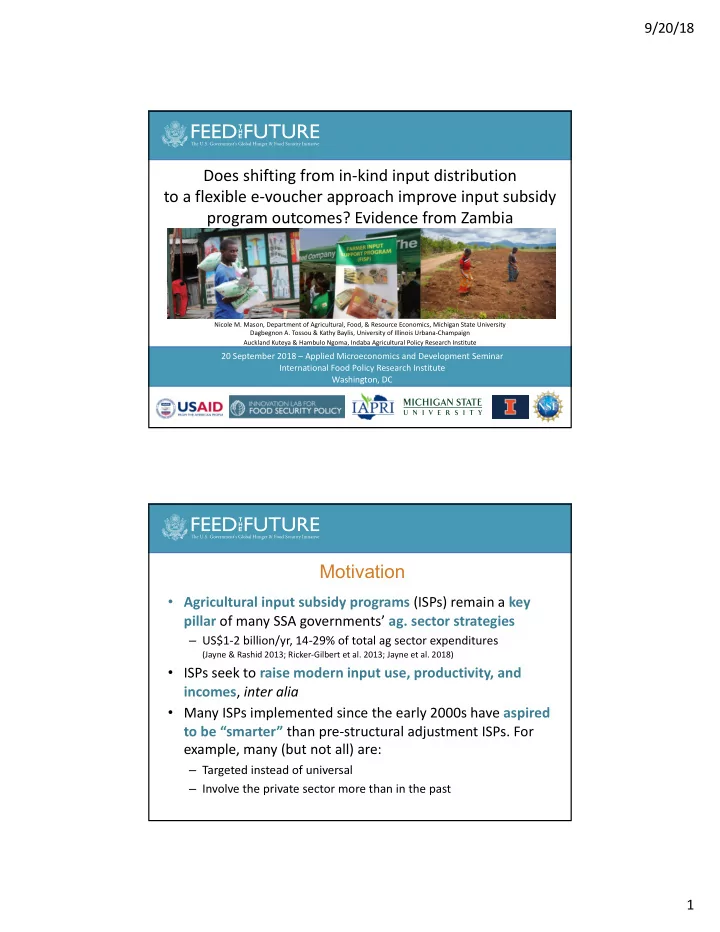
Motivation

  • Agricultural input subsidy programs (ISPs) remain a key

pillar of many SSA governments’ ag. sector strategies

– US$1-2 billion/yr, 14-29% of total ag sector expenditures

(Jayne & Rashid 2013; Ricker-Gilbert et al. 2013; Jayne et al. 2018)

  • ISPs seek to raise modern input use, productivity, and

incomes, inter alia

  • Many ISPs implemented since the early 2000s have aspired

to be “smarter” than pre-structural adjustment ISPs. For example, many (but not all) are:

– Targeted instead of universal – Involve the private sector more than in the past

slide-2
SLIDE 2

9/20/18 2

Motivation (cont’d)

  • ISPs have continued to evolve over time in an attempt to better

support private sector investment and development, and/or to

  • vercome previous challenges with targeting, late delivery, etc.,

and reduce the burden on national treasuries

  • Yet little rigorous empirical evidence on if recent, major ISP

innovations are improving program outcomes

– C.f. – the huge literature on ISP targeting and impacts (see Jayne et al. 2018) – Main exception: Kaiyatsa et al. (2018) on supply-side effects of Malawi’s decision to allow ISP beneficiaries to redeem their fertilizer vouchers at select private sector retailers’ shops

A natural experiment in Zambia

  • Zambia’s piloting of an e-voucher approach to its ISP beginning

in 2015/16 offers a unique opportunity/natural experiment to analyze if/how major ISP innovations affect program outcomes

  • The Farmer Input Support Programme (FISP)

2002/03-2014/15: “Conventional” FISP 2015/16-present (phased rollout): “FISP E-voucher” Inputs distributed in-kind à Beneficiaries receive e-vouchers Private sector retailers NOT involved à E-vouchers redeemable at private sector retailers’ shops Maize seed and fertilizer à “Flexible” e-vouchers - redeemable for a wide range of inputs/equipment

slide-3
SLIDE 3

9/20/18 3

Contributions

  • Add to thin literature on effects of ISP innovations on program
  • utcomes
  • We focus on the effects of the recent major changes to Zambia’s FISP
  • n rural HHs (input use, cropping patterns, food security, others)

– Complements Kaiyatsa et al.’s work on the effects of changes to Malawi’s ISP on private sector retailers – 1st rigorous study on effects of Zambia’s shift to flex. e-voucher

  • We use two different rich, complementary datasets & approaches

– Nationally- and district-representative pooled cross-sectional data (~40,000 obs.) spanning years before and during the FISP e-voucher phased rollout à Diff-in-diff – 2-year, district-representative HH panel survey data (12 districts, ~1900 obs.) during phased rollout à HH fixed effects model

  • Explore additional outcomes and mechanisms

Background on Zambia’s FISP

200,000 400,000 600,000 800,000 1,000,000 1,200,000 1,400,000 1,600,000 1,800,000 2 2 / 3 2 3 / 4 2 4 / 5 2 5 / 6 2 6 / 7 2 7 / 8 2 8 / 9 2 9 / 1 2 1 / 1 1 2 1 1 / 1 2 2 1 2 / 1 3 2 1 3 / 1 4 2 1 4 / 1 5 2 1 5 / 1 6 2 1 6 / 1 7 2 1 7 / 1 8 # of intended beneficiaries Agricultural year Conventional E-voucher

Sources: 2016/17 FISP implementation manual (for 2002/03-2016/17); Ministerial statement on the implementation of the Farmer Input Support Programme, 2017/18 agricultural season (for 2017/18)

Number of intended beneficiaries

slide-4
SLIDE 4

9/20/18 4

FISP share of ag sector total and Poverty Reduction Program (PRP) spending

Source: Zambia Ministry of Finance (various years).

0% 10% 20% 30% 40% 50% 60% 70% 80% 2009 2010 2011 2012 2013 2014 2015 2016 2017

Budget year

% of total ag spending % of total ag PRP spending

Evolution of Zambia’s ISPs over time

2002/03-2008/09: Fertilizer Support Program (FSP)

  • Implemented through selected farmer cooperatives
  • Private sector retailers NOT involved
  • Selected beneficiaries got 400 kg fertilizer, 20 kg hybrid maize seed
  • Subsidy rate: 50-75% for fertilizer, and 50-60% for seed

2009/10-2016/17: (Conventional) Farmer Input Support Program (FISP)

  • Similar to FSP but pack halved to 200 kg fertilizer and 10 kg hybrid maize seed
  • Very small qty of seed for other crops (e.g., rice, sorghum, and groundnuts)

included beginning in 2012/13. Farmers could only get inputs for one crop.

slide-5
SLIDE 5

9/20/18 5

Shift to the FISP flexible e-voucher

2015/16-2016/17: Piloting of the FISP (flexible) e-voucher

  • 13 districts in 2015/16, 39 districts in 2016/17 (of 106+ districts)
  • Pre-paid Visa card redeemable at participating registered agro-dealers
  • E-voucher worth K2100 (US$210) = K400 farmer + K1700 gov’t
  • Flexible: redeemable for crop, livestock, or fisheries inputs or equipment

2017/18: FISP e-voucher program implemented nationwide 2018/19: Partial return to conventional FISP (40% of beneficiaries)

2015/2016 2016/2017 2017/2018

Year FISP e-voucher introduced

Map of Zambia showing the year the FISP e-voucher was introduced in each district

100 100 200 300 400 km

Rollout of the FISP e-voucher

Zambia’s line

  • f rail

Source: The Economist Intelligence Unit (2011)

Zambia’s line of rail

slide-6
SLIDE 6

9/20/18 6

What drove the shift to the e-voucher?

1. Challenges with conventional FISP (anecdotal & empirical evidence) – Diversion and resale of inputs – Poor targeting and leakage to farmers that don’t meet selection criteria – Late delivery of inputs – Failure to build private sector networks – Expensive – Maize-centric and uniform fertilizer recommendations 2. Perception that e-voucher could help address some of these challenges 3. Mounting evidence that e-voucher approach was feasible in Zambia – E.g., Zoona w/ Conservation Farming Unit and Expanded Food Security Pack Program – Zambia National Farmers Union pre-paid Visa card platform for its Lima Credit Scheme

Source: Resnick & Mason (2016)

What drove the shift to the e-voucher? (cont’d)

4. Powerful advocacy coalition pushing for e-voucher

– Indaba Agricultural Policy Research Institute (research),

  • Ag. Consultative Forum (advocacy)

– Zambia National Farmers’ Union, Conservation Farmer Unit – Donor community / Cooperating Partners – Civil society organizations

5. MAL technocrats opposed to e-voucher leave in 2014 6. Diversifying input subsidies away from maize part of PF platform 7. New Minister of Ag. in 2015 (appointed after Pres. Lungu elected)

– Background in agricultural economics; perceived to be more open to research and other orgs – Called for Indabas in March & May 2015 with diverse stakeholders to work out details of pilot

8. Needed budget resources available: Min. of Finance and donor funding (and seen as way to reduce costs to gov’t over time)

Source: Resnick & Mason (2016)

slide-7
SLIDE 7

9/20/18 7

Objectives of the conventional FISP

Overall objective:

  • “Improve the supply and delivery of agricultural inputs to small-scale

farmers through sustainable private sector participation at affordable cost, in

  • rder to increase household food security and incomes”

Specific objectives:

  • 1. “Expand markets for private sector input suppliers/dealers and increase

their involvement in the distribution of agricultural inputs in rural areas, which will reduce the direct involvement of Government”

  • 2. “Ensure timely, effective and adequate supply of agricultural inputs to

targeted small-scale farmers”

  • 3. “Improve access of small-scale farmers to agricultural inputs”
  • 4. “Ensure competitiveness and transparency in the supply and distribution of

inputs”

  • 5. “Serve as a risk-sharing mechanism for small-scale farmers to cover part of

the cost of improving agricultural productivity”

Source: Ministry of Agriculture 2016. 2016/17 FISP implementation manual (p. 3)

Underlined = analyzed in this study

Objectives of the FISP e-voucher

Same as the conventional FISP plus:

  • 1. “Further increase private sector

participation and hence reduce government participation in agricultural input marketing”

  • 2. “Ensure timely access to inputs by smallholder farmers”
  • 3. “Further improve beneficiary targeting”
  • 4. “Promote agricultural diversification”

Source: Ministry of Agriculture 2016. 2016/17 FISP e-voucher implementation manual (p. 1)

Underlined = analyzed in this study

slide-8
SLIDE 8

9/20/18 8

Official targeting criteria (not very well enforced)

Conventional FISP FISP e-voucher Be a member of a selected, registered farmer organization Be registered with the Ministry of Agriculture Have the capacity to pay the farmer contribution (K400) Cultivate 5 ha of land or less Cultivate 0.5 to 2 ha of land AND/OR Raise a certain amount of livestock/fish (2-10 cattle, 5-30 pigs or goats, 20-100 chickens, or 1-2 fish ponds)

Source: Ministry of Agriculture 2015 and 2016. 2015/16 and 2016/17 FISP implementation manuals (conventional and e-voucher).

Farmers are required to present their NRCs and all the details on the e-card are tied to the NRC. When a farmer redeems e-voucher, agro-dealer enters the farmer’s NRC number to bring up the farmer’s details and then proceeds with e-voucher redemption.

FISP e-voucher eligible inputs

  • Assorted types of fertilizers
  • Assorted types of seeds
  • Insecticides
  • Herbicides
  • Fungicides
  • Agricultural Lime
  • Livestock feed
  • Veterinary Drugs
  • Dip chemicals
  • Fingerlings
  • Sprayers
  • Farm tools
  • Fencing materials for farm structures
  • Breeding stock for goats, pigs, heifers
  • Day old chicks
  • Drinkers
  • Fish feed
  • Watering cans

Sources:2016/17 FISP E-voucher Implementation Manual; personal communications with MoA officials.

E-voucher security features

slide-9
SLIDE 9

9/20/18 9

Research question: To what extent did the shift to the FISP flexible e-voucher improve program outcomes relative to the conventional FISP? Approach #1 (MSU/IAPRI): Data & methods

  • Use Zambia Crop Forecast Survey (CFS) data

– Nationally- and district-representative pooled cross-sectional data for smallholder farm HHs (cultivate < 20 ha) – Collected by Zambia Central Statistical Office & Ministry of Agriculture – 2013/14, 2014/15, & 2015/16 ag seasons (2016/17 to be added)

  • Approx. 13,200 HHs per year; 39,678 total obs.

– Data on access to/use of inputs, cropped area, crop diversification, and FISP timeliness, inter alia. Also HH and basic plot characteristics (size, soil fertility).

  • Have CFS data for years before and during FISP e-voucher pilot

à Difference-in-difference (DD) analysis

slide-10
SLIDE 10

9/20/18 10

Approach #1: Empirical model

Multi-district regression DD

(Angrist and Pischke, 2015)

!"#$ = & + ())*+,-.ℎ01

#$ + 2*+,-.ℎ01 #$34

+567896:8#; + <=>9$? + @"#$A + B"#$

  • Key assumption: parallel trends in the absence of the policy change

– If no differential pre-treatment trends, then 2=0 – Fail to reject H0: 2=0

2015/2016 2016/2017 2017/2018

Year FISP e-voucher introduced

Map of Zambia showing the year the FISP e-voucher was introduced in each district

100 100 200 300 400 km

Approach #2 (UIUC): Data

  • Part of NSF-funded Climate Change, Food Security, and Market

Dynamics Research Project

  • Includes questions on FISP participation (in general and

e-voucher in particular)

  • 2-wave HH panel survey, covers 12 districts

– Wave 1: covers 2015/16 ag year, 1174 HHs – Wave 2: covers 2016/17 ag year, 1024 HHs re-interviewed – Focus on maize-growing HHs in analysis (1109/886 obs.)

  • Of the 12 districts:

– 2015/16: 10 conventional FISP + 2 FISP e-voucher – 2016/17: 7 conventional FISP + 5 FISP e-voucher

slide-11
SLIDE 11

9/20/18 11

Approach #2: Districts covered in panel survey

Approach #2: FISP participation by year & program

2015/16 2016/17 HHs in conventional FISP districts 770 (69%) 467 (53%) HHs in FISP e-voucher districts 339 (31%) 419 (47%) Total HHs 1109 886 Conventional FISP beneficiary HHs 389 (35%) 271 (31%) FISP e-voucher beneficiary HHs 214 (19%) 232 (26%) Non-beneficiary HHs 504 (46%) 383 (43%) Total HHs 1107 886 # of HHs that switched from conventional FISP to FISP e-voucher (2015/16 to 2016/17) 91 % of all 2016/17 HHs 10.3% % of 2016/17 FISP beneficiary HHs 18.1%

slide-12
SLIDE 12

9/20/18 12

Approach #2: Empirical model

!"#= % + '()*+,

"# + '-)*+, "#×/0123ℎ56 "#

+ 7"#8 + 3" + 9# + :"#

  • '- is key parameter of interest (differential effect of e-voucher)
  • Outcome variables: maize yield, food expenditures (cash only),

and 2 food security indicators - FCS, modified HDDS (7-day recall)

– HDDS: # of food groups consumed by HH

  • Indicator of diet quality

– FCS: weighted score of # of food groups X frequency

  • Indicator of caloric intake and diet quality
  • Estimate via POLS and FE (without X)

– Relying on FE to control for endogeneity of FISP (i.e., assuming self-selection is related to time-constant, not time-varying HH unobservables)

Results: DD – Access to & use of fertilizer

Explanatory variables Km to nearest fertilizer seller =1 if used fertilizer =1 if purchased fertilizer (not w/ e-voucher) Coef. Coef. Coef. Coef. Coef. Coef. Evoucherdt

  • 1.85

2.75 0.027 0.070***

  • 0.105***
  • 0.119***

Evoucherdt+1

  • 3.53
  • 3.25
  • 0.021
  • 0.016
  • 0.018
  • 0.015

District dummies Yes Yes Yes Yes Yes Yes Year dummies Yes Yes Yes Yes Yes Yes Province X year dummies No Yes No Yes No Yes HH characteristics No Yes No Yes No Yes Observations 39,678 39,671 39,678 39,671 39,678 39,671 R-squared 0.172 0.178 0.242 0.272 0.151 0.176 Sample mean 39.2 0.564 0.287

  • Probability of using fertilizer (may be) higher among HHs in e-voucher districts in 2015/16:

b/c of more effective targeting under e-voucher of HHs o.w. less likely to use fertilizer (and elimination of “ghost farmers”)?

  • Probability of purchasing unsubsidized fertilizer lower among HHs in e-voucher pilot districts

in 2015/16 : b/c can potentially redeem for 7x50-kg bags (K300/bag) vs. only 4 bags w/ conventional FISP?

Note: *** p<0.01, ** p<0.05, *p<0.10. Standard errors clustered at district level.

slide-13
SLIDE 13

9/20/18 13

Results: DD – Use of F1 hybrid maize seed

Explanatory variables =1 if grew F1 hybrid maize Hectares of F1 hybrid maize Coef. Coef. Coef. Coef. Evoucherdt

  • 0.050**
  • 0.016
  • 0.23***
  • 0.04

Evoucherdt+1

  • 0.018
  • 0.004

0.03 0.02 District dummies Yes Yes Yes Yes Year dummies Yes Yes Yes Yes Province X year dummies No Yes No Yes HH characteristics No Yes No Yes Observations 39,678 39,671 39,678 39,671 R-squared 0.193 0.225 0.127 0.486 Sample mean 0.525 0.63

  • Some (but not robust) evidence of reduction in hybrid maize seed use
  • Consistent w/ HH panel survey data: e-voucher recipients spent most of e-

voucher value on fertilizer (86-92%) and only 5-9% on hybrid maize seed; they were also more likely to plant recycled hybrids. (Will discuss more later.)

Note: *** p<0.01, ** p<0.05, *p<0.10. Standard errors clustered at district level.

Inputs purchased with e-voucher based on a sample of beneficiaries in 10 districts (IAPRI)

Input % of e-voucher transactions by input type (among IAPRI survey farmers) 2015/16 2016/17 Fertilizer 60.7% 67.0% Maize Seed 24.3% 19.9% Veterinary Drugs 3.8% 1.4% Dip Chemicals 2.6% 1.4% Herbicides 2.0% 6.5% Insecticides 1.6% 0.7% Other (unspecified) 1.4% 0.5% Sprayers 1.3%

  • Horticultural Inputs

1.1% 1.4% Cowpea seed 0.6% 0.2% Common bean seed 0.6%

  • Agricultural Lime

0.1% 0.5% Tillage equipment

  • 0.2%

Soybean bean

  • Livestock Feed
  • Live Animals
  • 0.2%

Fingerlings

  • TOTAL

100% 100% N (e-voucher recipients) 437 634

Source: 2016 and 2017 IAPRI FISP E-Voucher Surveys. Sample included 10 of 13 of the districts included in the 2015/16 pilot. Pilot districts excluded were Ndola, Kalomo, and Mumbwa.

slide-14
SLIDE 14

9/20/18 14

Results: DD – Cropped area (hectares)

Explanatory variables Maize Other field crops Coef. Coef. Coef. Coef. Evoucherdt

  • 0.15***

0.01 0.20*** 0.14** Evoucherdt+1 0.04 0.02

  • 0.03
  • 0.06*

District dummies Yes Yes Yes Yes Year dummies Yes Yes Yes Yes

  • Prov. X year dummies

No Yes No Yes HH characteristics No Yes No Yes Observations 39,678 39,671 39,678 39,671 R-squared 0.159 0.629 0.112 0.277 Sample mean 0.94 0.74

  • CFS covers maize + 22 other field crops (horticultural crops not covered)
  • Compared to maize-centric conventional FISP, flexible e-voucher

à HHs diversifying their crop production?

Note: *** p<0.01, ** p<0.05, *p<0.10. Standard errors clustered at district level.

  • ↓ maize
  • ↑ legumes & oilseeds
  • ↑ cash crops
  • ↑ roots & tubers
  • No Δ other cereals

Results: DD – Crop diversification

  • Simpson index = 1 − ∑%&'

(

)%

* (increase is ~11-16%)

  • Additional evidence of crop diversification effect of FISP e-voucher relative to

conventional, maize-centric FISP

  • Mechanism unclear: few HHs use e-voucher to buy seed for non-maize crops.

Perhaps “if they give you maize seed, you’ll plant it” effect w/ conventional FISP?

Note: *** p<0.01, ** p<0.05, *p<0.10. Standard errors clustered at district level.

Explanatory variables =1 if grew at least

  • ne non-maize

field crop Number of field crops grown Simpson index

  • f field crop

diversity Coef. Coef. Coef. Coef. Coef. Coef. Evoucherdt 0.06* 0.03 0.30*** 0.15 0.063*** 0.041** Evoucherdt+1 0.01

  • 0.01
  • 0.00
  • 0.04

0.001

  • 0.003

District dummies Yes Yes Yes Yes Yes Yes Year dummies Yes Yes Yes Yes Yes Yes Province X year dummies No Yes No Yes No Yes HH characteristics No Yes No Yes No Yes Observations 39,678 39,671 39,678 39,671 39,678 39,671 R-squared 0.156 0.185 0.194 0.269 0.216 0.260

Note: *** p<0.01, ** p<0.05, *p<0.10. Standard errors clustered at district level.

slide-15
SLIDE 15

9/20/18 15

Results: DD – FISP fertilizer distance & timeliness (among HHs acquiring fertilizer through FISP)

  • Some evidence that at least in the 1st year of the pilot, HHs that accessed fertilizer

through the FISP e-voucher had to travel farther and were less likely to get the fertilizer on time, compared to those acquiring it through conventional FISP

Note: *** p<0.01, ** p<0.05, *p<0.10. Standard errors clustered at district level.

Explanatory variables Km to FISP fertilizer collection point =1 if FISP basal fertilizer available on time =1 if FISP top dressing fertilizer available on time Coef. Coef. Coef. Coef. Coef. Coef. Evoucherdt 6.96*** 2.15

  • 0.117*
  • 0.075
  • 0.085*
  • 0.048

Evoucherdt+1

  • 1.05

0.39 0.048

  • 0.034

0.035

  • 0.047

District dummies Yes Yes Yes Yes Yes Yes Year dummies Yes Yes Yes Yes Yes Yes Province X Year dummies No Yes No Yes No Yes HH characteristics No Yes No Yes No Yes Observations 13,538 13,533 13,463 13,458 13,480 13,475 R-squared 0.043 0.053 0.075 0.111 0.095 0.141 Sample mean 6.7 0.761 0.709

Note: *** p<0.01, ** p<0.05, *p<0.10. Standard errors clustered at district level.

DD results – Main takeaways

1. Fairly robust evidence that shift to e-voucher in 2015/16 increased crop diversification 2. The shift may have increased the % of HHs using fertilizer (perhaps through better targeting/elimination of ghost farmers) 3. But the shift appears to have reduced the % of HHs purchasing unsubsidized fertilizer (e.g., perhaps b/c e-voucher beneficiaries spent it almost entirely on fertilizer; little residual demand for unsubsidized fertilizer) 4. No evidence that the shift reduced distance to fertilizer retailers 5. And HHs that acquired fertilizer through e-voucher no better off (and may have been worse off) w.r.t. FISP fertilizer timeliness and proximity

  • Why #4 & #5? Private sector response may take more than 1 year
slide-16
SLIDE 16

9/20/18 16

Results: POLS/FE – Maize yield

Explanatory variables Log maize yield

  • Coef. (POLS)
  • Coef. (FE)

FISPit 0.440*** 0.414*** FISPit X Evoucherit

  • 0.208***
  • 0.196***

HH characteristics Yes No District dummies Yes No Agricultural camp dummies Yes No Year dummy No Yes Observations 1,904 1,975 R-squared (w/in for FE) 0.249 0.041

Note: *** p<0.01, ** p<0.05, *p<0.10. Number of observations is lower for POLS due to missing data on some HH characteristics for some HHs.

  • FISP participation (conventional or e-voucher) boosted maize yields by 40-44%
  • But relative to conventional FISP beneficiaries, FISP e-voucher beneficiaries’ yields

were ~20% lower

Mechanisms for lower maize yields among e- voucher beneficiaries relative to conventional?

E-voucher beneficiary HHs: 1. Had their e-voucher cards activated later (on average) than conventional FISP beneficiaries received their inputs in (especially in 2016/17) 2. Spent most of their voucher on fertilizer – Perhaps b/c vouchers were late & they had already planted à didn’t make sense to buy seed for that year anymore 3. Were more likely to plant recycled hybrid maize seed (27-31% vs. 21-24% of conventional FISP HHs) – Info constraint and/or needed to plant and couldn’t wait for e-voucher to be activated?

slide-17
SLIDE 17

9/20/18 17

Results: POLS/FE – food expenditures, FCS, & HDDS

  • Lower food expenditures among e-FISP beneficiaries could be good thing. These are

cash expenditures only; do not include value of consumption from own production. (Some CFS evidence that expected gross value of production/ha greater w/ e-FISP.)

  • Greater crop diversification does not necessarily translate into ↑ FCS/HDDS but need to

explore further. (Some other model specifications suggest a + effect on HDDS.)

Note: *** p<0.01, ** p<0.05, *p<0.10. Standard errors clustered at district level.

Explanatory variables Log of food expenditures in last 7 days FCS HDDS

  • Coef. (FE)
  • Coef. (POLS)
  • Coef. (FE)
  • Coef. (POLS)
  • Coef. (FE)

FISPit 17.4** 1.98** 2.22 0.20*** 0.16* FISPit X Evoucherit

  • 43.6***

0.04

  • 2.75
  • 0.11
  • 0.11

HH characteristics No Yes No Yes No District dummies No Yes No Yes No Agricultural camp dummies No Yes No Yes No Year dummy Yes No Yes No Yes Observations 1,993 1,922 1,993 1,922 1,993 R-squared (w/in for FE) 0.029 0.191 0.006 0.200 0.011 Sample mean 59 5.5

Note: *** p<0.01, ** p<0.05, *p<0.10. Standard errors clustered at district level.

Additional analyses planned

1. Additional robustness checks 2. Instrument for selection as e-voucher pilot district in 2015/16 vs. 2016/17 (vs. non-pilot district) using distance from line of rail X year dummy – Line of rail established during the colonial period 3. Add 2016/17 data to DD analysis

slide-18
SLIDE 18

9/20/18 18

Conclusions

  • Good intentions but implementation challenges
  • Results so far suggest that the 2015/16 FISP e-voucher pilot

spurred greater crop diversification and possibly an increase in the % of HHs using fertilizer relative to the conventional FISP

  • But at least in its first year, the FISP e-voucher did not result in

shorter distances between farmers and fertilizer sellers or increase the likelihood that farmers purchased unsubsidized fertilizer, nor did it improve timely availability of FISP fertilizer

  • Why? These are short-run effects. May take multiple years to

build private sector confidence and catalyze major investment in retail networks (and stocking of more diverse inputs).

Conclusions (cont’d)

  • HH panel survey-based results suggest that maize yields

were 20% lower among FISP e-voucher beneficiaries than conventional FISP beneficiaries – Due to late activation and e-vouchers being spent mainly on fertilizer and not fertilizer + hybrid maize seed

  • Differential effects on food expenditure, food security

mixed

  • Late activation of e-vouchers is a major problem

à whether it’s inputs (conventional FISP) or e-vouchers, early mobilization of funds and early start to activities are

  • critical. Fundamentally a question of political will.
slide-19
SLIDE 19

9/20/18 19

Which situation will prevail in 2018/19?

Source: News Diggers Source: News Diggers (February 12, 2018)

Acknowledgements

This work was made possible in part by the generous support of the American People provided to the Feed the Future Innovation Lab for Food Security Policy [grant number AID-OAA-L-13-00001] through the United States Agency for International Development (USAID). Funding was also provided by the National Science Foundation (NSF). It is also based upon work that is supported by the U.S. Department of Agriculture National Institute of Food and Agriculture and Michigan AgBioResearch (project number MICL02501). The contents are the responsibility of the authors and do not necessarily reflect the views of USAID, the NSF, or the United States Government.

Thank you for your attention!

Nicole Mason (masonn@msu.edu) Kathy Baylis (baylis@illinois.edu)

slide-20
SLIDE 20

9/20/18 20

www.feedthefuture.gov