Community Work Programme: Meeting childhood food and nutrition - - PowerPoint PPT Presentation

community work programme meeting childhood food and
SMART_READER_LITE
LIVE PREVIEW

Community Work Programme: Meeting childhood food and nutrition - - PowerPoint PPT Presentation

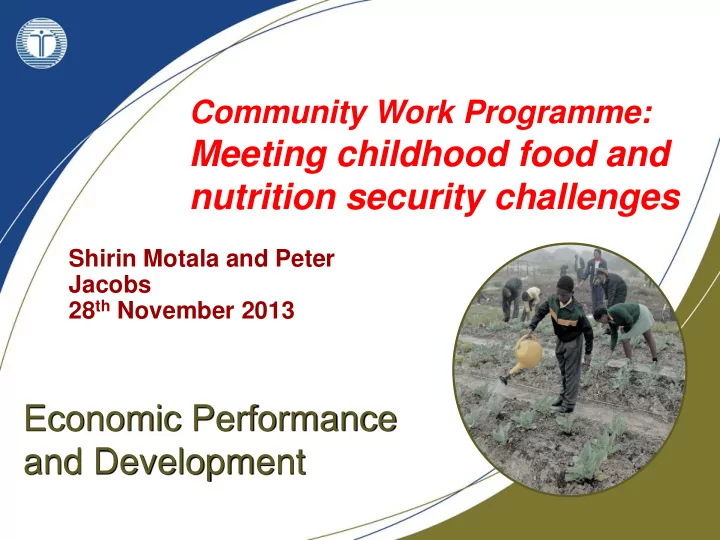
Community Work Programme: Meeting childhood food and nutrition security challenges Shirin Motala and Peter Jacobs 28 th November 2013 Economic Performance and Development CWP is working wonders, feeding my children and is bringing in


slide-1
SLIDE 1

Economic Performance and Development

Shirin Motala and Peter Jacobs 28th November 2013

Community Work Programme:

Meeting childhood food and nutrition security challenges
slide-2
SLIDE 2

“CWP is working wonders, feeding my children and is bringing in money”

slide-3
SLIDE 3

Presentation Road Map

  • Study Purpose
  • HSRC interest in promoting innovations in CWP design
  • Contextualising it within the framework of social

protection and labour policies

  • Why childhood food and nutrition security is important?
  • Food and Nutrition Security in SA – Policy Priority
  • Understanding SA’s Community Work Programme
  • Research Study overview
  • Findings
  • Achievements and Challenges
  • Conclusions
slide-4
SLIDE 4

Purpose of the CWP Study To explore potential for CWP to contribute to strengthening and promoting integration of food security and child-wellbeing interventions.

slide-5
SLIDE 5

Why is HSRC interested in promoting innovations in CWP design? (1)

  • Ongoing policy-oriented research at the HSRC on

human wellbeing and employment

  • EPD: Sustainable development and labour market

dynamics; employment scenarios and food and nutrition security of children

  • Transition to sustainable employment in the context of

high unemployment (especially among youth) and structural inequalities

  • Improvements in food and nutrition security- focusing on

various interventions: employment (wage income), social grants, direct F&NS interventions, food pricing dynamics, etc.

slide-6
SLIDE 6

Why is HSRC interested in promoting innovations in CWP design? (2)

  • Contribution of public sector employment

programmes to:

  • short-term job creation
  • transition to sustainable employment in the long-run

(labour market dynamics, human capital development, reduce costs of eco participation, etc)

  • EPD work on ‘Developmental Social Policy’:
  • explore options to coordinate or integrate

government sponsored interventions for sustainable development

  • how to move beyond silo-approaches?
slide-7
SLIDE 7

Social Protection and Active Labour Market Policies

  • Effective SPL policies occupy centre stage globally;
  • Social protection and labor systems, programs and

policies buffer individuals from shocks;

  • While social protection and labor policies and programs

are designed for individuals and families, they can also be broadly transformative—by providing a foundation for inclusive growth and social stability;

slide-8
SLIDE 8

Policy Gaps in SPL

  • Evidence suggests however that there are four

elemental gaps in SPL policies today:

  • in integration across programs and functions,
  • in access to SPL instruments,
  • in promotion to ensure access to jobs and
  • pportunities, and
  • in global knowledge of effective SPL approaches.
slide-9
SLIDE 9

Why is childhood food and nutrition security important?

  • A child’s mental and physical development is harmed if

the child does not eat enough nutritious foods and this usually manifests in:

  • poor cognitive development,
  • weak educational performance,
  • increased risk of morbidity and
  • impaired immune functions.
  • Vitamin A deficiency is strongly associated with night

blindness and high rates of early child mortality.

  • It is difficult to reverse stunting after age 2, and therefore

early intervention essential.

slide-10
SLIDE 10

Nutritional Deficit Impacts

  • 1000 day window of opportunity from pregnancy to 23

months – malnutrition during this period irreversible (LANCET Study)

  • Productivity losses, poor cognitive development, and

increased health care costs in malnourished populations lead to significant economic losses.

  • For every 1 percent increase in height, adults will

experience a 4 percent increase in total agricultural wages.

  • Eliminating anemia has been shown to increase adult

productivity by 5 to 17 percent

slide-11
SLIDE 11

Understanding Child Development

slide-12
SLIDE 12

Food and nutrition security: International & national government priorities

  • 2009, peak of global economic crisis - undernourished

people surpassed 1 billion

  • MDG 1 – target to reduce proportion of those in hunger

by 2015

  • SA Government objective to halve unemployment and

poverty by 2014

  • Food and nutrition security for all is foundational goal.
  • Fundamental building block for human participation
  • Nutrition is key foundation that influence effectiveness
  • f other interventions
slide-13
SLIDE 13

Food and Nutrition security in SA?

  • South Africa is one of the top 20

countries with the highest burden of under nutrition.

  • GHS suggests that household food

insecurity, or hunger, has fallen dramatically since 2001.

slide-14
SLIDE 14

However nutrition levels have not improved that much….

  • Average South African consumes less than 4 of 9 food

groups – min should be 6

  • Nationally 45% of children had an inadequate zinc

status (NFCS, 2005). One quarter of women, and 2/3 children nationally had poor vitamin A status. About a third of women and children iron deficient

  • 38% of S. Africans did not meet daily energy

requirements

  • Under-nutrition is critical issue for SA women, (1/3 of

young women are HIV+)

slide-15
SLIDE 15

Factors contributing to good nutritional outcomes

  • Access to essential nutrients in

appropriate amounts

  • Equitable access to nutritious food
  • Knowledge of nutrition
  • Adequate health and access to health care

services

  • Regular developmental screening for

children

slide-16
SLIDE 16

Origins of CWP

  • In 2005, India passed a law guaranteeing every rural

households with unemployed adults willing to do unskilled work up to 100 days of work per annum, at minimum wage rates - The Mahatma Gandhi National Rural Employment Guarantee Act (NREGA)

  • World first in terms of “right to work”
  • Over 55 million households now participate in the

programme, with significant impacts on poverty in rural India.

  • 3 objectives – provide wage employment; strengthen

rural governance (transparency and accountability); strengthening sustainable livelihoods – asset creation.

slide-17
SLIDE 17

Why the need for CWP in SA?

  • SA has one of the highest unemployment rates globally

(25.2% or 4,3 million people)

  • If we include discouraged work seekers then its 32.7% or

6,2 million people.

  • Uneven distribution – former Bantustans and informal

settlements e.g. 58% in Umzumbe

  • High levels of inequality (structural, spatial, capacity)

makes it difficult to create jobs and for rural areas to play the role of absorbing unemployed and food security

  • No safety net for unemployed adults if they have never

been formally employed

  • Need to break cycle of “discouraged work seekers” –

sector is growing annually (50% of 35 year olds and under have never worked – give back dignity etc.

slide-18
SLIDE 18

Current Policy Context

  • SA has already implemented a public employment

scheme through EPWP

  • EPWP Phase 1 (2004-2009) reached 1 million work
  • pportunities
  • Phase 2 (now till 2014) – 4.5 million work opportunities –

680 000 FTE

  • Targets low in relation to problem
  • Many challenges to scaling up EPWP (sustainable

employment, exit strategies? Targeting Etc.)

  • Exit strategies almost non existent
slide-19
SLIDE 19

CWP - SA

  • 2007 - pilot, outside government with donor funding

(DFID), Steering Committee from Cabinet & implemented by TIPS

  • Currently operated via COGTA
  • NOT an employment guarantee like India
  • It offers 2 days employment per week (8 days pm) at

R50 pppd in 2011

  • From 2009 to Sept 2010 – 75 000 participants in all

provinces in 55 sites

  • Currently (March 2013) 155 000 participants in 74 sites.
  • Target to establish one CWP in each municipality by

2014.

  • MTEF grow CWP to 1 million participants 2015
slide-20
SLIDE 20

The SA Model

  • A site is between 2-10 wards in a municipality
  • 1000 people employed
  • Work to be done decided by community through

participatory processes

  • Must be useful work and benefit the community, not

individuals

  • Work includes home-based care, food gardens, teacher

assistance, ECD assistance, environmental services and the creation and maintenance of community assets such as parks, graveyards, schools, clinics, churches, secondary and village roads, and water pipelines

  • Sites have supervisors and clerks (1;25 ratio)
slide-21
SLIDE 21

Conceptual Framework for Study

 Enhanced access to a social package (social wage/social floor) can contribute to lowering the costs of transitioning people into a sustainable livelihoods. Well developed and targeted interventions in early childhood set the platform for future development outcomes.

slide-22
SLIDE 22

HSRC Research on CWP Innovations

  • Qualitative study – focused on 16

selected sites nationally – purpose built sampling.

  • NOT an EVALUATION
  • Focused on food security, early

childhood development interventions and home based care and support.

slide-23
SLIDE 23

Methods

  • Ethics Protocol: reflection of respect – e.g. informed

consent (right to choose if you want to participate), manner in which research is conducted and information collected must not harm a person

  • Desk top review
  • Quantitative Data analysis
  • Data collection: Interviews, focus groups, review of

documents and participation in CWP workshops;

  • Sample Selection: 16 sites out of 77 sites (56 we

identified) – purposive. Criteria included rural, urban, geographical, type of work undertaken

  • Site based and telephonic interviews
slide-24
SLIDE 24

Research Sites

  • KZN: 3 – Mthwalume and Duzi (informal discussion

Dlangubo)

  • E. C: 3 – Pefferville, Bulungula (part of Elliotdale), Senqu

(Matatiele)

  • F.S.: 2 – Welkom and Harrismith
  • G.P.: 2 – Kagiso (Merafong)
  • LP: 1 – Lephephane
  • M.P. 1 – Bohlabela
  • N.C.: 1 - Riemvasmaak
  • N.W.: 1 - Meriting
  • W.C.: 2 – Grabouw and Mannenberg
slide-25
SLIDE 25

Who was interviewed?

  • CWP Site Managers;
  • CWP ECD; Food Garden and Social Coordinators;
  • CWP Reference Committee members
  • ECD centre Principals and Board members;
  • Implementing Agents, (TSMS)
  • ECD stakeholders – Training agencies, advocacy bodies
  • Local Government representatives
  • Provincial government stakeholders in KZN and WC
  • DoSD; DoH; DoE; DoPW; DoCoGTA
slide-26
SLIDE 26

Study Limitations

  • Time constraints – Limited time, period of

interviews

  • Financial and Human Resource

Constraints – only 4 sites visited, reliant heavily on telephonic interviews

slide-27
SLIDE 27

Findings

slide-28
SLIDE 28

Meanings of childhood food and nutrition security

  • ‘Food and nutrition security’ is mainly associated

with access to food, but rarely with nutritional status linked to age, weight & height.

  • Understanding of food security is commonly

associated with the ‘visible signs of hunger’- eating enough food 3 times a day

  • Some respondents lacked complete familiarity

with the concept food security

slide-29
SLIDE 29

CWP- food production and distribution

  • A number of CWP sites operate food gardens, often alongside
  • ther work activities
  • Grow and harvest a limited range of vegetable crops- with

seasonal variation; however, virtually no horticultural (fruits, etc) and no animal keeping reported

  • There is growing interest in transitioning from community

food gardens to ‘1 home 1 garden’ as has become popular in KZN- transfer farming skill needs to match access to suitable land – Sukhume Sakhe

  • Lower cost of access to food (affordability)- Riemvasmaak

R80 per shopping trip in nearby town

slide-30
SLIDE 30

Scale of home based food production

  • Extensive roll out of food gardens at CWP sites…
  • Home gardens E.g. Sterkspruit in EC – 5000 home

gardens developed and maintained.

  • Food Solidarity - food gardens in schools, creches,

hospitals, orphanage . E.g. KKH – 54 schools and 30 creches food gardens and 1 hospital garden established.

  • Communal gardens established supply vulnerable hh.
  • Cooperative Gardens – emerging as income

generators

slide-31
SLIDE 31

Most common food distribution channels

 Distribution to vulnerable households (sick), orphans and vulnerable children

  • Targeted beneficiaries are elderly, sick, disabled, children and
  • ther “vulnerable” members of community
  • Soup kitchens established to provide food for vulnerable people.

E.g. Welkom site was providing cooked foor for 57 bedridden and chronically ill people – now only 9 require feeding – rest have recovered with food, care and medication.

  • Vulnerable children fed at school and also given products to take

home  Selling into local informal markets but there is no clarity how income from sales (profits) get distributed among project participants or reinvested  Some sites allocate a share of output to CWP participants  Extensive evidence of food solidarity

slide-32
SLIDE 32

CWP food security cont.

  • Gardening for commercial production. E.g.

Dlangubo site - Sunflower seed production -

  • rganic oil for local market – funds directed to
  • rphan project.
  • Seedling nurseries developed for commercial

purposes and to supply CWP gardens

  • Vegetable production mainly – some sites

involved with fruit production - Bulungula

  • Maize production - value added milling for local

consumption– KKH site

  • Agriculture extension services utilized
slide-33
SLIDE 33

ECD Centres: food access and consumption

  • The majority of ECDs in our study

appear to rely primarily on food purchases, food packs from parents and donations (DSD subsidy, etc) rather than ‘food gardens’

  • Some ECDs operate their own

food gardens whilst others do not

  • Active ECD food gardens tend to

cultivate and harvest a limited range and quantity of vegetable crops- spinach, cabbage, carrots, potatoes…

slide-34
SLIDE 34

Cont.

  • ECD Centre menus show limited ranges of the food (lack

diversity of food groups)- concentrated around caloric intake rather than dietary diversity (rare fruit consumption); some snacks are not nutritious

  • Some ECD Centres were unable afford the written menu

throughout the last year: in the most extreme case the ECD ran out of money to buy food on the menu for 150 days.

  • ECD Centres rarely tracked information on child

malnutrition (stunting)- not eating enough of the right kinds of food – which requires information about the health status.

slide-35
SLIDE 35

CWP-ECD interaction for early childhood food and nutrition security

  • In some instances CWP food gardens interact with ECDs

(perhaps not as complex as in other areas) whereas in other cases they do not.

  • Some CWP workers leave their children at ECDs on workdays,

but the centers often close before the end of their workday

  • Even where they exist in the same locality, CWP support around

food needs of ECDs is varied and criteria for partnering remain hazy:

  • “The CWP has not approached us yet and perhaps it is because we are the

best ECD centre in Manenberg. Also, the CWP may think we do not need assistance from them.” (Manenberg, ECD)

  • A bottom-up community-driven approach works better:
  • “There was a community agreement in place to address hunger in ECD

centers and in homes who cannot afford food…. We use a consultative way to approach the growing of food.” (Harrismith CWP site)

slide-36
SLIDE 36

Support for food production and access

  • Provincial Departments Agriculture-

inputs, extension advice, training

  • Department of Social Development-

subsidy grants

  • Implementing agents (Teba, Seriti,

Lima, etc)

  • Local supermarkets
  • Municipalities- seeds, inputs, land,

fencing

  • Kirstenbosch- training to Manenberg

CWP?

slide-37
SLIDE 37

Achievements Home Gardens Stimulated

  • International evidence - for improved nutritional status home gardens

more successful than other types of agricultural interventions (Berti et al. 2004) as easier to adopt under existing conditions – poverty, environment, etc

  • Produced food is for own consumption - mainly vegetables,

thereby increasing micronutrient intake

  • Permits expenditure of limited income on other more nutritious

foods

  • Without household production food security of the ultra-poor would

be significantly reduced (van Averbeke and Khosa 2007)

  • Ndunakazi Project followed integrated production and nutrition

education approach – intake of micronutrients improved (Faber et al. 2002a, 2002b)

  • Traditional leafy vegetables widely grown consumed - a good source
  • f various nutrients and tend to grow well in semi-arid areas (Hart

and Vorster 2007, Jansen van Rensburg et al. 2007)

  • Agricultural activities contribute positively to household nutrition –

access, availability and diversity, although greater contribution might

  • ccur when commercially focused as this increases income and

purchasing power (Kirsten et al. 1998, Hendriks 2003)

slide-38
SLIDE 38

Achievements (2)

  • Food bank established for low cost

purchase of beans, maize etc – Welkom site.

  • Contribute to sources of food for hhs – not

quantified

  • Profit from surplus sold and funds utilized

for supplementary food purchases

  • Agriculture extension services provided
  • Food Solidarity initiatives.
slide-39
SLIDE 39

Challenges for CWP (1)

  • Targeting: Unclear how targeting is determined.

Unclear of criteria for assessing vulnerability for food access;

  • Type of food production: insufficient evidence of how

dietary diversity is promoted. No evidence of animal production for dairy and protein needs;

  • Typical CWP workers in food security: No data
  • available. Anecdotal evidence suggests that majority are

women and mainly older women – need to address gender imbalance in labour activities around food production.

slide-40
SLIDE 40

Challenges…(2)

  • CWP Operational Guidelines do not contribute to food
  • security. CWP Workers not allowed to share in

production – appears short sighted. Research evidence suggests that an adult needs to spend R 260 per month to achieve dietary diversity and nutrition. CWP Income of R 480 per month (often shared by other household members.) Typically family size 5 with cash transfers for 3 children will not have sufficient funds to cover their nutritional needs.

  • Food security interventions need to be coupled with
  • ther interventions – like nutrition counseling.
  • Barriers to scaling up: Inadequate collaboration and

coordination with state services – Dept of Agriculture, Dept of Water Affairs

slide-41
SLIDE 41

Challenges (3)

  • Expand awareness of early childhood nutritional status

to include dietary diversity, etc…

  • Active use of nutritional health information from clinics-

RtHCard

  • Food gardens require access to land, water, seeds,

etc… leverage support from other state departments?

  • Training in agro-ecological farm practices
  • Lack of funding for nutritionally adequate food for

children..

slide-42
SLIDE 42

Key Message for CWP

  • Incorporate household food security

and/or nutrition objectives in project

  • design. This will ensure that food security

and nutrition concerns are addressed.

  • Be intentional about measuring impacts
  • n food security and nutrition. It

promotes better targeting of the most vulnerable and helps improve effectiveness of implementation