SLIDE 1 1
Motion Estimation
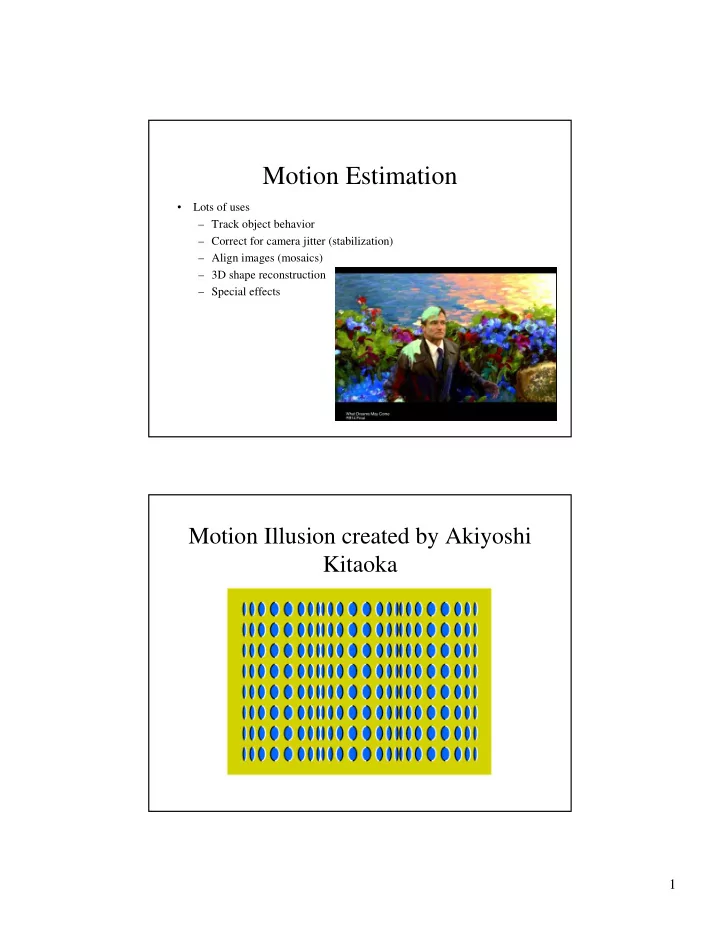
– Track object behavior – Correct for camera jitter (stabilization) – Align images (mosaics) – 3D shape reconstruction – Special effects
Motion Illusion created by Akiyoshi Kitaoka
SLIDE 2
2
Motion Illusion created by Akiyoshi Kitaoka
SLIDE 3
3
SLIDE 4
4
SLIDE 5
5
Optical flow
SLIDE 6
6
SLIDE 7
7
Aperture problem
SLIDE 8
8
Aperture problem
SLIDE 9
9
SLIDE 10
10
SLIDE 11
11
SLIDE 12
12
SLIDE 13
13
Hamburg Taxi Video
SLIDE 14
14
Hamburg Taxi Video Horn & Schunck Optical Flow
SLIDE 15
15
Fleet & Jepson Optical Flow
SLIDE 16 16
Tian & Shah Optical Flow Solving the Aperture Problem
- Basic idea: assume motion field is smooth
- Horn and Schunk: add smoothness term
- Lucas and Kanade: assume locally constant motion
– pretend the pixel’s neighbors have the same (u,v)
- If we use a 5x5 window, that gives us 25 equations per pixel!
– works better in practice than Horn and Schunk
SLIDE 17 17
Lucas-Kanade Flow
- How to get more equations for a pixel?
– Basic idea: impose additional constraints
- most common is to assume that the flow field is smooth locally
- one method: pretend the pixel’s neighbors have the same (u,v)
– If we use a 5x5 window, that gives us 25 equations per pixel!
– minimum least squares solution given by solution of:
Lucas-Kanade Flow
- Problem: more equations than unknowns
– The summations are over all pixels in the K x K window – This technique was first proposed by Lukas and Kanade (1981)
- Solution: solve least squares problem
SLIDE 18 18
Conditions for Solvability
– Optimal (u, v) satisfies Lucas-Kanade equation When is this solvable?
- ATA should be invertible
- ATA should not be too small due to noise
– eigenvalues λ1 and λ2 of ATA should not be too small
- ATA should be well-conditioned
– λ1/ λ2 should not be too large (λ1 = larger eigenvalue)
Eigenvectors of ATA
- Suppose (x,y) is on an edge. What is ATA?
– gradients along edge all point the same direction – gradients away from edge have small magnitude – is an eigenvector with eigenvalue – What’s the other eigenvector of ATA?
- let N be perpendicular to
- N is the second eigenvector with eigenvalue 0
- The eigenvectors of ATA relate to edge direction and magnitude
SLIDE 19 19
Edge
– large gradients, all the same
– large λ1, small λ2
Low Texture Region
– gradients have small magnitude
– small λ1, small λ2
SLIDE 20 20
High Texture Region
– gradients are different, large magnitudes
– large λ1, large λ2
Observation
- This is a two image problem BUT
– Can measure sensitivity by just looking at one of the images – This tells us which pixels are easy to track, which are hard
- very useful later on when we do feature tracking
SLIDE 21 21
Errors in Lucas-Kanade
- What are the potential causes of errors in this
procedure?
– Suppose ATA is easily invertible – Suppose there is not much noise in the image
- When our assumptions are violated
– Brightness constancy is not satisfied – The motion is not small – A point does not move like its neighbors
- window size is too large
- what is the ideal window size?
– Can solve using Newton’s method
- Also known as Newton-Raphson method
– Lucas-Kanade method does one iteration of Newton’s method
- Better results are obtained with more iterations
Improving Accuracy
- Recall our small motion assumption
- This is not exact
– To do better, we need to add higher order terms back in:
- This is a polynomial root finding problem
SLIDE 22 22
Iterative Refinement
- Iterative Lucas-Kanade Algorithm
- 1. Estimate velocity at each pixel by solving
Lucas-Kanade equations
- 2. Warp H towards I using the estimated flow field
- use image warping techniques
- 3. Repeat until convergence
Revisiting the Small Motion Assumption
- When is the motion small enough?
– Not if it’s much larger than one pixel (2nd order terms dominate) – How might we solve this problem?
SLIDE 23 23
Reduce the Resolution
image I image H
Gaussian pyramid of image H Gaussian pyramid of image I image I image H
u=10 pixels u=5 pixels u=2.5 pixels u=1.25 pixels
Coarse-to-Fine Optical Flow Estimation
SLIDE 24 24
image I image J
Gaussian pyramid of image H Gaussian pyramid of image I image I image H
Coarse-to-Fine Optical Flow Estimation
run iterative L-K run iterative L-K warp & upsample
. . .
Optical Flow Result
SLIDE 25
25
Spatiotemporal (x-y-t) Volumes
SLIDE 26 26
Visual Event Detection using Volumetric Features
- Y. Ke, R. Sukthankar, and M. Hebert, CMU,
CVPR 2005
- Goal: Detect motion events and classify actions
such as stand-up, sit-down, close-laptop, and grab-cup
- Use x-y-t features of optical flow
– Sum of u values in a cube – Difference of sum of v values in one cube and v values in an adjacent cube
SLIDE 27
27
3D Volumetric Features
Approximately 1 million features computed
Optical Flow Features
Optical flow of stand-up action (light means positive direction)
SLIDE 28 28
Classifier
- Cascade of binary classifiers that vote on the
classification of the volume
- Given a set of positive and negative examples at a
node, each feature and its optimal threshold is
- computed. Iteratively add filters at each node
until a target detection rate (e.g., 100%) or false positive rate (e.g., 20%) is achieved
- Output of the node is the majority vote of the
individual filters
Action Detection
- 78% - 92% detection rate on 4 action types: sit-
down, stand-up, close-laptop, grab-cup
- 0 – 0.6 false positives per minute
- Note: while lengths of actions vary, the first
frames are all aligned to a standard starting position for each action
- Classifier learns that beginning of video is more
discriminative than end because of variable length
- Relatively robust to viewpoint (< 45 degrees) and
scale (< 3x)
SLIDE 29 29
Results Structure-from-Motion
- Determining the 3-D structure of the world, and the motion
- f a camera (i.e., its extrinsic parameters) using a sequence
- f images taken by a moving camera
– Equivalently, we can think of the world as moving and the camera as fixed
- Like stereo, but the position of the camera isn’t known
(and it’s more natural to use many images with little motion between them, not just two with a lot of motion) and we have a long sequence of images, not just 2 images
– We may or may not assume we know the intrinsic parameters of the camera, e.g., its focal length
SLIDE 30
30
SLIDE 31
31
SLIDE 32
32
SLIDE 33
33
SLIDE 34
34
SLIDE 35 35
Results
Extensions
– [Poelman & Kanade, PAMI 97]
– [Morita & Kanade, PAMI 97]
- Factorization under perspective
– [Christy & Horaud, PAMI 96] – [Sturm & Triggs, ECCV 96]
- Factorization with Uncertainty
– [Anandan & Irani, IJCV 2002]
SLIDE 36
36
SLIDE 37
37 = [[e´]xF | e´]
SLIDE 38
38
SLIDE 39 39
- Sequential Structure and Motion
Computation
" " # !
Sequential structure and motion recovery
- Initialize structure and motion from two views
- For each additional view
– Determine pose – Refine and extend structure
- Determine correspondences robustly by jointly
estimating matches and epipolar geometry
SLIDE 40
40
SLIDE 41
41
Pollefeys’ Result
SLIDE 42 42
Object Tracking
- 2D or 3D motion of known object(s)
- Recent survey: “Monocular model-based
3D tracking of rigid objects: A survey” available at http://www.nowpublishers.com/
SLIDE 43
43
SLIDE 44
44
SLIDE 45
45
SLIDE 46
46
SLIDE 47
47