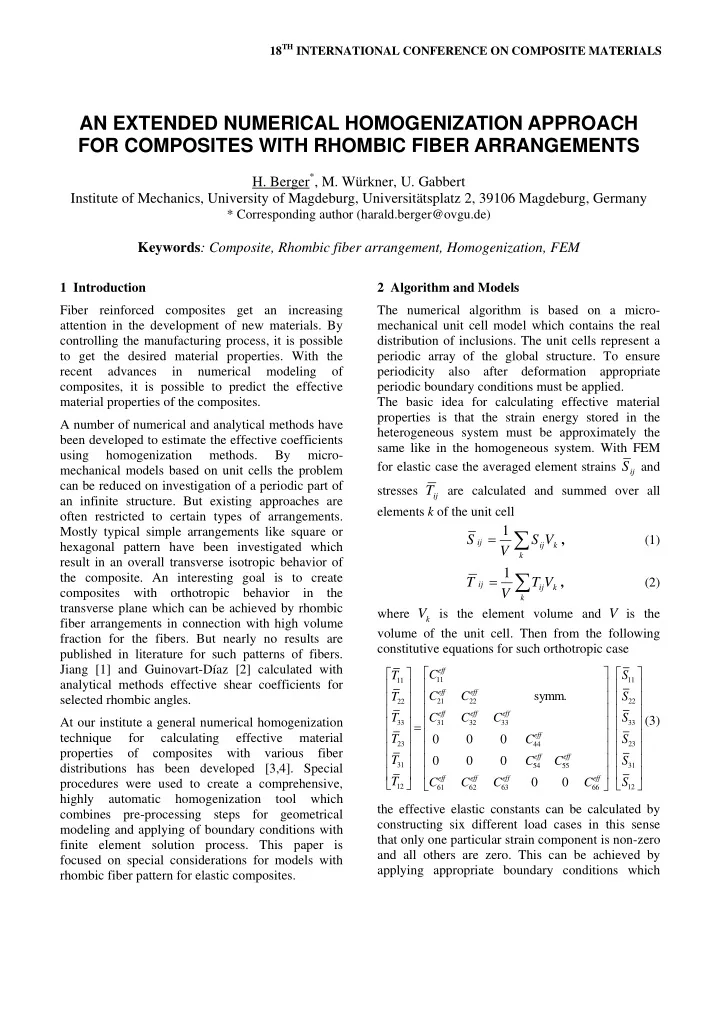
Mostly typical simple arrangements like square or S S V , (1) - - PDF document

mostly typical simple arrangements like square or s s v 1
SMART_READER_LITE
LIVE PREVIEW

Mostly typical simple arrangements like square or S S V , (1) - - PDF document

18 TH INTERNATIONAL CONFERENCE ON COMPOSITE MATERIALS AN EXTENDED NUMERICAL HOMOGENIZATION APPROACH FOR COMPOSITES WITH RHOMBIC FIBER ARRANGEMENTS H. Berger * , M. Wrkner, U. Gabbert Institute of Mechanics, University of Magdeburg,


slide-1
SLIDE 1

18TH INTERNATIONAL CONFERENCE ON COMPOSITE MATERIALS

1 Introduction Fiber reinforced composites get an increasing attention in the development of new materials. By controlling the manufacturing process, it is possible to get the desired material properties. With the recent advances in numerical modeling

  • f

composites, it is possible to predict the effective material properties of the composites. A number of numerical and analytical methods have been developed to estimate the effective coefficients using homogenization methods. By micro- mechanical models based on unit cells the problem can be reduced on investigation of a periodic part of an infinite structure. But existing approaches are

  • ften restricted to certain types of arrangements.

Mostly typical simple arrangements like square or hexagonal pattern have been investigated which result in an overall transverse isotropic behavior of the composite. An interesting goal is to create composites with orthotropic behavior in the transverse plane which can be achieved by rhombic fiber arrangements in connection with high volume fraction for the fibers. But nearly no results are published in literature for such patterns of fibers. Jiang [1] and Guinovart-Díaz [2] calculated with analytical methods effective shear coefficients for selected rhombic angles. At our institute a general numerical homogenization technique for calculating effective material properties

  • f

composites with various fiber distributions has been developed [3,4]. Special procedures were used to create a comprehensive, highly automatic homogenization tool which combines pre-processing steps for geometrical modeling and applying of boundary conditions with finite element solution process. This paper is focused on special considerations for models with rhombic fiber pattern for elastic composites. 2 Algorithm and Models The numerical algorithm is based on a micro- mechanical unit cell model which contains the real distribution of inclusions. The unit cells represent a periodic array of the global structure. To ensure periodicity also after deformation appropriate periodic boundary conditions must be applied. The basic idea for calculating effective material properties is that the strain energy stored in the heterogeneous system must be approximately the same like in the homogeneous system. With FEM for elastic case the averaged element strains

ij

S and

stresses

ij

T are calculated and summed over all

elements k of the unit cell

k k ij ij

V S V S

 1

, (1)

k k ij ij

V T V T

 1

, (2) where

k

V is the element volume and V is the

volume of the unit cell. Then from the following constitutive equations for such orthotropic case

11 11 21 22 22 33 31 32 33 23 44 31 12

symm. 0 0 0                     

eff eff eff eff eff eff ef

C T C C T T C C C T C T T

11 22 33 23 31 54 55 12 61 62 63 66

0 0 0 0 0                                        

f eff eff eff eff eff eff

S S S S S C C S C C C C (3) the effective elastic constants can be calculated by constructing six different load cases in this sense that only one particular strain component is non-zero and all others are zero. This can be achieved by applying appropriate boundary conditions which

AN EXTENDED NUMERICAL HOMOGENIZATION APPROACH FOR COMPOSITES WITH RHOMBIC FIBER ARRANGEMENTS

  • H. Berger*, M. Würkner, U. Gabbert

Institute of Mechanics, University of Magdeburg, Universitätsplatz 2, 39106 Magdeburg, Germany

* Corresponding author (harald.berger@ovgu.de)

Keywords: Composite, Rhombic fiber arrangement, Homogenization, FEM

slide-2
SLIDE 2

produce pure tension and pure shear. E.g., for the calculation of

eff

C11 only

11

S

may be non-zero. Then

eff

C11 can be calculated from first row of constitutive

equations by the ratio of

11 11

/ T S and

21 eff

C

from the second row by the ratio of

22 11

/ T S

and analogous

31 eff

C

  • etc. Because the effective coefficients are

calculated in the global coordinate system x1-x2, which is not identical with the principal axes of the rhombus we get also non-zero coefficients

54 61 62 63

, , ,

eff eff eff eff

C C C C

. All calculations have been made with FE package ANSYS which provides with the included ANSYS Parametric Design Language (APDL) a convenient

  • pen interface for user specified input scripts.

In our approach we extract a unit cell like shown in

  • Fig. 1. To calculate all coefficients for the three

dimensional case a 3D FE model is used with one element in third direction (Fig. 2).

x1 x2

  • Fig. 1. Rhombic fiber arrangement and unit cell
  • Fig. 2. 3D finite element model of unit cell

The problem lies in the non rectangular geometry of the cell which arises problems in applying appropriate loads and periodic boundary conditions. Especially for the case of pure tension in x1 direction applying only traction forces results in additional shear strain. To overcome this problem modified loads are applied for this case which include a shear part to compensate the unwanted shear strains. To produce the non-zero strains for every load case displacement differences are applied between

  • pposite surfaces of the cell.

In particular to produce pure normal strains we apply: load case 1: non-zero strain

11

S :

1 1

1 1

 

 

X X

u u u and

2 2

1 1

cos( )

 

    

X X

u u u a

load case 2: non-zero strain

22

S

:

2 2

2 2

 

 

X X

u u u ,

load case 3: non-zero strain

33

S

:

3 3

3 3

 

 

X X

u u u

and for pure shear strains: load case 4: non-zero strain

23

S

:

3 3

2 2

 

 

X X

u u u ,

load case 5: non-zero strain

31

S

:

3 3

1 1

 

 

X X

u u u ,

load case 6: non-zero strain

12

S

:

2 2

1 1

 

 

X X

u u u .

Here u is an arbitrary non-zero value. For simplicity

1  u

is chosen. The values

 k

X i

u

and

 k

X i

u

are the i-th displacement components on unit cell boundary surfaces

 k

X

and

 k

X like shown in

  • Fig. 3. a and  which appear in load case 1 are the

base length of the unit cell and the rhombic angle, respectively.

X X X x x x X X X

1 2 1 2 3 1 2 3 3 +

  • +
  • +
  • Fig. 3. Notation of unit cell surfaces

To ensure the full periodicity in every load case all remaining displacement differences are set to zero. To apply these displacement differences opposite nodal pairs are coupled by appropriate constraint

  • equations. For that a special meshing procedure

ensures identical mesh configurations on opposite

  • surfaces. To avoid rigid body movement one

arbitrary node must be fixed in all directions. We used the corner node at origin of coordinate system. With the extension for load case 1 the numerical homogenization algorithm can also be used for composites with parallelogram fiber arrangement.

slide-3
SLIDE 3

3 AN EXTENDED NUMERICAL HOMOGENIZATION APPROACH FOR COMPOSITES WITH RHOMBIC FIBER ARRANGEMENTS

3 Results For testing the algorithm and comparison with results from literature isotropic material properties were used with a high stiffness ratio of 120 between fiber and matrix [1]. In particular the material constants listed in Table 1 were chosen. Table 1: Material constants for the components

Young's modulus Poisson's ratio Matrix 2.6 GPa 0.3 Fiber 312 GPa 0.3

For general verification of the algorithm the results were compared with Jiang [1] who presented values for rhombic angles of 45 and 75 degrees and different volume fractions (see Tables 2 and 3). A very good agreement was found. Table 3: Comparison of shear coefficients with Jiang for rhombic angle of 45 degrees

Vol. frac. C44 Jiang C44 FEM C54 Jiang C54 FEM C55 Jiang C55 FEM 0.1 1.223 1.227 ‐0.005 ‐0.005 1.214 1.217 0.2 1.516 1.526 ‐0.024 ‐0.025 1.468 1.476 0.3 1.922 1.937 ‐0.071 ‐0.071 1.780 1.791 0.4 2.533 2.547 ‐0.177 ‐0.174 2.180 2.185 0.5 3.621 3.641 ‐0.441 ‐0.446 2.738 2.749

Table 3: Comparison of shear coefficients with Jiang for rhombic angle of 75 degrees

Vol. frac. C44 Jiang C44 FEM C54 Jiang C54 FEM C55 Jiang C55 FEM 0.1 1.218 1.220 0.001 0.001 1.219 1.220 0.2 1.488 1.493 0.007 0.007 1.492 1.497 0.3 1.834 1.846 0.020 0.020 1.844 1.857 0.4 2.295 2.318 0.047 0.049 2.320 2.344 0.5 2.952 2.994 0.106 0.109 3.009 3.051 0.6 4.001 4.087 0.238 0.251 4.129 4.224

To study the overall behavior of such composites all coefficients where calculated for a rhombic angle range from 30 to 90 degrees and for various volume fractions.

  • Fig. 4 shows pairs of selected effective elastic

coefficients over change of rhombic angle. It can clearly be seen that for low rhombic angles a typical

20 30 40 50 60 70 80 90 100 6.0 8.0 10.0 12.0 14.0 16.0 18.0 Rhombic angle [°] C11, C22 [GPa] C11 C22 20 30 40 50 60 70 80 90 100 2.0 2.5 3.0 3.5 4.0 4.5 5.0 5.5 6.0 Rhombic angle [°] C44, C55 [GPa] C44 C55 20 30 40 50 60 70 80 90 100

  • 4.0
  • 3.0
  • 2.0
  • 1.0

0.0 1.0 Rhombic angle [°] C61, C62 [GPa] C61 C62

  • Fig. 4. Orthotropic behavior in transverse plane for

selected effective elastic coefficients vs. change of rhombic angle with fixed fiber volume fraction of 0.4

slide-4
SLIDE 4

0.1 0.2 0.3 0.4 0.5 0.6 0.7 4.0 6.0 8.0 10.0 12.0 Volume fraction C11 [GPa] angle 30° angle 50° angle 70° 0.1 0.2 0.3 0.4 0.5 0.6 0.7 40.0 60.0 80.0 100.0 120.0 140.0 160.0 180.0 200.0 Volume fraction C33 [GPa] angle 30° angle 50° angle 70° 0.1 0.2 0.3 0.4 0.5 0.6 0.7 1.0 1.5 2.0 2.5 3.0 3.5 4.0 4.5 Volume fraction C66 [GPa] angle 30° angle 50° angle 70°

  • Fig. 5. Behavior of selected effective elastic

coefficients vs. change of volume fraction for three rhombic angles

  • rthotropic behavior in the transverse plane is
  • bviously. Furthermore the special cases for 60

degrees (hexagonal arrangement) and 90 degrees (square arrangement) show the typical transverse isotropic behavior. This can be seen by identical values of both coefficients in every plot. In Fig. 5 the behavior of selected coefficinets is shown over volume fraction and for three different rhombic angles. Due to geometry of rhombus the maximum volume fractions depends on the rhombic

  • angle. E.g. for rhombic angle of 30 degrees only a

volume fraction until 0.4 can be reached. The second plot shows obviously that this axial coefficient is independent of rhombic angle. In the third plot it is interesting that with lower rhombic angle a higher in-plane shear stiffness can be reached. 4 Conclusions A comprehensive tool for calculating effective material constants is introduced. Especially it is applied to composites with included fibers by rhombic arrangement. With this approach the excellent orthotropic behavior in transverse plane of such composites can be exhibited. References

[1] C.P. Jiang, Y.L. Xu, Y.K. Cheung and S.H. Lo “A rigorous analytical method for doubly periodic cylindrical inclusions under longitudinal shear and its application”. Mech. of Mat., Vol. 36, No. 3, pp 225– 237, 2004. [2] Guinovart-Díaz, R., López-Realpozo, J.C., Rodríguez-Ramos, R., Bravo-Castillero, J., Ramírez, M., Camacho-Montes, H., Sabina, F.J.: Influence of parallelogram cells in the axial behaviour of fibrous

  • composite. Int. J. Eng. Sci., Vol. 49, 75-84, 2011.

[3] H. Berger, S. Kari, U. Gabbert, R. Rodriguez-Ramos,

  • J. Bravo-Castillero and R. Guinovart-Diaz “A

comprehensive numerical homogenisation technique for calculating effective coefficients of piezoelectric fibre composites”. Mat. Sci. and Eng. A, Vol. 412,

  • No. 1-2, pp 53-60, 2005.

[4] Würkner, M., Berger, H., Gabbert, U.: On numerical evaluation of effective material properties for composite structures with rhombic fiber

  • arrangements. Int. J. Eng. Sci., Vol. 49, pp 322-332,

2011.