More work for Robin Supplementary Handout Ernie Manes, Halifax, - - PDF document

more work for robin supplementary handout ernie manes
SMART_READER_LITE
LIVE PREVIEW

More work for Robin Supplementary Handout Ernie Manes, Halifax, - - PDF document

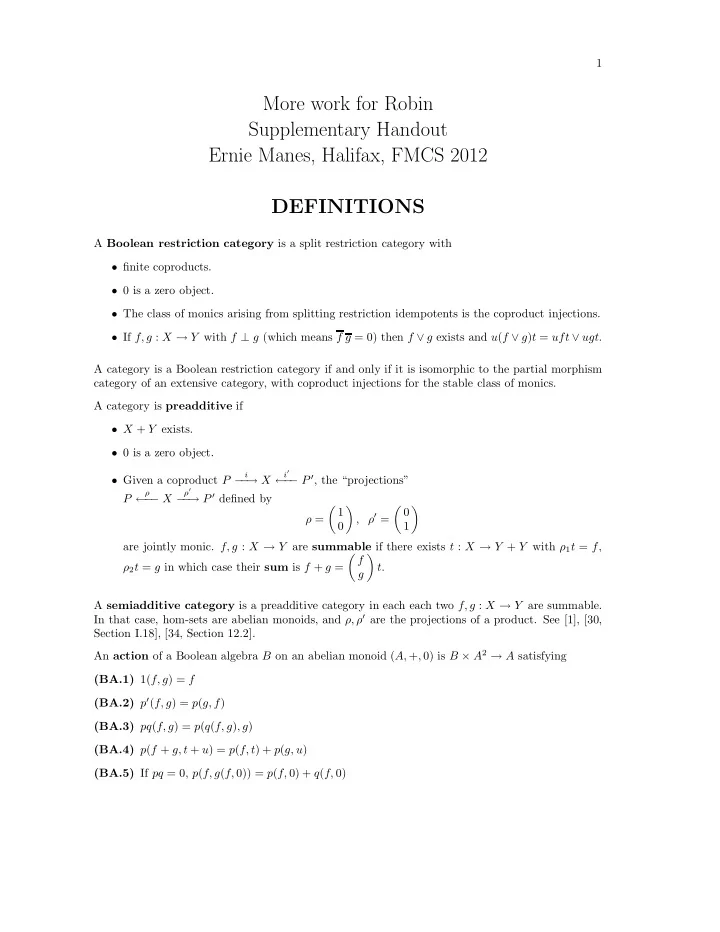
1 More work for Robin Supplementary Handout Ernie Manes, Halifax, FMCS 2012 DEFINITIONS A Boolean restriction category is a split restriction category with finite coproducts. 0 is a zero object. The class of monics arising from


slide-1
SLIDE 1

1

More work for Robin Supplementary Handout Ernie Manes, Halifax, FMCS 2012 DEFINITIONS

A Boolean restriction category is a split restriction category with

  • finite coproducts.
  • 0 is a zero object.
  • The class of monics arising from splitting restriction idempotents is the coproduct injections.
  • If f, g : X → Y with f ⊥ g (which means f g = 0) then f ∨ g exists and u(f ∨ g)t = uft ∨ ugt.

A category is a Boolean restriction category if and only if it is isomorphic to the partial morphism category of an extensive category, with coproduct injections for the stable class of monics. A category is preadditive if

  • X + Y exists.
  • 0 is a zero object.
  • Given a coproduct P

i

− − → X

i′

← − − P ′, the “projections” P

ρ

← − − X

ρ′

− − → P ′ defined by ρ =

  • 1
  • , ρ′ =
  • 1
  • are jointly monic. f, g : X → Y are summable if there exists t : X → Y + Y with ρ1t = f,

ρ2t = g in which case their sum is f + g = f g

  • t.

A semiadditive category is a preadditive category in each each two f, g : X → Y are summable. In that case, hom-sets are abelian monoids, and ρ, ρ′ are the projections of a product. See [1], [30, Section I.18], [34, Section 12.2]. An action of a Boolean algebra B on an abelian monoid (A, +, 0) is B × A2 → A satisfying (BA.1) 1(f, g) = f (BA.2) p′(f, g) = p(g, f) (BA.3) pq(f, g) = p(q(f, g), g) (BA.4) p(f + g, t + u) = p(f, t) + p(g, u) (BA.5) If pq = 0, p(f, g(f, 0)) = p(f, 0) + q(f, 0)

slide-2
SLIDE 2

2 A McCarthy algebra is (M, ∨, ∧, (·)′, 0, 2) subject to (M.1) x′′ = x (M.2) (x ∧ y)′ = x′ ∨ y′ (M.3) (x ∧ y) ∧ z = x ∧ (y ∧ z) (M.4) x ∧ (y ∨ z) = (x ∧ y) ∨ (x ∧ z) (M.5) (x ∨ y) ∧ z = (x ∧ z) ∨ (x′ ∧ y ∧ z) (M.6) x ∨ (x ∧ y) = x (M.7) (x ∧ y) ∨ (y ∧ x) = (y ∧ x) ∨ (x ∧ y) (M.8) 0 ∧ x = x, 2 ∧ x = 2 (M.9) 2′ = 2, 0′ ∧ 2 = 2, 0 ∧ 2 = 0 The McCarthy algebra 3 = {0, 1, 2} with x x′ x ∧ y 1 2 x ∨ y 1 2 1 1 2 1 1 1 2 1 1 1 1 2 2 2 2 2 2 2 2 2 2 generates the variety of McCarthy algebras, so truth-table analysis in 3 can be used to verify any potential equation of McCarthy algebras. 3 is the only subdirectly irreducible McCarthy algebra (as defined below). Let B be a Boolean algebra. Let MB be the set of all pairs (p, q) with p, q ∈ B, p ∧ q = 0. Define = (0, 1) 2 = (0, 0) (p, q)′ = (q, p) (p, q) ∧ (r, s) = (p ∧ q, q ∨ (p ∧ s)) (p, q) ∨ (r, s) = (p ∨ (q ∧ r), q ∧ s) Then MB is a McCarthy algebra. The origin of the idea is simple. There is a natural bijection between 3I and pairs of disjoint subsets

  • f I via

I

f

− − → 3 → (f−10, f−11) The formulas above are the transport of the pointwise operations in 3I. A subdirect embedding of algebra A in a family B of algebras is a subalgebra A → Bi with all Bi ∈ B and all A → Bi

prj

− − − − → Bj surjective. A is subdirectly irreducible if |A| > 1 and A admits no non-trivial subdirect embedding, i.e. if A → Bi is subdirect, some A → Bi

prj

− − − − → Bj is an isomorphism.

slide-3
SLIDE 3

3 In 1935, Garrett Birkhoff proved: Proposition A is subdirectly irreducible if and only if the intersection of all non-diagonal congru- ences on A is again non-diagonal. Proof idea If R is the set of all non-diagonal congruences, consider the canonical map A →

  • R∈R A/R.

Algebra A is primal if A is finite with at least two elements and is such that for all n > 0, every function An → A is the interpretation of some term. It is well known, indeed is a staple of electrical engineering, that 2 is primal in the variety of Boolean algebras. Theorem (Krauss, 1942) Let P be a primal algebra.

  • Each finite algebra in the variety V ar(P) generated by P is isomorphic to P m for some m.
  • P is the only primal algebra in V ar(P).
  • Two varieties each generated by a primal algebra of the same cardinality are isomorphic.

EXERCISES

  • 1. In a Boolean restriction category B, show that B is preadditive, and that f, g : X → Y are

summable if and only if f ⊥ g, i.e. f g = 0. If f, g are summable show that f + g = f ∨ g.

  • Hint. Show ρ1 ⊥ ρ2 and that t = in1f ∨ in2g. You will need some basic facts from Cockett

and Manes 2009.

  • 2. A semigroup is left zero if xy = x and right zero if xy = y. In a semigroup, two of Green’s

relations are x L y if there exists t, u with tx = y and uy = x; x R y if there exists t, u with xt = y, yu = x. Prove that the following statements are equivalent (these define a rectangular band). (a) xyx = x (b) x2 = x, xyz = xz (c) x L y ⇔ x = xy ; x R y ⇔ y = xy (d) If xy = yx then x = y. (e) S ∼ = L × R with L left zero and R right zero.

  • Hints. For (a)⇒(b), xyz = xy(zxz) = .... For (b)⇒(c), if x = ty then x = xy and y = yx. For

(d)⇒(e), L and R are semigroup congruences (true here, but not generally in a semigroup). The canonical map X → X/L × X/R is an isomorphism. To prove surjective, given x, y one has x R xy Ly.

  • 3. Let B be a Boolean algebra acting on an abelian monoid. Prove the following.

(a) Each p ∈ B is total, that is, p(f, f) = f. (b) Defining pf = p(f, 0), show p(f, g) = pf + p′g. (c) p(·, ·) is a rectangular band. (d) Say that binary operations a, b commute if a(b(f, g), b(t, u)) = b(a(f, t), a(g, u)). Show that p(·, ·) and q(·, ·) commute for every p, q ∈ B.

slide-4
SLIDE 4

4

  • 4. Let A be an abelian semigroup.

(a) Show that x ≤ y if x2 = xy is a partial order if and only if x2 = xy = y2 ⇒ x = y. (b) Suppose further that ∀ x ∈ A ∃ n > 1 xn = x. Show that A is an inverse semigroup whose restriction order (under the restriction x = x−1x) coincides with x2 = xy as above.

  • 5. For P

i

− − → X

j

← − − Q a coproduct in a category X, define maps ifY

PQ(f, g) by

X Y ✲ f P X ✲ i ❄ i ❄ ifY

PQ(f, g)

X ✛ g Q ✛ j ❄ j (a) Show that each ifY

PQ is a rectangular band and that ifY PQ is natural in Y

X(X, ·) × X(X, ·) → X(X, ·) (b) Assume that X has binary copowers and assume that given a split monic N : X → X +X the pullbacks X X + X ✲ in1 P X ✲ i ❄ i1 ❄ N X ✛ in2 Q ✛ j ❄ j1 exist with the top row a coproduct. For fixed X, let I : X(X, ·) × X(X, ·) → X(X, ·) be a natural transformation which is pointwise a rectangular band. Show that a coproduct P

i

− − → X

j

← − − Q exists with I = ifPQ. Hint. I corresponds to a map N : X → X + X by Yoneda. By rectangular band, the codiagonal X + X → X is a common splitting of in1 and N so that i = i1, j = j1. A Boolean ring is a ring (not necessarily with unit) in which x2 = x. Thus a Boolean algebra is a Boolean ring with unit –finite subsets of an infinite set is a Boolean ring which is not a Boolean algebra. 6. (a) Show that a Boolean ring is commutative with −x = x. Hint. Consider (x + y)2 = x + y. (b) For R a Boolean ring, y ∈ R, show that Ry = {xy + x : y ∈ R} is a subring. (c) Show that 2 is the only subdirectly irreducible Boolean ring. Hint. Suppose 0 < x < y in R. Then ψ : R → [0, y] × Ry, ψx = (xy, xy + x) is a subdirect embedding.

  • 7. A 3-ring is a commutative ring satisfying 3x = 0, x3 = x. In a 3-ring, prove the identity

x = 1 + (x − x2) + ((x + 2)2 − (2 + x)) Conclude that every element is the sum of three idempotents.

slide-5
SLIDE 5

5

  • 8. Show directly from the axioms on a McCarthy algebra that the following duality principle holds:

given any true equation of McCarthy algebras, the equation resulting from interchanging ∧ and ∨ also remains true.

  • 9. In a McCarthy algebra M, define x + y = (x ∧ y′) ∨(x′ ∧ y). (In a Boolean algebra, this would

be symmetric difference; here, the order of x, y′ and x′, y is crucial). Show that (M, +, 0) is an abelian monoid and that x ∧ (y + z) = (x ∧ y) + (x ∧ z).

  • 10. Let M be a McCarthy algebra. For a ∈ M define x θa y to mean a ∧ x = a ∧ y.

Define [0, a] = {a ∧ x : x ∈ M}. (a) Show that θa is a congruence. Hint. Use a ∧ (a′ ∨ x) = x. (b) Show that θa is nontrivial if and only if 0 = a = 1. (c) Show that the composition [0, a] ⊂ M → M/θa is a bijection, rendering [0, a] a McCarthy algebra with the same 0, ∧, ∨ and with complement a ∧ x′ and 2 = a ∧ 2.

  • 11. Prove that a primal algebra P has no nontrivial subalgebras or quotient algebras. Hints. If

S were a nontrivial subalgebra, consider a function P → P not mapping S into itself. If R is a congruence with x Ry but x = y and if u, v ∈ P are arbitrary, consider f : P → P with fx = u, fy = v.

  • 12. Prove that every finite McCarthy algebra is a subalgebra of MB for some finite Boolean

algebra B. Hint. By the proof of Birkhoff’s theorem above, each finite algebra is subdirectly embeddable in a finite product of subdirect irreducibles. If B = 2n then MB = 3n.

CHALLENGES FOR RESTRICTION CATEGORIES

Restriction categories abstract the category Pfn of sets and partial functions, the natural universe in which to discuss deterministic computation. When one is willing to allow multithreaded compu- tation in which one input may give eventual rise to different outputs, it is usually assumed without much thought that Pfn generalizes to Rel, the category of sets and relations. Just as Pfn is the springboard example for restriction categories, Rel motivates and abstracts to allegories [13]. Like restriction categories, allegories are a varietal extension of category theory, that is, result from the first order theory of categories by adding finitary operations and equations. A category can be a re- striction category or an allegory in different ways. (Note, however, that a category can be a Boolean restriction category in at most one way). For allegories, there are two new operations, intersection of relations and the unary R◦ = {(y, x) : (x, y) ∈ R} so that R◦ : Y → X if R : X → Y . I argue, now, that enlarging a restriction category to an allegory is often too big a jump. Consider the unique total function f : I N → 1. Then f◦ : 1 → I N maps one value to all natural numbers, and this seems far-fetched in a “typical” nondeterministic computational setting. The tutorial talk discussed another reason to enlarge to a semiadditive category, namely to expand a network into a sum of paths. Here, it is not crucial that sum be always defined since only certain sums are needed, but this does allow a universal-algebraic description by building on abelian monoids as opposed to partial abelian monoids. Challenge 1: Given a restriction category X, find a “non-deterministic completion” X which is semiadditive and as “computationally viable” as X was.

slide-6
SLIDE 6

6 Such X should at least be a support category (i.e. the fourth restriction axiom g f = fgf which expresses that f is deterministic is weakened to the axiom of support that g f = gf) in which X is embedded so as to preserve f. Now Rel has support R = 1 ∩ R◦R = {(x, x) : ∃ y xRy} and Pfn ⊂ Rel preserves f. The principal

  • bjection is lack of computational viability.

Notice that the partial order R ≤ S if SR = R is not subset inclusion but is rather the extension

  • rdering of the restriction category Pfn thinking of a relation from X to Y as a partial function

from X to the nonempty subsets of Y . Let X be a locally small preadditive category. An ideal I ⊂ X(X, Y ) satisfies 0 ∈ I and, for summable f, g : X → Y , f, g ∈ I ⇔ f + g ∈ I. Every intersection of ideals again is, so let I(A) be the ideal generated by A ⊂ X(X, Y ). Let X(X, Y ) be the set of all finitely generated ideals in X(X, Y ). [25, Theorem 13.14] proves the following facts.

X is a Boolean category (see the “footnote on Boolean categories” below), with composition well defined by I(B) ◦ I(A) = I(BA).

  • X →

X, f → I(f) is an embedding.

  • If P

i

− − → X

i′

← − − P ′ is a coproduct in X with projections P

ρ

← − − X

ρ′

− − → P ′ then P

I(i)

− − − − → X

I(i′)

← − − − − P ′ is a coproduct in X and P

I(ρ)

← − − − − X

I(ρ′)

− − − − → P ′ is a product in

  • X. It follows that
  • X is a semiadditive category. I(A) + I(B) = I(A ∪ B) so that the abelian monoid hom-sets

are semilattices.

  • Every Boolean functor X → Y with Y a Boolean semiadditive category whose hom-sets are

semilattices uniquely extends to X as a Boolean functor. Next observe that no restriction category can be its own completion: Exercise 1A Show that if a semiadditive support category satisfies 0 = 0 for all zero morphisms and is nontrivial in that some morphism is not 0, then the support cannot be a restriction. Hints. Apply the matrix calculus available in any semiadditive category. For f, g : X → Y consider X (1 1) − − − − − − − → X + X

  • f

g

− − − → Y . Show that

  • f

g

  • =
  • f

g

  • . Show that the fourth restriction

axiom for the maps above leads to the conclusion that f = f + g = g. Say that a relation R : X → Y is bounded-valued (bv) if there exists an integer n such that ∀ x |{y : (x, y) ∈ R}| ≤ n. The least such n is written R. Given S : Y → Z with R, S bv, SR is also bv and SR ≤ S R. Exercise 1B For a relation R : X → Y show that the following are equivalent.

  • 1. R is bv.
  • 2. R is a finite union of partial functions.
  • 3. There exists a finitely generated ideal I ⊂ Pfn(X, Y ) with R = I.

(As Pfn is a Boolean restriction category, it is preadditive by Exercise 1, so ideals make sense). Hint. Show for any Boolean restriction category that I(f1, ..., fn) = {g1∨· · ·∨gn : gi ⊥ gj if i = j, gi ≤ fi} By the second condition above, bv-relations are “computationally viable”.

slide-7
SLIDE 7

7 Exercise 1C Use the previous exercise to show that Pfn is the subcategory of Rel of all bv-relations, and is a support subcategory of Rel. Hints. One must prove I(A) = I(B) ⇒ I(A) = I(B). To that end, write I(B) = I(c1, . . ., cn) with the ci pairwise disjoint. For a ∈ A, partition its domain into the (possibly empty) blocks X1, . . ., Xn with Xi = {x : ax = cix} to conclude that a is a disjoint supremum of elements of I(B). We note that for X any Boolean restriction category, the support in X is well defined by I(A) = I({a : a ∈ A}). In any poset P with least element 0, say that x ∈ P is a Boolean element if ↓x = {y : y ≤ x} is a Boolean algebra. Say that P is Boolean generated if every element is a finite supremum of Boolean elements. Exercise 1D Show that X(X, Y ) is a Boolean generated distributive lattice for any Boolean restric- tion category X. In any support category, say that a morphism f : X → Y is deterministic if for all g : Y → Z, g f = f gf. The subcategory of deterministic morphisms is always a restriction category. For X a Boolean restriction category, all morphisms in X are deterministic in

  • X. When X = Pfn, all

deterministic bv-relations are indeed partial functions. Open Problem I For which Boolean restriction categories X does X coincide with the deterministic morphisms in X? Another semiadditive completion of Pfn is finite-valued relations. Unlike bv-relations, this is the Kleisli category of a submonad of the power set monad. Of course, the universal property of the ideal completion is lost. Open Problem II Is there a general construction to complete a Boolean restriction category to a semiadditive Kleisli category for a monad on its total morphism category, which specializes to finite-valued relations when the category is Pfn? An important source of examples of Boolean restriction categories is the partial morphism category

  • f a Boolean topos, since such a topos is an extensive category in which every monic is a coproduct
  • injection. The category of all relations over any topos is a tabular allegory with a number of nice

properties [13]. Challenge 2: Toward a theory of restriction allegories. We work in a split restriction category X with binary restriction products. If we can embed X in an allegory in which two relations have a union, a suitable subcategory could provide a useful semiadditive completion. The challenge is to define a restriction allegory with axioms (RA.1), (RA.2), ... of which is first is (RA.1) Given a restriction idempotent R : X × Y → X × Y there exists a least e : Y → Y (in the restriction order) with Y Y ✲ e X × Y X × Y ✲ R ❄ prY ❄ prY ≥ Note that e in (RA.1) is a restriction idempotent since idY prY ≥ prY R ⇒ e ≤ idY .

slide-8
SLIDE 8

8 Definition A relation X ⇁ Y is a restriction idempotent X×Y → X×Y . Relation composition S ◦ R : X ⇁ Z given R : X ⇁ Y , S : Y ⇁ Z is defined by (RA.1): X × Y × Z X × Y × Z ✲ R × 1 X × Y × Z ✲ 1 × S X × Z X × Z ✲ S ◦ R ❄ prXZ ❄ prXZ ≥ (noting that R × 1, 1 × S, and hence their composition, are restriction idempotents). One routinely checks that this gives the usual notion of relation and relation composition if X is the category Pfn of sets and partial functions. In establishing the tabular allegory of a regular category, it is a mild task to establish the associativity

  • f composition. Here we have:

Exercise 2A Show that relation composition is associative. Hint. Both T ◦ (S ◦ R) and (T ◦ S) ◦ R are induced (via proper placement of parentheses in W × X × Y × Z) by W × X × Y × Z

R×1×1

− − − − − − − → W × X × Y × Z

1×S×1

− − − − − − − → W × X × Y × Z

1×1×T

− − − − − − − → W × X × Y × Z Definition The opposite relation Ro : Y ⇁ X of R : X ⇁ Y is the composition Ro = Y × X ∼ = X × Y

R

− − → X × Y ∼ = Y × X That Ro is a restriction idempotent is immediate from the next exercise. Exercise 2B In any restriction category, given a commutative square Y Z ✲ q W X ✲ p ❄ f ❄ f with p = p and f total and epic, necessarily q = q. The restriction idempotents of an object form a meet semilattice. For relations we use the notations R ⊂ S for the restriction ordering RS = R, and R ∩ S for the infimum RS. Exercise 2C Establish the following allegory axioms:

  • Roo = R.
  • (S ◦ R)o = RoSo.
  • (R ∩ S)o = Ro ∩ So.
  • For R : X ⇁ Y , S, T : Y ⇁ Z, S ⊂ T ⇒ S ◦ R ⊂ T ◦ R.
slide-9
SLIDE 9

9 Unaddressed so far is the modular law for R : X ⇁ Y , S : Y ⇁ Z, T : X ⇁ Z, (S ◦ R) ∩ T ⊂ S ◦ (R ∩ (So ◦ T)) This might be true. We haven’t had the fortitude to figure it out because of other aspects currently in limbo. Do we even have a category? How is X embedded in this category once we get one? An obvious axiom to try is what [7] would possibly call the “axiom of discreteness”, namely (RA.2) Given X

i

← − − P

f

− − → Y with i a restriction monic and f total, [i f] : P → X × Y is again a restriction monic. By the Cockett-Lack completeness theorem in [8], the partial morphism category of such [i, f] is precisely X (noting that X is presumed split), so (RA.2) tells us how to embed morphisms in relations. This hopefully also provides identity relations. So far, I have not seen how to show without further axioms that partial morphism composition and relation composition coincide. Note, however, that all works correctly if X = Pfn. Challenge 3: Determine when (RA.1, RA.2) force the split restriction category X with binary restriction products to be ranged. Definition In a restriction category, say that f : X → Y is restriction-surjective if whenever f = X → Q

j

− − → Y with j a restriction monic, j is an isomorphism. Exercise 3A Show that an epic restriction monic is an isomorphism. Conclude that every split epic is restriction-surjective. It comes down to determining when the following axiom is true. (RA.3) Given a pullback X Y ✲ f P Q ✲ g ❄ i ❄ j with f restriction-surjective and j a restriction monic, g is restriction surjective. (RA.3) does not involve relations or restriction products and is conceivably true in any split restric- tion category. One would hope to adapt the proof of [6, Theorem 4.4] to prove this, but so far I haven’t seen how. In the final corollary of this handout, however, we see that (RA.3) does hold for any Boolean restriction category. Exercise 3B Show that a restriction category in which the composition of two restriction-surjectives fails to be restriction-surjective leads to a counterexample to (RA.3). Hint. Consider the idempotent completion. Theorem If (RA.1, RA.2, RA.3) hold, X is a ranged restriction category. Proof By the theory of [6, Section 4.2] it suffices to show that every total morphism factors through a least restriction monic. Given total f : X → Y let X × Y

sf

− − → X

[1 f]

− − → X × Y be the restriction idempotent corresponding to the restriction monic [1 f] and let ef : Y → Y be the least morphism of (RA.1) corrresponding to [1 f] sf with splitting Y

t

− − → Q

j

− − → Y . We will show that f factors through Q an that if f factors through the restriction monic subobject k : R → Y

slide-10
SLIDE 10

10 then Q ⊂ R. As f is total, [1 f]prY = f so (RA.1) gives jtprY ≥ fsf . Then efprY ≥ fsf = fsf = sf = [1 f]sf so [1 f]eff = [1 f]efprY [1 f] = efprY [1 f] ≥ [1 f]sf[1 f] = [1 f]. It follows that eff = sf[1 f]eff ≥ sf[1 f] = idX which gives eff = idX. But then eff = eff = feff = fidX = f. As j = eq(ef, iX), we have unique ψ as in the left triangle below Q Y ✲ j f ❅ ❅ ❅ ❘ X ❄ ψ R Q ✲ k f ❅ ❅ ❅ ❘ X ❄ ϕ (Indeed ψ = X

f

− − → Y

t

− − → Q). Such ψ is total as f is. Now suppose that Q

u

− − → R

k

− − → Q splits a restriction idempotent of Q and that f factors through R so that ϕ exists as in the triangle on the right above. Then idR = R

k

− − → Q

j

− − → X

t

− − → Q

u

− − → R and jkut is a restriction idempotent since jkut = jut = jtut = jt ut. We pause for Exercise 3C For general posets, a monotone injective map need not reflect the order. Show, however, that if j is a monic in a restriction category that jx ≤ jy ⇒ x ≤ y. By this exercise, tprY ≥ ψsf . We have ϕsf = ukϕsf = uψsf = utpryψsf = utprY kϕsf = utprY ϕsf so utprY ≥ ϕsf and tprY = kutprY ≥ kψsf = ψsf . As jt = ef, jt ≤ jkut = j(ku)t ≤ jt (as ku = ku) so jt = jkut. As j is monic and t is epic, ku = idQ. Thus k is split monic and epic, hence an isomorphism. Finally, let S be any restriction monic subobject through which f factors. Then f factors through Q ∩ S. By the argument just given, Q ∩ S = Q so Q ⊂ S as desired. ✷ Footnote on Boolean categories Boolean categories were introduced in [25]. At that time, restriction categories had not yet appeared. We take this opportunity to advocate for the utility of these categories within the restriction framework. Definition A Boolean category satisfies the following axioms. (B.1) Finite coproducts exist. (B.2) The pullback of a coproduct injection along any morphism exists and is again a coproduct injection. (B.3) A coproduct injection pulls back coproducts. (B.4) If X

f

− − → X

f

← − − X is a coproduct, X = 0 is the initial object. In any Boolean category, coproduct injections are monic and Summ(X), the poset of summands –those subobjects of X represented by a coproduct injection– is a Boolean algebra. In any category, say that f : X → Y is deterministic if given a coproduct Q

j

− − → Y

j′

← − − Q′ there exists a coproduct P

i

− − → X

i′

← − − P ′ and a commutative diagram P X ✲ i P ′ ✛ i′ Q Y ✲ j Q′ ✛ j′ ❄ ❄ f ❄

slide-11
SLIDE 11

11 A morphism f in a category with an initial object 0 is null if it factors through 0 and is total if ft null ⇒ t is null. In a Boolean category, the pullback of 0 along f : X → Y is the kernel Ker(f)

  • f f and its Boolean complement in Summ(X) is the domain Dom(f) of f. Here are some basic

results. Theorem [25, 27] For a category X, the following are equivalent.

  • 1. X is a Boolean restriction category.
  • 2. X is a Boolean category for which 0 is a zero object and in which every map is deterministic.
  • 3. X is a Boolean category for which 0 is a zero object and is such that f defined for f : X → Y

by Dom(f) X ✲ i i ❅ ❅ ❅ ❅ ❅ ❘ X ❄ Ker(f) ✛ i′ f

is a restriction. The restrictions in (1, 3) are the same and the total maps are indeed those with f = 1. The next result is immediate from [25, Corollary 12.3]. Theorem A category is extensive if and only if it is a Boolean category in which all morphisms are total and deterministic. It is then quite easy to show that the Cockett-Lack completeness theorem for restriction categories gives Theorem A category is a Boolean restriction category if and only if it is isomorhic to a partial morphism category Par(X, M) with X an extensive category and M its class of coproduct injections. An important tool for the study of any Boolean category B is its Kozen functor K : B → Rel defined by KX = {U : U is an ultrafilter on the Boolean algebra Summ(X)} (U, V) ∈ Kf ⇔ V ∈ V ⇒ <f>V ∈ U where <f > V = ([f]V ′)′ and [f]Q is the pullback. This functor was introduced in [25, Section 11], being adapted from Dexter Kozen’s work [21, 3.8’] on dynamic algebras. K has the following properties:

  • K preserves X + Y and [f]Q.
  • K preserves and reflects 0.
  • K induces a boolean algebra injection Summ(X) → 2KX.
  • K preserves and reflects null morphisms.
  • K preserves and reflects total morphisms.
slide-12
SLIDE 12

REFERENCES 12 Note that, in general, K need not be faithful. Sets and bag-valued functions provides an example, K being the forgetful to Rel. Say that a map f in a category is summand-surjective if it factors through no proper summand of its codomain. In Rel, this is just onto, that is, every element of the codomain is related to at least one element of the domain. The next result didn’t quite make it into [25] so is observed here. Proposition The following hold.

  • K preserves and reflects summand-surjectives.
  • K preserves and reflects deterministic morphisms.

Proof for the first statement, “preserves” is [25, Theorem 11.23], whereas “reflects” is immediate since if f factors X → Q → Y with Q a summand and Kf onto, KQ → KY is onto so that Q = Y . We turn to the second statement. For “preserves”, suppose f : X → Y with Kf not a partial function, so that there exists (U, V), (U, W) ∈ Kf with V = W. By [25, Proposition 12.2], a morphism f in a Boolean category is deterministic ⇔ <f> (Q ∩ Q′) =<f> Q ∩ <f> Q′ ⇔ [f](Q ∪ R) = [f]Q ∪ [f]R. Thus if f is deterministic, choose a summand V with V ∈ B, V ′ ∈ W and observe 0 = <f>0 = <f>(V ∩ V ′) = <f>V ∩ <f>V ′ ∈ U a contradiction. For the converse, suppose Kf is a partial function. Then in 2KX, K([f]Q∪[f]R) = [Kf]Q ∪ [Kf]R = [Kf](Q∪R) = K([f](Q∪R)) so that [f]Q∪[f]R = [f](Q∪R) since KX → 2KX is injective. ✷ Notice that, by the above, the Kozen functor of a Boolean restriction category maps into Pfn. The following illustrates the powerful metatheoretic consequences of the Kozen functor. Corollary In any Boolean category B, given a pullback X Y ✲ f P Q ✲ g ❄ i ❄ j with f deterministic and summand-surjective and Q a summand, g is summand-surjective. Proof In Rel, the pullback is P = {x ∈ X : (x, y) ∈ f ⇒ y ∈ Q}. If f is onto and q ∈ Q, there exists x with (x, q) ∈ f. As f is a partial function such q is unique, so x ∈ P. This shows g is onto as well. Back in B, the argument shows that Kg is onto, so g is summand-surjective. ✷ In a Boolean restriction category, the restriction monics are the coproduct injections, so the restriction- surjectives are just the summand-surjectives. We then immediately have from the theorem of Chal- lenge 3 that Corollary A Boolean restriction category with restriction products satisfying (RA.1), (RA.2) is a ranged restriction category.

References

[1] Jiˇ r´ ı Ad´ amek, Horst Herrlich and George Strecker, Abstract and Concrete Categories, John Wiley, 1990.

slide-13
SLIDE 13

REFERENCES 13 [2] Garrett Birkhoff, On the structure of abstract algebras, Proceedings of the Cambridge Philo- sophical Society 31, 1935, 433–454. [3] Stanley Burris and H. P. Sankappanavar, A Course in Universal Algebra, Springer-Verlag, 1981. [4] Stephen Bloom, Zolt´ an ´ Esik and Ernie Manes, A Cayley theorem for Boolean algebras, Amer- ican Mathematical Monthly 97, 1990, 831–833. [5] Aurelio Carboni, Stephen Lack and R. F. C. Walters, Introduction to extensive and distributive categories, Journal of Pure and Applied Algebra 84, 1993, 145–158. [6] Robin Cockett, Xiuzhan Guo and Pieter Hofstra, Range categories I: general theory, August 2011, to appear. [7] Robin Cockett, Xiuzhan Guo and Pieter Hofstra, Range categories II: towards regularity, August 2011, to appear. [8] Robin Cockett and Stephen Lack, Restriction categories I: categories of partial maps, Theo- retical Computer Science 270, 2002, 223-259. [9] Robin Cockett and Ernie Manes, Boolean and classical restriction categories, Mathematical Structures in Computer Science 19, 2009, 357–416. [10] Alfred Foster, p-rings and their Boolean vector representation, Acta Mathematica 84, 1951, 231–261. [11] Alfred Foster, Generalized “Boolean” theory of universal algebras, part I: subdirect sums and normal representation theorem, Mathematische Zeitscrift 58, 1953, 306–336. [12] Peter Freyd, Abelian Categories: An Introduction to the Theory of Functors, Harper and Row, 1964. [13] Peter Freyd and Andre Scedrov, Categories, Allegories, North-Holland, 1989. [14] George Gr¨ atzer, Universal Algebra, D. Van Nostrand, 1968. [15] Fernando Guzm´ an and Craig Squier, The algebra of conditional logic, Algebra Universalis 27, 1990, 88–110. [16] Tah-Kai Hu, Stone duality for primal algebra theory, Mathematische Zeitschrift 110, 1969, 180–198. [17] E. V. Huntington, Sets of independent postulates for the algebra of logic, Transactions of the American Mathematical Society 5, 1904, 288–309. [18] E. V. Huntington, New sets of independent postulates for the algebra of logic, with special reference to Whitehead and Russell’s Principia Mathematica, Transactions of the American Mathematical Society 35, 1933, 274–304. [19] James S. Johnson and Ernie Manes, On modules over a semiring, Journal of Algebra 15, 1970, 57–67. [20] S. C. Kleene, Introduction to Metamathematics, D. van Nostrand, 1952. [21] Dexter Kozen, A representation theorem for models of *-free PDL, in J. W. de Bakker and

  • J. van Leeuwen (eds.), Automata, Languages and Programming, ICALP ’80, Lecture Notes in

Computer Science 85, Springer-Verlag, 1980, 351–362.

slide-14
SLIDE 14

REFERENCES 14 [22] P. Krauss, On primal algebras, Algebra Universalis 2, 1972, 62–67. [23] A. Mal’cev, On the general theory of algebraic systems (Russian), Mat. Sb. 35, 1954, 3–20. [24] Ernie Manes, Guard modules, Algebra Universalis 21, 1985, 103–110. [25] Ernie Manes, Predicate Transformer Semantics, Cambridge University Press, 1992. [26] Ernie Manes, Adas and the equational theory of if-then-else, Algebra Universalis 30, 1993, 373–394. [27] Ernie Manes, Boolean restriction categories and taut monads, Theoretical Computer Science 360, 2006, 77–95. [28] John McCarthy, A basis for a mathematical theory of computation, in P. Braffort and

  • D. Hirschberg (eds.), Computer Programming and Formal Systems, North-Holland, 1963, 33–

70. [29] N. H. McCoy and D. Montgomery, A representation of generalized Boolean rings, Duke Math- ematics Journal 3, 1937, 455–459. [30] Barry Mitchell, Theory of Categories, Academic Press, 1972. [31] Alden Pixley, Distributivity and permutability of congruence relations in equational classes of algebras, Proceedings of the American Mathematical Society 14, 1963, 105–109. [32] J. Plonka, Diagonal algebras, Fundamenta Mathematicae LVIII, 1966, 309–321. [33] P. C. Rosenbloom, Post algebras I. postulates and general theory, American Journal of Math- ematics 64, 1942, 167–188. [34] Horst Schubert, Categories, Springer-Verlag, 1972. [35] M. Sholander, Postulates for distributive lattices, Canadian Journal of Mathematics III, no. 1, 1951, 28-30. [36] W. Sierpinski, Sur les fonctions des plusieurs variables, Fundamenta Mathematicae 33, 1945, 169–173. [37] Marshall Stone, The theory of representations for Boolean algebras, Transactions of the Amer- ican Mathematical Society 40, 1936, 37–111. [38] A. Tarski, A remark on functionally free algebras, Annals of Mathematics 47, 1946, 163–165.