More Social Issues Impact and Control 1 Questions to Ponder How - - PDF document

more social issues
SMART_READER_LITE
LIVE PREVIEW

More Social Issues Impact and Control 1 Questions to Ponder How - - PDF document

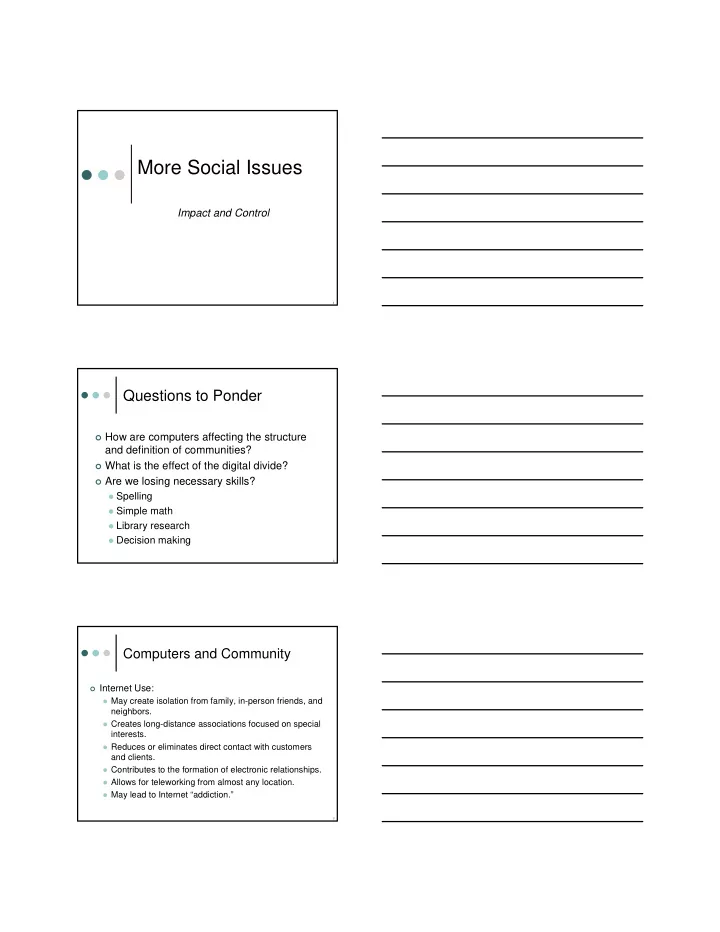
More Social Issues Impact and Control 1 Questions to Ponder How are computers affecting the structure and definition of communities? What is the effect of the digital divide? Are we losing necessary skills? Spelling Simple


slide-1
SLIDE 1

1

More Social Issues

Impact and Control

2

Questions to Ponder

How are computers affecting the structure

and definition of communities?

What is the effect of the digital divide? Are we losing necessary skills? Spelling Simple math Library research Decision making

3

Computers and Community

Internet Use: May create isolation from family, in-person friends, and

neighbors.

Creates long-distance associations focused on special

interests.

Reduces or eliminates direct contact with customers

and clients.

Contributes to the formation of electronic relationships. Allows for teleworking from almost any location. May lead to Internet “addiction.”

slide-2
SLIDE 2

4

Computers and Community

E-commerce vs. Downtown and Community Market Dynamics Issues:

  • What do consumers want?
  • How much are consumers willing to pay?
  • What is the competition?

E-commerce:

  • What draws consumers to purchase products

and services online?

Local Business:

  • What draws customers to purchase products and

services at traditional stores and businesses?

5

Information Haves and Have-Nots

The Digital Divide Factors contributing to access (or lack

thereof) to computers and information systems:

  • Developed country.
  • Individual wealth.
  • Age.
  • Gender.
  • Ethnic background.
  • Politics.

6

Information Haves and Have-Nots

Universal Service Guarantee Universal Access to the Telephone

  • In the 1930s, access to the telephone was deemed

necessary in order to function in society.

  • The Communications Act of 1934 requires telephone

companies to provide telephone service to the poor.

Universal Access to the Net

  • Advocates stress that access to the Net is necessary in order

to function in today’s society.

  • Critics argue that the cost to supply universal access to the

Net for the poor is an unfair and unnecessary burden.

slide-3
SLIDE 3

7

Information Haves and Have-Nots

Trends In Computer Access

  • Declining costs for hardware, software, and connectivity

contribute to greater access.

  • Easier to use and understand.
  • Gender gap has vanished.
  • Age gap is narrowing.
  • Families perceive Web access to be important.
  • Non-white households trail in access.
  • Rural, isolated, or remote regions often have limited

access.

  • Some businesses offer home access as a benefit.
  • Public-access becoming more common.

8

Loss of Skills and Judgment

Writing, Thinking, and Memory Computers Affect the Way We:

  • Write in the form of spell- and grammar-

checkers and desktop publishing.

  • Research due to online archives, periodicals,

and search tools.

  • Think because a vast amount of data is

available, quickly, from all parts of the globe.

  • Communicate using text, graphics, audio, and

video.

9

Loss of Skills and Judgment

Abdicating Responsibility People may rely too much on computers

for decisions about:

  • Approval of loans or insurance coverage.
  • Assessment of student, teacher, and school

administrator progress.

  • The arrest of certain individuals.
  • How to make a particular business decision.
  • The treatment of a disease with a particular

medicine.

slide-4
SLIDE 4

10

Evaluations of the Impact of Computer Technology

The Neo-Luddite View Criticisms of Computer Technology:

  • Causes massive unemployment and deskilling of jobs.
  • We use them because they are there.
  • Causes social inequality.
  • Source of social disintegration; they are dehumanizing.
  • Separates humans from nature and destroys the environment.
  • Benefits big business and big government.
  • Thwarts development of social skills in children.
  • Solves no real human problems.

11

Evaluations of the Impact of Computer Technology

Accomplishments of Technology Some Benefits:

  • Food prices have dropped worldwide.
  • Raw materials are more abundant and prices of natural

resources have declined.

  • Wages and salaries have risen in both rich and poor countries.
  • New substitutes for natural resources have been created.
  • New forms of crop management.
  • Improved transportation of food from field to table.
  • More diseases now treatable or eradicated.
  • Improved, safety-minded products for home, school, and work.

12

Prohibiting Bad Technologies

Q: Is it possible for society to prohibit certain technologies?

slide-5
SLIDE 5

13

Prohibiting Bad Technologies

Choice of Values Technology Advocates

  • People can choose to use a technology for good or ill.
  • Influenced by society, technology does more than it

was designed to do.

  • People adopt technologies that give us more choices

for action and relationships.

Technology Critics

  • Technology is not “neutral.”
  • Big business and governments make decisions about

technology.

  • Once created, technology drives itself.

14

Prohibiting Bad Technologies

The Difficulty of Prediction Guessing the Consequences of Technology

  • How will people use the new technology?
  • How will people benefit from the new technology?
  • Will people like the new technology?
  • How much will people pay for the new

technology?

  • What problems will the technology cause?

15

Prohibiting Bad Technologies

The Difficulty of Prediction (cont’d) Example Objections to Speech-Recognition

Systems

  • “The problem is so enormous that only the largest

computers will ever be able to manage it.”

  • “…a speech-recognition machine is bound to be

enormously expensive,…”

  • “What can it possibly be used for?”
  • “…a long step toward a fully automated battlefield.”
  • Governments can use speech recognition to

increase wiretap efficiency and effectiveness.

slide-6
SLIDE 6

16

Prohibiting Bad Technologies

The Difficulty of Prediction (cont’d) The Decision-Making Process About

Introducing New Technologies Should:

  • Be decentralized and noncoercive.
  • Produce what people want.
  • Work well.
  • Respect the diversity of personal opinions.
  • Be relatively free of political manipulation.

17

The Future???

“The telephone is so important, every city will need one!” —

Anonymous

“My personal desire would be to prohibit entirely the use of alternating

  • currents. They are unnecessary as they are dangerous.” — Thomas

Edison, 1899

“I think there is a world market for maybe five computers.” — Thomas

  • J. Watson, chairman of IBM, 1943

“Computers in the future may... only weigh 1.5 tons.” — Popular

Mechanics, 1949

“There is no reason for any individual to have a computer in their

home.” — Ken Olson, president of Digital Equipment Corp., 1977

“The U.S. will have 220,000 computers by the year 2000.” — Official

forecast by RCA Corporation, 1966. (The actual number was close to 100 million.)