More class design with C++ Class operations are typically - - PDF document

more class design with c
SMART_READER_LITE
LIVE PREVIEW

More class design with C++ Class operations are typically - - PDF document

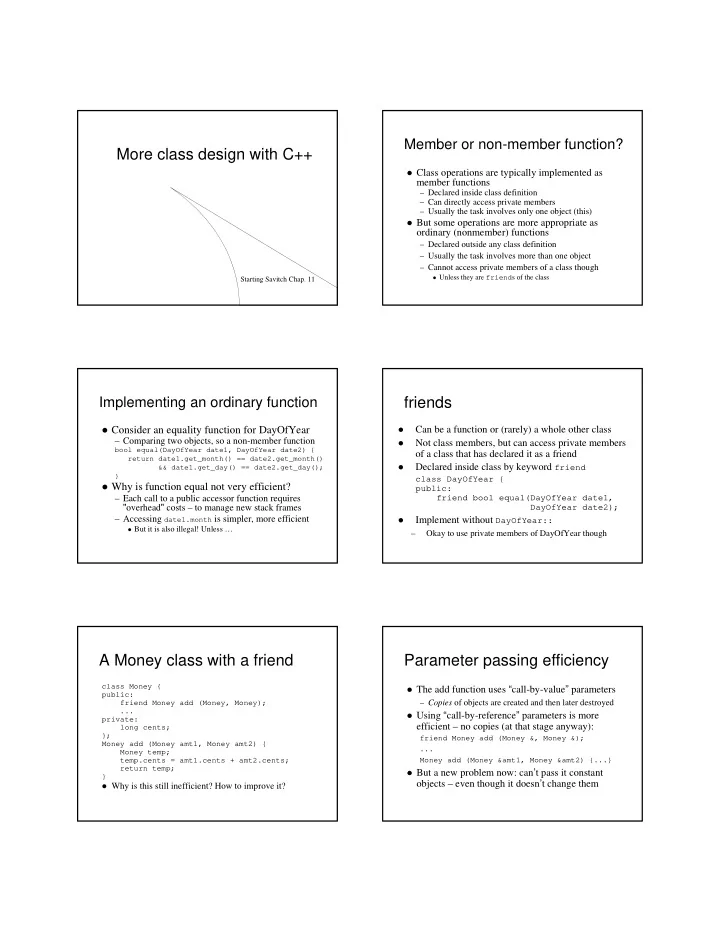
Member or non-member function? More class design with C++ Class operations are typically implemented as member functions Declared inside class definition Can directly access private members Usually the task involves only one


slide-1
SLIDE 1

More class design with C++

Starting Savitch Chap. 11

Member or non-member function?

Class operations are typically implemented as

member functions

– Declared inside class definition – Can directly access private members – Usually the task involves only one object (this)

But some operations are more appropriate as

  • rdinary (nonmember) functions

– Declared outside any class definition – Usually the task involves more than one object – Cannot access private members of a class though

Unless they are friends of the class

Implementing an ordinary function

Consider an equality function for DayOfYear

– Comparing two objects, so a non-member function

bool equal(DayOfYear date1, DayOfYear date2) { return date1.get_month() == date2.get_month() && date1.get_day() == date2.get_day(); }

Why is function equal not very efficient?

– Each call to a public accessor function requires "overhead" costs – to manage new stack frames – Accessing date1.month is simpler, more efficient

But it is also illegal! Unless …

friends

  • Can be a function or (rarely) a whole other class
  • Not class members, but can access private members
  • f a class that has declared it as a friend
  • Declared inside class by keyword friend

class DayOfYear { public: friend bool equal(DayOfYear date1, DayOfYear date2);

  • Implement without DayOfYear::

– Okay to use private members of DayOfYear though

A Money class with a friend

class Money { public: friend Money add (Money, Money); ... private: long cents; }; Money add (Money amt1, Money amt2) { Money temp; temp.cents = amt1.cents + amt2.cents; return temp; }

Why is this still inefficient? How to improve it?

Parameter passing efficiency

The add function uses “call-by-value” parameters

– Copies of objects are created and then later destroyed

Using “call-by-reference” parameters is more

efficient – no copies (at that stage anyway):

friend Money add (Money &, Money &); ... Money add (Money &amt1, Money &amt2) {...} But a new problem now: can’t pass it constant

  • bjects – even though it doesn’t change them
slide-2
SLIDE 2

const

Part of an object’s type in C++ const int x = 12; // must initialize on creation; can never change afterwards someFunction(x); // error if parameter is int& without const Good classes support constant objects: “SCO”

friend Money add (const Money &, const Money &); ... Money add(const Money &amt1, const Money &amt2){…}

But what about amt1.getCents() inside add?

– Answer: won’t compile! Unless getCents() is const too:

long getCents() const; ... long Money::getCents const { return cents; }

Operator function overloading

Example: ADT operator+(const ADT &, const ADT &);

– Overloads + to return an ADT object (hopefully the sum of the two

ADT arguments – best to not change operator’s meaning)

Can overload almost any C++ operator

– At least one argument must be a user-defined type – Precedence, “narity”, and associativity rules apply as usual

e.g., + has usual precedence, is binary or unary, l-r e.g., = has lower precedence, is binary only, r-l

– See other rules on page 629 of the Savitch text

But “just because you can does not mean you should”

– e.g., a bad idea to overload , or && or || even if legal – And should always maintain the expected operator behavior

Operator functions for Money

Replace add function with operator + friend Money operator+ (const Money &, const Money &); ... Money operator+(const Money &amt1, const Money &amt2){ /* same implementation as add */ } Replace equal function with operator == friend bool operator== (const Money &, const Money &); ... bool operator== (const Money &amt1, const Money &amt2) { return amt1.cents == amt2.cents; }

2 ways to use operator functions

Money a(100), b(50); // two Money objects Can add/compare by functional notation: Money sum1 = operator+(a, b); if ( operator==(a, b) ) … // false in this case But now can use infix notation too: Money sum2 = a + b; if ( sum1 == sum2 ) … // true in this case By the way: C++ will try to convert any function

argument to match the parameter type

if ( sum1 == 150 ) … // still true! See next slide.

Implicit type conversion in C++

Converting ctors – e.g., Money(long dollars);

– Any ctor that takes exactly one argument – Invoked whenever an argument of that type is passed to a function that expects an object

In the case on previous slide – 150 converted to Money(150)

Operator conversion functions – inverse idea

– Specify types to which an object may be converted – Say class Money has operator double() const;

Means a Money object can be implicitly converted to

double in certain circumstances, like cout << sum1;

– Better to overload << instead for this purpose though

Member vs. non-member ops

Recall that some functions are more naturally

defined as class members

– Specifically, any function that needs a this pointer:

e.g., ++, +=, … all need to change the object

– And there are four operators that can only be

  • verloaded as class members: =, (), [], and ->

Sometimes non-member functions better though

– e.g., binary functions, where the order of the arguments doesn’t matter:

e.g., ==, <, …, and binary forms of +, -, *, /, %

– Also when must access other types – like << and >> that require access to ostream and istream (cout, cin)

slide-3
SLIDE 3

Overloading << and >>

Want to do: cout << cost << endl;

– Need: friend ostream& operator<<

(ostream& outs, const Money& amount);

...

  • stream& operator<<( ostream& outs, const

Money& amount) { // print to outs (e.g., outs << amount.cents;) return outs; // must return the ostream reference } Want to do: cin >> price >> tax;

– Need: friend istream& operator>>

(istream& ins, Money& amount);

About member operator functions

First argument is this – but it’s hidden

– Always the left argument of binary operations – So there can be no implicit conversion of left argument – must be object of the correct type – Is the only argument of unary operations

Often return *this to allow operation chaining

– e.g., imagine a Money += (compound assignment op)

Money& operator+= (const Money &right); ... Money& Money::operator+= (Money const &right) { return *this = *this + right; } // assuming operator= and operator+ are both already defined

Note: two versions of operator++ and operator-- And usually want two versions of operator[]

Three free member operators

By default, for any class C (even class C {};),

the compiler supplies three member operators

An assignment operator C& operator=(const C &);

– Like a free copy ctor … makes a shallow copy – So often necessary to redefine it to make a deep copy

And two different address-of operators

– One for mutable objects:

C* operator&();

– And one for constant objects:

const C* operator&() const;

– No good reason to redefine either of these functions!

Classes with dynamic memory

Must properly manage – to avoid memory leaks

– C++ does not have an automatic garbage collector – so C++ programmers are responsible for returning memory to the free store

Example class from text (Display 11.11): StringVar ... private: char *value; // pointer to dynamic array of characters

int max_length; //declared max length of array

– Point is to hold/manage a C-string of any length

Second Exam Friday, May 3