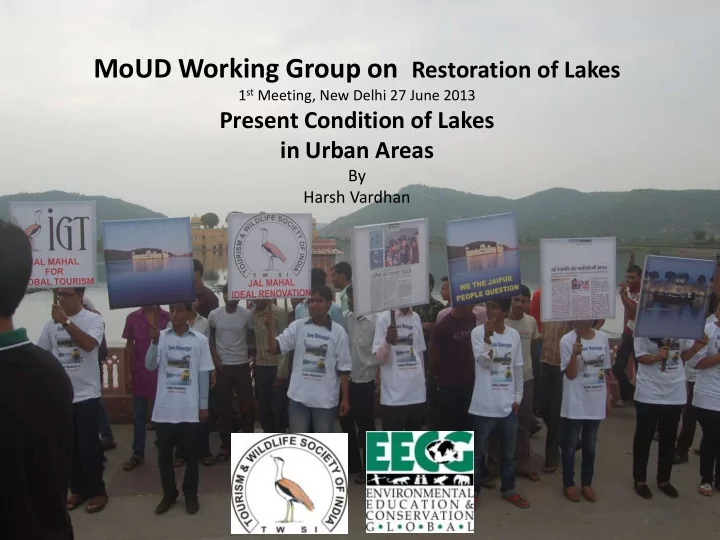
SLIDE 1 MoUD Working Group on Restoration of Lakes
1st Meeting, New Delhi 27 June 2013
Present Condition of Lakes in Urban Areas
By Harsh Vardhan
SLIDE 2
SLIDE 3
Monsoon is stored in (i) “Tanka” (ii) Village ponds “Nadi” (iii) Lakes, etc
SLIDE 4 Let us tour Lakes:
(i) Ambatur lake in Tamil Nadu (ii) Vembanad lake in Kerala (iii) Bangalore lake (iv) Hyderabad lake (v) Kolkatta lake (vi) Bhopal lake (vii) Kota lake (viii) Udaipur lake (ix) Ajmer lake (x) Pushkar lake (xi) Jodhpur lake (xii) Jaisalmer lake (xiii) Dal lake
SLIDE 5
SLIDE 6
SLIDE 7
SLIDE 8
SLIDE 9
SLIDE 10
SLIDE 11
SLIDE 12
SLIDE 13
SLIDE 14
SLIDE 15
SLIDE 16
SLIDE 17
SLIDE 18
- How many lakes in India?
- Dams: 5,100,
- f which 400 under
construction
SLIDE 19
- Who administers lakes?
- MoEF.
- It gave Rs 1,000 to 100+ lakes
- For ‘development’ or ‘conservation’
- How many ‘conserved’?
- Examples of lakes:
- Hyderabad – use of JICA funds
- Bhopal – MoEF funds
- Ajmer – MoEF funds
- Pushkar – MoEF funds
- Udaipur – MoEF funds
SLIDE 20 Reasons for poor performance?
- (i) Lake development treated as an engineering design
- (ii) Lake not treated as the Natural Resource
- (iii) Restoration/conservation not accorded priority
- (iv) Ad hoc works initiated
- (v) Lack of monitoring
- (vi) Stake holders not involved
- (vii) Sewerage-treatment not addressed
- (viii) Eco System Based Approach not adopted
- (ix) Recycle and reuse of sewerage water not prioritized
- (x) MoEF reduced to a grant-agency
SLIDE 21
Possibilities:
(i) Lakes to offer quality water for uses (ii) Potable water use be separated (iii) Cities adopt own Water Budget (iv) Cities try to be self-sufficient in water
SLIDE 22
An Ideal model:
(i) Adopt re-cycle and re-use pattern (ii) Stop Chemical treatment at ETPs/STPs (iii) Start Bio Treatment (iv) Will reduce huge capital cost (v) Will avoid use of power (vi) Will reduce implementation time (v) No foul odour around
SLIDE 23
Inputs needed:
(i) Aquatic vegetation (ii) Fish, frogs, micro-organisms, etc (iii) Flow of water (flushing) (iv) Sedimentation Basin mechanism
SLIDE 24 An example: Jaipur’s Man Sagar:
(i) Drain bypassed (ii) Aquatic vegetation introduced (iii) Islands created (iv) Bio treatment of sewerage (v) Water depth increased (vi) Water did not dry up (vii) Foul odour gone (viii) Biodiversity revived (ix) Immense recreation (xi) Peoples’ life improving
SLIDE 25 PPP approach:
(i) Land around be lure (ii) Lake be objective (iii) Conservation-cap (iv) Model for other lakes
Possible :
Citizens’ Birding Fairs (1997 continue)
PPP (2005 onwards)
SLIDE 26
Hyderabad Recovery Scenario
SLIDE 27
Dal, richer with vegetation
SLIDE 28
Birds make Udaipur’s Pichhola rich
SLIDE 29
Chandalai on death bed
SLIDE 30
Jaipur’s Man Sagar: then (prior to 2005) and now (after 2006)
SLIDE 31
Inputs need recognition for Lakes
SLIDE 32
Inputs undermined at Lakes
SLIDE 33
An ideal can be recreated
SLIDE 34
One person can change the world!
Thanks