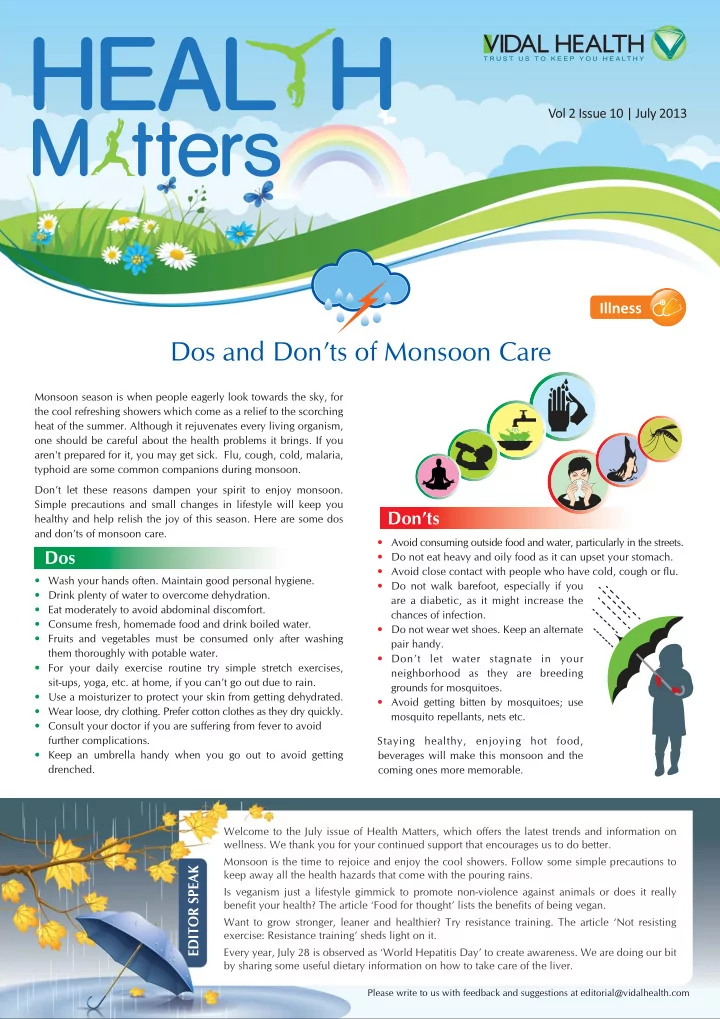
Dos and Donts of Monsoon Care Monsoon season is when people eagerly - - PDF document

dos and don ts of monsoon care
SMART_READER_LITE
LIVE PREVIEW

Dos and Donts of Monsoon Care Monsoon season is when people eagerly - - PDF document

Vol 2 Issue 10 | July 2013 Illness Dos and Donts of Monsoon Care Monsoon season is when people eagerly look towards the sky, for the cool refreshing showers which come as a relief to the scorching heat of the summer. Although it rejuvenates


slide-1
SLIDE 1

Illness

Monsoon season is when people eagerly look towards the sky, for the cool refreshing showers which come as a relief to the scorching heat of the summer. Although it rejuvenates every living organism,

  • ne should be careful about the health problems it brings. If you

aren't prepared for it, you may get sick. Flu, cough, cold, malaria, typhoid are some common companions during monsoon. Don’t let these reasons dampen your spirit to enjoy monsoon. Simple precautions and small changes in lifestyle will keep you healthy and help relish the joy of this season. Here are some dos and don’ts of monsoon care.

Dos

  • Wash your hands often. Maintain good personal hygiene.
  • Drink plenty of water to overcome dehydration.
  • Eat moderately to avoid abdominal discomfort.
  • Consume fresh, homemade food and drink boiled water.
  • Fruits and vegetables must be consumed only after washing

them thoroughly with potable water.

  • For your daily exercise routine try simple stretch exercises,

sit-ups, yoga, etc. at home, if you can’t go out due to rain.

  • Use a moisturizer to protect your skin from getting dehydrated.
  • Wear loose, dry clothing. Prefer cotton clothes as they dry quickly.
  • Consult your doctor if you are suffering from fever to avoid

further complications.

  • Keep an umbrella handy when you go out to avoid getting

drenched.

Dos and Don’ts of Monsoon Care

Don’ts

  • Avoid consuming outside food and water, particularly in the streets.
  • Do not eat heavy and oily food as it can upset your stomach.
  • Avoid close contact with people who have cold, cough or flu.
  • Do not walk barefoot, especially if you

are a diabetic, as it might increase the chances of infection.

  • Do not wear wet shoes. Keep an alternate

pair handy.

  • Don’t let water stagnate in your

neighborhood as they are breeding grounds for mosquitoes.

  • Avoid getting bitten by mosquitoes; use

mosquito repellants, nets etc. Staying healthy, enjoying hot food, beverages will make this monsoon and the coming ones more memorable.

EDITOR SPEAK

Welcome to the July issue of Health Matters, which offers the latest trends and information on

  • wellness. We thank you for your continued support that encourages us to do better.

Monsoon is the time to rejoice and enjoy the cool showers. Follow some simple precautions to keep away all the health hazards that come with the pouring rains. Is veganism just a lifestyle gimmick to promote non-violence against animals or does it really benefit your health? The article ‘Food for thought’ lists the benefits of being vegan. Want to grow stronger, leaner and healthier? Try resistance training. The article ‘Not resisting exercise: Resistance training’ sheds light on it. Every year, July 28 is observed as ‘World Hepatitis Day’ to create awareness. We are doing our bit by sharing some useful dietary information on how to take care of the liver.

Vol 2 Issue 10 | July 2013

Please write to us with feedback and suggestions at editorial@vidalhealth.com

slide-2
SLIDE 2

Lifestyle

When one enters a restaurant or is invited for a party, the first question asked is ‘Vegetarian or Non-vegetarian food’? The world

  • f food has come a long way and now includes several

combinations of these two preferences. While most combinations are based on the choices dictated by the palate, health, and culture, there is one that is influenced by concern for the environment and a primary ingredient – veganism. Read on to find

  • ut more about this diet that counts amongst its many celebrity

followers like Vidya Balan and Carl Lewis. Simply put, veganism is an extension of vegetarianism. Individuals following a vegan diet not only avoid consumption of animal products including eggs but also all dairy products. Some vegans even avoid using animal made products (fur, wool, leather, and so

  • n) or products tested on animals (cosmetics. personal care, etc).

The reasons for vegan may vary from person to person. The reasons may be ethical, religious and environmental or may be promoting a cruelty-free lifestyle and personal health. There is often a common question about a vegan diet – does it provide an individual a complete balanced diet?

Balancing it right

The answer is simple – yes, provided it is well planned. A little awareness about nutritional need and a well planned vegetarian diet can easily meet the needs of children, teenagers, pregnant or feeding mothers. The American Dietetic Association recommends planned vegetarian diets, including total vegetarian or vegan diets that are both health-wise and nutritionally adequate.

Plant sources for a nutritious diet:

What is not very well known is that a vegan diet without intake of dairy products could cause osteoporosis as there is no calcium consumption in the diet. Also, lack of animal products in the diet could also make vegetarians prone to Vitamin B12 deficiency. Therefore, it has become very important for vegans to properly plan a complete diet.

Some important plant sources of key nutrients:

  • Iron: This is mainly found in dark green leafy vegetables, dried

fruits, dried beans, peas, seeds, whole grain products, and iron-fortified cereals and breads. As iron from plant sources is not easily absorbed, doubling its intake is recommended for all vegetarians and for better absorption of iron, foods rich in vitamin C are also recommended.

  • Vitamin B12: This vitamin is essential for the production of red

blood cells and the prevention of anemia. All vegetarians, particularly vegans, who shun animal products, should be vigilant about its deficiency. Consuming vitamin supplements, vitamin-enriched cereals and fortified soy products can be a useful source of this essential nutrient.

  • Calcium: Nuts, tofu, greens, broccoli, grain products and dark

green vegetables contain calcium. Calcium-enriched juices, and calcium-fortified soymilk are good sources of calcium.

  • Iodine: This is very important for the body. The consumption of

cruciferous vegetables, soya beans, and sweet potatoes increases the risk of goiter. Inclusion of iodized salt should largely meet this requirement.

  • Zinc: Whole grains such as wheat germ and bran, tofu, seeds,

nuts, whole-wheat breads and cereals are rich in zinc.

Going green

Diligently following a vegan lifestyle provides great benefits to the environment and one’s own lifestyle. A regular exercise and regular intake of vegan diet helps to lose weight and stay fit. The diet also helps in:

  • Prevention and treatment of certain diseases such as heart

disease and cancer.

  • All stages of the lifecycle including pregnancy, lactation,

infancy, childhood and adolescence.

  • Tackling blood pressure.
  • Lowering cholesterol and high blood sugar.
  • Lowering Body Mass Index.

It is upon each individual to decide one’s way of living. But the United Nations Environment Program’s report suggests that in 2050 the global population will reach predicted 9.1 billion and meeting all the needs of meat and dairy products will pose possible challenges that will eventually lead to a diet change, away from animal products. Is veganism the way forward? Certainly, some food for thought there!

Food for Thought Food for Thought

  • Zinc: Whole grains such as wheat germ and bran, tofu, seeds,

nuts, whole-wheat breads and cereals are rich in zinc.

Going green

Diligently following a vegan lifestyle provides great benefits to the environment and one’s own lifestyle. A regular exercise and regular intake of vegan diet helps to lose weight and stay fit. The diet also helps in:

  • Prevention and treatment of certain diseases such as heart

disease and cancer.

  • All stages of the lifecycle including pregnancy, lactation,

infancy, childhood and adolescence.

  • Tackling blood pressure.
  • Lowering cholesterol and high blood sugar.
  • Lowering Body Mass Index.

It is upon each individual to decide one’s way of living. But the United Nations Environment Program’s report suggests that in 2050 the global population will reach predicted 9.1 billion and meeting all the needs of meat and dairy products will pose possible challenges that will eventually lead to a diet change, away from animal products. Is veganism the way forward? Certainly, some food for thought there!

slide-3
SLIDE 3

Resistance machines

Resistance machines strengthen the body by restricting body

  • movement. Also known as weight machines, they provide more

controlled exercise and adjustable resistance during each exercise

  • set. Popular weight machine exercises include the shoulder press,

chest press, leg press, lateral pull and biceps curl.

  • Pros

Both types of weight training provide benefits such as strengthening of bones and muscles; they also reduce the risk of certain conditions such as lower back pain and osteoporosis. Free weights are versatile and inexpensive and can improve whole body balance. Weight machines, on the other hand, are easier and safer to use.

  • Cons

Free weights require more trained assistance than weight machines and can easily cause injury. Experts say weight machines are less effective than free weights when one needs to build muscles fast. So people, who want to build muscle fast, choose free weights and those who want to stay in shape choose weight machines.

How much training

The amount of resistance training needed differs for every

  • individual. According to the ACSM, individuals should gradually

increase their resistance training routine and customise it to suit

  • ne’s fitness level, and ensure that it provides activity for all the

major muscle groups. Get stronger, toned, and most importantly, healthier. Choose any method of resistance training, but don’t resist the training itself. PLEASE NOTE: A visit to a certified trainer is highly recommended before starting any exercising regime.

Not Resisting Exercise: Resistance Training

Here’s another great way to NOT resist exercise and it’s called resistance training. Resistance training is so popular that the American College of Sports Medicine (ACSM), the governing body for exercise in USA, has included it in its recommendations for Americans since 1998. Here’s why! Resistance training strengthens and tones the body by creating tension in muscles. It increases muscular strength, mass and

  • endurance. The resistance can be produced externally using

equipments such as dumbbells and rubber exercise tubing, and common articles such as bricks and water bottles.

Stronger, leaner, healthier

Resistance exercise has many styles to resist boredom!

  • Olympic lifting - weights are lifted overhead

as in the Olympics.

  • Power lifting
  • this style includes the squat,

dead lift and bench press.

  • Weight lifting
  • this features lifting heavy weights.

Tear to grow stronger

Tears in the muscle cells caused during resistance training help muscles regenerate and grow stronger. They are quickly repaired by the body in time. The breakdown of the muscle fibre, repair and re-growth of the muscle tissue are the characteristics of resistance training. Resistance exercise causes influx of hormones such as testosterone, growth hormone, along with proteins and other nutrients into the muscles to make them stronger.

Free or machine

Experts say whether one uses free weights or resistance machines,

  • ne can increase lean muscle mass and body’s metabolism with
  • both. As with everything else, there are pros and cons to both free

weights and machine weights. A choice can be made depending

  • n individual fitness level, experience, fitness goals under the

guidance of a certified trainer.

Free weights

Free weights allow for a free range of motion, which enables muscles and joints to move in any direction without restrictions. They keep the resistance on the muscle constant throughout the joint's range of motion. Free weights include dumbbells, barbells, ankle weights and one’s own body weight. Popular free-weight exercises include squats, bench press, shoulder press, pull-ups, push-ups, biceps curl and triceps extension. The progressive overload is a universally accepted method to gain strength. Milo, an athlete in ancient Greece was trained for the Olympics by carrying a newborn calf on his back every

  • day. By the time the games arrived, the calf had grown to

a full-size cow, and Milo was still carrying it on his back! This made him stronger. This method of lifting progressively heavier weights by gradually increasing the endurance threshold is called progressive overload.

The method to gain more strength - principle of progressive overload.

slide-4
SLIDE 4

Make Your Liver Smile Each Time You Eat

General dietary guidelines for liver care

  • Wash your hands with soap before eating, to protect yourself

from infections.

  • Consume freshly prepared food; avoid eating junk food.
  • Thoroughly wash fruits and raw vegetables before eating.
  • Drink boiled or packaged drinking water.
  • Eat fruits that come with a thick skin such as banana, orange,

mosambi, watermelon, muskmelon etc.

  • Reduce the intake of protein. Avoid chicken and fish; instead,

include low fat milk, curd and buttermilk.

  • Carbohydrates are necessary to provide calories and prevent

protein breakdown. Include lots of fruits, fruit juices, sugar, jaggery, honey, etc.

  • Eating several small meals a day is highly
  • recommended. This gives a regular dose
  • f energy throughout the day and also

reduces load on the liver.

  • Drink lots of water to remove the toxins.
  • Avoid alcohol as it worsens your liver.

Diet

Hepatitis is the inflammation of the liver cells ultimately affecting the normal functioning of the liver. Since the liver plays a major role in digestion, it is very important to take care of it by planning a healthy diet that will not only reduce the load on the liver, but also promote its healing. A thumb rule for the Anti-Hepatitis diet is to incorporate plenty of fluids with a balanced diet that helps damaged liver cells to regenerate.

Foods to be taken:

  • Bread or chapati of wheat, rice, maize, ragi.
  • Breakfast cereals of wheat, rice, oatmeal or maize.
  • Skimmed milk and its products.
  • Thin soups.
  • Cooked vegetables.
  • Fruits.
  • Beverages (strong tea or coffee excluded).

Foods to be avoided:

  • Pulses or beans.
  • Meat, fish or chicken.
  • Not more than three eggs a week.
  • Fatty salad dressings, mayonnaise,

sour cream, fried and fatty foods.

  • Nuts, peanut butter, nut spreads.
  • Vegetables smothered in butter or white/cheese sauces.
  • Papads, chutney or pickles.
  • All foods prepared by frying in butter, margarine or oil. Rather

boil, grill or cook food in a nonstick pan with oil spray.

Quiz

  • 1. Monsoon
  • a. Improves muscle

strength, mass, tone and also endurance

  • 2. Vegan
  • b. Strictly avoid alcohol
  • 3. Resistance training
  • c. Increase in cold, flu, food

poisoning and other infections

  • 4. Hepatitis
  • d. Need to balance diet with

plant sources of iron, calcium, zinc, etc.

Match the following.

, , g

  • atmeal or m

r maize. s. l d d)

Vidal Healthcare Services Private Limited,

Plot No. 132/1, Palm Meadows, Whitefield Road, Ramagondanahalli, Bangalore 560066.

  • Ph. No.: +91-80-4115 5122

E-mail: info@vidalhealth.com

w w w . v i d a l h e a l t h . c o m

Bangalore - Mangalore - Hubli - Cochin - Trivandrum Chennai - Coimbatore - Hyderabad - Vizag - Mumbai Pune - Delhi - Kolkata - Ahmedabad - Bhubaneswar

Disclaimer: Content is sourced from public domain and is provided by Vidal Healthcare for educaonal and informaonal purposes. It should not be considered as a substute to medical advice. Vidal Healthcare makes every effort to ensure accuracy or completeness of editorial content, however we do not take responsibility for any errors, omissions and also do not take responsibility to ensure that data, informaon of material is kept up-to-date. The views expressed in these arcles are not necessarily those of Vidal Healthcare. Reproducon, modificaon, storage in a retrieval system or retransmission, in any form or by any means, electronic, mechanical or otherwise, for reasons other than educaonal and/or informaonal purposes are strictly prohibited without prior wrien permission of Vidal Healthcare. E-mail your answers to: healthmatters@vidalhealth.com