Monkey Microbes and Human Health: Putting health disparities into an - - PowerPoint PPT Presentation

monkey microbes and human health
SMART_READER_LITE
LIVE PREVIEW

Monkey Microbes and Human Health: Putting health disparities into an - - PowerPoint PPT Presentation

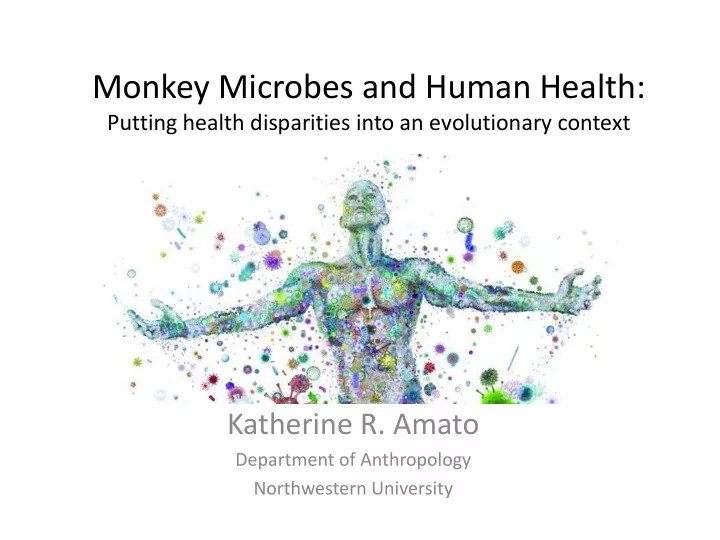
Monkey Microbes and Human Health: Putting health disparities into an evolutionary context Katherine R. Amato Department of Anthropology Northwestern University Gut microbiota Nutrition Immune function Mental state The Gut Microbiota

slide-1
SLIDE 1

Monkey Microbes and Human Health:

Putting health disparities into an evolutionary context

Katherine R. Amato

Department of Anthropology Northwestern University

slide-2
SLIDE 2

Nutrition Immune function Mental state

Gut microbiota

slide-3
SLIDE 3

The Gut Microbiota

  • Implicated in:

– Hypertension – Asthma – Cardiovascular Disease – Obesity – Cancer – And more…

slide-4
SLIDE 4

Health Disparities

  • Apparent in:

– Hypertension – Asthma – Cardiovascular Disease – Obesity – Cancer – And more…

slide-5
SLIDE 5

How important are gut microbes for understanding patterns of health inequality across populations?

slide-6
SLIDE 6
slide-7
SLIDE 7
slide-8
SLIDE 8

Increased SCFA Production à More Energy to Host

slide-9
SLIDE 9
slide-10
SLIDE 10
slide-11
SLIDE 11
slide-12
SLIDE 12

Gut Microbes Compensate Across Seasons

F2,38 = 3.56, r2 = 0.14, p = 0.0002

Amato et al. 2015, Microbial Ecology Energy Intake ê

slide-13
SLIDE 13

Gut Microbes Compensate For Life History

  • Juveniles

– Characterized by Firmicutes (Faecalibacterium, Roseburia, Ruminococcus)

  • Adult Females

– High Firmicutes:Bacteroidetes ratio – Characterized by Lactococcus

Amato et al. 2014, AJPA

slide-14
SLIDE 14

Do these apparently beneficial relationships break down?

slide-15
SLIDE 15

Gut Microbes Degraded With Habitat Disturbance

Amato et al. 2013, ISME J

slide-16
SLIDE 16

Gut Microbes Degraded With Habitat Disturbance

2000 4000 6000 8000 10000 12000 14000

Continuous Rainforest Continuous SD Fragmented Rainforest Captivity Chao1 diversity estimate Amato et al. 2013, ISME J Habitat Quality ê

slide-17
SLIDE 17

0.000% 0.005% 0.010% 0.015% 0.020% 0.025% 0.030%

Relative abundance

Butyrivibrio Desulfovibrio Amato et al. 2013, ISME J Habitat Quality ê

Gut Microbes Degraded With Habitat Disturbance

slide-18
SLIDE 18

Extreme Case: Captivity in Primates

Captive

Wild

Provenance

PC3 - 9%

(A) (B)

PC2 - 19% PC1 - 25%

  • 0.2
  • 0.1

0.0 0.1 0.2

  • 0.2
  • 0.1

0.0 0.1 0.2

MDS1 MDS2 Genus

Alouatta Cercopithecus Colobus Gorilla Pan

Wild_captive

captive wild

Amato et al. 2016, GECCO Frankel et al. in prep

slide-19
SLIDE 19
slide-20
SLIDE 20

uncertain GI Health Status healthy unhealthy Langur Colobus Douc Host Genus

Unweighted Unifrac Weighted Unifrac

Amato et al. 2016, GECCO

slide-21
SLIDE 21

Not just diet…

Weighted UniFrac (F1,51=5.01, r2=0.09, p <0.01)

PC1: 35.8% PC2: 15.2% PC3: 9.5% (18) Cayo: Adult (9) Cayo: Juvenile (15) SS: Adult (10) SS: Juvenile

Sample Location and Age

500 1000 1500 2000 2500 3000 Adult Juvenile Adult Juvenile Cayo Sabana Seca Chao1

Amato et al. in prep

slide-22
SLIDE 22
slide-23
SLIDE 23

Probably…but we need more data

slide-24
SLIDE 24

Industrialization and the Gut Microbiota

Schnorr et al. 2014, Martinez et al. 2015, Clemente et al. 2015

slide-25
SLIDE 25

What about mismatch situations?

slide-26
SLIDE 26
slide-27
SLIDE 27
slide-28
SLIDE 28
slide-29
SLIDE 29

Hossain et al. 2007

slide-30
SLIDE 30
slide-31
SLIDE 31

Major Questions

  • Does a maternal history of undernutrition in

early life lead to a energy-efficient gut microbiota in adulthood?

  • Can these microbial traits be passed to infants

and affect health outcomes (particularly if the nutritional environment shifts)?

slide-32
SLIDE 32

« Philippines Study site

slide-33
SLIDE 33

Offspring Mothers

1984-6 2000 2005 2017 1998-9 1994 1991 preg & birth 1983-4 infancy childhood puberty young adult

Data collection on full sample

Birth

The Cebu Study

3327 pregnant women enrolled (1983)

The Cebu Longitudinal Health & Nutrition Survey Grandoffspring

slide-34
SLIDE 34

Mom

slide-35
SLIDE 35

Mom Baby (2 weeks)

slide-36
SLIDE 36

Mom Baby (2 weeks) Baby (6 months)

slide-37
SLIDE 37

Final Thoughts

  • To understand what is ‘wrong’ with the

microbiome when there are health issues, we need to:

– Understand what was evolutionarily ‘right’ – Understand what perturbations have altered the system

  • Studies of human populations are critical
  • Non-human primates give us an even broader

context

slide-38
SLIDE 38

Thank you!