Monitoring and management of climate resilient water services in the - - PowerPoint PPT Presentation
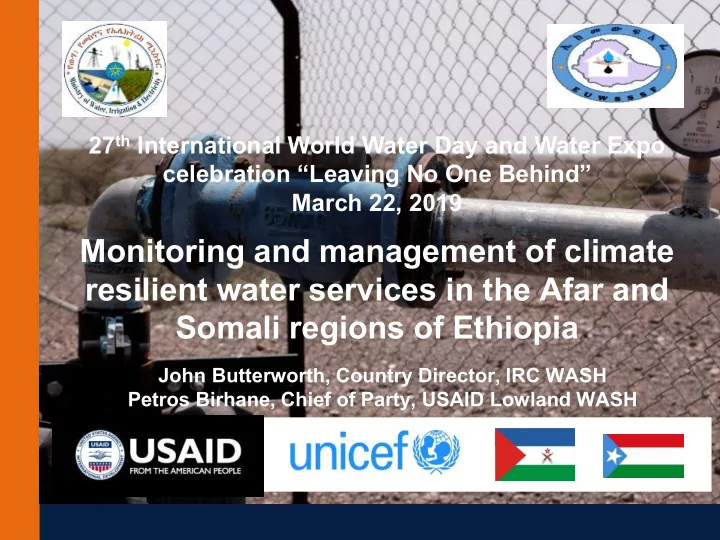
27 th International World Water Day and Water Expo celebration Leaving No One Behind March 22, 2019 Monitoring and management of climate resilient water services in the Afar and Somali regions of Ethiopia John Butterworth, Country
Insights
- Major new infrastructure investments are
hard to justify without improvements in maintenance
- Improvements in maintenance will depend
- n improvements in monitoring
- Sensors and mobile as entry points
to strengthen the system
- Already providing new data, but with
limited operational use to date
- Use of data through facilitation and
capacity building need as much attention as new ICT introduction
Context
Human right to water Harsh climate: frequent drought Mobile pastoralist communities New roads, railways, towns and irrigation schemes Conflicts
- ver scarce
resources Very little private sector presence
System
- Govt. & partners provide
new infrastructure
- WASHCOs and small
town utilities manage it
- Do O but not M
- Few schemes generate
regular income
- Incentives favour waiting
and escalation when there is a failure
- Woredas and region
respond (often in emergency mode) but have limited capacity
- Low utilisation,
short lifespans and high non- functionality rates
Innovation
- New monitoring
technologies provide an
- pportunity to strengthen
the system ➢mobile-based data collection ➢asset inventory supported with flow rate and quality measurement ➢Sensors for near real- time updating
- Key objectives are
prioritization of maintenance and asset management, and related financing
- Consistent with flagship
Climate Resilient WASH initiative
New ways of working
In Somali region, UNICEF supported the water bureau to develop the Somali Functionality Inventory - a response to the 2016/17 drought - now includes 424 motorized boreholes
Evidence
2018:
- Political changes
- New staff in woredas
- Less investment from govt/
UNICEF
- Less MMT activity
- BHs running 15-20 hrs day
2017:
- asset inventory and updates
by telephone calls and MMTs
- Non-functionality reduced
by 5%
Asset management
USAIDs Lowland WASH Activity has led a multi- stakeholder partnership focused on improving rural water asset management in Afar
https://afar.mwater.co/
Near real-time
- Deep motorised boreholes
with pumps cost approx. USD 100,000 each
- A sensor adds 1% to costs
- Measures power to pump.
Enables calculation of:
- Runtime
- Production (based on known
power to flow rate relationship)
- Potential failure
- Data transmitted by mobile
phone network or satellite
- New low-bandwidth satellite
communications becoming available
Context
USAID Lowland WASH activity has installed sensors at 180 boreholes in Afar, and more recently 10 pilot sites in Somali. In Afar, pumps are operated for an average of 4 hours per day
Context
Next steps
Small Town Water Utilities and new pilot public rural water utilities as data users In Afar, piloting use of data to improve maintenance managed by region (April-June) In Somali, USAID Lowland WASH and UNICEF will install 81 further sensors on critical boreholes Potential to roll out a common asset management platform in Somali region (and elsewhere). Impact evaluation in Afar based on implementation science framework Advocacy based on data to reduce non-functionality Test SWARM for low-cost sensor communications
Links
Prepared by USAID Lowland WASH Activity, USAID Sustainable WASH Systems Learning Partnership, UNICEF and SweetSense
For more information on innovations in Afar and Somali to strengthen rural water supply monitoring see https://www.usaid.gov/sites/default/files/documents/1860/ Ethiopia_Lowland-WASH-Sensor-Brief_FINAL.pdf https://www.sciencedirect.com/science/article/pii/S004896 9719306941?via%3Dihub