Molecular Subtypes of Renal Cell Carcinoma Deepika Sirohi, MD - - PDF document

molecular subtypes of renal cell carcinoma
SMART_READER_LITE
LIVE PREVIEW

Molecular Subtypes of Renal Cell Carcinoma Deepika Sirohi, MD - - PDF document

Molecular Subtypes of Renal Cell Carcinoma Deepika Sirohi, MD University of Utah and ARUP Laboratories 2019 Annual Park City Anatomical Pathology Update No disclosures Learning Objectives Familiarization with the genomic landscape of


slide-1
SLIDE 1

1

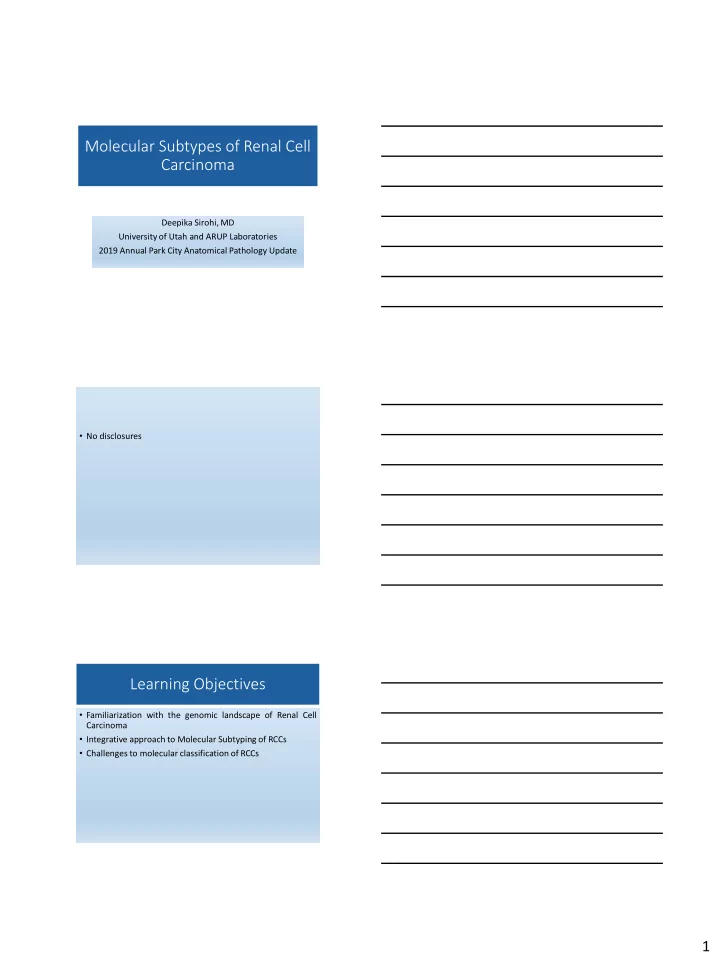
Molecular Subtypes of Renal Cell Carcinoma

Deepika Sirohi, MD University of Utah and ARUP Laboratories 2019 Annual Park City Anatomical Pathology Update

  • No disclosures

Learning Objectives

  • Familiarization with the genomic landscape of Renal Cell

Carcinoma

  • Integrative approach to Molecular Subtyping of RCCs
  • Challenges to molecular classification of RCCs
slide-2
SLIDE 2

2

Outline

  • Introduction
  • Treatment strategies
  • Genomic Landscape of RCC
  • Histopathological and molecular subtypes
  • Genomic correlates with clinical outcomes
  • Integrated Multi-omics across RCC subtypes
  • Immunotherapy Biomarkers
  • Challenges to Molecular Classification of RCCs
  • Conclusion

Renal Cell Carcinomas: Subtypes

<1% Clear cell RCC 75% Medullary RCC Papillary RCC 15% Collecting duct carcinoma Chromophobe RCC 5% MiTF-RCC Clear cell papillary RCC 4% FH deficient RCC and/or HLRCC Unclassified RCC 4% SDH deficient RCC Tubulocystic RCC Multilocular cystic renal neoplasm of low malignant potential Mucinous tubular and spindle cell carcinoma Acquired cystic disease-associated RCC

Hseieh JJ et al. Genomic classifications of renal cell carcinoma: a critical step towards the future application of personalized kidney cancer care with pan-omics precision. J Pathol 2018; 244: 525–537

RCC: Prognosis

  • About 30% of patients present with metastatic disease at

the time of diagnosis

  • An additional 30% of patients with localized RCC, despite

surgery with curative intent, eventually develop recurrence

  • r metastasis

Hseieh JJ et al. Genomic classifications of renal cell carcinoma: a critical step towards the future application of personalized kidney cancer care with pan-omics precision. J Pathol 2018; 244: 525–537

slide-3
SLIDE 3

3

RCC: Treatment Strategies NCCN Guidelines

  • Determined by
  • Tumor Stage
  • Amenability to resection
  • Co-morbidities
  • Systemic

Therapy: Surgically unresectable/advanced disease/ metastatic disease

  • Other targetable pathways/ alterations:
  • Hippo
  • NRF2-ARE
  • MAP kinase
  • ALK
  • CHECK2/PBRM1
  • ATM/BRCA2

Targeted therapies approved for RCC VEGFR inhibitors Sunitinib, Pazopanib, Bavacizumab mTORC1 inhibitors Temsorilimus, Everolimus C-MET inhibitors Cabozantinib FGFR inhibitors Cytokines Interluekin-2, Interferon-α Anti-PD1/PD-L1 Nivolumab

Hseieh JJ et al. Genomic classifications of renal cell carcinoma: a critical step towards the future application of personalized kidney cancer care with pan-omics precision. J Pathol 2018; 244: 525–537

slide-4
SLIDE 4

4

Genomic Landscape of RCC Hereditary RCC Syndromes

Adeniran AJ et al. Hereditary Renal Cell Carcinoma Syndromes: Clinical, Pathologic, and Genetic Features. Am J Surg Pathol 2015;39(12): e1-e18 Ricketts et al. The Cancer Genome Atlas Comprehensive Molecular Characterization of Renal Cell Carcinoma. Cell Reports 2018;23:313–326

slide-5
SLIDE 5

5

4 Classification Categories

  • Histopathology
  • Molecular Pathology
  • Genomic correlates with clinical outcomes
  • Integrated Multi-omics across RCC subtypes

Hseieh JJ et al. Genomic classifications of renal cell carcinoma: a critical step towards the future application of personalized kidney cancer care with pan-omics precision. J Pathol 2018; 244: 525–537

Histopathology and Molecular Pathology Clear Cell RCC

  • Majority- sporadic
  • <5%- inherited cancer syndromes
slide-6
SLIDE 6

6 TCGA: ccRCC

TP53 VHL/HIF VHL Chromatin remodeling BAP1 SETD2 PBRM1 KDM5C PI3K/AKT PTEN mTOR

The Cancer Genome Atlas Research Network. Comprehensive molecular characterization of clear cell renal cell carcinoma. Nature. 2013;499:43-49

Clear Cell RCC

  • VHL/ 3p LOH (90%)
  • Deletion of 3p >90% (biallelic)- 3 genes
  • VHL: Tumor suppressor
  • PBRM1- chromatin remodeling complex
  • BAP1, SETD2, JARID1
  • Epigenetic silencing in ~7%, mutually exclusive with

mutation

  • Inactivation of VHL serves as the fundamental driver event
  • f human ccRCC

Casuscelli J et al. Molecular Classification of Renal Cell Carcinoma and Its Implication in Future Clinical Practice. Kidney Cancer 1 (2017) 3–13

HIF 1-⍺ VHL O2, Fe Prolyl hydroxylase, 2OG

E3 ubiquitin ligase complex

Anaerobic Glycolysis VEGF EPO CAIX

ROS

slide-7
SLIDE 7

7

Linehan WM et al. The genetic basis of kidney cancer: a metabolic disease. Nat Rev Urol. 2010;7(5):277-285 Casuscelli J et al. Molecular Classification of Renal Cell Carcinoma and Its Implication in Future Clinical Practice. Kidney Cancer 1 (2017) 3–13

Common Genetic Alterations in ccRCCs

Casuscelli J et al. Molecular Classification of Renal Cell Carcinoma and Its Implication in Future Clinical Practice. Kidney Cancer 1 (2017) 3–13 Hseieh JJ et al. Genomic classifications of renal cell carcinoma: a critical step towards the future application of personalized kidney cancer care with pan-omics precision. J Pathol 2018; 244: 525–537 Mutations in 93% of ccRCC Percentage of cases Clinical Impact VHL >70% Diagnostic No prognostic impact PBRM1 ~ 40% Longer survival on MTORI BAP1 ~ 15-20% High grade, poor outcomes on VEGFR TKI/ MTOR Inhibitor SETD2 ~ 7-11% Worse survival, associated with metastases KDM5C ~ 14% Longer survival on VEGF TKI TP53 2.2 – 8% High grade, decreased survival PIK3CA Targetable MTOR ~ 5% Response to MTORI, mutations in metastases better response than mutations in primary TSC1 Targetable NF2 ~ 3% Targetable

slide-8
SLIDE 8

8

The Cancer Genome Atlas Research Network. Comprehensive molecular characterization of clear cell renal cell carcinoma. Nature. 2013;499:43-49 The Cancer Genome Atlas Research Network. Comprehensive molecular characterization of clear cell renal cell carcinoma. Nature. 2013;499:43-49

Copy Number Changes: ccRCCs

Papillary RCC

  • Gain of chromosomes 7 and 17
  • Loss of Y chromosome
  • Hereditary pRCC
  • c-Met gene mutations, AD
  • No extra renal manifestations
  • Bilateral, multiple, multifocal

type 1 pRCCs/ adenomas

  • Sporadic Type 1 pRCC- MET gene

mutations (13%)

  • MET inhibitors
  • Type 2 pRCC- Heterogeneous group
slide-9
SLIDE 9

9

TCGA: pRCC

Type 1 MET Chr 7, 17+ Type2, uRCCs TFE3 TFEB CDKN2A loss Chromatin remodeling CIMP CDKN2A promoter hypermethylation FH Glycolytic Krebs cycle

The Cancer Genome Atlas Research Network. Comprehensive Molecular Characterization of Papillary Renal-Cell Carcinoma. N Engl J Med 2016;374:135-45.

Papillary RCCs

  • Type 1 pRCC: MET (trisomy 7): Targetable with MET/VEGFR2

inhibitors

  • Type 2 pRCC
  • CDKN2A silencing (Chr 9p21 loss); decreased overall survival
  • SETD2 mutations
  • TFE3 fusions
  • NRF2-ARE (antioxidant response element) pathway (increased

expression)

  • CUL3 mutations
  • NRF2 mutations
  • NF2 mutations: Targetable by YES1 kinase inhibitors (Dasatinib)
  • TERT promoter mutations

Hseieh JJ et al. Genomic classifications of renal cell carcinoma: a critical step towards the future application of personalized kidney cancer care with pan-omics precision. J Pathol 2018; 244: 525–537

A Distinct pRCC Subtype

  • CpG Island Methylator Phenotype
  • Universal hypermethylation of CDKN2A promoter
  • 5.6% of papillary RCCs
  • FH mutations ~ 56%)
  • Earlier age of presentation
  • Decreased survival
  • Warburg like metabolic shift

The Cancer Genome Atlas Research Network. Comprehensive Molecular Characterization of Papillary Renal-Cell Carcinoma. N Engl J Med 2016;374:135-45.

slide-10
SLIDE 10

10

Molecular Differences Between Type 1 &2 pRCCs

Type 1 Type 2 NF2 Hippo signaling pathway 2.8% 10.0% SMARCB1, PBRM1 SWI/SNF complex 19.7% 26.7% SETD2, KDM6A, BAP1 Chromatin remodeling pathways 35.2% 38.3%

The Cancer Genome Atlas Research Network. Comprehensive Molecular Characterization of Papillary Renal-Cell Carcinoma. N Engl J Med 2016;374:135-45. The Cancer Genome Atlas Research Network. Comprehensive Molecular Characterization of Papillary Renal-Cell Carcinoma. N Engl J Med 2016;374:135-45.

Copy Number Changes: pRCCs

Chromophobe RCC

  • Multiple

complex chromosomal losses (Hypodiploid)

  • 1, 2, 6, 10, 13, 17 and 21 (7-set)
  • TERT promoter (10%)
  • TP53 (32%)
  • PTEN (9%)
  • Mitochondrial DNA mutations

Davis CF et al. The somatic genomic landscape of chromophobe renal cell carcinoma.Cancer Cell. 2014; 26(3): 319–330

slide-11
SLIDE 11

11 Aggressive Chromophobe RCCs

  • Metastatic ChRCC: ~10-15%
  • Casuscelli et al
  • Integrated analyses of 79 chRCC patients, 38 with

metastatic disease

  • Whole-genome sequencing
  • Targeted exome sequencing
  • OncoScan
  • FACETS
  • FISH
  • High-risk genomic features: Any of the 3
  • TP53 mutation
  • PTEN mutation
  • Imbalanced chromosome duplication

Casuscelli J et al. Genomic landscape and evolution of metastatic chromophobe renal cell carcinoma.JCI Insight. 2017;2(12):e92688

Aggressive Chromophobe RCCs

Casuscelli J et al. Genomic landscape and evolution of metastatic chromophobe renal cell carcinoma.JCI Insight. 2017;2(12):e92688

Unclassified RCC

  • 4-5%
  • Adverse histological

features, heterogeneous

  • Aggressive biological

potential

  • Higher rate of nodal and/or

distant metastases at presentation

  • Low survival rates
slide-12
SLIDE 12

12 Aggressive Unclassified RCCs

55%

  • NF2 loss and

dysregulated Hippo–YAP signaling (18%)

  • Worse outcomes
  • Hyperactive mTORC1

signaling (26%)

  • Better outcomes,

therapeutic target

  • MTOR, TSC1, TSC2, PTEN
  • FH: worse outcomes
  • ALK

45%

  • Chromatin modulation

(13%)

  • Intermediate outcomes
  • (SETD2, BAP1, KMT2A/C/D,

PBRM1)

  • DNA damage response

(8%)

  • (TP53, CHEK2, BRCA2)
  • No recurrent molecular

features (24%)

Chen Y-B et al. Molecular analysis of aggressive renal cell carcinoma with unclassified histology reveals distinct subsets. Nat Commun. 2016;7:13131

Other RCC Subtypes

RCC Subtype Molecular Alterations Collecting Duct Carcinoma NF2 (5/17) SETD2 (4/17) SMARCB1 (3/17) FH (2/17) CDKN2A (2/17) Medullary RCC SMARCB1/INI: LOH/ balanced translocations/ biallelic loss TFE3 RCC Translocations with SFPQ, ASPSCR1, PRCC, NONO, CLTC, KSHRP, and LUC7L3 Sarcomatoid RCCs TP53, BAP1, ARID1A, PTEN, CDKN2A, and NF2

Hseieh JJ et al. Genomic classifications of renal cell carcinoma: a critical step towards the future application of personalized kidney cancer care with pan-omics precision. J Pathol 2018; 244: 525–537

Genomic correlates with clinical

  • utcomes
slide-13
SLIDE 13

13 DNA methylation patterns

  • 10 subtypes
  • KIRC + KIRP (type 2): hypermethylation and poor outcomes
  • 4 subtypes of KIRC, 2 of which were enriched for BAP1 and

associated with poor outcomes

  • 2 subtypes of KIRP

Chen F et al. Multilevel Genomics-Based Taxonomy of Renal Cell Carcinoma. Cell Reports 2016;14, 2476–2489

KIRP Morphological pattern Outcomes Cluster 1 Type 1, MET mutation, Chr 7+ Low tumor stage. Best survival Cluster 2a Type 2 Low tumor stage, Best survival Cluster 2b Type2, unclassified papillary RCC, High tumor stage. Poor survival Cluster 2c CIMP tumor subtype NRF2-ARE pathway alterations Worst survival

DNA Methylation

The Cancer Genome Atlas Research Network. Comprehensive molecular characterization of clear cell renal cell carcinoma. Nature. 2013;499:43-49

miRNA: CCRCC

  • miR-21: worse outcomes, role in metabolism
  • miR-21, miR-10b, miR-30a: inversely correlated with DNA

promoter methylation

  • Significant component of epigenetic regulation

The Cancer Genome Atlas Research Network. Comprehensive molecular characterization of clear cell renal cell carcinoma. Nature. 2013;499:43-49

slide-14
SLIDE 14

14 miRNA: ccRCC

The Cancer Genome Atlas Research Network. Comprehensive molecular characterization of clear cell renal cell carcinoma. Nature. 2013;499:43-49

Metabolomic classification ccRCC

  • mCluster 1-4
  • mCluster 2: High glutathione, worse outcomes
  • mCluster 3: High dipeptides, worse outcomes
  • mCluster 4: Low glutathione, better outcomes
  • mCluster 1: Low dipeptides, better outcomes

The Cancer Genome Atlas Research Network. Comprehensive molecular characterization of clear cell renal cell carcinoma. Nature. 2013;499:43-49

Metabolomic classification

  • Up regulation of oxidative phosphorylation genes: Ch-e
  • Down regulation of oxidative phosphorylation genes
  • ccRCC, P.CIMP-e
  • MAP kinase: ccRCC
  • NRF2-ARE (antioxidant response element), HIPPO

pathways: P.CIMP-e

  • Loss of NF2: P.CIMP-e
  • PI3K/AKT/mTOR: ccRCC, pRCC

Chen F et al. Multilevel Genomics-Based Taxonomy of Renal Cell Carcinoma. Cell Reports 2016;14, 2476–2489

slide-15
SLIDE 15

15

  • Worse survival:
  • Pentose phosphate

pathway

  • Fatty acid synthesis
  • PI3K pathway genes
  • Better survival
  • AMPK
  • Krebs cycle
  • PI3K pathway

inhibitor genes

The Cancer Genome Atlas Research Network. Comprehensive molecular characterization of clear cell renal cell carcinoma. Nature. 2013;499:43-49 The Cancer Genome Atlas Research Network. Comprehensive molecular characterization of clear cell renal cell carcinoma. Nature. 2013;499:43-49

Integrated Multi-omics across RCC subtypes

slide-16
SLIDE 16

16

Chen F et al. Multilevel Genomics-Based Taxonomy of Renal Cell Carcinoma. Cell Reports 2016;14, 2476–2489 The Cancer Genome Atlas Research Network. Comprehensive molecular characterization of clear cell renal cell carcinoma. Nature. 2013;499:43-49 The Cancer Genome Atlas Research Network. Comprehensive molecular characterization of clear cell renal cell carcinoma. Nature. 2013;499:43-49

slide-17
SLIDE 17

17

The Cancer Genome Atlas Research Network. Comprehensive Molecular Characterization of Papillary Renal-Cell Carcinoma. N Engl J Med 2016;374:135-45.

9 Molecular Subtypes

RCC Subtype Molecular Subtype Molecular and Clinical Correlates Clear cell m1 Chromatin remodeling gene alterations, PBRM1 mutations: ccA m2 ccB m3 CDKN2A deletions, PTEN mutations: ccB m4 BAP1 and mTOR mutations Papillary Type 1 P-e.1a Better P-e.1b Intermediate Papillary Type 2 P-e.2 Hypermethylation; intermediate; included cases with TFE3 fusions P-CIMP-e Hypermethylation; enriched for hereditary pRCC, CDKN2A loss/silencing, FH Chromophobe Ch-e

Chen F et al. Multilevel Genomics-Based Taxonomy of Renal Cell Carcinoma. Cell Reports 2016;14, 2476–2489 Casuscelli J et al. Molecular Classification of Renal Cell Carcinoma and Its Implication in Future Clinical Practice. Kidney Cancer 1 (2017) 3–13

Immunotherapy Biomarkers

slide-18
SLIDE 18

18 PD-L1/PD-1 Inhibitors

  • ccRCC: High expression of several immunotherapy gene

targets

  • Greater levels of immune infiltrates
  • Many poor risk and Sarcomatoid tumors
  • High levels of PD-L1 expression
  • Greatest relative benefit with nivolumab over

everolimus

  • CheckMate 025 trial: Higher PD-L1 expression
  • Poor survival
  • No correlation with increased response rate to

Nivolumab

Chen F et al. Multilevel Genomics-Based Taxonomy of Renal Cell Carcinoma. Cell Reports 2016;14, 2476–2489 Özdemir BC et al. Current and Future Applications of Novel Immunotherapies in Urological Oncology: A Critical Review of the Literature. Eur Urol

  • Focus. 2018 Apr;4(3):442-454

PD-1/PD-L1 Challenges

  • Different antibodies
  • Immune infiltrating cells evaluated
  • Intratumoral and intertumoral heterogeneity of PD-L1

expression

  • Temporal evolution of PD-L1 status during the development
  • f treatment resistance
  • Variation in PD-L1 expression according to the level of tissue

hypoxia

Mutational Load

RCC: Low mutational burden

Alexandrov LB et al. Signatures of mutational processes in human cancer. Nature 2013; 500:415

slide-19
SLIDE 19

19

Turajlic S et al. Insertion-and-deletion-derived tumour-specific neoantigens and the immunogenic phenotype: a pan-cancer analysis. Lancet Oncol. 2017 Aug;18(8):1009-1021

  • Highest

number

  • f

small insertions and deletions of all cancer types

  • Insertions/ deletions: result in 3

times more immunogenic high- binding affinity neoantigens

  • Microsatellite instability, BRCA1:

targetable

Challenges to Molecular Classification

  • f RCCs
  • Marked intra and inter-tumoral heterogeneity
  • Mutations different between primary and metastatic tumors
  • Most genes are tumor suppressors with loss of function, not

directly targetable

  • Methylation, copy number loss, miRNA: not detectable by

DNA mutation platforms

  • Bionikk (phase 2BIOmarker driven trial)
  • Molecular classification
  • Nivolumab plus ipilimumab/ Nivolumab
  • Nivolumab plus ipilimumab/ TKI

Conclusion

  • Integrated multi-omics approach
  • Molecular subtypes of RCCs
  • Ongoing research
  • To improve therapeutic approach to RCCs
  • Identify biomarkers relevant to therapy
  • Research into RCC subtypes
slide-20
SLIDE 20

20

Thank you