Molecular clouds as the origin of the Fermi Gamma-ray GeV excess - - PowerPoint PPT Presentation

molecular clouds as the origin of the fermi gamma ray gev
SMART_READER_LITE
LIVE PREVIEW

Molecular clouds as the origin of the Fermi Gamma-ray GeV excess - - PowerPoint PPT Presentation

Molecular clouds as the origin of the Fermi Gamma-ray GeV excess July 18, 2017 ICRC 2017, Busan, Korea Iris Gebauer , Peter L. Biermann, Wim de Boer, Leo Bosse, Alexander Neumann INSTITUT FR EXPERIMENTELLE KERNPHYSIK KIT Universitt des


slide-1
SLIDE 1

Software-Entwurf und -Qualität Institut für Programmstrukturen und Datenorganisation

1

9/22/12 KIT – Universität des Landes Baden-Württemberg und nationales Forschungszentrum in der Helmholtz-Gemeinschaft INSTITUT FÜR EXPERIMENTELLE KERNPHYSIK

www.kit.edu

Molecular clouds as the origin of the Fermi Gamma-ray GeV excess

July 18, 2017 ICRC 2017, Busan, Korea Iris Gebauer, Peter L. Biermann, Wim de Boer, Leo Bosse, Alexander Neumann

slide-2
SLIDE 2

Iris Gebauer Institut für Experimentelle Kernphysik July 18th, Molecular clouds as the origin of the Fermi GeV-excess (contribution DM-035)

2

THE FERMI GEV EXCESS Calore et al., 1411.4647 Spatial distribution in latitude compatible with generalized NFW profile Spectral shape of excess compatible with 35 GeV DM particle annihilating into bb. Daylan et al. 1402.6703

slide-3
SLIDE 3

Iris Gebauer Institut für Experimentelle Kernphysik July 18th, Molecular clouds as the origin of the Fermi GeV-excess (contribution DM-035)

3

USUAL APPROACH: SPATIAL TEMPLATES

  • Calculate diffuse emission (π0, bremsstrahlung, inverse Compton) from

spatial templates using models like Galprop or Dragon

  • Based on astronomical data on gas distributions/ISRF

→ models do not describe galactic center well THIS STUDY: SPECTRAL TEMPLATES

  • Calculate diffuse emission from spectral templates of known physical

processes (π0, bremsstrahlung, inverse Compton), use local cosmic ray measurements and gamma-rays to determine interstellar cosmic ray spectra spectra.

  • Derive spatial distribution of fit components from Fermi data.

→ allows to determine if new physical processes are required → fit is over-constrained

slide-4
SLIDE 4

Iris Gebauer Institut für Experimentelle Kernphysik July 18th, Molecular clouds as the origin of the Fermi GeV-excess (contribution DM-035)

4

PROPGATED COSMIC RAYS (PCR) Propagated cosmic rays (PCR): π0 production by propagated cosmic ray protons in the diffuse interstellar medium, following an E-2.85 spectrum consistent with the AMS-02 data above 20 GV. Simplest possible approach: assume local cosmic ray spectra are representative for Galaxy → independent of transport model. Proton flux template Gamma-ray template

slide-5
SLIDE 5

Iris Gebauer Institut für Experimentelle Kernphysik July 18th, Molecular clouds as the origin of the Fermi GeV-excess (contribution DM-035)

5

BREMSSTRAHLUNG (BR) Bremsstrahlung (BR): cosmic ray electrons emit bremsstrahlung in the interstellar gas. The interstellar electron spectrum follows E-3.21, consistent with the AMS-02 data. Below 1 GeV, where ionization losses dominate, a harder spectrum of E-0.81 is required by the gamma-ray data. E-3.21 E-0.81 1 GeV Electron flux template Gamma-ray template

slide-6
SLIDE 6

Iris Gebauer Institut für Experimentelle Kernphysik July 18th, Molecular clouds as the origin of the Fermi GeV-excess (contribution DM-035)

6

INVERSE COMPTON (IC)

Inverse Compton scattering (IC): photons from the interstellar radiation field (starlight, dust emission, CMB) scatter off cosmic ray electrons.

E-3.21 E-0.81 1 GeV Gamma-ray template Electron flux template

slide-7
SLIDE 7

Iris Gebauer Institut für Experimentelle Kernphysik July 18th, Molecular clouds as the origin of the Fermi GeV-excess (contribution DM-035)

7

SOURCE COSMIC RAYS (SCR) E-2.1

CRs accelerated in sources see high density gas in shock wave and surrounding ISM → expect copious π0 production with a spectrum from 1/E2.1 protons

[Völk, Berezhko, 1309.3955, de Boer et al., 1407.4114, 1509.05310, Biermann et al. 1009.5592, Hillas, J. Phys. G31 (2005) 95] Proton flux template

slide-8
SLIDE 8

Iris Gebauer Institut für Experimentelle Kernphysik July 18th, Molecular clouds as the origin of the Fermi GeV-excess (contribution DM-035)

8

SOURCE COSMIC RAYS

Source cosmic rays (SCR): π0 production by freshly accelerated protons in the vicinity of cosmic ray sources, following a hard E-2.1

  • spectrum. The SCR template agrees with the Fermi bubbles shown as

the blue band.

E-2.1 SCR spectrum agrees with Fermi bubbles. Proton flux template Gamma-ray template

slide-9
SLIDE 9

Iris Gebauer Institut für Experimentelle Kernphysik July 18th, Molecular clouds as the origin of the Fermi GeV-excess (contribution DM-035)

9

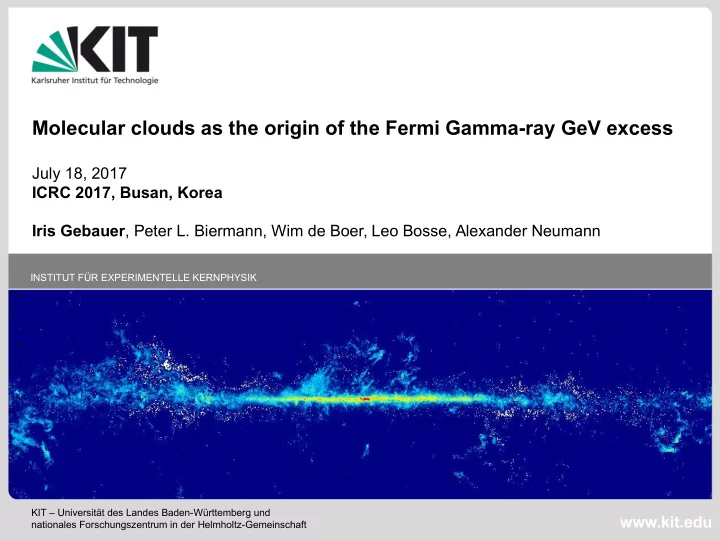
MOLECULAR CLOUDS Central Molecular Zone (CMZ) Size CMZ:

  • 1.5° < l < 2°
  • 0.5° < b < 0.5°

Mass CMZ: 5.107Mʘ (Black hole GC: 4.106Mʘ) Total mass fraction in MCs: ~ 40% CO Skymap from Planck Satellite (by measurement of CO rotation lines) Molecular clouds are accompanied by strong magnetic fields

slide-10
SLIDE 10

Iris Gebauer Institut für Experimentelle Kernphysik July 18th, Molecular clouds as the origin of the Fermi GeV-excess (contribution DM-035)

10

MOLECULAR CLOUD COSMIC RAYS (MCR) Earth's magnetic field leads to position dependent cutoff of low rigidity cosmic rays. Geomagnetic cutoff in AMS-01 data.

slide-11
SLIDE 11

Iris Gebauer Institut für Experimentelle Kernphysik July 18th, Molecular clouds as the origin of the Fermi GeV-excess (contribution DM-035)

11

MOLECULAR CLOUD COSMIC RAYS (MCR) Earth's magnetic field leads to position dependent cutoff of low rigidity cosmic rays. A similar effect is expected for molecular clouds: the magnetic moment of the cloudlets will prevent low rigidity cosmic rays from entering the dense cores. Only over-cutoff protons can enter the dense cores and produce π0. proton spectrum inside clouds proton spectrum

  • utside clouds
slide-12
SLIDE 12

Iris Gebauer Institut für Experimentelle Kernphysik July 18th, Molecular clouds as the origin of the Fermi GeV-excess (contribution DM-035)

12

MOLECULAR CLOUD COSMIC RAYS (MCR)

Molecular cloud cosmic rays (MCR): π0 production by propagated cosmic ray protons in the dense cores of molecular clouds.

Above cutoff: MCR follows PCR spectrum Position dependent cutoff [6GV, 14GV] due to magnetic deflection → no CR in MCs below cutoff Proton flux template Gamma-ray template

slide-13
SLIDE 13

Iris Gebauer Institut für Experimentelle Kernphysik July 18th, Molecular clouds as the origin of the Fermi GeV-excess (contribution DM-035)

13

ALTERNATIVELY: TEST DARK MATTER HYPOTHESIS

Alternatively, to test the Dark Matter (DM) hypothesis an additional gamma-ray template expected for a DM candidate with a mass of 45 GeV annihilating into bb quark pairs is used instead of the MCR template.

Gamma-ray template

slide-14
SLIDE 14

Iris Gebauer Institut für Experimentelle Kernphysik July 18th, Molecular clouds as the origin of the Fermi GeV-excess (contribution DM-035)

14

RESULTS

CMZ Scutum- Centaurus arm Halo

best fit for 45 GeV → bb

CMZ Halo Scutum- Centaurus arm

MC hypothesis DM hypothesis

slide-15
SLIDE 15

Iris Gebauer Institut für Experimentelle Kernphysik July 18th, Molecular clouds as the origin of the Fermi GeV-excess (contribution DM-035)

15

RESULTS: DARK MATTER HYPOTHESIS vs MOLECULAR CLOUDS

Molecular clouds

5 templates + isotropic background + variable MC cutoff value

DM: 45 GeV → bb

5 templates + isotropic background

slide-16
SLIDE 16

Iris Gebauer Institut für Experimentelle Kernphysik July 18th, Molecular clouds as the origin of the Fermi GeV-excess (contribution DM-035)

16

THE MCR TEMPLATE DISTRIBUTION “GeV-excess” is longitudinally extended, tracing the rectangular shape

  • f the Galactic bar
slide-17
SLIDE 17

Iris Gebauer Institut für Experimentelle Kernphysik July 18th, Molecular clouds as the origin of the Fermi GeV-excess (contribution DM-035)

17

CORRELATION BETWEEN MCR AND CO ROTATION LINES Along latitude the GeV-excess shows indeed the morphology of a generalized NFW profile. The MCR template traces molecular clouds.

Cygnus Centaurus arm Spiral arms

CO surveys are the primary way of identifying molecular clouds (low J transitions). We use the Planck measurements on the CO J 2 →1 emission.

Planck 2013 results. XIII. Galactic CO emission”, Astron. Astrophys. 571 (2014) A13

Calore et al., 1411.4647 CMZ

slide-18
SLIDE 18

Iris Gebauer Institut für Experimentelle Kernphysik July 18th, Molecular clouds as the origin of the Fermi GeV-excess (contribution DM-035)

18

THE DM TEMPLATE DISTRIBUTION rectangular shape is incompatible with the expected spherical morphology of DM

slide-19
SLIDE 19

Iris Gebauer Institut für Experimentelle Kernphysik July 18th, Molecular clouds as the origin of the Fermi GeV-excess (contribution DM-035)

19

THE DM TEMPLATE DISTRIBUTION The DM sky map does not resemble the expected spherical DM halo profile but has a morphology similar to the CO sky map.

slide-20
SLIDE 20

Iris Gebauer Institut für Experimentelle Kernphysik July 18th, Molecular clouds as the origin of the Fermi GeV-excess (contribution DM-035)

20

THE SCR TEMPLATE DISTRIBUTION

slide-21
SLIDE 21

Iris Gebauer Institut für Experimentelle Kernphysik July 18th, Molecular clouds as the origin of the Fermi GeV-excess (contribution DM-035)

21

THE SCR TEMPLATE DISTRIBUTION SCR traces Fermi bubbles, bar and spiral arms Bar [40..-30deg] Cygnus Centaurus arm Spiral arms

slide-22
SLIDE 22

Iris Gebauer Institut für Experimentelle Kernphysik July 18th, Molecular clouds as the origin of the Fermi GeV-excess (contribution DM-035)

22

CONCLUSION Using a fit based on energy templates we find that the GeV excess is compatible with the emission of π0 decay from molecular clouds. We compared the dark matter hypothesis and the molecular cloud hypothesis to explain Fermi GeV excess. The molecular cloud hypothesis is preferred for the following reasons:

  • it provides better fits if the whole sky and all energies are considered
  • both hypotheses follow the CO profile instead of a NFW profile
  • the CMZ shows a strong excess in the Galactic Center in a longitudinal extended

rectangular profile of l x b=4o x 1o instead of a spherical DM profile

slide-23
SLIDE 23

Iris Gebauer Institut für Experimentelle Kernphysik July 18th, Molecular clouds as the origin of the Fermi GeV-excess (contribution DM-035)

23

ADDITIONAL MATERIAL

slide-24
SLIDE 24

Iris Gebauer Institut für Experimentelle Kernphysik July 18th, Molecular clouds as the origin of the Fermi GeV-excess (contribution DM-035)

24

CORRELATION BETWEEN SCR AND AL26 EMISSION Al26 synthesized by proton capture of Mg25 in heavy, magnesium rich sources, 1.8 MeV line emitted in decay [SPI/Integral]. Source cosmic rays trace Al26 emission

A l 2 6 e m i s s i

  • n

[ c m

  • 2

s

  • 1

s r

  • 1

]

Sources are expected to reside inside molecular clouds → correlation between MCR and SCR template.

slide-25
SLIDE 25

Iris Gebauer Institut für Experimentelle Kernphysik July 18th, Molecular clouds as the origin of the Fermi GeV-excess (contribution DM-035)

25

FIT WITH 5 COMPONENTS The total flux in a given direction can be described by a linear combination of the gamma-ray fluxes from the various processes: Propagated cosmic rays Brems- strahlung Inverse Compton Source cosmic rays Molecular cloud cosmic rays (or DM) Isotropic background (fixed normalization)

slide-26
SLIDE 26

Iris Gebauer Institut für Experimentelle Kernphysik July 18th, Molecular clouds as the origin of the Fermi GeV-excess (contribution DM-035)

26

SPECTRAL TEMPLATE FIT Data: Fermi-LAT data between 0.1 and 100 GeV using the diffuse class of the public P7REP SOURCE V15 data collected from August, 2008 till July 2014 (72 months). Total: 797 cones binning adapted to strucures 18.5ox18.5o 10ox10o 1ox3.5o For each cone in the sky the normalization of 5 components is

  • ptimized and the optimal cutoff

position for the MCR template is chosen. total error on data(i, j) Template contribution Each cone has 21 energy bins with only Ni ≤ 6 free parameters → fit is overconstrained.

slide-27
SLIDE 27

Iris Gebauer Institut für Experimentelle Kernphysik July 18th, Molecular clouds as the origin of the Fermi GeV-excess (contribution DM-035)

27

ISOTROPIC BACKGROUND Isotropic background is redetermined by comparing observed and fitted flux for each energy bin in regions outside the bubbles and the disk. Fitted flux Observed flux Offset determines misestimate of EB for each energy bin → iterative process Final template deviates from template provided by Fermi by around 10%, 40% at highest energies.