WBS 121.5 Conventional Facilities Design and Scope Steve Dixon In - - PowerPoint PPT Presentation

wbs 121 5 conventional facilities
SMART_READER_LITE
LIVE PREVIEW

WBS 121.5 Conventional Facilities Design and Scope Steve Dixon In - - PowerPoint PPT Presentation

WBS 121.5 Conventional Facilities Design and Scope Steve Dixon In partnership with: India Institutes Fermilab Collaboration PIP-II Directors Review Istituto Nazionale di Fisica Nucleare Science and Technology Facilities Council 10-12


slide-1
SLIDE 1

In partnership with: India Institutes Fermilab Collaboration Istituto Nazionale di Fisica Nucleare Science and Technology Facilities Council
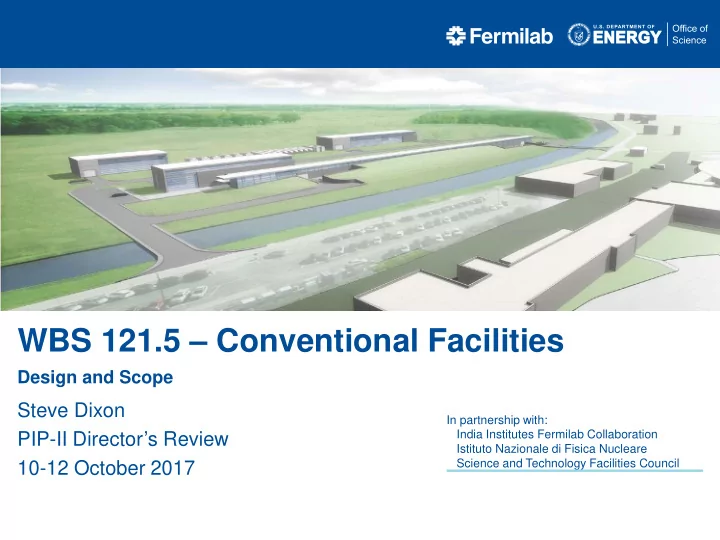
Steve Dixon PIP-II Director’s Review 10-12 October 2017

WBS 121.5 – Conventional Facilities

Design and Scope

slide-2
SLIDE 2

Design and Scope

Charge 1:

  • Does the acquisition strategy document a carefully

considered analysis of alternatives that supports the preferred alternative?

  • Does the conceptual design satisfy the performance

requirements?

  • Does the conceptual design support the stated cost range

and duration?

10/10/17

  • S. Dixon | Conventional Facilities | Design and Scope

2

slide-3
SLIDE 3

Agenda

  • Conceptual Design Process
  • Alternates Investigated

– Siting – ICW Cooling – Pulsed Mode vs. Continuous Wave Operatio

  • Next Steps

10/10/17

  • S. Dixon | Conventional Facilities | Design and Scope

3

slide-4
SLIDE 4

Conventional Facilities Overview

10/10/17

  • S. Dixon | Conventional Facilities | Design and Scope

4 Cryo Plant Building Utility Plant Building Linac Gallery Beam Transport Line Booster Connection

Work Breakdown Structure 121.5.2 Site Preparation 121.5.3 Cryo Plant Building 121.5.4 Utility Plant Building 121.5.5 High Bay Building 121.5.6 Linac Tunnel 121.5.7 Linac Gallery 121.5.8 Beam Transfer Line 121.5.9 Booster Connection

Linac Tunnel High Bay Building

slide-5
SLIDE 5

Conventional Facilities Overview

10/10/17

  • S. Dixon | Conventional Facilities | Design and Scope

5

Looking Southeast From Wilson Hall

AZero Service Building Tevatron Enclsoure Berm

View from Wilson Hall Looking South Along Beamline

White Flags = Warm Components Blue Flags = Cold Components

slide-6
SLIDE 6

Process

  • Functional Requirements Specification (Project Level)
  • Functional Requirements Specification (Subproject Level)
  • Technical Requirements Specifications
  • Conceptual Design

– Drawings [1] – Text [2] – Estimate Assumptions [3]

  • Cost/Schedule Estimate (Separate Breakout Presentation)

10/10/17

  • S. Dixon | Conventional Facilities | Design and Scope

6 [1] – Conceptual Design Drawings can be found in PIP-II-doc-1155 [2] – Conceptual Design Report can be found at PIP-II-doc-113 [3] – Estimate Assumptions can be found at PIP-II-doc-333, Item D

slide-7
SLIDE 7

PIP-II Functional Requirements Specifications

10/10/17

  • S. Dixon | Conventional Facilities | Design and Scope

7

  • “PIP-II is focused on upgrades to the Fermilab accelerator complex capable of

providing proton beam power in excess of 1 MW on target at the initiation of the Long Baseline Neutrino Facility/Deep Underground Neutrino Experiment (LBNF/DUNE) program, currently anticipated for the mid-2020s”

  • TeamCenter document ED0001222, signed in March 2017

Conventional Facilities specific requirements

slide-8
SLIDE 8

Conventional Facilities FRS and TRS

10/10/17

  • S. Dixon | Conventional Facilities | Design and Scope

8

  • Functional Requirements Specification (FRS) define the

function of each component (what);

  • Technical Requirements Specification (TRS) define the critical

technical requirements for each components (how);

  • Support the PIP-II Project FRS;
  • Developed for each conventional facilities work package;
  • Ensures design meets the requirements;
  • Currently in the review/approval process.

WBS Identification

TeamCenter Date TeamCenter Date

121.5.2 Site Preparation

ED0006787 21-Jul-17 ED0006798 24-Jul-17

121.5.3 Cryo Plant Building

ED0006718 21-Jul-17 ED0006719 24-Jul-17

121.5.4 Utility Plant Building

ED0006748 12-Jul-17 ED0006749 7-Jul-17

121.5.5 High Bay Building

ED0006756 12-Jul-17 ED0006757 26-Jul-17

121.5.6 Linac Tunnel

ED0006790 21-Jul-17 ED0006791 21-Jul-17

121.5.7 Linac Gallery

ED0006792 21-Jul-17 ED0006793 26-Jul-17

121.5.8 Beam Transfer Line

ED0006785 20-Jul-17 ED0006786 24-Jul-17

121.5.9 Booster Connection

ED0006764 21-Jul-17 ED0006785 21-Jul-17

Functional Requirements Specification Technical Requirements Specification

slide-9
SLIDE 9

Typical FRS

10/10/17

  • S. Dixon | Conventional Facilities | Design and Scope

9

The function of the Cryogenics Plant Building is to house the processes required to install, assemble and

  • perate the cryogenic plant and

related spaces to support PIP-II accelerator operations.

slide-10
SLIDE 10

Typical TRS Contents

10/10/17

  • S. Dixon | Conventional Facilities | Design and Scope

10

Typical Technical Requirements Specification Table of Contents

slide-11
SLIDE 11

Typical TRS

10/10/17

  • S. Dixon | Conventional Facilities | Design and Scope

11

Typical Technical Requirements Specification page

slide-12
SLIDE 12

Conceptual Design Process

  • Meetings with Stakeholders:

– Goal: Document the spatial and infrastructure requirements for PIP-II facilities; [4] – Started in January 2016;

  • Results:

– Conceptual Design drawings and text that described the sizes/arrangement of spaces and buildings to accommodate the functional requirements; [5] – Cost Estimate Assumptions; [6] – Life Safety Analysis; [7] – Developed cooling strategies for pulsed mode and continuous wave

  • peration;

– Conventional facilities are similar to typical Fermilab construction;

10/10/17

  • S. Dixon | Conventional Facilities | Design and Scope

12

[4] – Meeting Minutes can be found in PIP-II-doc-70 [5] – Conceptual Design Drawings can be found in PIP-II-doc-1155 [6] – Assumptions can be found at PIP-II-doc-333 [7] – Final LSA can be found at PIP-II-doc-120

slide-13
SLIDE 13

Conceptual Design Process

Stakeholders:

Fermilab: Alessandro Vivoli, Anindya Chakravarty, Anthony F Leveling, Arkadiy L Klebaner Beau F. Harrison, Curtis M. Baffes, David E Johnson, David W Peterson Don Cossairt, Donald V Mitchell, Emil Huedem, Jim Niehoff, Fernanda G Garcia Jerry R Leibfritz, Jerzy Czajkowski, John E Anderson Jr, Luisella Lari Matthew Quinn, Maurice Ball, Paul Derwent, Ralph J Pasquinelli Todd M Sullivan, Valeri A Lebedev, William A Pellico Consultants: Tom Lackowski, TGRWA Ron Jedziniak, LG Associates Rick Glenn, Jensen Hughes

10/10/17

  • S. Dixon | Conventional Facilities | Design and Scope

13

slide-14
SLIDE 14

Meeting Minutes (PIP-II-doc-70)

  • 01 - Coordination Meeting - 17FEB16 (pdf)
  • 02 - Cryogenic Department Meeting 19FEB16 (pdf) – Cryo Meeting
  • 03 - Coordination Meeting - 02MAR16 (pdf) – Linac Enclosure
  • 04 - Coordination Meeting - 09MAR16 R1 (pdf) – Linac Enclosure and Cooling
  • 05 - Coordination Meeting - 24MAR16 R1 (pdf) – Linac Enclosure and Cryo Plant
  • 06 - Cryo Coordination Meeting - 01APR16 (pdf) – ICW Cooling and Cryo
  • 07 - Coordination Meeting - 14APR16 (pdf) – Penetrations and Cooling Strategy
  • 08 - Coordination Meeting - 28APR16 (pdf) – Cooling Strategy
  • 09 - Coordination Meeting r1 - 12MAY16 (pdf) – Shielding and Transport Line
  • 10 - Coordination Meeting - 09JUN16 (pdf) – Shielding Summary
  • 11 - Coordination Meeting - 07JUL16 (pdf) – RF Distribution and LCW Cooling
  • 12 - Coordination Meeting - 21JUL16 (pdf) – High Bay Equipment
  • 13 - Coordination Meeting - 04AUG16 (pdf) – Cryo Summary and Linac Gallery
  • 14 - Coordination Meeting - 15SEP16 (pdf) – Sitewide Electrical Distribution

10/10/17

  • S. Dixon | Conventional Facilities | Design and Scope

14

slide-15
SLIDE 15

Drawings (PIP-II-doc-1155)

10/10/17

  • S. Dixon | Conventional Facilities | Design and Scope

15

55 Drawings

  • One (1) General sheet
  • Seven (7) Civil sheets
  • Forty-Three (43) Architectural sheets
  • Three (3) Mechanical sheets
  • One (1) Electrical sheet
slide-16
SLIDE 16

Typical Design Basis Sheet

10/10/17

  • S. Dixon | Conventional Facilities | Design and Scope

16

Base Design: Eliminates this portion of the Linac Gallery (included as an Additive Alternate)

slide-17
SLIDE 17

Typical Linac Tunnel Cross Section

10/10/17

  • S. Dixon | Conventional Facilities | Design and Scope

17

1’-10” Aisle 1’-10” Aisle RF Zone LCW Zone

slide-18
SLIDE 18

Linac Tunnel Plan (WBS 121.5.6)

10/10/17

  • S. Dixon | Conventional Facilities | Design and Scope

18

Plan at Enclosure Level

FRS Section 5 (Facility Scope): The linac enclosure will be constructed with a length to accommodate two (2) HB650 cryomodules beyond the nominal compliment required for 800 MeV ~75’

slide-19
SLIDE 19

Preliminary Shielding Considerations

10/10/17

  • S. Dixon | Conventional Facilities | Design and Scope

19

6’ 17.5’ 7.5’ 18.5’ 18.5’

(transport line and absorber)

Preliminary Shielding Depths shown below. Further analysis required, especially at the Booster.

Thanks to D. Cossairt, T. Leveling and M. Quinn

Used the 10W/m curve for the conceptual design

slide-20
SLIDE 20

Linac Gallery Plan (WBS 121.5.7)

10/10/17

  • S. Dixon | Conventional Facilities | Design and Scope

20

Cross Section Looking South at Waveguide Penetrations Cross Section Looking South at Coax Penetrations

slide-21
SLIDE 21

Beam Transfer Line (WBS 121.5.8)

10/10/17

  • S. Dixon | Conventional Facilities | Design and Scope

21

FRS Integration and Upgradability: I2: The siting of the PIP-II facility will be consistent with future upgrades to provide 100 kW beams to the Mu2e hall on the Muon Campus

slide-22
SLIDE 22

Booster Connection (WBS 121.5.9)

10/10/17

  • S. Dixon | Conventional Facilities | Design and Scope

22

Looking Northeast Towards Booster Tower Southeast

FRS Integration and Upgradability: I4: The SC Linac will be constructed in a manner that allows installation and commissioning without interruption to ongoing accelerator

  • perations
slide-23
SLIDE 23

Cryo Plant Building (WBS 121.5.3)

10/10/17

  • S. Dixon | Conventional Facilities | Design and Scope

23

Warm Compressor Station Cold Box Station Tank Farm

slide-24
SLIDE 24

Utility Plant Building (WBS 121.5.4)

10/10/17

  • S. Dixon | Conventional Facilities | Design and Scope

24

slide-25
SLIDE 25

Cooling Concept

10/10/17

  • S. Dixon | Conventional Facilities | Design and Scope

25

Base Design Direct ICW flow through cryo compressors Base Design Cooling for pulsed mode. Additive Alternate for continuous wave cooling

slide-26
SLIDE 26

Electrical Distribution Concept

10/10/17

  • S. Dixon | Conventional Facilities | Design and Scope

26

Manhole P71

slide-27
SLIDE 27

Alternates Considered

  • Siting
  • ICW Cooling
  • Pulsed Mode vs. Continuous Wave Operation

10/10/17

  • S. Dixon | Conventional Facilities | Design and Scope

27

slide-28
SLIDE 28

Preconceptual Location

10/10/17

  • S. Dixon | Conventional Facilities | Design and Scope

28

2014 Location

slide-29
SLIDE 29

Siting Considerations

10/10/17

  • S. Dixon | Conventional Facilities | Design and Scope

29

Existing Utilities and Services FRS Integration and Upgradability:

  • I1: Future RCS or Pulsed Linac
  • I2: Future 100 kW beam to Mu2e;
  • I4: Installation/Commissioning during ongoing
  • perations

FRS Section 5 (Facility Scope):

  • Linac length to accommodate two (2) additional HB650

cryomodules

I2 I1 5

slide-30
SLIDE 30

December 2016 Siting Alternatives Study

10/10/17

  • S. Dixon | Conventional Facilities | Design and Scope

30

8 GeV Tangent Option Northward Shift Option See PIP-II-doc-136 for Memo

slide-31
SLIDE 31

Cryo Plant Cooling Water

10/10/17

  • S. Dixon | Conventional Facilities | Design and Scope

31

Cryo Compressors

slide-32
SLIDE 32

Cryo Plant – Water Quality Requirements

10/10/17

  • S. Dixon | Conventional Facilities | Design and Scope

32

Existing Data

slide-33
SLIDE 33

Cryo Plant Cooling – Initial Analysis

10/10/17

  • S. Dixon | Conventional Facilities | Design and Scope

33

  • Water Requirements

– ~2,000 gpm flow (ideal)

  • Pond System

– Chemical characteristics met by Pond system; – Solids content characteristics NOT met by Pond system; – No Pond Exists - ~$500-$700k per acre;

  • Industrial Cooling Water (ICW) System

– Testing indicates that ICW meets most requirements [4];

  • Chemical characteristics met by existing ICW system;
  • Solids content characteristics NOT met by ICW system;

– Only 1,400 gpm available per the ICW model – Verified with Cryo that 1,400 gpm at 17 degree F delta T is acceptable

[4] – ICW Water Quality Test Results study can be found at PIP-II-doc-155

slide-34
SLIDE 34

Cryo Plant Cooling – Additional Analysis

10/10/17

  • S. Dixon | Conventional Facilities | Design and Scope

34

BZero Compressor Building

  • Summer/Fall 2016
  • Test Station, installed as part of the

Mu2e Cryo work for CDF;

  • Installed test ports to sample the ICW

before and after the strainer;

  • Three Options:
  • Adams strainer with 250 micron

slot sizes (baseline);

  • Two month rental of a Lakos

strainer to reduce the solids with 25 micron filter;

  • Replacement filter elements in

Adams strainer with 75 micron slot size;

  • Arranged for FESS/O water testing

service to increase the testing to include solids;

  • Compare strainer options with water

quality requirements.

Strainer

Port for Rental Strainer Port for Rental Strainer

slide-35
SLIDE 35

Cryo Plant Cooling - Results

10/10/17

  • S. Dixon | Conventional Facilities | Design and Scope

35

Desription Unit Closed loop Open loop pH value 7.5 - 9.0 7.5 - 9.0 7.51 7.71 8.28 8.23 Hardness

[dH]

< 20 < 20 12.10 12.03 13.98 14.01 Carbonate hardness

[dH]

< 20 < 4 1.02 1.01 1.03 1.03 Chloride (Cl)

[mg/l]

< 100 < 100 Dissolved iron (Fe)

[mg/l]

< 0.2 < 0.2 0.07 0.07 0.10 0.12 Sulphate (SO4)

[mg/l]

< 200 < 200 36.02 34.63 46.16 44.41 Sulfide (S2-)

[mg/l]

< 0.1 < 0.1 Silicic acid (SiO2)

[mg/l]

< 200 < 200 5.62 5.56 5.52 5.54 HCO3 / SO4

  • > 1

> 1 Electrical conductivity

[µS/cm]

10 - 800 10 - 1500 672.00 672.00 698.00 695.00 Ammonium (NH4)

[mg/l]

< 1 < 1 0.20 0.20

  • 0.30
  • 0.22

Dissolved manganese (Mn)

[mg/l]

< 0.2 < 0.1 0.01 0.01 0.01 0.01 Phosphate (PO4)

[mg/l]

< 15 < 15 0.29 0.44 0.07 0.31 Glycol

[%]

20 - 40

  • 0.00

0.00 0.00 0.00 Solids (particle size)

[mm]

< 0.1 < 0.1

  • 0.04
  • 0.03
  • 0.03

Solids (particle amount)

[mg/l]

< 10 < 10 see chart see chart see chart Appearance clear, colorless clear, colorless Total bacterial count

[CFU/ml]

< 104 < 104 1,000 1,000 Proportion of non-dissolved solids

[ppm]

< 20 < 20 Algae

cells/mL

  • not allowed
  • not allowed

986,751 1,347,557 447 47 23,785 2,144 87 13 Magnesium

ppm

107.12 106.63 122.72 122.87 Calcium

ppm

108.86 108.13 126.81 127.12 Copper

ppm

0.00 0.00 0.00 0.00 Zinc

ppm

0.00 0.01 0.01 0.01 Sodium

ppm

62.19 61.77 60.21 59.70 Molybdate

ppm

0.01 0.00 0.00 0.01 Boron

ppm

107.12 106.63 122.72 122.87 Aluminum

ppm

0.03 0.03 0.04 0.04 Adams Strainer (75 micron) 14-Dec-16 After Before Lakos Filter (25 micron) 16-Nov-16 CUB Cooling Towers 14-Dec-17 16-Nov-16 After Before

PIP-II Requirements

21-Oct-16 Adam's Strainer (250 micron) After Before

Results:

  • Additional testing (chloride) and discussion with cryo folks;
  • Algae is likely seasonal, still requires a solution or better definition of requirements;
  • Baseline design will assume direct flow of ICW through cryo compressors;
  • Additive Option: heat exchanger to isolate the ICW from the cryo compressor side;
slide-36
SLIDE 36

Pulsed Mode vs. Continuous Wave Operation

10/10/17

  • S. Dixon | Conventional Facilities | Design and Scope

36

  • Driven by duty factor of the accelerator equipment

– 15% for Pulsed Mode – 100% for Continuous Wave Mode

  • Common For Both Modes

– Physical arrangement of heat producing equipment; – Electrical power supply (not usage); – Conventional Facilities handles the heat load to air (HLA);

  • Difference is Primarily Cooling

– ~5.4 MW in pulsed mode; – ~11.6 MW in continuous wave mode;

slide-37
SLIDE 37

Pulsed Mode vs. Continuous Wave Operation

10/10/17

  • S. Dixon | Conventional Facilities | Design and Scope

37

slide-38
SLIDE 38

Pulsed Mode vs. Continuous Wave Operation

10/10/17

  • S. Dixon | Conventional Facilities | Design and Scope

38

  • Goal: Modular approach that allows for efficient operation in

both modes;

  • CUB Chilled Water Budget: ~250 tons total. Used for small

equipment loads, building loads and RF heat load to air

  • Pulsed Mode

– Heat Load to Air (HLA): Utilize chilled water from existing CUB for equipment cooling; – LCW: (1) Cooling Tower + 1 standby; – Cryo: 1,400 gpm of ICW directly through the compressors.

  • Continuous Wave Mode

– Heat Load to Air (HLA): Install a chilled water loop to supplement the pulsed mode system with (2) air cooled chillers; – LCW: (3) additional Cooling Towers; – Cryo: No change

slide-39
SLIDE 39

Pulsed Mode vs. Continuous Wave Operation

10/10/17

  • S. Dixon | Conventional Facilities | Design and Scope

39 Basis of Estimate

Pulsed Mode

LCW 1 towers HLA chilled water via CUB Cryo 1,400 gpm @17 Fdt Standby 1 tower

CW Mode

LCW 4 towers HLA (PM) chilled water via CUB HLA (CW) 2 Air Cooled Chillers Cryo 1,400 gpm @17 Fdt Standby 1 tower

slide-40
SLIDE 40

Summary

  • Completed:

– Developed a conceptual design based on technical requirements from stakeholders; – Investigated alternate siting locations; – Investigated alternate means of cooling cryo compressors; – Developed a modular approach to cooling during pulsed mode and continuous wave operation;

  • Next Steps

– Approvals of TRS and FRS (in process); – Refine the design during Detailed Design phase; – Value Engineering (purchase order in place); – Update the cost/schedule estimate; – Constructability Review at ~60%;

10/10/17

  • S. Dixon | Conventional Facilities | Design and Scope

40

slide-41
SLIDE 41

Questions

10/10/17

  • S. Dixon | Conventional Facilities | Design and Scope

41