
SLIDE 1
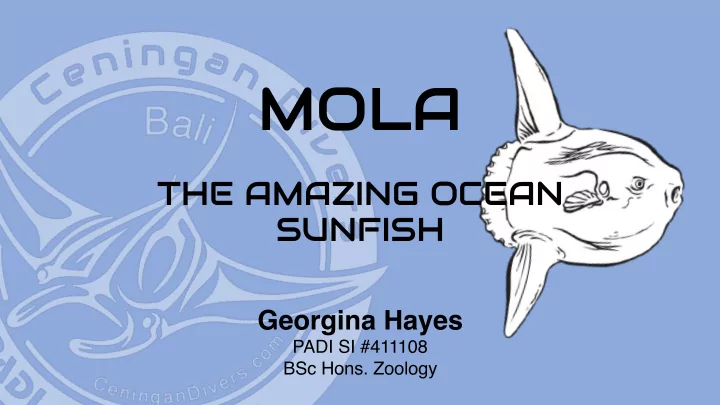
MOLA
THE AMAZING OCEAN SUNFISH
Georgina Hayes
PADI SI #411108 BSc Hons. Zoology
MOLA WHAT? Sunfish in Bali have almost always been referred to as - - PowerPoint PPT Presentation
MOLA THE AMAZING OCEAN SUNFISH Georgina Hayes PADI SI #411108 BSc Hons. Zoology MOLA WHAT? Sunfish in Bali have almost always been referred to as Mola Mola Actual species name is mola ramseyi or bumphead sunfish In
Georgina Hayes
PADI SI #411108 BSc Hons. Zoology
been referred to as Mola Mola
ramseyi” or “bumphead sunfish”
had actually been already described in 1839 as “mola alexandrini” and this is the mola’s true name.
(zubludiving, 2019)
heaviest known bony fish – can weigh up to 1000kg!
range between 10 and 27.5∘ C and depths from the surface to 250 m. Dive depths can extend below 400 m, They basically look like a giant squashed football!
(zubludiving, 2019)
This unusual fish swims by flapping its long pectoral and dorsal fins; the caudal fin is used as a rudder (for steering) One of the interesting structures that ocean sunfish have is a thick layer of collagen just under the very thin, rough skin. This white tissue is hard and surrounds the body cavity of the fish. No one is sure
protection for the organs
nebshark.org
Skeleton of Mola mola By their “teenage years” they will no longer have a tail fin, no ribs, a fused spine and their beak like mouth will stay permanently open
(Naturhistorisches Museum Wien, 2009)
The female Mola can produce more eggs at once than any
At birth – Mola larvae are star shaped and the size of a pin head On a diet of jellyfish they can grow up to 60million times their
(G. David Johnson, 2005)
water and spit it out to attack prey
comb jellies – both deep and shallow water.
apart food.
(Georgina Hayes 2019)
mola season is known for it’s crazy thermoclines
and even dip lower
mola and temperature the “Bali Ocean Sunfish Research Project” have been using temperature logging devices underwater since 2013
they like to live in deep colder water – best time to see mola is when the water temperature drops! (June - October)
water to approach the surface to be cleaned
(Robert Delfs 2008)
are there to be cleaned
around mola have been found – hence the need for cleaning!
cleaning process
(Tamarind Divers 2019)
(Reinhard Dirscherl 2010) (MensJournal.com 2019) (University of Tasmania 2018)
help with identification, recognising individuals and species injury rates SO WHAT MAKES A GOOD PHOTO?
sides if possible is better
patterns
http://www.thebalisunfish.org/matchmymola/
DON’T FORGET THE DATA!
you get to name it!
http://www.thebalisunfish.org/matchmymola/
view.
approach until the cleaning has begun and the fish have been stationary for at least 1 minute.
the closest sunfish when animal is at a cleaning station.
when an animal is unsettled (not in cleaning) and considering approach to the reef.
(Coral Triangle Centre – MMF)
animal.
cleaning behaviour.
If you touch it, you will remove the layer of mucus that protects it against infection.
(Coral Triangle Centre – MMF)
vehicles or make unnecessary loud noises.
to 5 minutes when other groups are present.
the Code of Conduct. Follow the directions of your dive guide.
(Coral Triangle Centre – MMF)
(The Green Fins)
(The Green Fins)
research-project
two-tonne-fish-is-the-heaviest-of-its-kind/
facebook.com/ceningandivers Instagram.com/ceningandivers ceningandivers.com +62 821 45855934 (English/French) +62 822 37599484 (English, French, Italian, German, Spanish) Ceningan Divers