MOL2NET , 2019 , 5, ISSN: 2624-5078 2 - - PDF document

mol2net 2019 5 issn 2624 5078 2 http sciforum net
SMART_READER_LITE
LIVE PREVIEW

MOL2NET , 2019 , 5, ISSN: 2624-5078 2 - - PDF document

MOL2NET , 2019 , 5, ISSN: 2624-5078 1 http://sciforum.net/conference/mol2net-05 MDPI MOL2NET, International Conference Series on Multidisciplinary Sciences MODEC-04: Workshop on Natural Products and Agro-Industrial Procesess in Amazon, UEA, Puyo,


slide-1
SLIDE 1

MOL2NET, 2019, 5, ISSN: 2624-5078 1 http://sciforum.net/conference/mol2net-05

MDPI

MOL2NET, International Conference Series on Multidisciplinary Sciences MODEC-04: Workshop on Natural Products and Agro-Industrial Procesess in Amazon, UEA, Puyo, Ecuador, 2019

Preliminary update on structural and chemotaxonomical aspects of pharmacologically evaluated flavonoids

Sana Zouaoui (sanahamza971@gmail.com)a, Muhammad Farman (farman@qau.edu.pk)b Nabil Semmar (nabilsemmar5@gmail.com)a*

a BioInformatics, bioMathematics & bioStatistics Laboratory (BIMS). Pasteur Institute of Tunis.

University of Tunis El Manar. Tunisia.

b Department of Chemistry, Quaid-i-Azam University, Islamabad-45320, Pakistan

Graphical Abstract

  • Abstract. This communication presents a

preliminary update

  • n

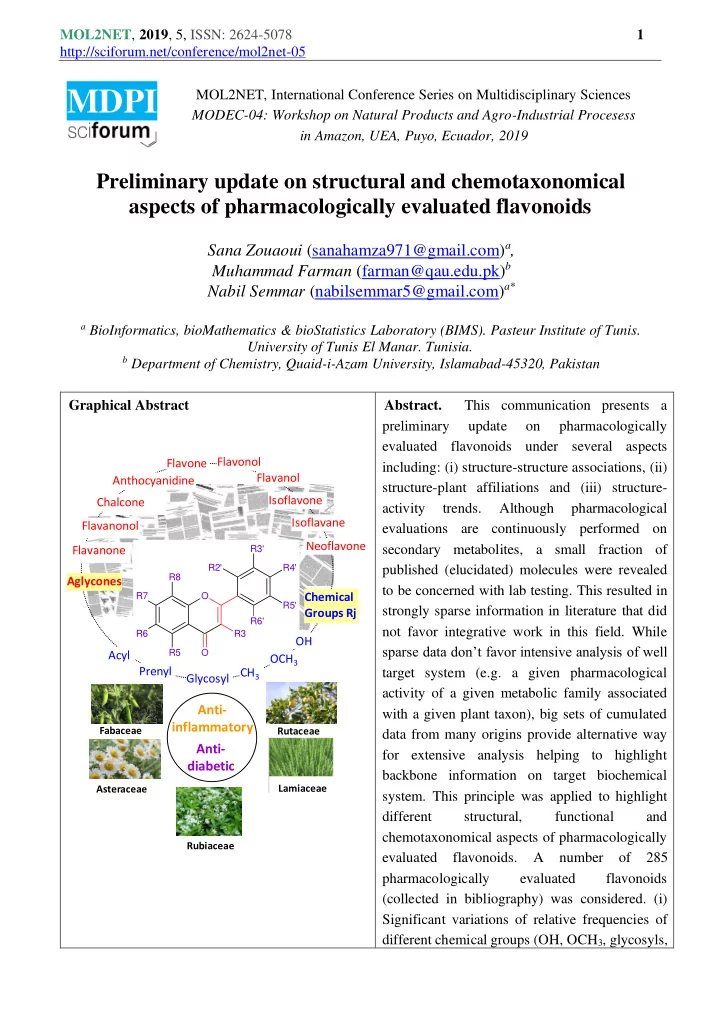
pharmacologically evaluated flavonoids under several aspects including: (i) structure-structure associations, (ii) structure-plant affiliations and (iii) structure- activity trends. Although pharmacological evaluations are continuously performed on secondary metabolites, a small fraction of published (elucidated) molecules were revealed to be concerned with lab testing. This resulted in strongly sparse information in literature that did not favor integrative work in this field. While sparse data don’t favor intensive analysis of well target system (e.g. a given pharmacological activity of a given metabolic family associated with a given plant taxon), big sets of cumulated data from many origins provide alternative way for extensive analysis helping to highlight backbone information on target biochemical

  • system. This principle was applied to highlight

different structural, functional and chemotaxonomical aspects of pharmacologically evaluated flavonoids. A number

  • f

285 pharmacologically evaluated flavonoids (collected in bibliography) was considered. (i) Significant variations of relative frequencies of different chemical groups (OH, OCH3, glycosyls,

Chemical Groups Rj OH OCH3 Glycosyl Aglycones Flavanone Flavanonol Flavone Chalcone Anthocyanidine Flavonol Isoflavone Isoflavane Neoflavone Prenyl

Fabaceae Rutaceae Asteraceae Lamiaceae

Anti- inflammatory Anti- diabetic

CH3

O R3 O R5 R6 R7 R8 R3' R4' R5' R2' R6'

Rubiaceae

Acyl Flavanol

slide-2
SLIDE 2

MOL2NET, 2019, 5, ISSN: 2624-5078 2 http://sciforum.net/conference/mol2net-05 prenyl) were highlighted in different flavonoid

  • aglycones. (ii) Different plant families were

revealed to be characterized by clear structural differentiation ways based on relatively high frequencies of some aglycones and chemical

  • groups. (iii) Different chemical groups occurring

in some carbons of aglycones showed positive or negative effects on anti-inflammatory and antidiabetic activities (benefitting from more available data).

  • Introduction. This communication presents a preliminary update on structural and functional order of

pharmacologically evaluated flavonoids. It is a preliminary original work providing an initial statistical step for further valorization of sparse information available in bibliography. Such a sparse aspect represented a constraint toward integrative studies until now. However, extensive cumulation of pharmacological data from many published sources provides an alternative efficient way to openly extract evolving backbone information in this widely promising field. Materials and Methods. Structure-Structure, structure-plant family and structure-activity trends were analyzed from 285 pharmacologically evaluated flavonoids belonging to different aglycone families and

  • riginated from different plant taxa (Mirossay et al., 2018; Cirmi et al., 2016; Panche et al., 2016; Xiao,

2015; Lago et al., 2014; Kumar et Pandey, 2013; Semmar, 2010). Nonparametric comparison and link tests as well as multivariate analyses were applied to highlight/detect such trends (Semmar, 2011, 2013).

  • Results. For structure-structure associations, OH and OCH3 showed opposite distributions of relative
  • ccurrences in overall chemical structural pool (Fig. 1a). Prenylation showed relatively higher
  • ccurrence in upstream flavonoids (chalcones, flavanones) and their immediate derivatives (isoflavanes,

isoflavones). Glycosylation (Gly) showed lower occurrence than other chemical substitutions; this could be linked a priori to lower testing trend of glycosides because of well-known negative effect of Gly on pharmacological activities. For structure-plant family affiliations, relatively high occurrences were recorded for (i) flavanones and flavones in Rutaceae, (ii) isoflavones and isoflavanes in Fabaceae, (iii) flavones in Lamiaceae, (iv) flavones and flavonols in Asteraceae, (v) neoflavones in Rubiaceae (Fig. 1b). Moreover, Fabaceae showed more heterogeneous phenolic profile than the other plant families. Plant families were also differentiated by relative occurrences of chemical groups: OH was relatively more frequent in Asteraceae, Fabaceae and Lamiaceae whereas OCH3 markedly characterized Rutaceae and Rubiaceae. Concerning pharmacological activities, antidiabetic (ADb) and anti-inflammatory (AInf) seemed to be influenced by types and positions of chemical groups, respectively (Fig. 1c): ADb seemed to be favored by hydroxylation and glycosylation vs opposite effect from OCH3. However, AInf showed positive links with 6-OCH3 and 7-OH vs negative effects from 8-OH, and 8-OCH3.

  • Conclusion. This preliminary work showed highly informative aspect of pharmacologically evaluated

flavonoids in matter of (i) chemical differentiation of plant families and (ii) links between structural traits and biological activities. The results call for further investigations in pharmacological evaluations

  • f flavonoids. They are openly ready for updates by considering further biologically evaluated

flavonoids as they are published.

slide-3
SLIDE 3

MOL2NET, 2019, 5, ISSN: 2624-5078 3 http://sciforum.net/conference/mol2net-05 Figure 1. (a) Relative occurrence levels of chemical groups in different flavonoid families. (b) Relative

  • ccurrence levels of aglycones in different plant families. (c) Statistically detected chemical groups and

substitution positions influencing anti-inflammatory and anti-diabetic activities of flavonoids. (a)

Neoflavone Isoflavone Isoflavane Flavonol Flavone Flavanol Flavanone Chalcone Catechine Anthocyanidine Asteraceae Lamiaceae Rutaceae Rubiaceae Fabaceae OH OCH3 Gly Prn Botanical Families Flavonoid families Chemical Groups

(b)

OH OCH3 Gly Prn C5' C4' C3' C8 C7 C6 C5 C3 OH OCH3 Glc Prn C5' C4' C3' C8 C7 C6 C5 C3 Anti-inflammatory activity Antidiabetic activity Substituted carbons of flavonoids Substituted carbons of flavonoids

(c)

O OH 2 3 4 1

Flavanol Flavone Flavanone Flavonol Isoflavone Isoflavane

O 2 3 4

Chalcone Anthocyanidin Neoflavone

OH OCH3 Gly Prn Anthocyanidine Chalcone Flavanone Flavanonol Flavanol Flavone Flavonol Isoflavane Isoflavone Neoflavone Chemical Groups Flavonoid Families Dominant Important Frequent Minor Dominant Important Frequent Minor Positive Effect Negative Effect

O O

slide-4
SLIDE 4

MOL2NET, 2019, 5, ISSN: 2624-5078 4 http://sciforum.net/conference/mol2net-05 References Cirmi S, Ferlazzo N, Lombardo GE, Ventura-Spagnolo E, Gangemi S, Calapai G, Navarra M, 2016. Neurodegenerative Diseases: Might Citrus Flavonoids Play a Protective Role?. Molecules, 21, 1312. Kumar S, Pandey AK, 2013. Chemistry and Biological Activities of Flavonoids: An Overview , The ScientificWorld Journal, 2013, 1-16. Lago JHG, Toledo-Arruda AC, Mernak M, Barrosa KH, Martins MA, Tibério IFLC, Prado CM,

  • 2014. Structure-Activity Association of Flavonoids in Lung Diseases , Molecules, 19, 3570-3595.

Mirossay L, Varinská L, Mojžiš J, 2018. Antiangiogenic Effect of Flavonoids and Chalcones: An Update , International Journal of Molecular Sciences, 19, 27. Panche AN, Diwan AD, Chandra SR, 2016. Flavonoids: an overview , Journal of Nutritional Science, 5, e47, 1-15. Semmar N, 2010. Chemotaxonomical analyses of herbaceous plants based on phenolic and terpenic

  • patterns. Nova Science Publishers, New York, 257p.

Semmar N, 2011. Computational metabolomics. Nova Science Publishers, New York, 238p. Semmar N, 2013. Native statistics for natural sciences. Nova Science Publishers, New York, 515p. Xiao J, 2015. Dietary Flavonoid Aglycones and Their Glycosides: Which Show Better Biological Significance? , Critical Reviews in Food Science and Nutrition, 57(9), 1874-1905. Xiao J, Capanoglu E, Jassbi AR, Miron A, 2015. Advance on the Flavonoid C-glycosides and Health Benefits , Critical Reviews in Food Science and Nutrition, 56:sup1, S29-S45