MOL2NET, 2018 , 4, http://sciforum.net/conference/mol2net-04 2 - - PDF document

mol2net 2018 4 http sciforum net conference mol2net 04 2
SMART_READER_LITE
LIVE PREVIEW

MOL2NET, 2018 , 4, http://sciforum.net/conference/mol2net-04 2 - - PDF document

MOL2NET, 2018 , 4, http://sciforum.net/conference/mol2net-04 1 MOL2NET, International Conference Series on Multidisciplinary Sciences MDPI Predicting Proteasome Inhibition using Atomic Weighted Vector and Machine Learning Yoan Martnez-Lpez


slide-1
SLIDE 1

MOL2NET, 2018, 4, http://sciforum.net/conference/mol2net-04 1

MDPI

MOL2NET, International Conference Series on Multidisciplinary Sciences

Predicting Proteasome Inhibition using Atomic Weighted Vector and Machine Learning

Yoan Martínez-Lópeza,b, Efrain Edgar Chaluisa Quishpea, Yaile Caballeroa,b, Stephen J. Barigye,c Francisco Torrensd and Juan Alberto Castillo-Garite

aDepartment of Computer Sciences, Faculty of Computer Sciences, Camagüey University, Camagüey

city, 74650, Camagüey, Cuba

bArtificial Intelligence Researches Group (AIRES), Faculty of Computer Sciences, Camagüey

University, Camagüey, Cuba

cDepartment of Chemistry, McGill University, 801 Sherbrooke Street West, MontreÌA˛al, QC H3A

0B8, Canada

dInstitut Universitari de Ciència Molecular, Universitat de València, Edifici d'Instituts de Paterna,

P.O. Box 22085, E-46071, València, Spain;

eUnidad de Toxicología Experimental, Universidad de Ciencias Médicas de Villa Clara, Carretera a

acueducto y circunvalación, Santa Clara, Villa Clara, Cuba. CP: 50200, Cuba. . Graphical Abstract Abstract. Ubiquitin/Proteasome System (UPS) is a highly regulated mechanism of intracellular protein degradation and turnover. Through the concerted actions of a series of enzymes, proteins are marked for proteasomal degradation by being linked to the polypeptide co-factor, ubiquitin. The UPS participates in a wide array of biological functions such as antigen presentation, regulation

  • f

gene transcription and the cell cycle, and activation

  • f NF-κB. Some researchers have applied QSAR

method and machine learning in the study of proteasome inhibition (EC50(µmol/L)), such as: the analysis of proteasome inhibition prediction, in the prediction of multi-target inhibitors of UPP and in the prediction of protein contact

  • map. Following this idea, we applied the new

tool for obtaining molecular descriptor for modeling

  • f

proteasome Inhibition EC50 (µmol/L), in which has used this novel molecular descriptors (MDs) and different classification algorithms for these quantitative structure- activity relationship (QSAR) studies. In the

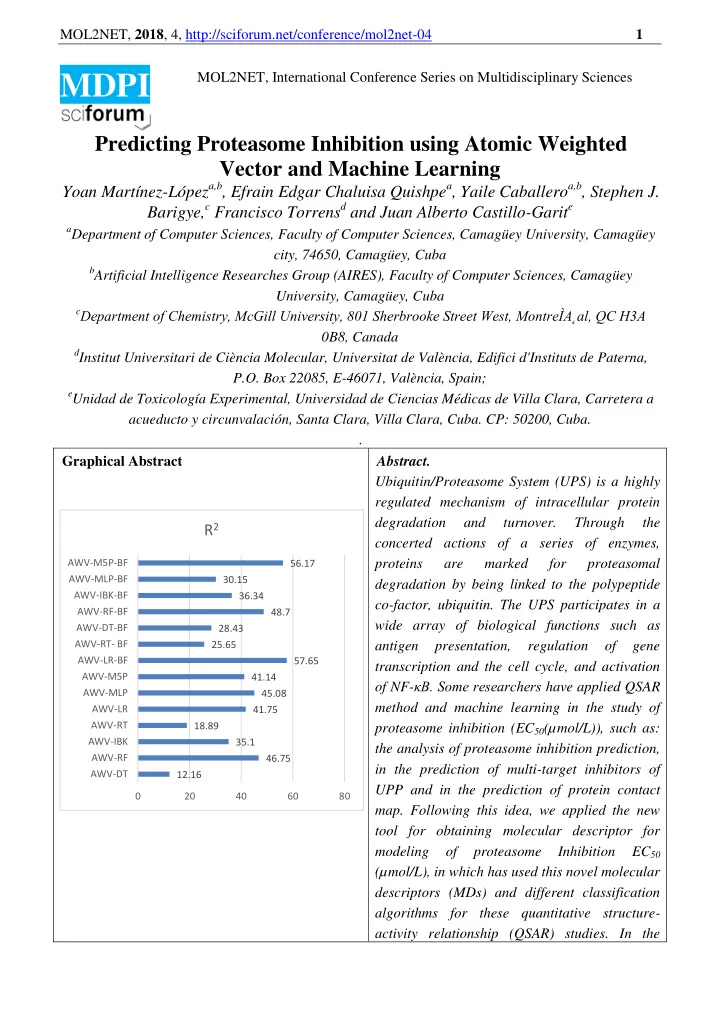
12.16 46.75 35.1 18.89 41.75 45.08 41.14 57.65 25.65 28.43 48.7 36.34 30.15 56.17 20 40 60 80 AWV-DT AWV-RF AWV-IBK AWV-RT AWV-LR AWV-MLP AWV-M5P AWV-LR-BF AWV-RT- BF AWV-DT-BF AWV-RF-BF AWV-IBK-BF AWV-MLP-BF AWV-M5P-BF

R2

slide-2
SLIDE 2

MOL2NET, 2018, 4, http://sciforum.net/conference/mol2net-04 2 present research, we use the Atomic Weighted Vector (AWV) as attributes with the objective to develop the QSAR modeling of this datasets and also compare a set of different machine learning (ML) techniques to solve this problem, such as: Linear Regression (LR), Multiple linear regression (MLR), Decision tree(DT), Regression Tree(RT), Random Forest(RF), M5P, K-nearest neighbors (IBK or kNN), Multi-Layer perceptron (MLP), Best-first search (BF) and Genetic Algorithm (GA). The figure shows the results of R2 of the ML-QSAR using ten- folds cross validation for 258 compounds. The results indicate that AWVs are very important tool for modeling the proteasome inhibitory regardless

  • f the ML algorithm used. It can be suggested

that the MD-AWV are suitable for codifying important structural information

  • f

the molecules and, thus, constitute an interesting alternative to building effective models for the prediction of the values of EC50 (µmol/L). References (mandatory)  Crawford, L.J., B. Walker, and A.E. Irvine, Proteasome inhibitors in cancer therapy. J Cell Commun Signal 2011. 5(2): p. 101–110.  Martínez-López, Y., et al., The Summation of Atomic Contributions is an Overly Simplified Characterization of the Holistic Molecular Behavior. Letters in Drug Design & Discovery, 2016. 13(7): p. 12.  Martínez-López, Y., et al., Prediction of aquatic toxicity of benzene derivatives using molecular descriptor from atomic weighted vectors. Environmental Toxicology and Pharmacology, 2017. 56:

  • p. 314-321.

 Castillo-Garit, J.A., et al., Machine learning-based models to predict modes of toxic action of phenols to Tetrahymena pyriformis. SAR QSAR Environ. Res. 2017, 28 (9), 735–747.  Martínez-López, Y., et al., State of the Art Review and Report of New Tool for Drug Discovery. Current Topics in Medicinal Chemistry, 2017. 17: p. 1-20.  Svetnik, V., et al., Random forest: a classification and regression tool for compound classification and QSAR modeling. Journal of chemical information and computer sciences, 2003. 43(6): p. 1947-1958.  Liaw, A. and M. Wiener, Classification and regression by randomForest. R news, 2002. 2(3): p. 18-22.  Zhan, C., A. Gan, and M. Hadi, Prediction of lane clearance time of freeway incidents using the M5P tree algorithm. IEEE Transactions on Intelligent Transportation Systems, 2011. 12(4): p. 1549-1557.

slide-3
SLIDE 3

MOL2NET, 2018, 4, http://sciforum.net/conference/mol2net-04 3  Quinlan, R.J., Learning with Continuous Classes., in 5th Australian Joint Conference on Artificial

  • Intelligence. 1992: Singapore. p. 343-348.

 Cover, T. and P. Hart, Nearest neighbor pattern classification. IEEE transactions on information theory, 1967. 13(1): p. 21-27.  Prasad, A.M., L.R. Iverson, and A. Liaw, Newer classification and regression tree techniques: bagging and random forests for ecological prediction. Ecosystems, 2006. 9(2): p. 181-199.  Hess, K.R., et al., Classification and regression tree analysis of 1000 consecutive patients with unknown primary carcinoma. Clinical Cancer Research, 1999. 5(11): p. 3403-3410.