
MOL2NET, 2018, 4, http://sciforum.net/conference/mol2net-04 1
MDPI
MOL2NET, International Conference Series on Multidisciplinary Sciences
A preliminary assessment of the differences between the Malaysian and Bangladesh strains of the highly lethal Nipah virus
Proyasha Roya, Sumanta Deya, Tathagata Duttaa, Ashesh Nandya and Subhas C Basakb
a Centre for Interdisciplinary Research and Education, 404B Jodhpur Park, Kolkata 700058, India b Department of Chemistry and Biochemistry, University of Minnesota Duluth, 1802 Stanford Avenue,
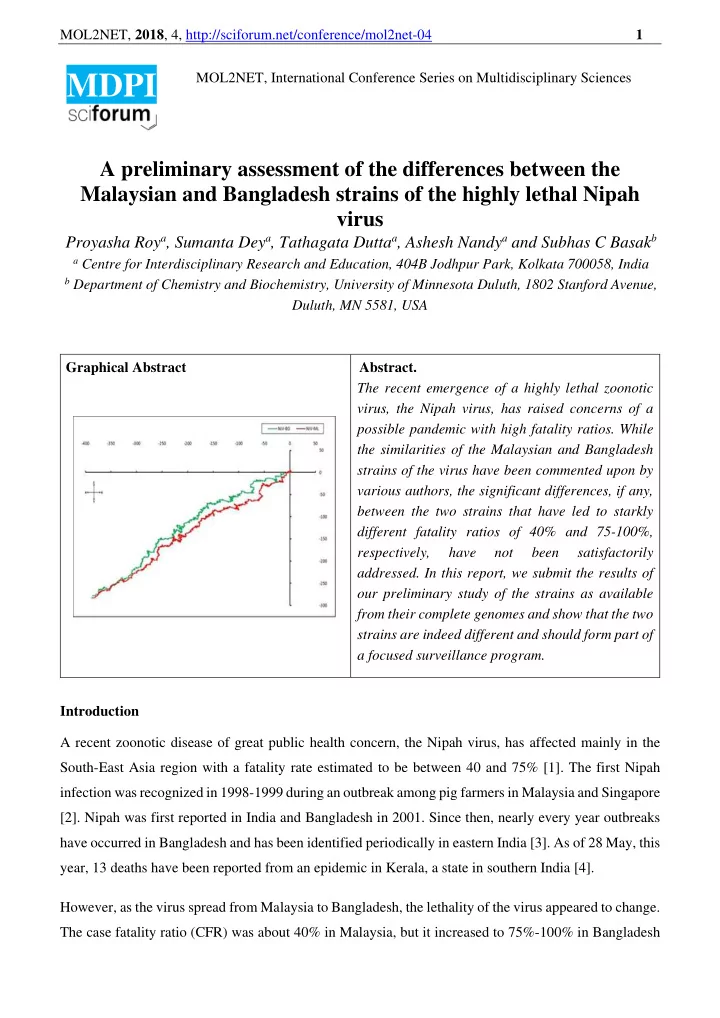
Duluth, MN 5581, USA Graphical Abstract Abstract. The recent emergence of a highly lethal zoonotic virus, the Nipah virus, has raised concerns of a possible pandemic with high fatality ratios. While the similarities of the Malaysian and Bangladesh strains of the virus have been commented upon by various authors, the significant differences, if any, between the two strains that have led to starkly different fatality ratios of 40% and 75-100%, respectively, have not been satisfactorily
- addressed. In this report, we submit the results of
- ur preliminary study of the strains as available
from their complete genomes and show that the two strains are indeed different and should form part of a focused surveillance program. Introduction A recent zoonotic disease of great public health concern, the Nipah virus, has affected mainly in the South-East Asia region with a fatality rate estimated to be between 40 and 75% [1]. The first Nipah infection was recognized in 1998-1999 during an outbreak among pig farmers in Malaysia and Singapore [2]. Nipah was first reported in India and Bangladesh in 2001. Since then, nearly every year outbreaks have occurred in Bangladesh and has been identified periodically in eastern India [3]. As of 28 May, this year, 13 deaths have been reported from an epidemic in Kerala, a state in southern India [4]. However, as the virus spread from Malaysia to Bangladesh, the lethality of the virus appeared to change. The case fatality ratio (CFR) was about 40% in Malaysia, but it increased to 75%-100% in Bangladesh