MODULE SPECIFICATION FORM Module Title: Level: 4 Credit Value: 20 - - PDF document

module specification form module title level 4 credit
SMART_READER_LITE
LIVE PREVIEW

MODULE SPECIFICATION FORM Module Title: Level: 4 Credit Value: 20 - - PDF document

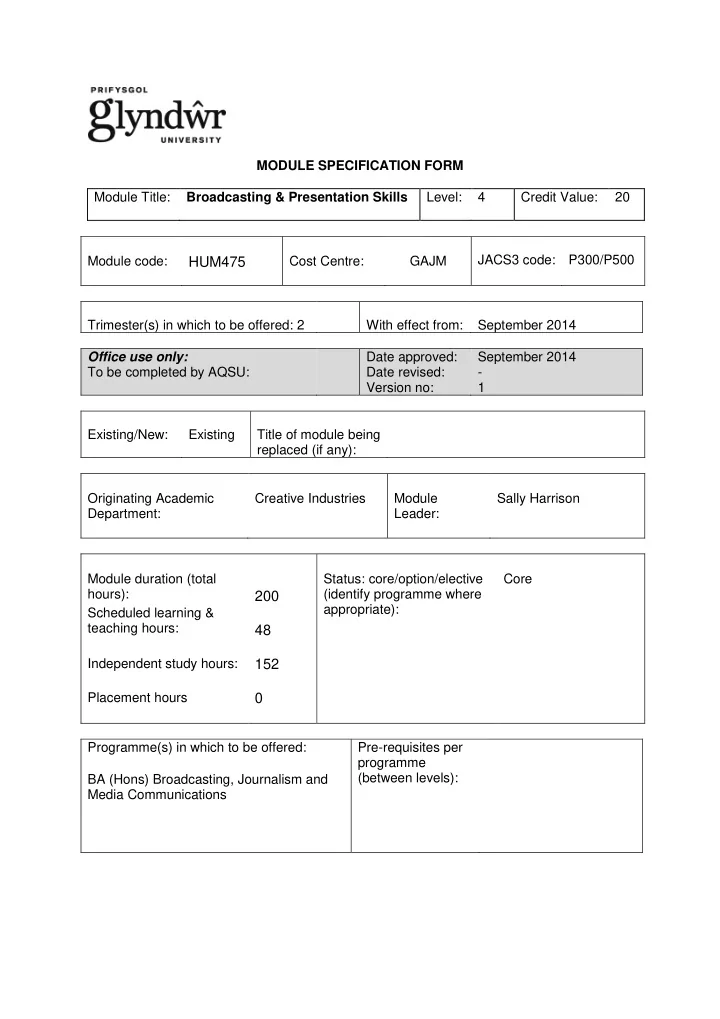
MODULE SPECIFICATION FORM Module Title: Level: 4 Credit Value: 20 Broadcasting & Presentation Skills Module code: Cost Centre: GAJM JACS3 code: P300/P500 HUM475 Trimester(s) in which to be offered: 2 With effect from: September 2014


slide-1
SLIDE 1

MODULE SPECIFICATION FORM Module Title: Broadcasting & Presentation Skills Level: 4 Credit Value: 20 Module code:

HUM475

Cost Centre: GAJM JACS3 code: P300/P500 Trimester(s) in which to be offered: 2 With effect from: September 2014 Office use only: To be completed by AQSU: Date approved: Date revised: Version no: September 2014

  • 1

Existing/New: Existing Title of module being replaced (if any): Originating Academic Department: Creative Industries Module Leader: Sally Harrison Module duration (total hours):

200

Status: core/option/elective (identify programme where appropriate): Core Scheduled learning & teaching hours:

48

Independent study hours:

152

Placement hours Programme(s) in which to be offered: BA (Hons) Broadcasting, Journalism and Media Communications Pre-requisites per programme (between levels):

slide-2
SLIDE 2

Module Aims: This module focuses on key skills for personal presentation and projection, including the essential communication and personal competencies required for broadcasting and public relations, familiarisation with broadcast studio and technical processes, practical experience

  • f writing and developing project work suitable for the media industry. The module is

designed to help students to:

acquire an understanding of the essential requirements of media professions, in terms

  • f generic skills, understanding, and personal qualities.

cultivate personal poise and confidence along with fluid and articulate communication skills which can ultimately be demonstrated in group or individual presentations.

Develop a critical awareness that is self-reflexive and keenly aware of the needs and demands of the client/audience. Intended Learning Outcomes Knowledge and Understanding Students will be able to:

  • 1. Demonstrate familiarity with and knowledge of key processes and skills involved

in various forms of presentation, (KS1,KS4)

  • 2. Understand the processes involved in preparing for a range of encounters from
  • ne-to-one encounters to small groups and broadcasts. (KS2, KS3)
  • 3. Know how to present information to an audience coherently, confidently and
  • convincingly. (KS3, KS4, KS6)
  • 4. Demonstrate a general repertoire of personal and technical communication skills,

in addition to enhanced confidence and a professional delivery style, with a broad understanding of the ways in which specific media and their attendant technologies make possible different kinds of aesthetic effects and forms (K1,K4, K8) Key skills for employability

  • 1. Written, oral and media communication skills
  • 2. Leadership, team working and networking skills
  • 3. Opportunity, creativity and problem solving skills
  • 4. Information technology skills and digital literacy
  • 5. Information management skills
  • 6. Research skills
  • 7. Intercultural and sustainability skills
  • 8. Career management skills
  • 9. Learning to learn (managing personal and professional development, self management)
  • 10. Numeracy
slide-3
SLIDE 3

Assessment: Indicative Assessment For both Assignments, students will be required to choose from a selection of detailed briefs which involve the research, preparation and presentation of material within an appropriate format to an assembled group and to a broadcast audience.

Assessment Learning

  • utcomes to

be met Type of assessment Weighting Duration (if exam) Word count (if coursework) Assignment I Project 50% 2,000 words Assignment II All Project 50% 2,000 words

Learning and Teaching Strategies: The module will be delivered through a combination of formal lectures and practical class and studio exercises designed to replicate the professional environment of the meeting or broadcast studio, providing opportunities for student development through practice. Students will be encouraged to develop these through practical presentation activities. The module will be delivered on the basis of established professional practices from effective public speaking which govern the preparation and effective delivery of verbal information to a live or unseen audience Syllabus outline: The module will cover a range of examples and forms of media communication practices and, through extended practice, develop and apply their own presentation and broadcasting skills. This will include: Forms of personal and Public presentation. The application of key principles of effective speaking to all aspects of programme presentation including voice quality, fluency, enthusiasm, projection, body language, resonance, breathing, confidence, poise and other attributes key to interpersonal communications in the broadcast environment. This will embrace three basic aspects:

Controlling your material

Controlling yourself

Controlling your audience Tuition will be provided on voice quality, audience contact, projection, breathing, body language, confidence & poise. Media Communications skills. Essential skills in research, scriptwriting, speechwriting, and editing as well as practising interviewing techniques and presentations to a group. There will also be coverage of technical capabilities including use of recording and storage technology and by working in the studio environment. Students will apply these practices to the creation

  • f effective and stimulating broadcasts along with confident and persuasive verbal

presentations.

slide-4
SLIDE 4

Bibliography Essential Reading Clayton, P. (2003), Body Language at Work. London: Duncan Petersen Publishing Ltd Crissell, A. (1994) Understanding Radio. London & New York: Routledge. Hargie, O. (2004) Skilled Interpersonal Communication London & New York: Routledge. Stewart, P. (2010) Essential Radio Skills: How to Present a Radio Show. London: A & C Black Publishing Ltd. Weissman, J. (2008), Presenting to Win New Jersey: Prentice Hall. The Radio Journal: International Studies in Broadcast & Audio Media Journal of Radio and Audio Media