Module 4: Building Working with Standard Dimensions Dimensions - - PDF document

module 4 building
SMART_READER_LITE
LIVE PREVIEW

Module 4: Building Working with Standard Dimensions Dimensions - - PDF document

Overview Understanding Dimension Basics Shared vs. Private Dimensions Module 4: Building Working with Standard Dimensions Dimensions Using the Basic Level Properties Working with Parent-Child Dimensions Dimension Editor


slide-1
SLIDE 1

1

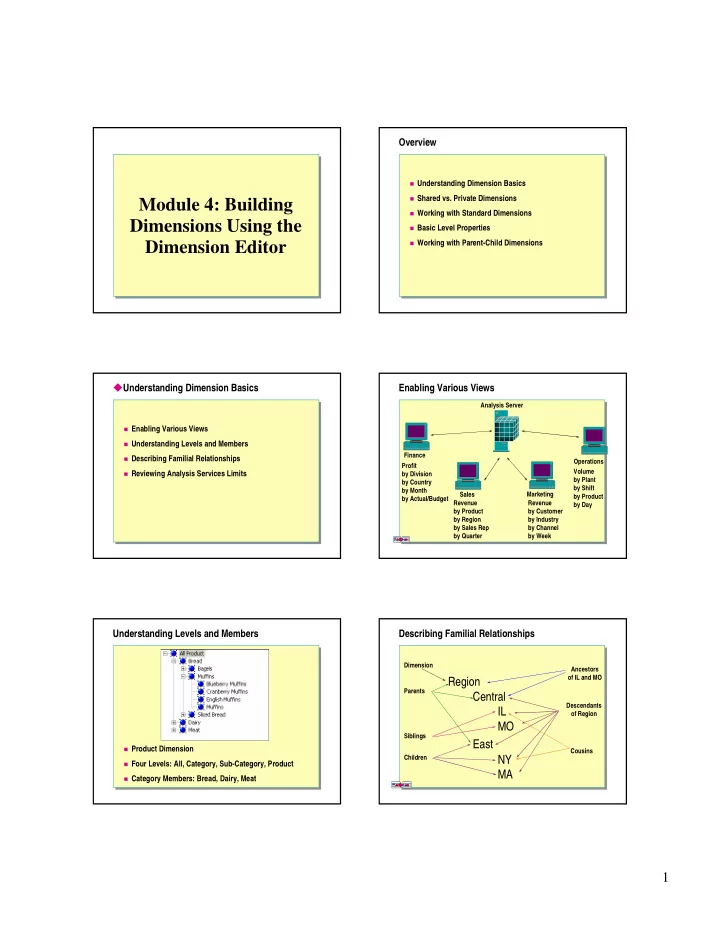
Module 4: Building Dimensions Using the Dimension Editor

Overview

Understanding Dimension Basics Shared vs. Private Dimensions Working with Standard Dimensions Basic Level Properties Working with Parent-Child Dimensions

Understanding Dimension Basics

Enabling Various Views Understanding Levels and Members Describing Familial Relationships Reviewing Analysis Services Limits

Enabling Various Views

Finance Operations Profit by Division by Country by Month by Actual/Budget Revenue by Product by Region by Sales Rep by Quarter Revenue by Customer by Industry by Channel by Week Sales Marketing Volume by Plant by Shift by Product by Day Analysis Server

Understanding Levels and Members

Product Dimension Four Levels: All, Category, Sub-Category, Product Category Members: Bread, Dairy, Meat

Region Central IL MO East NY MA

Dimension Children Siblings Ancestors

  • f IL and MO

Parents Descendants

  • f Region

Cousins

Describing Familial Relationships

slide-2
SLIDE 2

2

Reviewing Analysis Services Limits

Limits Items 24 characters Length of dimension name 64,000 Members per parent 64 Levels per dimension 256 Levels per cube 128 Dimensions per cube 65,535 Levels per database 65,535 Dimensions per database

Shared vs. Private Dimensions

Working with Shared Dimensions Working with Private Dimensions

Working with Shared Dimensions

Created Once and Shared by One or More Cubes in a

Database

Cannot Be Changed to Private Maintained in Dimension Editor Administered in One Place Cause All Cubes Using that Dimension to be

Unavailable for Querying After Rebuilding Structure

Identified by a Sharing Hand Icon:

Working with Private Dimensions

Created and Used within Single Cube Maintained in Cube Editor, Not Dimension Editor Cannot Be Changed to Shared Rebuilt Automatically with Cube Process Identified by Dimension Icon:

Working with Standard Dimensions

San Jose La Jolla California Denver Colorado Chicago Peoria Springfield Illinois USA

Country State City

Each Level Corresponds to a Dimension Table Column All Members at a Given Level Have the Same Number of

Ancestors

Basic Level Properties

Assigning Member Keys and Names Identifying Uniqueness of Members Creating Members from Expressions Working with Ragged Dimensions Understanding Snowflake Dimensions Defining the All Level Specifying a Default Member

slide-3
SLIDE 3

3

Assigning Member Keys and Names

Defining the Member Key Column Determines the members included in a level Usually comes from a single dimension table column Defining the Member Name Column Provides names for members at a level Can be different from the Member Key Column Sorting Members in a Level Order by key Order by name Order by member property

Identifying Uniqueness of Members

Member Keys Unique Works with the Member Key Column Is set as a dimension or level property Affects cube processing performance with True setting Cannot be set within a parent-child dimension Member Names Unique Works with the Member Name Column Is set as a dimension or level property Affects member naming in MDX with True setting

Creating Members from Expressions

Add Flexibility When Defining Levels Are Created from One or More Columns in a Single

Table

Are Defined in the Member Key Column and Member

Name Column in the Dimension Editor

Act as RDBMS Pass-Through Functions Must be Valid RDBMS Syntax

Working with Ragged Dimensions

Country State City

San Jose La Jolla California Chicago Illinois USA Tel Aviv Haifa Israel All

No States

Variable Depth in Branches Level Property Hide Member If

Understanding Snowflake Dimensions

Fact Table Dimension Tables

Defining the All Level

Summarizes All Data at Top Level of Dimension Is Included by Default Is Named All DimensionName by Default For example, All Product Can Be Turned Off within the Dimension Editor Cannot Be Defined by the Member Key Column or the

Member Name Column

Can Be Renamed Using the All Caption Property

slide-4
SLIDE 4

4

Specifying a Default Member Lab A: Creating a Standard Dimension Lab B: Creating a Snowflake Dimension Working with Parent-Child Dimensions

Overview of Parent-Child Dimensions Structure of a Parent-Child Dimension Members with Data Parent-Child Level Management Skipped Levels Column

Overview of Parent-Child Dimensions

Are Based on a Two Column Dimension Table Contain Levels Created by Parent-Child

Relationships

Contain Unbalanced Levels Are Created with the Dimension Wizard Can Slow Queries that Reference Them

Structure of a Parent-Child Dimension

Block Fox Smart Hunt Hart Knight Jones White Smith Hunt Smart Hart Hunt Hart Fox Jones Knight Jones Hart Jones Block Smith White Smith Jones <none> Smith Manager Employee

slide-5
SLIDE 5

5

Members with Data

In Standard Dimensions, Only Leaf Members Can

Correspond to Fact Table Data

In Parent-Child Dimensions, Leaf and Upper Level

Members Correspond to Fact Table Data

The Members with Data Property Has Three Possible

Settings:

Leaf Members Only Non-leaf Data Hidden Non-leaf Data Visible

Parent-Child Level Management Skipped Levels Column

Creates Ragged Hierarchies within Parent-Child

Dimensions

Uses a Column in the Dimension Table that Contains the

Number of Levels to Skip

Is Accessed from the Advanced Tab of the Properties

Pane

Lab C: Creating a Parent-Child Dimension Review

Understanding Dimension Basics Shared vs. Private Dimensions Working with Standard Dimensions Basic Level Properties Working with Parent-Child Dimensions