Module 2: Computer-System Structures Computer-System Operation I/O - - PDF document

module 2 computer system structures
SMART_READER_LITE
LIVE PREVIEW

Module 2: Computer-System Structures Computer-System Operation I/O - - PDF document

' $ Module 2: Computer-System Structures Computer-System Operation I/O Structure Storage Structure Storage Hierarchy Hardware Protection General System Architecture & % Operating System Concepts 2.1 Silberschatz


slide-1
SLIDE 1 ' & $ %

Module 2: Computer-System Structures

  • Computer-System Operation
  • I/O Structure
  • Storage Structure
  • Storage Hierarchy
  • Hardware Protection
  • General System Architecture

Operating System Concepts 2.1 Silberschatz and Galvin c 1998

' & $ %

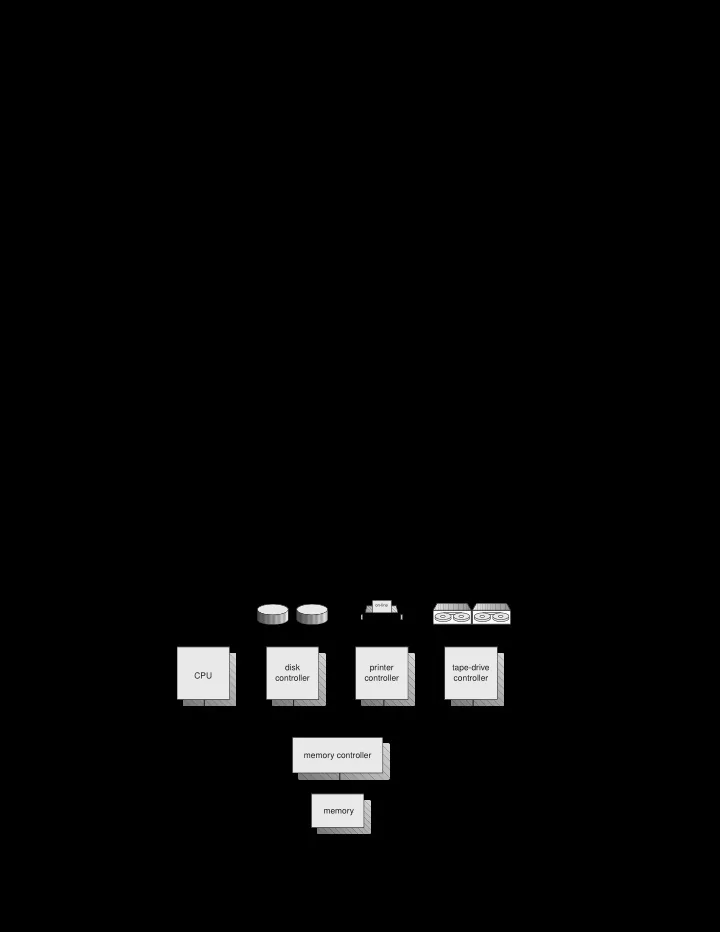
Computer-System Architecture

tape drives printer disk disk CPU disk controller printer controller tape-drive controller memory memory controller system bus

  • n-line

Operating System Concepts 2.2 Silberschatz and Galvin c 1998

slide-2
SLIDE 2 ' & $ %

Computer-System Operation

  • I/O devices and the CPU can execute concurrently.
  • Each device controller is in charge of a particular device type.
  • Each device controller has a local buffer.
  • CPU moves data from/to main memory to/from the local buffers.
  • I/O is from the device to local buffer of controller.
  • Device controller informs CPU that it has finished its operation

by causing an interrupt.

Operating System Concepts 2.3 Silberschatz and Galvin c 1998

' & $ %

Common Functions of Interrupts

  • Interrupt transfers control to the interrupt service routine,

generally, through the interrupt vector, which contains the addresses of all the service routines.

  • Interrupt architecture must save the address of the interrupted

instruction.

  • Incoming interrupts are disabled while another interrupt is

being processed to prevent a lost interrupt.

  • A trap is a software-generated interrupt caused either by an

error or a user request.

  • An operating system is interrupt driven.

Operating System Concepts 2.4 Silberschatz and Galvin c 1998

slide-3
SLIDE 3 ' & $ %

Interrupt Handling

  • The operating system preserves the state of the CPU by

storing registers and the program counter.

  • Determines which type of interrupt has occurred:

– polling – vectored interrupt system

  • Separate segments of code determine what action should be

taken for each type of interrupt.

Operating System Concepts 2.5 Silberschatz and Galvin c 1998

' & $ %

I/O Structure

  • After I/O starts, control returns to user program only upon I/O

completion. – wait instruction idles the CPU until the next interrupt. – wait loop (contention for memory access). – at most one I/O request is outstanding at a time; no simultaneous I/O processing.

  • After I/O starts, control returns to user program without waiting

for I/O completion. – System call – request to the operating system to allow user to wait for I/O completion. – Device-status table contains entry for each I/O device indicating its type, address, and state. – Operating system indexes into I/O device table to determine device status and to modify table entry to include interrupt.

Operating System Concepts 2.6 Silberschatz and Galvin c 1998

slide-4
SLIDE 4 ' & $ %

Direct Memory Access (DMA) Structure

I/O devices Memory CPU I/O instructions

  • Used for high-speed I/O devices able to transmit information at

close to memory speeds.

  • Device controller transfers blocks of data from buffer storage

directly to main memory without CPU intervention.

  • Only one interrupt is generated per block, rather than the one

interrupt per byte.

Operating System Concepts 2.7 Silberschatz and Galvin c 1998

' & $ %

Storage Structure

  • Main memory – only large storage media that the CPU can

access directly.

  • Secondary storage – extension of main memory that provides

large nonvolatile storage capacity.

  • Magnetic disks – rigid metal or glass platters covered with

magnetic recording material. – Disk surface is logically divided into tracks, which are subdivided into sectors. – The disk controller determines the logical interaction between the device and the computer.

Operating System Concepts 2.8 Silberschatz and Galvin c 1998

slide-5
SLIDE 5 ' & $ %

Storage Hierarchy

  • Storage systems organized in hierarchy:

– speed – cost – volatility

  • Caching – copying information into faster storage system; main

memory can be viewed as a fast cache for secondary storage.

Operating System Concepts 2.9 Silberschatz and Galvin c 1998

' & $ %

Storage-Device Hierarchy

magnetic tapes

  • ptical disk

magnetic disk electronic disk cache main memory registers

Operating System Concepts 2.10 Silberschatz and Galvin c 1998

slide-6
SLIDE 6 ' & $ %

Hardware Protection

  • Dual-Mode Operation
  • I/O Protection
  • Memory Protection
  • CPU Protection

Operating System Concepts 2.11 Silberschatz and Galvin c 1998

' & $ %

Dual-Mode Operation

  • Sharing system resources requires operating system to ensure

that an incorrect program cannot cause other programs to execute incorrectly.

  • Provide hardware support to differentiate between at least two

modes of operations.

  • 1. User mode – execution done on behalf of a user.
  • 2. Monitor mode (also supervisor mode or system mode) –

execution done on behalf of operating system.

Operating System Concepts 2.12 Silberschatz and Galvin c 1998

slide-7
SLIDE 7 ' & $ %

Dual-Mode Operation (Cont.)

  • Mode bit added to computer hardware to indicate the current

mode: monitor (0) or user (1).

  • When an interrupt or fault occurs hardware switches to monitor

mode

user monitor interrupt/fault set user mode

  • Privileged instructions can be issued only in monitor mode.

Operating System Concepts 2.13 Silberschatz and Galvin c 1998

' & $ %

I/O Protection

  • All I/O instructions are privileged instructions.
  • Must ensure that a user program could never gain control of

the computer in monitor mode (i.e., a user program that, as part of its execution, stores a new address in the interrupt vector).

Operating System Concepts 2.14 Silberschatz and Galvin c 1998

slide-8
SLIDE 8 ' & $ %

Memory Protection

  • Must provide memory protection at least for the interrupt vector

and the interrupt service routines.

  • In order to have memory protection, add two registers that

determine the range of legal addresses a program may access: – base register – holds the smallest legal physical memory address. – limit register – contains the size of the range.

  • Memory outside the defined range is protected.

Operating System Concepts 2.15 Silberschatz and Galvin c 1998

' & $ %

Example of Memory Protection

monitor job 1 job 2 job 3 job 4 1024000 880000 420940 300040 256000 300040 base register 120900 limit register

Operating System Concepts 2.16 Silberschatz and Galvin c 1998

slide-9
SLIDE 9 ' & $ %

Protection Hardware

CPU trap to operating system monitor—addressing error memory base + limit base address yes yes no no

≥ <

  • When executing in monitor mode, the operating system has

unrestricted access to both monitor and users’ memory.

  • The load instructions for the base and limit registers are

privileged instructions.

Operating System Concepts 2.17 Silberschatz and Galvin c 1998

' & $ %

CPU Protection

  • Timer – interrupts computer after specified period to ensure
  • perating system maintains control.

– Timer is decremented every clock tick. – When timer reaches the value 0, an interrupt occurs.

  • Timer commonly used to implement time sharing.
  • Timer also used to compute the current time.
  • Load-timer is a privileged instruction.

Operating System Concepts 2.18 Silberschatz and Galvin c 1998

slide-10
SLIDE 10 ' & $ %

General-System Architecture

  • Given that I/O instructions are privileged, how does the user

program perform I/O?

  • System call – the method used by a process to request action

by the operating system. – Usually takes the form of a trap to a specific location in the interrupt vector. – Control passes through the interrupt vector to a service routine in the OS, and the mode bit is set to monitor mode. – The monitor verifies that the parameters are correct and legal, executes the request, and returns control to the instruction following the system call.

Operating System Concepts 2.19 Silberschatz and Galvin c 1998