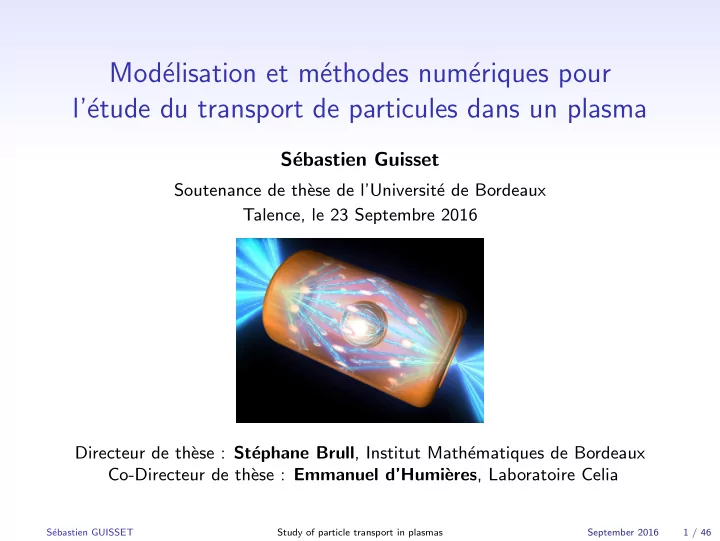
Mod elisation et m ethodes num eriques pour l etude du transport - - PowerPoint PPT Presentation

mod elisation et m ethodes num eriques pour l etude du
SMART_READER_LITE
LIVE PREVIEW

Mod elisation et m ethodes num eriques pour l etude du transport - - PowerPoint PPT Presentation

Mod elisation et m ethodes num eriques pour l etude du transport de particules dans un plasma S ebastien Guisset Soutenance de th` ese de lUniversit e de Bordeaux Talence, le 23 Septembre 2016 Directeur de th` ese :


slide-1
SLIDE 1

Mod´ elisation et m´ ethodes num´ eriques pour l’´ etude du transport de particules dans un plasma

S´ ebastien Guisset

Soutenance de th` ese de l’Universit´ e de Bordeaux Talence, le 23 Septembre 2016 Directeur de th` ese : St´ ephane Brull, Institut Math´ ematiques de Bordeaux Co-Directeur de th` ese : Emmanuel d’Humi` eres, Laboratoire Celia

S´ ebastien GUISSET Study of particle transport in plasmas September 2016 1 / 46

slide-2
SLIDE 2

Physical context

֒ → Contribution to the modelling and numerical methods for the transport of charged particles in plasmas ֒ → Hot plasmas created by lasers General context: Understanding of the processes leading to ignition of the fusion reactions by inertial confinement Multiphysics processes:

◮ Laser-plasma absorption ◮ Neutron production ◮ Radiative transfer ◮ Transport of particles

Related research areas:

◮ Hypersonic flows ◮ Radiotherapy ◮ Magnetic confinement fusion ◮ Astrophysics

֒ → long time regimes studies (hydrodynamics scales)

S´ ebastien GUISSET Study of particle transport in plasmas September 2016 2 / 46

slide-3
SLIDE 3

Outline

  • 1. Modelling in plasma physics: the angular moments models
  • 2. Numerical methods for the study of the particle transport on large

scales

  • 3. First step towards multi-species modelling: the angular M1 model in a

moving frame

  • 4. Conclusion / Perspectives

S´ ebastien GUISSET Study of particle transport in plasmas September 2016 3 / 46

slide-4
SLIDE 4

Modelling

Plasma: set of totally ionised atoms. Electronic transport, fixed ions Kinetic description: electron distribution function f (t, x, v), ֒ → Resolution of the Vlasov or Fokker-Planck-Landau equation ∂f ∂t + v.∇xf

  • advection term

+ qα mα (E + v × B).∇vf

  • force

term

= Cee(f , f ) + Cei(f ),

  • collisional

terms

Accurate but numerically expensive (usually limited to short scales) Hydrodynamic description: cheap but less accurate for far equilibrium regimes ֒ → describe kinetic effects on fluid time scales is challenging! ֒ → Intermediate description, angular moment models.

S´ ebastien GUISSET Study of particle transport in plasmas September 2016 4 / 46

slide-5
SLIDE 5

Angular moments models

֒ → Angular moments extraction: v = ζ Ω with ζ = |v|. f0(ζ) = ζ2

  • S2

f (v)dΩ, f1(ζ) = ζ2

  • S2

f (v)ΩdΩ, f2(ζ) = ζ2

  • S2

f (v)Ω ⊗ ΩdΩ. Set of admissible states1 A =

  • (f0, f1) ∈ R × R3, f0 ≥ 0,

|f1| ≤ f0

  • .

Angular moments model      ∂tf0 + ∇x.(ζf1) + q m ∂ζ(f1.E) = 0, ∂tf1 + ∇x.(ζf2) + q m ∂ζ(f2E) − q mζ (f0E − f2E) − q m (f1 ∧ B) = 0. ֒ → Closure relation?

  • 1D. Kershaw, Tech. Report (1976).

S´ ebastien GUISSET Study of particle transport in plasmas September 2016 5 / 46

slide-6
SLIDE 6

The PN closure

Spherical Harmonic expansion2 f (t, x, ζ, Ω) = 1 4π

+∞

  • n=0

n

  • m=−n

Am

n f m n (t, x, ζ)Y m n (Ω),

with Y m

n (Ω) = P|m| n

(cos θ)eimϕ, Am

n = (2n + 1)(n − |m|)!

(n + |m|)! , and Pm

n (z) are the associated Legendre functions3.

֒ → Positivity of the distribution function is required ֒ → Positive PN closure 4 ֒ → We prefer a closure based on a entropy minimisation criterion5

2Pomraning, Pergamon Press (1973). 3Abramowitz and Stegun. Dover Publications (1964). 4Hauck and McLarreen. Siam J. Sci. Comput. (2010). 5G.N. Minerbo, J. Quant. Spectrosc. Ra. (1978).

S´ ebastien GUISSET Study of particle transport in plasmas September 2016 6 / 46

slide-7
SLIDE 7

The M1 closure

Determination of f2 as a function of f0 and f1: Entropy minimisation problem6,7. min

f ≥0

  • H(f ) / ∀ζ ∈ R+,

ζ2

  • S2 f (Ω, ζ)dΩ = f0(ζ),

ζ2

  • S2 f (Ω, ζ)ΩdΩ = f1(ζ)
  • ,

with H(f ) = ζ2

  • S2(f ln f − f )dΩ.

Entropy minimisation principle8: f (Ω, ζ) = exp(a0(ζ) + a1(ζ).Ω) ≥ 0,

◮ positivity ◮ hyperbolicity ◮ entropy dissipation

Expression of f2: f2 = 1 − χ(α) 2 Id + 3χ(α) − 1 2 f1 |f1| ⊗ f1 |f1|

  • f0,

with χ(α) = 1 + |α|2 + |α|4 3 , α = f1/f0.

6G.N. Minerbo, J. Quant. Spectrosc. Ra. (1978).

  • 7D. Levermore, J. Stat. Phys. (1996).
  • 8B. Dubroca and J.L. Feugeas. C. R. Acad. Sci. Paris Ser. I (1999).

S´ ebastien GUISSET Study of particle transport in plasmas September 2016 7 / 46

slide-8
SLIDE 8

Advantages and limitations of the M1 model

Advantages

◮ Intermediate models (compromise) ◮ Application to radiative transfer and radiotherapy ◮ Accurate for isotropic configurations or configurations with one dominant

direction9 Limitations

◮ Validity of angular moments models for kinetic plasma studies? ◮ Complex configurations in collisionless regimes10 (not presented here, see

chapter 2) ֒ → Adapted for collisional plasma applications

9Dubroca, Feugeas and Frank. Eur. Phys. J. (2010). 10Guisset, Moreau, Nuter, Brull, d’Humi`

eres, Dubroca, Tikhonchuk. J. Phys. A

  • Math. Theor. (2015).

S´ ebastien GUISSET Study of particle transport in plasmas September 2016 8 / 46

slide-9
SLIDE 9

Collisional operators

Electronic Fokker-Planck-Landau equation ∂f ∂t + v.∇xf + q m (E + v × B).∇vf = Cee(f , f ) + Cei(f ), Cee(f , f ) = αeedivv

v′∈R3 S(v − v ′)[∇vf (v)f (v ′) − f (v)∇vf (v ′)]dv ′

, Cei(f ) = αeidivv

  • S(v)∇vf (v)
  • ,

S(u) = 1 |u|3 (|u|2Id − u ⊗ u). ֒ → Cee non-linear: complex angular moments extraction Simplification Cee(f , f ) ≈ Qee(F0) = Cee(F0, F0)11, 12 F0 = f0 ζ2 =

  • S2 fdΩ.

֒ → Angular moments extraction

11Berezin, Khudick and Pekker J. Comput. Phys. (1987). 12Buet and Cordier J. Comput. Phys. (1998).

S´ ebastien GUISSET Study of particle transport in plasmas September 2016 9 / 46

slide-10
SLIDE 10

Collisional operators

Electronic M1 model:        ∂tf0 + ∇x.(ζf1) + ∂ζ qE m f1

  • = Q0(f0),

∂tf1 + ∇x.(ζf2) + ∂ζ qE m f2

  • − qE

mζ (f0 − f2) = Q1(f1). Collision operators Q0(f0) = αee∂ζ

  • ζ2A(ζ)∂ζ( f0

ζ2 ) − ζB(ζ)f0

  • ,

Q1(f1) = −αei 2f1 ζ3 , A(ζ) = ∞ min( 1 ζ3 , 1 µ3 )µ2f0(µ)dµ, B(ζ) = ∞ min( 1 ζ3 , 1 µ3 )µ3∂µ(f0(µ) µ2 )dµ. ֒ → Admissibility requirement Modification: admissible M1 model13        ∂tf0 + ∇x.(ζf1) + ∂ζ qE m f1

  • = Q0(f0),

∂tf1 + ∇x.(ζf2) + ∂ζ qE m f2

  • − qE

mζ (f0 − f2) = Q1(f1) + Q0(f1).

  • 13J. Mallet, S. Brull and B. Dubroca. KRM (2015).

S´ ebastien GUISSET Study of particle transport in plasmas September 2016 10 / 46

slide-11
SLIDE 11

Collisional operators

Fundamental properties of the M1 collisional operators14,15:

◮ admissibility ◮ H-theorem (entropy dissipation) ◮ conservation properties ◮ caracterisation of the equilibrium states

֒ → Long time behavior: derivation of the plasma transport coefficients Boltzmann → Chapman-Enskog expansion: Navier-Stokes Fokker-Planck-Landau → Spitzer-H¨ arm approximation: Electron collisional hydrodynamics Electronic M1 model → Spitzer-H¨ arm approximation: Electron collisional hydrodynamics ֒ → different plasma transport coefficients

14Mallet, Brull, Dubroca. KRM (2015) 15Guisset, Brull, Dubroca, d’Humi`

eres, Tikhonchuk. Physica A (2016).

S´ ebastien GUISSET Study of particle transport in plasmas September 2016 11 / 46

slide-12
SLIDE 12

Electron collisional hydrodynamics

Strongly collisional fully ionised hot plasma: f (t, x, ζ, Ω) = Mf (ζ, Te(t, x), ne(t, x)) + εF(t, x, ζ, Ω), where ε = λei/L, Mf (ζ, Te(t, x), ne(t, x)) = ne(t, x)

  • me

2πTe(t, x) 3/2 exp

meζ2 2Te(t, x)

  • ,

F(t, x, ζ, Ω) = F0(t, x, ζ) + F1(t, x, ζ).Ω. Density and energy conservation laws:      ∂ne ∂t + ∇x.(neue) = 0, ∂Te ∂t + ue.∇x(Te) + 2 3Te∇x.(ue) + 2 3ne ∇x.(q) = 2 3ne j.E, where j = −eneue = −4πe 3 +∞ F1ζ3dζ, q = 2π 3 +∞ F1(meζ2 − 5Te)ζ3dζ. ֒ → Closure: derivation of F1

S´ ebastien GUISSET Study of particle transport in plasmas September 2016 12 / 46

slide-13
SLIDE 13

Plasma transport coefficients

Long time behavior Mf ζ eE ∗ Te + 1 2Te ∇x(Te)(meζ2 Te − 5)

  • = −2αei

ζ3 F1 + 1 ζ2 Q0(ζ2F1), with E ∗ = E + (1/ene)∇x(neTe). ֒ → Solve an integro-differential equation16 ֒ → Expansion17,18 of F1 on the generalised Laguerre polynomials Closure j = σE ∗ + α∇xTe, q = −αTeE ∗ − χ∇xTe.

  • 16L. Spitzer and R. H¨
  • arm. Phys. Rev. (1953).

17S.I. Braginskii. Rev. Plasma Phys. (1965).

  • 18S. Chapman. Phil. Trans. Roy. Soc. (1916).

S´ ebastien GUISSET Study of particle transport in plasmas September 2016 13 / 46

slide-14
SLIDE 14

Plasma transport coefficients19

2 4 6 8 10 12

Z

0.2 0.3 0.4 0.5 0.6 0.7 0.8

α

Landau M1 2 4 6 8 10 12

Z

0.2 0.3 0.4 0.5 0.6 0.7 0.8

χ

Landau M1 2 4 6 8 10 12

Z

0.1 0.2 0.3 0.4 0.5 0.6 0.7 0.8

κ

Landau M1 2 4 6 8 10 12

Z

0.3 0.4 0.5 0.6 0.7 0.8 0.9 1.0

σ

Landau M1

֒ → Very good agreement for α, χ, κ and good agreement for σ.

19Guisset, Brull, Dubroca, d’Humi`

eres, Tikhonchuk. Physica A (2016).

S´ ebastien GUISSET Study of particle transport in plasmas September 2016 14 / 46

slide-15
SLIDE 15

Outline

  • 1. Modelling in plasma physics: the angular moments models
  • 2. Numerical methods for the study of the particle transport on large

scales

  • 3. First step towards multi-species modelling: the angular M1 model in a

moving frame

  • 4. Conclusion / Perspectives

S´ ebastien GUISSET Study of particle transport in plasmas September 2016 15 / 46

slide-16
SLIDE 16

Long time behavior and singular limit

◮ Different scales:

λDe, τpe << λei, τei << L, T Quasi-neutral limit (t∗ >> τpe)      ∂f ∂t + v.∇xf − (E + v × B).∇vf = Cee(f , f ) + Cei(f ), ∂E ∂t = − j α2 , with α = τpe/t∗. Diffusive limit20 (t∗ >> τei)      ε∂f ∂t + v.∇xf − (E + v × B).∇vf = 1 ε Cee(f , f ) + 1 ε Cei(f ), ∂E ∂t = − j ε3α2 , with ε2 = τei/t∗. ֒ → constraints on the numerical schemes ֒ → asymptotic-preserving schemes

  • 20S. Bianchini, B. Hanouzet and R. Natalini. Commun. Pur. Appl. Math. (2007).

S´ ebastien GUISSET Study of particle transport in plasmas September 2016 16 / 46

slide-17
SLIDE 17

Quasi-neutral limit (t∗ >> τpe)

As α → 0, impossibility to compute E n+1. ֒ → Reformulation21,22 of the M1-Maxwell model23 Time semi-discretisation f n+1

1

− f n

1

∆t + ∇x(ζf n

2 ) − ∂ζ(E n+1f n 2 ) + E n+1

ζ (f n

0 − f n 2 ) = Q0(f n 1 ) + Q1(f n 1 ).

Electric current: jn = − +∞ f n

1 ζdζ,

       jn+1 − jn ∆t = β1(f n

0 , f n 1 )E n+1 + β2(f n 0 , f n 1 ),

E n+1 − E n ∆t = −jn+1 α2 . E n+1 = −α2E n ∆t2 + β2(f n

0 , f n 1 ) + jn

∆t − α2 ∆t2 − β1(f n

0 , f n 1 )

. If α → 0 we can obtain E n+1, ∆t is not constrained by α (asymptotic stability). ֒ → Realistic collision operators

21Degond, Liu, Savelief, Vignal J. Sci. Comp. (2012). 22Degond, Deluzet, Savelief. J. Comp. Phys. (2012). 23Guisset, Brull, d’Humi`

eres, Dubroca, Karpov, Potapenko. CICP (2016).

S´ ebastien GUISSET Study of particle transport in plasmas September 2016 17 / 46

slide-18
SLIDE 18

Diffusive limit24 (t∗ >> τei)

Diffusive scaling: ˜ t = t/t∗, ˜ x = x/x∗, ˜ v = v/vth, such that τei/t∗ = ε2, λei/x∗ = ε. Dimensionless system (Lorentz approximation)    ε∂tf0 + ζ∂xf1 + E∂ζf1 = 0, ε∂tf1 + ζ∂xf2 + E∂ζf2 − E ζ (f0 − f2) = −2σ ζ3 f1 ε . Hilbert expansion f ε

0 = f 0 0 + εf 1 0 + O(ε2),

f ε

1 = f 0 1 + εf 1 1 + O(ε2).

Limit equation f 0

1 = 0,

∂tf 0

0 +ζ∂x

  • − ζ4

6σ ∂xf 0

0 −Eζ3

6σ ∂ζf 0

0 +Eζ2

3σ f 0

  • +E∂ζ
  • − ζ4

6σ ∂xf 0

0 −Eζ3

6σ ∂ζf 0

0 +Eζ2

3σ f 0

  • = 0.

֒ → Mixed x and ζ derivatives

24Collaboration with R. Turpault

S´ ebastien GUISSET Study of particle transport in plasmas September 2016 18 / 46

slide-19
SLIDE 19

Derivation of the scheme: problem setting

◮ Simplified case: no electric field

Model and diffusive limit    ε∂tf ε

0 + ζ∂xf ε 1 = 0,

ε∂tf ε

1 + ζ∂xf ε 2 = −2σ

ζ3 f ε

1

ε . ∂tf 0

0 (t, x)−ζ∂x

  • ζ4

6σ(x)∂xf 0

0 (t, x)

  • = 0.

Limit of the HLL scheme:        εf n+1,ε

0i

− f n,ε

0i

∆t + ζ f n,ε

1i+1 − f n,ε 1i−1

2∆x −ax f n,ε

0i+1 − 2f n,ε 0i

+ f n,ε

0i−1

∆x = 0, εf n+1,ε

1i

− f n,ε

1i

∆t + ζ f n,ε

2i+1 − f n,ε 2i−1

2∆x − ax f n,ε

1i+1 − 2f n,ε 1i

+ f n,ε

1i−1

∆x = −2σi ζ3 f n+1,ε

1i

ε . ֒ → HLL numerical scheme: numerical viscosity in O(∆x ε ), wrong limit. ֒ → New scheme to compute f n+1

0i

S´ ebastien GUISSET Study of particle transport in plasmas September 2016 19 / 46

slide-20
SLIDE 20

Harten, Lax and van Leer formalism

Riemann problem for hyperbolic system of conservation laws ∂tU + ∂xF(U) = 0, with U ∈ Rm, x ∈ R, t > 0. Initial conditions U(x, t = 0) =

  • UL

if x < 0, UR if x > 0. ֒ → Self-similarity of the exact Riemann solution U(x/t, UL, UR) Approximate Riemann solver URP(x/t, UL, UR) =                      U1 = UL if x/t < λ1, . . . Uk if λk−1 < x/t < λk . . . Ul+1 = UR if x/t > λl. λ1 λl λk t x UR UL

S´ ebastien GUISSET Study of particle transport in plasmas September 2016 20 / 46

slide-21
SLIDE 21

Harten, Lax and van Leer formalism

Godunov-type scheme Un+1

i

= 1 ∆x xi+1/2

xi−1/2

Uh(x, tn+1)dx, Uh(x, tn+1) = URP x − xi+1/2 tn + ∆t , Ui, Ui+1

  • if x ∈ [xi, xi+1].

Consistency with the integral form of the hyperbolic system25

  • ∆x

2

− ∆x

2

∆t (∂tU + ∂xF(U))dxdt = 0, ֒ → F(UR) − F(UL) =

l

  • k=1

λk(Uk+1 − Uk).

  • 25A. Harten, P. Lax, B. Van Leer. Siam Review, 1983.

S´ ebastien GUISSET Study of particle transport in plasmas September 2016 21 / 46

slide-22
SLIDE 22

Approximate Riemann solver

Source terms: approximate Riemann solvers which own a stationnary discontinuity26,27 (0-contact discontinuity). UR(x/t) =              UL if x/t < −ax UL∗ if − ax < x/t < 0 UR∗ if 0 < x/t < ax UR if ax < x/t −ax ax t x UR UL U∗

R

U∗

L

֒ → Two intermediate states UL∗= t(f L∗

0 , f ∗ 1 ) and UR∗= t(f R∗

, f ∗

1 ).

CFL condition ∆t ≤ ∆x 2ax . Numerical scheme f n+1

0i

= ax∆t ∆x f R∗

0i−1/2 + (1 − 2ax∆t

∆x )f n

0i + ax∆t

∆x f L∗

0i+1/2.

  • 26F. Bouchut, Frontiers in Mathematics series (2004).
  • 27L. Gosse, Math. Mod. Meth. Apl. Sci. (2001)

S´ ebastien GUISSET Study of particle transport in plasmas September 2016 22 / 46

slide-23
SLIDE 23

Derivation of f ∗

1

Consistency condition for f ∗

1

f ∗

1 = f L 1 + f R 1

2 − 1 2ax (ζf R

2 − ζf L 2 ) − 2

ζ3 1 2ax∆t ax ∆t

−ax ∆t

∆t σ(x)f1(x, t)dtdx. Approximation (stiff source term) 1 2ax∆t ax ∆t

−ax ∆t

∆t σ(x)f1(x, t)dtdx ≈ ¯ σ∆tf ∗

1 ,

¯ σ = σ(0). Definition of f ∗

1 , 28

f ∗

1 =

2axζ3 2axζ3 + 2¯ σ∆x f L

1 + f R 1

2 − 1 2ax (ζf R

2 − ζf L 2 )

  • .
  • 28C. Berthon and R.Turpault. Numer. Meth. Part. D. E. (2011).

S´ ebastien GUISSET Study of particle transport in plasmas September 2016 23 / 46

slide-24
SLIDE 24

Derivation of f L∗ and f R∗

Consistency condition for f0 f L∗ + f R∗ 2 = f L

0 + f R

2 − 1 2ax (ζf R

1 − ζf L 1 ).

Definition of f L∗ and f R∗

  • f L∗

= ˜ f0 − Γ, f R∗ = ˜ f0 + Γ. ˜ f0 = f L

0 + f R

2 − 1 2ax (ζf R

1 − ζf L 1 ).

The Rankine-Hugoniot conditions gives Γ        f L∗ = f L

0 − ζ

ax (f ∗

1 − f L 1 ),

f R∗ = f R

0 − ζ

ax (f R

1 − f ∗ 1 ).

Γ = 1 2[f R

0 − f L 0 − ζ

ax (f L

1 − 2f ∗ 1 + f R 1 )].

Admissibility conditions: modification of f L∗ and f R∗

  • f L∗

= ˜ f0 − Γθ, f R∗ = ˜ f0 + Γθ. ˜ θ = ˜ f0 − |f ∗

1 |

|Γ| ≥ 0, θ = min(˜ θ, 1).

S´ ebastien GUISSET Study of particle transport in plasmas September 2016 24 / 46

slide-25
SLIDE 25

Properties of the scheme

◮ Admissibility requirement

If Un

i,j ∈ A then Un+1 i,j

∈ A under the CFL condition ∆t ≤ ∆x/(2ax).

◮ Consistency in the limit regime

In the diffusive regime, the unknown f n+1,0

0i

satisfies the discrete equation f n+1,0

0i

− f n,0

0i

∆t − ζ ∆x

  • ζ4

6¯ σi+1/2∆x (f n,0

0i+1 − f n,0 0i ) −

ζ4 6¯ σi−1/2∆x (f n,0

0i

− f n,0

0i−1)

  • = 0.

֒ → In the limit θ = 1, no limitation is required ֒ → Homogeneous case with electric field source term naturally included and well-balanced property

S´ ebastien GUISSET Study of particle transport in plasmas September 2016 25 / 46

slide-26
SLIDE 26

General model

Model    ε∂tf0 + ζ∂xf1 + E∂ζf1 = 0, ε∂tf1 + ζ∂xf2 + E∂ζf2 − E ζ (f0 − f2) = −2σ ζ3 f1 ε . Diffusive limit ∂tf 0

0 +ζ∂x

  • − ζ4

6σ ∂xf 0

0 −Eζ3

6σ ∂ζf 0

0 +Eζ2

3σ f 0

  • +E∂ζ
  • − ζ4

6σ ∂xf 0

0 −Eζ3

6σ ∂ζf 0

0 +Eζ2

3σ f 0

  • = 0.

Consider f n+1

0ij

− f n

0ij

∆t = ax ∆x f R∗

0i−1/2j − 2ax

∆x f n

0ij + 2ax∆t

∆x f L∗

0i+1/2j

+ aζ ∆ζ f R∗

0ij−1/2 − 2aζ

∆ζ f n

0ij + aζ

∆ζ f L∗

0ij+1/2.

֒ → Wrong asymptotic limit, mixed derivatives?

S´ ebastien GUISSET Study of particle transport in plasmas September 2016 26 / 46

slide-27
SLIDE 27

General model

Mixed derivatives: Modification of the intermediate state f ∗

1

f ∗

1i+1/2j = αi+1/2j

f1i+1j + f1ij 2 − 1 2ax (ζjf2i+1j−ζjf2ij)−ci+1/2jθ1i+1/2j(∂f0 ∂ζ )i+1/2j(1 − αi+1/2j)

  • f ∗

1ij+1/2 = βij+1/2

f1ij+1 + f1ij 2 − 1 2aζ (Eif2ij+1−Eif2ij)−¯ cij+1/2θ2ij+1/2(∂f0 ∂x )ij+1/2(1 − βij+1/2)

  • with

αi+1/2j = 2axζ3

j

2axζ3

j + σi+1/2∆x ,

βij+1/2 = 2aζζ3

j+1/2

2aζζ3

j+1/2 + σi∆ζ .

֒ → c and ¯ c are fixed to obtain the correct limit equation ci+1/2j = Ei+1/2∆x 3ax , ¯ cij+1/2 = ζj+1/2∆ζ 3aζ .

S´ ebastien GUISSET Study of particle transport in plasmas September 2016 27 / 46

slide-28
SLIDE 28

General model

Upwinding depending of the sign of ci+1/2j and ¯ cij+1/2 ¯ cij+1/2(∂f0 ∂x )ij+1/2 ≈ ¯ cij+1/2 f0i+1j+1 − f0ij+1 + f0i+1j − f0ij 2∆x , ci+1/2j(∂f0 ∂ζ )i+1/2j ≈        ci+1/2j f0i+1j − f0i+1j−1 + f0ij − f0ij−1 2∆ζ if ci+1/2j < 0, ci+1/2j f0i+1j+1 − f0i+1j + f0ij+1 − f0ij 2∆ζ if ci+1/2j > 0. ֒ → θ1i+1/2j and θ2ij+1/2 fixed to ensure the admissibility conditions.

◮ Admissibility property

If Un

i,j ∈ A then Un+1 i,j

∈ A under the CFL condition ∆t ≤ ∆ζ∆x 2ax∆ζ + 2aζ∆x .

◮ Consistency in the limit regime

S´ ebastien GUISSET Study of particle transport in plasmas September 2016 28 / 46

slide-29
SLIDE 29

Numerical test cases: diffusive regime

Initial conditions f0(0, x, ζ) =      1 if x ≤ L/3, 0 if L/3 ≤ x ≤ 2L/3, f1(0, x, ζ) = 0. 1 if L/3 ≤ x, Periodical boundary conditions, αei = 104 and E = 0.

−10 −5 5 10

x

0.0 0.2 0.4 0.6 0.8 1.0

f0

Initial condition HLL AP diffusion

Figure: diffusive regime: f0 profile at time t=200.

S´ ebastien GUISSET Study of particle transport in plasmas September 2016 29 / 46

slide-30
SLIDE 30

Numerical test cases: diffusive regime

Periodical boundary conditions, αei = 104 and E = 1. Initial conditions

  • f0(0, x, ζ) = ζ2 exp(−x2) exp(−2(ζ − 3)2),

f1(0, x, ζ) = 0.

x ζ −5 5 1 2 3 4 5 0.2 0.4 0.6 0.8 1

Figure: f0 profile at initial time.

S´ ebastien GUISSET Study of particle transport in plasmas September 2016 30 / 46

slide-31
SLIDE 31

Numerical test cases: diffusive regime

HLL AP Diffusion t = 1

x ζ −5 5 1 2 3 4 5 x ζ −5 5 1 2 3 4 5 x ζ −5 5 1 2 3 4 5 0.2 0.4 0.6 0.8 1

t = 50

x ζ −5 5 1 2 3 4 5 x ζ −5 5 1 2 3 4 5 x ζ −5 5 1 2 3 4 5 0.2 0.4 0.6 0.8 1

t = 100

x ζ −5 5 1 2 3 4 5 x ζ −5 5 1 2 3 4 5 x ζ −5 5 1 2 3 4 5 0.2 0.4 0.6 0.8 1

Figure: f0 profile at time t=1 (top), t=50 (middle), t=100 (bottom), for the HLL

scheme (left), the AP scheme (middle) and the diffusion equation (right), (αei = 104).

S´ ebastien GUISSET Study of particle transport in plasmas September 2016 31 / 46

slide-32
SLIDE 32

Numerical test cases: Electron beams interaction

v x v1 v2

Initial conditions: f (0, x, v) = 1 2 (1 + A cos(kx)) exp(−(v + v1)2) + 1 2 (1 − A cos(kx)) exp(−(v + v2)2), E(0, x) =0.

10 20 30

  • 20
  • 10

log(E) AP kinetic

Duclous, Dubroca, Filbet and Tikhonchuk. J. Comput. Phys. (2009)

S´ ebastien GUISSET Study of particle transport in plasmas September 2016 32 / 46

slide-33
SLIDE 33

Numerical test cases: non-constant collisional parameter

Linear profile: αei(x) = ax + b, αei(xmin = −40) = 5 · 103, αei(xmax = 40) = 105. Self-consistent electric field: E = −∂xT.

  • 40
  • 20

20 40 x 1 2 3 4 Temperature

Initial condition AP Diffusion

Figure: Temperature profile at time t=5000.

S´ ebastien GUISSET Study of particle transport in plasmas September 2016 33 / 46

slide-34
SLIDE 34

Outline29

  • 1. Modelling in plasma physics: the angular moments models
  • 2. Numerical methods for the study of the particle transport on large

scales

  • 3. First step towards multi-species modelling: the angular M1 model in a

moving frame

  • 4. Conclusion / Perspectives

29Collaboration with D. Aregba-Driollet

S´ ebastien GUISSET Study of particle transport in plasmas September 2016 34 / 46

slide-35
SLIDE 35

First step towards multispecies modelling

֒ → Change of velocity frame30,31 Interests:

◮ Velocity grid reduction ◮ Simplification of the collisional operators ◮ Galilean invariance property for angular moments models

Velocity change of variable c = v − u(t, x), f (t, x, v) = g(t, x, c). Kinetic equations ∂tf + divx(vf ) = C(f ), ֒ → ∂tg + divx((c + u)g) − divc((∂tu + ∂xu(c + u))g) = C(g). ֒ → Evolution equation for u ?

  • 30F. Filbet and T. Rey J. Comp. Phys. (2013)
  • 31A. Bobylev, J. Carrillo and I. Gamba. J. Stat. Phys. (2000).

S´ ebastien GUISSET Study of particle transport in plasmas September 2016 35 / 46

slide-36
SLIDE 36

First step towards multispecies modelling

Different choices of u:

◮ Ion mean velocity

∂t(niui)+divx(

  • R3 f i(v)v⊗v dv)−qiniE =
  • R3 Cie(v)vdv,

1 n

  • R3 g(c)cdc = ue−ui.

֒ → Plasma physics applications First step: one species of non-charged particles

◮ Particles mean velocity (main difficulties of the multispecies case)

Momentum equation ∂t(nu) + divx(nu ⊗ u +

  • R3 g(c)c ⊗ c dc) = 0,
  • R3 g(c)cdc = 0.

֒ → Rarefied gas dynamics applications ֒ → Heat flux

S´ ebastien GUISSET Study of particle transport in plasmas September 2016 36 / 46

slide-37
SLIDE 37

Angular moments model

֒ → Angular moments extraction The M1 angular moment model        ∂tg0 + divx(ζg1 + ug0) − ∂ζ du dt .g1 + ζ∂xu : g2

  • = 0,

∂tg1 + divx(ζg2 + ug1) − ∂ζ

  • g2 du

dt + ζg3∂xu

  • + g0Id − g2

ζ du dt +

  • ∂xug1 − g3∂xu
  • = 0,

where du dt = ∂tu + (∂xu)u. Evolution equation on u ∂tu + (∂xu)u + 1 n divx( +∞ g2(ζ)ζ2dζ) = 0. ֒ → Closure relation for g2 and g3.

S´ ebastien GUISSET Study of particle transport in plasmas September 2016 37 / 46

slide-38
SLIDE 38

Model properties

The M1 angular moment model        ∂tg0 + divx(ζg1 + ug0) − ∂ζ du dt .g1 + ζ∂xu : g2

  • = 0,

∂tg1 + divx(ζg2 + ug1) − ∂ζ

  • g2 du

dt + ζg3∂xu

  • + g0Id − g2

ζ du dt +

  • ∂xug1 − g3∂xu
  • = 0,

with ∂tu + (u.∂x)u + 1 n divx( +∞ g2(ζ)ζ2dζ) = 0.

◮ Godunov’s symmetrisation32 (entropic variables33): Friedrichs-symmetric

system

◮ Conservation laws

◮ Mass and energy conservation ◮ Momentum conservation and zero mean velocity

+∞ g1(ζ)ζdζ = 0.

◮ Galilean invariance (rotational and translational invariance)

  • 32T. Goudon, C. Lin. J. Math. Anal. Appl. (2013).
  • 33D. Levermore. J. Stat. Phys. (1996).

S´ ebastien GUISSET Study of particle transport in plasmas September 2016 38 / 46

slide-39
SLIDE 39

Galilean invariance

A0 : fixed frame ∂tf + divx(vf ) = C(f )

S´ ebastien GUISSET Study of particle transport in plasmas September 2016 39 / 46

slide-40
SLIDE 40

Galilean invariance

A0 : fixed frame ∂tf + divx(vf ) = C(f ) ˜ x = x − st ˜ v = v − s B0 : Uniform translation frame ∂t˜ f + div˜

x(˜

v˜ f ) = C(˜ f )

S´ ebastien GUISSET Study of particle transport in plasmas September 2016 39 / 46

slide-41
SLIDE 41

Galilean invariance

A0 : fixed frame ∂tf + divx(vf ) = C(f ) ˜ x = x − st ˜ v = v − s B0 : Uniform translation frame ∂t˜ f + div˜

x(˜

v˜ f ) = C(˜ f ) A : Mobile frame ∂tg + divx((c + u)g) −divc

  • (∂tu + ∂xu(c + u))g
  • = C(g)

c = v − u(t, x) nu(t, x) =

  • v

fvdv

S´ ebastien GUISSET Study of particle transport in plasmas September 2016 39 / 46

slide-42
SLIDE 42

Galilean invariance

A0 : fixed frame ∂tf + divx(vf ) = C(f ) ˜ x = x − st ˜ v = v − s B0 : Uniform translation frame ∂t˜ f + div˜

x(˜

v˜ f ) = C(˜ f ) A : Mobile frame ∂tg + divx((c + u)g) −divc

  • (∂tu + ∂xu(c + u))g
  • = C(g)

c = v − u(t, x) nu(t, x) =

  • v

fvdv B : Uniform translation Mobile frame ∂t ˜ g + div˜

x((˜

c + ˜ u)˜ g) −div˜

c

  • (∂t˜

u + ∂˜

u(c + ˜ u))˜ g

  • = C(˜

g) ˜ c = ˜ v − ˜ u(t, ˜ x) n˜ u(t, ˜ x) =

  • ˜

v

˜ f ˜ vd˜ v

S´ ebastien GUISSET Study of particle transport in plasmas September 2016 39 / 46

slide-43
SLIDE 43

Galilean invariance

A0 : fixed frame ∂tf + divx(vf ) = C(f ) ˜ x = x − st ˜ v = v − s B0 : Uniform translation frame ∂t˜ f + div˜

x(˜

v˜ f ) = C(˜ f ) A : Mobile frame ∂tg + divx((c + u)g) −divc

  • (∂tu + ∂xu(c + u))g
  • = C(g)

c = v − u(t, x) nu(t, x) =

  • v

fvdv B : Uniform translation Mobile frame ∂t ˜ g + div˜

x((˜

c + ˜ u)˜ g) −div˜

c

  • (∂t˜

u + ∂˜

u(c + ˜ u))˜ g

  • = C(˜

g) ˜ c = ˜ v − ˜ u(t, ˜ x) n˜ u(t, ˜ x) =

  • ˜

v

˜ f ˜ vd˜ v ˜ x = x − st ˜ c = c ˜ u = u − s

S´ ebastien GUISSET Study of particle transport in plasmas September 2016 39 / 46

slide-44
SLIDE 44

Numerical schemes

One-dimension spatial framework with a BGK collision operator        ∂tg0 + ∂x(ζg1 + ug0) − ∂ζ du dt g1 + ζ∂xug2

  • = 1

τ (Mg0 − g0), ∂tg1 + ∂x(ζg2 + ug1) − ∂ζ du dt g2 + ζ∂xug3

  • + du

dt g0 − g2 ζ + ∂xu(g1 − g3

  • = − 1

τ g1, with Mg0 = ζ24πn m 2πT 3

2 exp(−mζ2

2T ), and n = +∞ g0dζ, T = m 3n +∞ g0ζ2dζ. ֒ → Suitable numerical scheme?

S´ ebastien GUISSET Study of particle transport in plasmas September 2016 40 / 46

slide-45
SLIDE 45

Numerical schemes

Intermediate state      ∂tg0 − ∂ζ(du dt g1 + ζ∂xug2) = 0, ∂tg1 − ∂ζ(du dt g2 + ζ∂xug3) = 0. Underlying kinetic equation ∂tg(ζ) + ∂ζ(b(ζ)g(ζ)) = 0, with b(ζ) = −(du dt µ + ζ∂xuµ2). ֒ → Variable coefficient scalar equation Conservative scheme g n+1

j

− g n

j

∆t + hn

j+1/2 − hn j−1/2

∆ζ = 0, with hn

j+1/2 = b− j+1/2g n j+1 + b+ j+1/2g n j ,

b± = 1 2(b ± |b|).

S´ ebastien GUISSET Study of particle transport in plasmas September 2016 41 / 46

slide-46
SLIDE 46

Numerical scheme

Angular moments extraction Un+1

j

− Un

j

∆t + G n

j+1/2 − G n j−1/2

∆ζ = 0, with Un+1

j

= g n+1

0j

g n+1

1j

  • ,

G n

j+1/2 = 1

2 du dt g n

1j+1 + g n 1j

g n

2j+1 + g n 2j

  • + ζj+1/2∂xu

g n

0j+1 + g n 0j

g n

1j+1 + g n 1j

  • +(|du

dt | + ||ζ||∞|∂xu|) g n

0j+1 − g n 0j

g n

1j+1 − g n 1j

. ֒ → Admissibility requirement under CFL condition

◮ Same procedure for the spatial derivative ◮ Standard discretisation for the source terms and collisional terms

֒ → Admissibility for the complete scheme under reduced CFL condition

S´ ebastien GUISSET Study of particle transport in plasmas September 2016 42 / 46

slide-47
SLIDE 47

Numerical result: temperature gradient

  • 40
  • 20

20 40

x

1 2 3 4

Temperature

Initial condition BGK 1D3V Euler M1 mobile

  • 40
  • 20

20 40

x

0,6 0,8 1 1,2 1,4 1,6 1,8 2

Density

Initial conditions BGK 1D3V Euler M1 mobile

  • 40
  • 20

20 40

x

0,2 0,4 0,6 0,8

Velocity

BGK 1D3V Euler M1 mobile

  • 40
  • 20

20 40

x

0,1 0,2 0,3 0,4

Heat flux

BGK 1D3V M1 mobile

Figure: Temperature gradient with variable Knudsen at time t = 10. τ(x) = 1

2(arctan(1 + 0.1x) + arctan(1 − 0.1x)).

S´ ebastien GUISSET Study of particle transport in plasmas September 2016 43 / 46

slide-48
SLIDE 48

Conclusion

Plasma physics modelling

◮ Better understanding of the validity regimes of M1 and M2 angular

moments models for collisionless plasma applications

◮ Appropriate collisional operators for the electronic M1 model

Adapted numerical methods for the study of the large scale particles transport

◮ Study of numerical resolution of the electronic M1 model in the

quasi-neutral limit

◮ Study of numerical resolution of the electronic M1 model in the diffusive

limit First step towards multi-species modelling

◮ Angular M1 model in a moving frame

S´ ebastien GUISSET Study of particle transport in plasmas September 2016 44 / 46

slide-49
SLIDE 49

Perspectives

Modelling in plasma physics

◮ Transport coefficients considering magnetic fields34

Numerical methods for the study of the large scale particles transport

◮ Extension for electron-electron collision operator ◮ Uniform consistency / high order extensions ◮ Modified HLL schemes for diffusive regimes35 ◮ Asymptotic-preserving scheme for the quasi-neutral and diffusive limits

Angular M1 model in a moving frame

◮ Discrete energy conservation / discrete zero mean velocity ◮ Motion of heavy and light particles (ions and electrons) ◮ Easier and more systematic derivation of Galilean invariant minimum

entropy moment systems 36

34Braginskii, Reviews of Plasma Physics (1965). 35Collaboration with C. Chalons.

  • 36M. Junk and A. Unterreiter, Cont. Mech. Thermodyn. (2002).

S´ ebastien GUISSET Study of particle transport in plasmas September 2016 45 / 46

slide-50
SLIDE 50

Thank you

S´ ebastien GUISSET Study of particle transport in plasmas September 2016 46 / 46

slide-51
SLIDE 51

Uniform consistency

10−7 10−6 10−5 10−4 10−3 10−2 10−1 100 101 102

1/αei

10−3 10−2 10−1

L1 error

∆x = 1 ∆x = 0.5 ∆x = 0.25 ∆x = 0.125

Figure: L1 error as function of 1/αei in log scale (Relaxation of a temperature profile at time t = 10).

slide-52
SLIDE 52

Limit of the M1 model

֒ → Perturbative analysis (linearisation) and comparison with Vlasov.

◮ Linearisation around an equilibrium state

f0(t, x, ζ) = F0(ζ) + δF0(t, x, ζ), f1(t, x, ζ) = F1(ζ) + δF1(t, x, ζ).

◮ Space and time Fourier transform

ˆ f (ω, k) = 1 2π +∞

−∞

+∞

−∞

f (t, x)ei(ωt−kx)dxdt. ֒ → dispersion relation derivation

slide-53
SLIDE 53

Electron beams interaction (different velocities)

v x v1 v2

Relevance for laser-plasma interaction

Initial conditions: f (t = 0, x, v) = 1 2 (1 + A cos(kx)) exp(−(v + v1)2) + 1 2 (1 − A cos(kx)) exp(−(v + v2)2), E(0, x) = 0. ֒ → Correct dispersion relation

slide-54
SLIDE 54

Landau damping

Interest in plasma physics and galaxy dynamics ֒ → Perturbation of an isotropic Maxwellian

◮ Two population M1 model: f = f + + f − ◮ M2 model: higher order moments model

slide-55
SLIDE 55

Laser-plasma absorption (collisionless skin effect)

Electromagnetic configuration ֒ → Absorption coefficient derivation 37 ֒ → M1 model: not able to see the absorption phenomenon. ֒ → Limit of the two populations M1 and M2 models38.

  • 37W. Rozmus, V. T. Tikhonchuk and R. Cauble. Phys. of Plasmas (1996).
  • 38S. Guisset, J.G. Moreau, R. Nuter, S. Brull, E. d’Humi`

eres, B. Dubroca, V.T.

  • Tikhonchuk. J. Phys. A: Math. Theor. (2015).