More List-of-Num Examples ; A list-of-num is either ; - empty ; - - PowerPoint PPT Presentation

more list of num examples
SMART_READER_LITE
LIVE PREVIEW

More List-of-Num Examples ; A list-of-num is either ; - empty ; - - PowerPoint PPT Presentation

More List-of-Num Examples ; A list-of-num is either ; - empty ; - (cons num list-of-num) Implement the function feed-fish , which takes an aquarium and feeds each fish 1 lb of food Implement the function large-fish , which removes


slide-1
SLIDE 1

More List-of-Num Examples

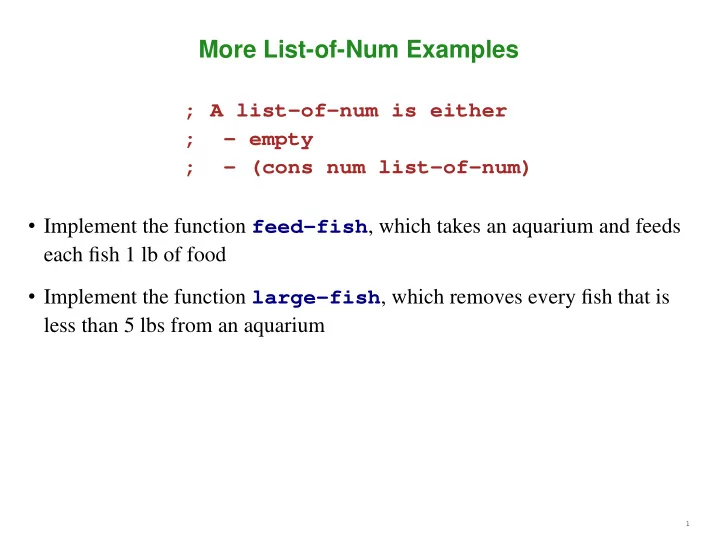
; A list-of-num is either ; - empty ; - (cons num list-of-num)

  • Implement the function feed-fish, which takes an aquarium and feeds

each fish 1 lb of food

  • Implement the function large-fish, which removes every fish that is

less than 5 lbs from an aquarium

1

slide-2
SLIDE 2

List-of-Posn

; A list-of-posn is either ; - empty ; - (cons posn list-of-posn)

2

slide-3
SLIDE 3

List-of-Posn

; A list-of-posn is either ; - empty ; - (cons posn list-of-posn)

3

slide-4
SLIDE 4

List-of-Posn

; A list-of-posn is either ; - empty ; - (cons posn list-of-posn) ; A posn is ; (make-posn num num)

4

slide-5
SLIDE 5

List-of-Posn

; A list-of-posn is either ; - empty ; - (cons posn list-of-posn) ; A posn is ; (make-posn num num)

; func-for-lop : list-of-posn -> ... (define (func-for-lop l) (cond [(empty? l) ...] [(cons? l) ...]))

5

slide-6
SLIDE 6

List-of-Posn

; A list-of-posn is either ; - empty ; - (cons posn list-of-posn) ; A posn is ; (make-posn num num)

; func-for-lop : list-of-posn -> ... (define (func-for-lop l) (cond [(empty? l) ...] [(cons? l) ... (first l) ... (rest l) ...]))

6

slide-7
SLIDE 7

List-of-Posn

; A list-of-posn is either ; - empty ; - (cons posn list-of-posn) ; A posn is ; (make-posn num num)

; func-for-lop : list-of-posn -> ... (define (func-for-lop l) (cond [(empty? l) ...] [(cons? l) ... (first l) ... (func-for-lop (rest l)) ...]))

7

slide-8
SLIDE 8

List-of-Posn

; A list-of-posn is either ; - empty ; - (cons posn list-of-posn) ; A posn is ; (make-posn num num)

; func-for-lop : list-of-posn -> ... (define (func-for-lop l) (cond [(empty? l) ...] [(cons? l) ... (func-for-posn (first l)) ... (func-for-lop (rest l)) ...])) ; func-for-posn : posn -> ... (define (func-for-posn p) ... (posn-x p) ... (posn-y p) ...)

8

slide-9
SLIDE 9

List-of-Posn

; A list-of-posn is either ; - empty ; - (cons posn list-of-posn) ; A posn is ; (make-posn num num)

; func-for-lop : list-of-posn -> ... (define (func-for-lop l) (cond [(empty? l) ...] [(cons? l) ... (func-for-posn (first l)) ... (func-for-lop (rest l)) ...])) ; func-for-posn : posn -> ... (define (func-for-posn p) ... (posn-x p) ... (posn-y p) ...)

9

slide-10
SLIDE 10

List-of-Posn Examples

  • Implement the function flip-posns, which flips the X and Y parts of

every posn in a list of posns

10

slide-11
SLIDE 11

List-of-Grade Example

; A grade is either ; - number ; - empty

  • Implement the function all-passed?, which takes a list of grades and

determines whether all are passes

11

slide-12
SLIDE 12

List-of-List-of-Num Example

; A list-of-lon is either ; - empty ; - (cons list-of-num list-of-lon)

  • Implement the function sums, which takes a list of list-of-numbers and

produces a list of sums

12

slide-13
SLIDE 13

Writing Down Large Lists

What does the list containing 0 to 10 look like?

(cons 0 (cons 1 (cons 2 (cons 3 (cons 4 (cons 5 (cons 6 (cons 7 (cons 8 (cons 9 (cons 10 empty)))))))))))

Here's a shortcut: (list 0 1 2 3 4 5 6 7 8 9 10) The list operator takes any number of arguments and constructs a list Still, DrScheme prints 11 conses

13-16

slide-14
SLIDE 14

Printing Large Lists

If you change DrScheme's language level to Beginning Student with List Abbreviations then DrScheme prints using the shortcut > (list 0 1 2 3 4 5 6 7 8 9 10) (list 0 1 2 3 4 5 6 7 8 9 10) > (cons 1 (cons 2 (cons 3 empty))) (list 1 2 3)

17-18

slide-15
SLIDE 15

When to Change Language Levels

  • 1. You're not tempted to write examples like this:

(feed-fish (cons 1 (cons 2 empty))) "should be" 2 3

  • 2. Your eyes hurt when you see

(cons 1 (cons 2)) because it isn't a list-of-num

  • 3. When you see

(list 1 2 3) (cons 1 (cons 2 (cons 3 empty))) you recognize instantly that they're the same Don't switch until you understand how list-of-... functions match the shape of the data definition

19-22

slide-16
SLIDE 16

Even Shorter

For the brave, there's an even shorter shortcut! '(1 2 3) is the same as (list 1 2 3) The apostrophe above doesn't make a symbol — it makes a list because it precedes a parenthesis Furthermore, the apostrophe gets distributed to everything inside: '(apple banana) is the same as (list 'apple 'banana) For consistency, '1 is the same as 1

23-26

slide-17
SLIDE 17

Even Shorter

Here's a list-of-lon using the shortcut: '((1 2 3) (2 4 6 8) (3 9 27)) which is the same as

(list (list 1 2 3) (list 2 4 6 8) (list 3 9 27))

which is the same as

(cons (cons 1 (cons 2 (cons 3 empty))) (cons (cons 2 (cons 4 (cons 6 (cons 8 empty)))) (cons (cons 3 (cons 9 (cons 27 empty))) empty)))

27-29