
SLIDE 1
KARS 6/30/2020
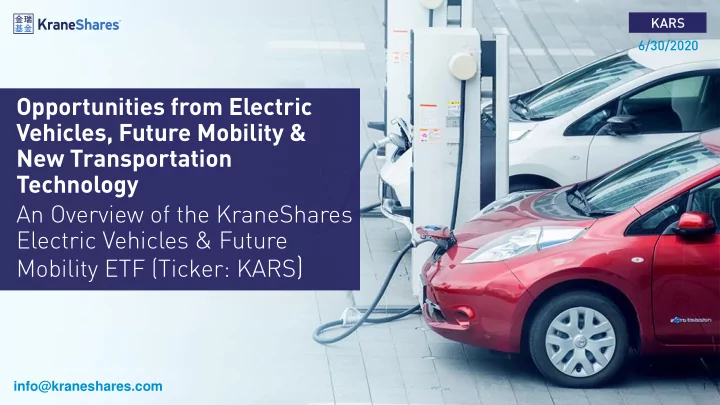
Opportunities from Electric Vehicles, Future Mobility & New Transportation Technology An Overview of the KraneShares Electric Vehicles & Future Mobility ETF (Ticker: KARS)
info@kraneshares.com
1
Mobility ETF (Ticker: KARS ) 1 info@kraneshares.com Introduction - - PowerPoint PPT Presentation
KARS 6/30/2020 Opportunities from Electric Vehicles, Future Mobility & New Transportation Technology An Overview of the KraneShares Electric Vehicles & Future Mobility ETF (Ticker: KARS ) 1 info@kraneshares.com Introduction to
KARS 6/30/2020
info@kraneshares.com
1
About KraneShares Krane Funds Advisors, LLC is the investment manager for KraneShares ETFs. Our suite of China focused ETFs provides investors with solutions to capture China’s importance as an essential element of a well-designed investment portfolio. We strive to provide innovative, first to market strategies that have been developed based on
trends and aim to provide meaningful diversification. Krane Funds Advisors, LLC is majority owned by China International Capital Corporation (CICC).
2
Investment Strategy: KARS seeks to measure the performance of Solactive Electric Vehicles and Future Mobility Index. The Index is designed to track the performance of companies engaged in the production of electric vehicles and/or their components, or engaged in other initiatives that may change the future of mobility. The Index includes issuers engaged in the electric vehicle production, autonomous driving, shared mobility, lithium and/or copper production, lithium-ion/lead acid batteries, hydrogen fuel cell manufacturing and/or electric infrastructure businesses. KARS Features:
autonomous vehicles and shared mobility.
adoption.
Future Mobility Sector Highlights
by 2050.3
KraneShares Electric Vehicles & Future Mobility ETF
1. Data from Bloomberg New Energy Finance as of 05/15/2019, retrieved 6/30/2020. 2. Morgan Stanley Research. “The EV Infrastructure 55: A Diversified Way to Play a Critical Enabler in the EV Theme.” Morgan Sta
3. Lanctot, Roger. “Accelerating The Future: The Economic Impact of the Emerging Passenger Economy.” Strategy Analytics. June 2017. 4. International Energy Agency. “Global EV Outlook 2020.” June, 2020.
3
Future Mobility – We are entering an electrified, connected, autonomous, and shared future.
Definition Electric Vehicles Electric vehicles (EV) are vehicles which use one or more electric motors for propulsion. Battery and Non-Ferrous Metals Adoption of electric vehicles dramatically increases demand for lithium-ion battery and non-ferrous metals such as lithium and copper. Vehicle Connectivity Vehicle connectivity has three main characteristics: the presence of sensors, vehicle connectivity to networks, and the ability to rapidly compute incoming data. Autonomous Driving Autonomous vehicles, also called driverless cars or self-driving cars, are vehicles that are capable of sensing the environment and navigating without human input. Shared Mobility Shared mobility allows passengers to share transportation includes carsharing, e-hailing, ridesharing and carpooling. 4
Autonomous Driving Shared Mobility Vehicle Connectivity
Electric Vehicles
Batteries and Non-Ferrous Metals
5
Electric vehicles (EV) are becoming increasingly widespread and economical.
projected to be electric by 2040.1
2025.1
platforms may result in electric vehicles becoming more cost competitive than vehicles with traditional internal combustion engines (ICE).
governments may be more motivated to manufacture them, and many have already introduced subsidies for electric vehicles.2
car markets, China has not given up on its EV ambitions by any
projects 1.6 million EVs will be sold in the country in 2021 compared to approximately one million in 2020.3
1. Data from Bloomberg New Energy Finance as of 5/15/2019, retrieved 6/30/2020. 2. Moss, Trefor. “China, With Methodical Discipline, Conjures a Market for Electric Cars.” Wall Street Journal. 2 October 2017. 3. Moss, Trefor. “China Auto Sales Bounce Back from Worst-Ever Quarter,” The Wall Street Journal. July 10, 2020.
Electric Vehicles 6
1% 3% 9% 20% 33% 200 400 600 800 1,000 1,200 1,400 1,600 1,800 2015 2020 2025 2030 2035 2040
Global light duty vehicle fleet1
EV Fleet ICE Fleet million cars on the road 3% 11% 28% 43% 55% 20 40 60 80 100 120 2015 2020 2025 2030 2035 2040
Annual global light duty vehicle sales1
EV Sales ICE Sales million vehicles
500 1,000 1,500 2,000 2016 2018 2020 2022 2024 2026 2028 2030
Growth
Passenger EVs Commercial EVs Stationary storage Consumer electronics E-buses
Batteries and Non-Ferrous Metals are an ideal avenue for capturing the potential value of electric vehicle markets.
1. Data from Bloomberg New Energy Finance as of 05/21/2018, retrieved 6/30/2020. 2. Desjardins, Jeff. “The Massive Impact of EVs on Commodities in One Chart.” Visual Capitalist. 15 September 2017. 3.
4. Ben Creagh, “Galaxy raises $61 million for development of lithium projects”, Feb 8 2017. 5. Data from Bloomberg New Energy Finance as of 5/15/2019, retrieved 6/30/2020
increase demand for lithium-ion battery and non-ferrous metals such as lithium and copper.
by 2030.5
electric vehicle batteries, is expected to grow 450% by 2025.2
capacity to meet the impending demand. Galaxy Resources recently purchased a mining area in South America’s “Lithium Triangle,” which is home to around 60 percent of the world’s reserves.4
Batteries and Non-Ferrous Metals 7
500 1,000 1,500 2,000 2,500 2018 2019 2020 2021 2022 2023 2024 2025 2026 2027 2028 2029 2030 Thousand metric tons
Projected global metals and materials demand from EV lithium-ion batteries1
Copper Lithium
Projected lithium-ion battery demand, by end-use5
The Internet of Vehicles (IoV) connects cars to each other and outside world.
United States are projected to be connected to the internet by 2022.1
revenue by 2026, according to a report by GSMA.2
China by 2030, according to PWC.3
connectivity solutions including Artificial Intelligence (AI), Vehicle-to- Vehicle (V2V) connectivity, and Vehicle-to-Everything (V2X) connectivity.
to increase steadily, carving out a larger role for data services companies including Alphabet and Baidu in the mobility space.
1. PwC, “The 2017 Strategy& Digital Auto Report", September 2017. 2. GSMA, “GSMA Highlights US$1.8 Trillion IoT Revenue Opportunity for Mobile Network Operators”, September 7, 2017 3.
Connectivity
35% 98% 100% 0% 25% 50% 75% 100% 2015 2020 2025
Share of new cars sold that are connected to the Internet worldwide from 2015 to 20251 IoV is designed to improve traffic management and enhance safety by connecting cars and signals to each other. 8
Autonomous vehicles could dramatically change the nature of the transportation market.
25% of the new car market and more than 30 million autonomous vehicles are projected to be sold per year globally.1
precursor to full autonomy, could reach $27 billion by 2024,6 compared to $11 billion in 2019.2
that are already being regularly used in California and Arizona and have amassed over 10 million “self-driven” miles.3
autonomous vehicle developers and has already partnered with
autonomous vehicles were used to deliver supplies in China.7
1. Boston Consulting Group,” Autonomous Vehicle Adoption Study”, April 10, 2017 2. Reuters, “Advanced Driver Assistance Systems (ADAS) Market Share 2019.” July 15, 2019. 3. Korosec, Kristen. “Waymo’s Self-Driving Cars Hit 10 Million Miles.” retrieved 6/30/2020. 4. Data from Apollo.auto, retrieved 6/30/2020..
Autonomous Driving
Autonomous vehicle launch timelines based on public announcements5
9
6.
7.
May 18, 2020.
Shared mobility is revolutionizing transport systems.
foundation for a major paradigm shift in transportation to a “passenger economy,” which is projected to add $7 trillion to the global economy by 2050.1
fast pace. 1.4 billion people use of ride hailing services worldwide and that number is projected to increase to over 1.5 billion by 2022.2
users to rent and drive a car for short periods of time. Examples include Baidu’s Pand-auto, GM’s Maven, Daimler’s Car2Go, and BMW’s ReachNow.
mobility vehicles. The company had over 15,000 electric cars and
the potential to disrupt vehicle ownership and insurance as transportation becomes a pay as you go service in many cases.
global revenues are expected to mostly recover by 2022.2
Shared Mobility
1. Lanctot, Roger. “Accelerating The Future: The Economic Impact of the Emerging Passenger Economy.” Strategy Analytics. June 2017. 2. Data from Statista as of 6/30/2020. 3. Abnewwire, “Pand-Auto is the Premier Car Sharing Operations in the Area”, Dec 12, 2017
10 281 290 302 192 254 298 334 365 100 200 300 400 2017 2018 2019 2020 2021 2022 2023 2024
Billions of USD
Global Ride Hailing Revenue Projections
China possesses unique advantages in future mobility development.
1. Data from Bloomberg New Energy Finance as of 05/15/2019, retrieved 6/30/2020. 2. International Energy Agency. “Global EV Outlook 2019.” retrieved 6/30/2020. 3. Justine Lau, ”Buffett buys BYD stake”, September 29 2008. 4. Yuanyuan, Liu. “The number of public charging stations for Evs in China surges 50.5% in May,” Renewable Energy World. July 2, 2019. 5. Lambert, Fred. “US now has over 20,000 electric car charging stations with more than 68,800 connectors,” electrek. July 9, 2019. 6. Yuanyuan, Liu. “China installed more than 1000 EV charging stations per day in 2019,” Renewable Energy World. January 13, 2020.
11
35 58 196 284 304 49 67 92 142 190 44 48 61 46 77 101 136 193 371 526 632 100 200 300 400 500 600 700 2012 2013 2014 2015 2016 2017 2018
China Europe U.S. Japan RoW Thousand units Global cumulative number of public EV charging points installed1
0.1 0.2 0.3 0.4 0.7 1.1 2.0 0.0 0.5 1.0 1.5 2.0 2.5 2012 2013 2014 2015 2016 2017 2018
Millions of EVs China Europe U.S. Japan
Australia Other Global Passenger EV Sales1
KARS constituents contribute to all components of future vehicles.
Batteries and Raw materials Connectivity and Autonomous Capability Entire Vehicle Manufacturers Electrical Grid 12
Example Holdings of the KraneShares Electric Vehicles and Future Mobility ETF:
*Data from Bloomberg as of 6/30/2020. See page 16 for the Fund’s top 10 holdings
Theme Example Holdings Holding weight in KARS (as of 6/30/2020)* Future Mobility Service Electric Vehicles Great Wall Motors 1.08% Great Wall Motors has launched product lines of both plug-in hybrids (PHEVs) and battery electric vehicles (BEVs). Some lines are still in the research and development phase. Autonomous Driving Alphabet 3.47% Alphabet Waymo’s self-driving cars has achieved millions of miles self-driven. Baidu 3.57% Baidu’s Apollo provides an open, reliable and secure software platform for its partners to develop their own autonomous driving systems. Vehicles Connectivity Nvidia 3.60% Nvidia’s Artificial Intelligence (AI) technology gives cars the power to see, think, and learn and to drive themselves eventually. NXP 2.07% NXP’s Vehicle-to-Everything (V2X) technology enables cars to communicate with their surroundings. Shared Mobility Baidu 3.57% Pand-auto, owned by Baidu, cooperate with Apollo Project and operates electric vehicles carsharing business in China. Daimler 3.49% Car2Go, a subsidiary of Daimler, offers exclusively Smart Fortwo and Mercedes-Benz vehicles and features one-way point-to-point rentals. Lithium-ion Battery Samsung SDI 1.96% Samsung SDI manufactures Lithium-ion batteries for electric vehicles. Guoxuan High-tech 1.40% Guoxuan High-tech is a Chinese company manufacturing lithium-ion batteries. Lithium and
Ferrous Metals Albemarle 1.51% Albemarle became a major lithium producer by owning lithium mines in South America and by acquiring lithium companies in China and globally. Southern Copper Corp. 2.12% Southern Copper Corp. is one of the largest integrated copper producers in the world. They produce copper, molybdenum, zinc, lead, coal and silver.
13
China, the United States, and Europe are leading the world in future mobility.
6/30/2020.
*includes Austria, Belgium, Bulgaria, Croatia, Cyprus, Czech Republic, Denmark. Estonia, Finland, France, Germany, Greece, Hungary, Iceland, Ireland, Italy, Latvia, Liechtenstein, Lithuania, Luxembourg, Malta, Netherlands, Norway, Poland, Portugal, Romania, Slovakia, Slovenia, Spain, Sweden, Switzerland, Turkey, and United Kingdom
United States
Ranking (2018): 3rd1
1,450,0001
Europe*
China
Ranking (2019): 1st1
3,350,0001
14
KARS is diverse in sector coverage, size, and geography in order to capture value wherever it is being created.
KARS Sector Breakdown KARS Market Cap Breakdown KARS Country Breakdown
Data from Bloomberg as of 6/30/2020.
15
*Others include Peru, Switzerland, Netherlands, Ireland, Hong Kong, Austria, Sweden, and the United Kingdom. Data from Bloomberg as of 6/30/2020. Data from Bloomberg as of 6/30/2020. Large Cap 68% Mid Cap 16% Small Cap 16% Consumer Discretionary 36% Information Technology 33% Industrials 14% Materials 10% Communication Services 7% United States 36% China 20% Germany 11% Japan 9% South Korea 4% Chile 3% Taiwan 2% Canada 2% Others 13%
Investment Strategy:
KARS seeks to measure the performance of Solactive Electric Vehicles and Future Mobility Index. The Index is designed to track the performance of companies engaged in the production of electric vehicles and/or their components, or engaged in other initiatives that may change the future of
vehicle production, autonomous driving, shared mobility, lithium and/or copper production, lithium-ion/lead acid batteries, hydrogen fuel cell manufacturing and/or electric infrastructure businesses.
KraneShares Electric Vehicles & Future Mobility ETF
Top Ten Holdings as of 6/30/2020 The Fund’s Holdings Are Subject to Change. % of Fund
NVIDIA CORP 3.60 ANALOG DEVICES INC 3.60 BAIDU INC - SPON ADR 3.57 TEXAS INSTRUMENTS INC 3.55 BAYERISCHE MOTOREN WERKE AG 3.50 DAIMLER AG-REGISTERED SHARES 3.49 ALPHABET INC-CL A 3.47 TOYOTA MOTOR CORP 3.40 ADVANCED MICRO DEVICES 3.35 HONDA MOTOR CO LTD 3.28 KARS Performance History as of 6/30/2020
Cumulative % Average Annualized % 3 Mo 6 Mo Since Inception 1 Yr 3 Yr Since Inception Fund NAV
32.39% 6.42% 4.00% 26.71%
–
1.61%
Closing Price
33.99% 6.82% 4.20% 26.39%
–
1.69%
Index
33.69% 7.61% 4.43% 28.31%
–
1.79%
Fund Details As of 6/30/2020 Primary Exchange NYSE Cusip 500767827 Total Annual Fund Operating Expense 0.70% Inception Date 1/18/2018 Distribution Frequency Annual Index Name Solactive Electric Vehicles and Future Mobility Index Index Ticker Bloomberg: SOLKARSN Number of Holdings (ex Cash) 57 The performance data quoted represents past performance. Past performance does not guarantee future results. The investment return and principal value of an investment will fluctuate so that an investor's shares, when sold or redeemed, may be worth more or less than their original cost and current performance may be lower or higher than the performance quoted. For performance data current to the most recent month end, please visit www.kraneshares.com Index returns are for illustrative purposes only. Index performance returns do not reflect any management fees, transaction costs or expenses. Indexes are unmanaged and one cannot invest directly in an index.
16
Important Notes Carefully consider the Funds' investment objectives, risk factors, charges and expenses before investing. This and additional information can be found in the Funds' full & summary prospectus, which may be obtained here: KARS. Read the prospectus carefully before investing. Investing involves risk, including possible loss of principal. There can be no assurance that a Fund will achieve its stated objectives. ETF shares are not redeemable with the issuing fund other than in large Creation Unit aggregations. Instead, investors must buy or sell ETF Shares in the secondary market with the assistance of a stockbroker. In doing so, the investor may incur brokerage commissions and may pay more than net asset value when buying and receive less than net asset value when selling. The NAV of the Fund’s shares is calculated each day the national securities exchanges are open for trading as of the close of regular trading on the New York Stock Exchange (“NYSE”), normally 4:00 p.m. Eastern time (the “NAV Calculation Time”). Shares are bought and sold at market price (closing price) not NAV. Market price returns are based on the midpoint of the bid/ask spread at 4:00 pm Eastern Time (when NAV is normally determined). The Fund is subject to political, social or economic instability within China which may cause decline in value. Fluctuations in currency of foreign countries may have an adverse effect to domestic currency values. Emerging markets involve heightened risk related to the same factors as well as increase volatility and lower trading volume Narrowly focused investments typically exhibit higher volatility. The ability of the fund to achieve its objective is dependent, in part, on the continuous availability of A Shares and the ability to obtain, if necessary, additional A Shares quota. If a Fund is unable to obtain sufficient exposure to limited availability of A Share quota, the Fund could seek exposure to the component securities of the Underlying Index by investment in other types of securities. The fund may in invest in derivatives, which are often more volatile than other investments and may magnify the Funds’ gains or losses. The fund is non-diversified. Indices are unmanaged and do not include the effect of fees. One cannot invest directly in an index. The KraneShares ETFs are distributed by SEI Investments Distribution Company (SIDCO), 1 Freedom Valley Drive, Oaks, PA 19456, which is not affiliated with Krane Funds Advisors, LLC, the Investment Adviser for the Fund. 17
Important Notes (continued) Although Krane Funds Advisors LLC and its affiliates (“Krane”) shall obtain data from sources that Krane considers reliable, all data contained herein is provided “as is” and Krane makes no representation or warranty of any kind, either express or implied, with respect to such data, the timeliness thereof, the results to be obtained by the use thereof or any other matter. Krane expressly disclaims any and all implied warranties, including without limitation, warranties of originality, accuracy, completeness, timeliness, non-infringement, merchantability and fitness for a particular purpose. Forward-looking statements (including Krane’s opinions, expectations, beliefs, plans, objectives, assumptions, or projections regarding future events or future results) contained in this presentation are based on a variety of estimates and assumptions by Krane. These statements generally are identified by words such as “believes,” “expects,” “predicts,” “intends,” “projects,” “plans,” “estimates,” “aims,” “foresees,” “anticipates,” “targets,” “should,” “likely,” and similar expressions. These also include statements about the future, including what “will” happen, which reflect Krane’s current beliefs. These estimates and assumptions are inherently uncertain and are subject to numerous business, industry, market, regulatory, geo-political, competitive, and financial risks that are outside of Krane’s control. The inclusion of forward-looking statements herein should not be regarded as an indication that Krane considers forward-looking statements to be a reliable prediction of future events and forward-looking statements should not be relied upon as such. Neither Krane nor any of its representatives has made or makes any representation to any person regarding forward-looking statements and neither of them intends to update or otherwise revise such forward-looking statements to reflect circumstances existing after the date when made or to reflect the occurrence of future events, even in the event that any or all of the assumptions underlying such forward-looking statements are later shown to be in error. Any investment strategies discussed herein are as of the date of the writing of this presentation and may be changed, modified, or exited at any time without notice. This material represents an assessment of the market environment at a specific point in time and is not intended to be a forecast of future events, or a guarantee of future
18