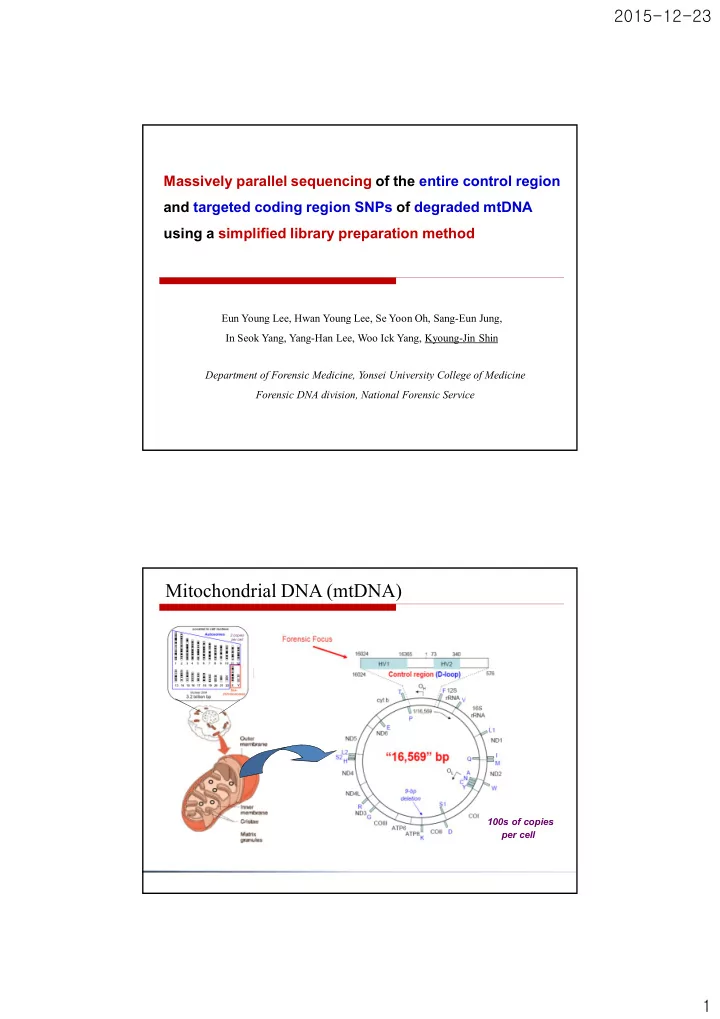
Mitochondrial DNA (mtDNA) 100s of copies per cell 1 2015-12-23 - - PDF document

mitochondrial dna mtdna
SMART_READER_LITE
LIVE PREVIEW

Mitochondrial DNA (mtDNA) 100s of copies per cell 1 2015-12-23 - - PDF document

2015-12-23 Massively parallel sequencing of the entire control region and targeted coding region SNPs of degraded mtDNA using a simplified library preparation method Eun Young Lee, Hwan Young Lee, Se Yoon Oh, Sang-Eun Jung, In Seok Yang,


slide-1
SLIDE 1

2015-12-23 1

Eun Young Lee, Hwan Young Lee, Se Yoon Oh, Sang-Eun Jung, In Seok Yang, Yang-Han Lee, Woo Ick Yang, Kyoung-Jin Shin

Massively parallel sequencing of the entire control region and targeted coding region SNPs of degraded mtDNA using a simplified library preparation method

Department of Forensic Medicine, Yonsei University College of Medicine Forensic DNA division, National Forensic Service

100s of copies per cell

Mitochondrial DNA (mtDNA)

slide-2
SLIDE 2

2015-12-23 2

Ø Importance of mitochondrial hyper-variable (HV) regions and coding region SNPs analysis in degraded samples identification Ø Limitation of existing methods for mtDNA analysis using degraded samples Ø Next-generation sequencing (NGS) is expected to be useful technique to analyze mtDNA effectively Ø More simple library preparation method is needed to easily access NGS analysis

Introduction

Ø Development of library preparation system for mtDNA sequencing

Object

§ Construct a multiplex PCR system

  • Amplification of entire control region and targeted coding region SNPs
  • Small-sized amplicons (<250 bp)
  • Simultaneous amplification of coding region SNPs specific to global

and East Asian haplogroups

§ Devise a simple library preparation method Ø Validation of devised NGS system for mtDNA analysis § Test using artificially or naturally degraded DNA samples

slide-3
SLIDE 3

2015-12-23 3

⇒ Amplicon size range; 229 ~ 242 bp

Ø Coding region SNPs (22 amplicons from 2 multiplex PCRs)

⇒ Amplicon size range; 101 ~ 135 bp

Ø Control regions (6 amplicons from 2 multiplex PCRs)

Multiplex PCR design for mtDNA sequencing Global mtDNA haplogroups

slide-4
SLIDE 4

2015-12-23 4 Ø Selected 32 coding region SNPs and haplogroups

Multiplex PCR design for mtDNA sequencing

Simplify library preparation

Fragment genomic DNA (PCR product) End repairs Beads purifications Adenylate 3’ ends Beads purifications Beads purifications Beads purifications

① ② ③ ④ ⑤ ⑥ ⑦ ① ②

slide-5
SLIDE 5

2015-12-23 5 Ø 1st PCR; Specific to mtDNA sequence

Strategy for NGS library preparation

Ø 2nd PCR; Specific to adaptor sequence

Strategy for NGS library preparation

slide-6
SLIDE 6

2015-12-23 6

Materials and Methods

Ø Workflow of library preparation and NGS run

1st PCR reaction; Midiplex I/II, mtSNP I/II 2nd PCR reaction; Adding indices Bead purification Library quantification Library pooling NGS (Illumina Miseq)

Ø 1st PCR condition Ø 2nd PCR condition

Reaction mixture Midiplex I/II mtSNP I/II 10x STR buffer 2.0 ul 2.0 ul Primers Adjusted conc. Adjusted conc. Gold Taq polymerase 0.3 ul (1.5 U) 0.6 ul (3.0 U) *Template 100 pg or 2 ul 100 pg or 2 ul Fill up to with dH2O 20.0 ul 20.0 ul Thermal cycling 95 ℃ 11 min 94 ℃ 20 sec 56 ℃ 60 sec X 25 cycles 72 ℃ 30 sec 72 ℃ 7 min 4 ℃ forever

*Template; 100 pg of degraded control DNA (2800M, 9947A and 9948) 2 ul of extracted DNA from bone

Reaction mixture 10x STR buffer 2.0 ul Index 1 2.0 ul Index 2 2.0 ul Gold Taq polymerase 0.2 ul (1.0 U) **Template 2.0 ul Fill up to with dH2O 20.0 ul

**Template; 1.0 ul of 1/100 diluent of 1st PCR I product + 1.0 ul of 1/100 diluent of 1st PCR II product

Thermal cycling 95 ℃ 15 min 94 ℃ 20 sec 59 ℃ 30 sec X 15 cycles 72 ℃ 30 sec 72 ℃ 7 min 4 ℃ forever

Materials and Methods
slide-7
SLIDE 7

2015-12-23 7

Materials and Methods

Ø DNA samples

§ Artificially degraded standard DNAs (2800M, 9947A and 9948) § 10 DNAs extracted from old skeletal remains

Ø Generation of library by 2-step PCR

§ Midiplex I/II

(Average size; 372 bp)

§ mtSNP I/II

(Average size; 257 bp)

Template; 2800M DNA

Materials and Methods

Ø Library quality control

§ Library quantification using using KAPA library quantification kit § Library QC using Bioanalyzer

Ø Library pooling and NGS run

§ 28 amplicons/sample ; 6 amplicons from Midiplex PCR + 22 amplicons from mtSNP PCR § 10 samples/run § NGS on Illumina platform ; MiSeq Reagent Nano Kit v2, 500 Cycles (2x250 bp)

slide-8
SLIDE 8

2015-12-23 8

Results

Ø The obtained data yield per sample

Read count distribution of 2800M control DNA

Ø Coverage for 22 amplicons for 32 coding region SNPs Ø Coverage for 6 amplicons on mitochondrial control region

slide-9
SLIDE 9

2015-12-23 9

Read count distribution of a skeletal sample

Ø Coverage for 22 amplicons for 32 coding region SNPs Ø Coverage for 6 amplicons on mitochondrial control region

Materials and Methods

Ø NGS data analysis

Miseq run; FASTQ Bowtie 2; Align with rCRS SAMtools; Convert to BAM VarScan 2; Variant calling IGV; Confirm calling results Hg designation; Refer to PhyloTree Build 16

slide-10
SLIDE 10

2015-12-23 10

mtDNA sequence and haplogroup

Sample ID Control Region Coding Region Haplogroup 2800M 16519C 152C 263G 315.1C 477C 8860G H1c 9947A 16311C 16519C 93G 195C 214G 263G 309.1C 309.2C 315.1C 8448C 8860G H11 SR0022 16223T 16362C 16519C 73G 150T 194T 205A 263G 315.1C 489C 523d 524d 4883T 7028T 8414T 8860G 9540C 9824A 11719A 12705T 14766T 14783C D4b2b SR0023 16223T 16231C 16362C 73G 263G 315.1C 489C 4883T 7028T 8414T 8860G 9540C 11696A 11719A 12705T 14766T 14783C D4j SR0026 16183C 16189C 16335G 16527T 73G 152C 249d 263G 309.1C 309.2C 315.1C 1005C 6392C 7028T 8860G 11719A 14766T F2 SR0027 16223T 16290T 16319A 16362C 73G 152C 207A 235G 260A 309.1C 309.2C 315.1C 523d 524d 4824G 7028T 8459G 8794T 8860G 11719A 12705T 14766T A15

… … … …

SR7041 16187T 16223T 16290T 16319A 16519C 73G 235G 263G 309.1C 315.1C 523d 524d 4824G 7028T 8794T 8860G 10670T 11719A 12705T 14766T A5a

Summary

Ø Construction of multiplex PCR system to amplify entire control regions and targeted coding region SNPs of mitochondrial DNA Ø Development of simple library preparation system for mtDNA NGS analysis Ø Demonstration validity of devised NGS system for analysis of mitochondrial DNA sequences using degraded samples

slide-11
SLIDE 11

2015-12-23 11

Acknowledgement

This research was supported by a fund (NFS2014DNA06) from the Forensic Research Program of the National Forensic Service, Korea.