Mismatch, damping and emittance growth o r LHC beam emittance - - PowerPoint PPT Presentation

mismatch damping and emittance growth
SMART_READER_LITE
LIVE PREVIEW

Mismatch, damping and emittance growth o r LHC beam emittance - - PowerPoint PPT Presentation

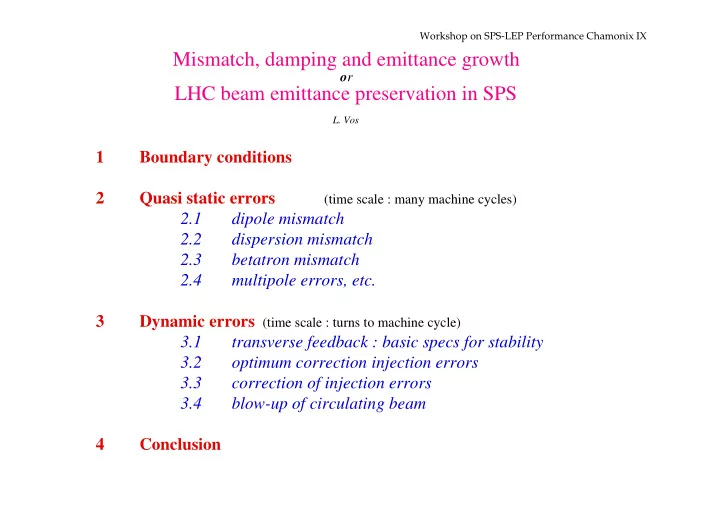
Workshop on SPS-LEP Performance Chamonix IX Mismatch, damping and emittance growth o r LHC beam emittance preservation in SPS L. Vos 1 Boundary conditions 2 Quasi static errors (time scale : many machine cycles) 2.1 dipole mismatch 2.2


slide-1
SLIDE 1

Workshop on SPS-LEP Performance Chamonix IX

Mismatch, damping and emittance growth

  • r

LHC beam emittance preservation in SPS

  • L. Vos

1 Boundary conditions 2 Quasi static errors

(time scale : many machine cycles)

2.1 dipole mismatch 2.2 dispersion mismatch 2.3 betatron mismatch 2.4 multipole errors, etc. 3 Dynamic errors (time scale : turns to machine cycle) 3.1 transverse feedback : basic specs for stability 3.2

  • ptimum correction injection errors

3.3 correction of injection errors 3.4 blow-up of circulating beam 4 Conclusion

slide-2
SLIDE 2

Workshop on SPS-LEP Performance Chamonix IX

  • 2-

1 Boundary conditions input emittance : 3.0 µmrad

  • utput emittance

: 3.5 µmrad

Total blow-up budget attributed to SPS : 0.5 µmrad

many contenders to have a piece of the cake

slide-3
SLIDE 3

Workshop on SPS-LEP Performance Chamonix IX

  • 3-

2 Quasi static errors 2.1 dipole mismatch

  • r dipole injection error

Transverse feedback (see later) can only handle errors below some limit

measure and correct static steering required when limit exceeded (injection error watch dog)

these errors do not contribute to emittance blow-up if treated correctly

slide-4
SLIDE 4

Workshop on SPS-LEP Performance Chamonix IX

  • 4-

2.2 dispersion mismatch Off momentum particles of a well injected beam (dipole) will be subjected to oscillations, filamentation and beam blow up. ∆ ∆ ε βγ β δ =       2

2 y

D p p

0.1 0.2 0.3 0.4 0.5 0.02 0.04 0.06 0.08

error in D / m emittance increase /µmrad for δp/p = 10

  • 3

■measure and correct measure trajectory of beam with small momentum spread (pencil beam, long bunches)

slide-5
SLIDE 5

Workshop on SPS-LEP Performance Chamonix IX

  • 5-

2.3 betatron mismatch

1

λ

ε λ λ ε = +

( )

1 2

2 2

Emittance increase due to quadrupole errors is multiplicative

slide-6
SLIDE 6

Workshop on SPS-LEP Performance Chamonix IX

  • 6-

1 1.05 1.1 1.15 1.2 1.25 1.3 1.35 1.4 3 3.1 3.2 3.3 3.4 3.5 3.6 3.7

µmrad mismatch factor λ

slide-7
SLIDE 7

Workshop on SPS-LEP Performance Chamonix IX

  • 7-

PS, transfer line PS-SPS, SPS

  • ptics well known and stable

ejection/ injection SPS injection trajectory clear of machine magnet gaps PS ejection trajectory more difficult to model (off-centered beams, stray-fields) some uncertainty on the exact optics persists

■measure and correct ■ install multiturn interceptive high resolution profile monitor in SPS ■ develop and install non interceptive quadrupole BPM (watch dog function)

slide-8
SLIDE 8

Workshop on SPS-LEP Performance Chamonix IX

  • 8-

2.4 multipole errors, etc.

■Avoid

non-linear resonances HF single bunch instabilities

■measure and correct =====> need a precise tune control and good betatron coupling compensation (much easier for LHC beam than for pbar-p beam : only zero order since no tune split as for low β

  • ptics !)
slide-9
SLIDE 9

Workshop on SPS-LEP Performance Chamonix IX

  • 9-

3 Dynamic errors Only dipole errors considered 3.1 transverse feedback : basic specs for stability Stability against RW imposes a minimum gain that rolls off from a min frequency to fb/2 ( 20 MHz).

G R Q E e Z i =

max G for ultimate intensity : 0.08

  • ccurs at ~ 3 frev due to non-uniform filling
slide-10
SLIDE 10

Workshop on SPS-LEP Performance Chamonix IX

  • 10-

3.2

  • ptimum correction injection error

In principle observation and correction can be done at any harmonic of fb. OK for observation but not for correction :

ideal correction correction at <f> correction at <f>/2 correction amplitude time

Comparison between base-band and high frequency corrections deflector frequency below <f>/2 = 80 MHz choice of base band is good!

slide-11
SLIDE 11

Workshop on SPS-LEP Performance Chamonix IX

  • 11-

3.3 correction of injection errors 3.3.1 errors

  • fast kickers

normalised deflection CERN kickers ∆x

m γ β = 0 1 .

====> total for kickers : eK = 0 5

. σ

fast kickers upstream SPS rise time < 100 ns ⇒ power bandwidth of 5 MHz.

  • bending magnets and septa ripple in transfer line

bendings in injection line

eB = 0 5 . σ

septa in injection line

eS = 0 25 . σ

e e e e

inj K B S 2 2 2 2 2

0 375 1 2 = + +

( ) =

⇒ γ β γσ β ε .

[ assumed similar H and V !] einj = 2.3 mm

slide-12
SLIDE 12

Workshop on SPS-LEP Performance Chamonix IX

  • 12-

3.3.2 correction by feedback

∆ ∆ ε τ τ = +       = +       1 2 1 1 1 2 1 1 2 5

2 2 2 2

e e G Q

inj dc d inj sc

.

direct space charge

∆Q i R Q Z R E e R Q

sc sc

= −

( )

=       ε σ π γ ε γ σ 2 2

2 2 2

ˆ

(ultimate intensity)

0.05 0.1 0.15 0.2 0.2 0.4 0.6 0.8

Gain emittance increase /µmrad

slide-13
SLIDE 13

Workshop on SPS-LEP Performance Chamonix IX

  • 13-

θ ε β γ = Gtotal

kic

2

ker ⇒

E dl

allowed blow-up µmrad 0.3 einj

2

µmrad 1.5 gain (RW) 0.08 gain (injection) 0.1 total gain 0.18 deflection ( β= 45m) µrad 6.3 E dl

kV 165 power band-width MHz 5 Gain and deflection requirements for SPS

slide-14
SLIDE 14

Workshop on SPS-LEP Performance Chamonix IX

  • 14-

Note Commissioning beam

  • 10x less intensity
  • √10 less emittance
  • same errors
  • fortunately √10 less ∆Qsc

∆ε ~ 0.06 µmrad for same G

slide-15
SLIDE 15

Workshop on SPS-LEP Performance Chamonix IX

  • 15-

3.4 blow-up of circulating beam

d dt x T Q ε γ β =

2

x is the r.m.s. noise level

noise level µV 40 effective monitor Z Ω/m 40 resolution A•µm 1 average coast time sec 7.2 max blow-up µmrad 0.1 max rate µmrad/s 0.014 max x for max rate µm 4 dynamic(digital) 5300 analog x for ultimate (1.09 A) µm 0.9 analog x for nominal (0.64 A) µm 1.5 Resolution and emittance blow-up in SPS

slide-16
SLIDE 16

Workshop on SPS-LEP Performance Chamonix IX

  • 16-

4 Conclusion input emittance : 3.0 µmrad

  • utput emittance

: 3.5 µmrad

Total blow-up budget attributed to SPS : 0.5 µmrad Tight but it can be done

Final quality control with high precision wire scanner beyond and above any suspicion