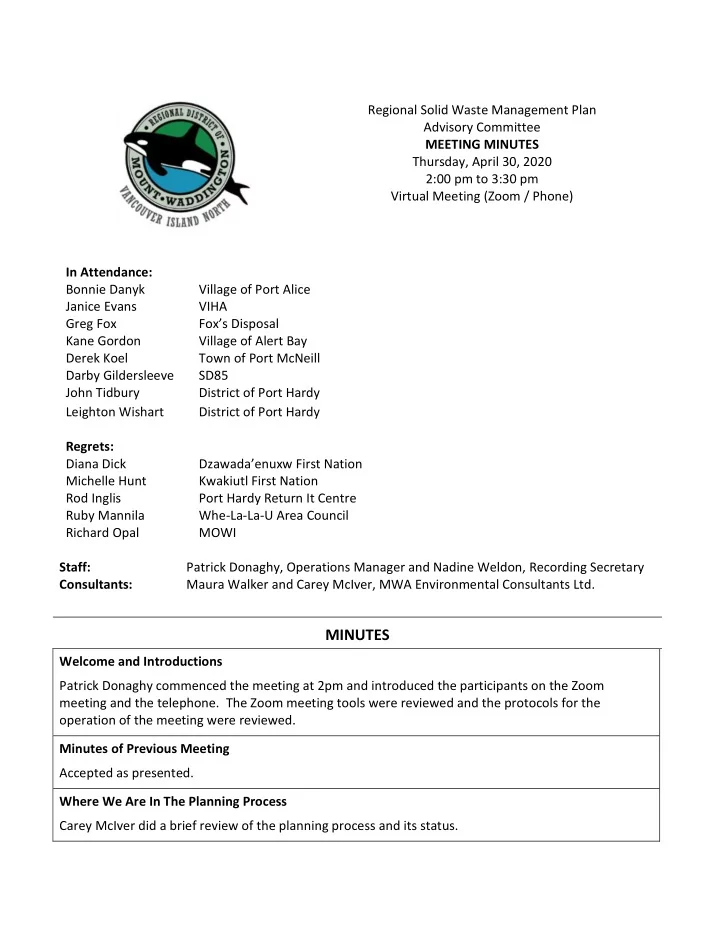
MINUTES Welcome and Introductions Patrick Donaghy commenced the - - PDF document

minutes
SMART_READER_LITE
LIVE PREVIEW

MINUTES Welcome and Introductions Patrick Donaghy commenced the - - PDF document

Regional Solid Waste Management Plan Advisory Committee MEETING MINUTES Thursday, April 30, 2020 2:00 pm to 3:30 pm Virtual Meeting (Zoom / Phone) In Attendance: Bonnie Danyk Village of Port Alice Janice Evans VIHA Greg Fox Foxs


slide-1
SLIDE 1

Regional Solid Waste Management Plan Advisory Committee MEETING MINUTES Thursday, April 30, 2020 2:00 pm to 3:30 pm Virtual Meeting (Zoom / Phone) In Attendance: Bonnie Danyk Village of Port Alice Janice Evans VIHA Greg Fox Fox’s Disposal Kane Gordon Village of Alert Bay Derek Koel Town of Port McNeill Darby Gildersleeve SD85 John Tidbury District of Port Hardy Leighton Wishart District of Port Hardy Regrets: Diana Dick Dzawada’enuxw First Nation Michelle Hunt Kwakiutl First Nation Rod Inglis Port Hardy Return It Centre Ruby Mannila Whe-La-La-U Area Council Richard Opal MOWI Staff: Patrick Donaghy, Operations Manager and Nadine Weldon, Recording Secretary Consultants: Maura Walker and Carey McIver, MWA Environmental Consultants Ltd.

MINUTES

Welcome and Introductions Patrick Donaghy commenced the meeting at 2pm and introduced the participants on the Zoom meeting and the telephone. The Zoom meeting tools were reviewed and the protocols for the

  • peration of the meeting were reviewed.

Minutes of Previous Meeting Accepted as presented. Where We Are In The Planning Process Carey McIver did a brief review of the planning process and its status.

slide-2
SLIDE 2

Recommended Strategies and Actions Maura Walker and Carey McIver reviewed the strategies and options that were included in the Strategies and Options memo. Cost estimates for each strategy were also presented. . There was consensus among the committee members in attendance that all of the items as presented should be included in the draft RSWMP. Financial Implications Carey presented how the five-year financial plan, showing the additional costs associated with the actions discussed under “recommended strategies and actions.” She also presented the staffing implications. Bonnie Danyk commented via email that Five-Year Financial Plan Table should show operating expenditures only and that capital is not generally funded by taxation. Next Steps / Wrap Up The next meeting will be Thursday, May 14, 2020 at 2 pm and will be held on-line and on the phone. The meeting was closed at 3:25 pm.

slide-3
SLIDE 3

REGIONAL SOLID WASTE MANAGEMENT PLAN ADVISORY COMMITTEE

April 30, 2020 Meeting

slide-4
SLIDE 4

Meeting Start Up (Patrick & Nicole)

  • Online Meeting Protocols
  • Roll Call
slide-5
SLIDE 5

Agenda (Carey)

  • Minutes of our previous meeting
  • Quick review of where we are at
  • Proposed strategies and actions
  • Financial implications
  • Wrap Up
slide-6
SLIDE 6

Review of Meeting Minutes

  • Errors or Omissions?
slide-7
SLIDE 7

The RDMW SWMP Update Process

1st Phase

Assess existing system Establish Advisory Committee

2nd Phase

Waste Minimization

Residual Waste Management

Recommended Options / Financial Implications

Draft RSWMP

3rd Phase

Obtain community & stakeholder feedback Finalize the new RSWMP

April December

slide-8
SLIDE 8

STRATEGIES AND ACTIONS

slide-9
SLIDE 9

Strategies and Actions

  • Prepared based in input we received from you at previous

meetings

  • Feedback from today will be used to draft an new solid

waste management plan for RDMW

slide-10
SLIDE 10

Focusing in…

  • Status of 7Mile needs to be resolved
  • Cornerstone of our recycling, composting and disposal system
  • Shift from establishing new diversion programs

and infrastructure to

  • 1. Confirming the long term picture for 7 Mile
  • 2. Based on outcome of #1, develop the necessary

strategies for:

  • Organic waste diversion
  • Collection (what, where, who, when)
  • Cost recovery
slide-11
SLIDE 11

Strategies and Actions (Maura)

1.

Reduction and Reuse

2.

Organic Waste Management

3.

Collection

4.

Residential Recycling

5.

ICI Recycling

6.

CD Waste Diversion

7.

Education & Outreach

8.

EPR

9.

Recovery

  • 10. Residual Management
  • 11. Illegal Dumping

Mitigation

  • 12. Human Wildlife

Conflict Mitigation

  • 13. Wood Waste
  • 14. Finance &

Administration

slide-12
SLIDE 12

Reduction and Reuse Strategy

Build awareness of reduction and reuse through events and campaigns that encourage behaviours that minimize waste.

slide-13
SLIDE 13

Reduction and Reuse Actions

1.

Continue to allow for recovery of reusable items and materials received at 7Mile and continue to seek additional opportunities for reuse.

2.

Increase support to the self-management of organic waste

3.

Undertake a campaign that targets reduction of “avoidable” food waste

4.

Identify and address barriers to the donation of food by businesses and institutions

5.

Enhance the profile of organizations involved in the reuse, repair and rental of goods

6.

Encourage a reuse mindset through hosting and/or supporting reuse events

7.

Develop regional campaigns to encourage reduction and reuse behaviours

8.

Develop a fund to seed local circular economy projects

slide-14
SLIDE 14

Reduction and Reuse Estimated Cost

Cost Estimate Capital Operating Notes Start-Up On-going

Increase self- management of organic waste $ 3,000 for backyard composters / digesters $ 1,000 $ 2,500 Start up: develop information displays and other

  • utreach materials (printed and online). Ongoing:

provision of workshops and print materials Food waste reduction campaign $ - $ - $ 2,000 Use communication materials available through

  • ther government agencies. On-going cost for

printing, web site design, promotion. Research barriers to ICI food donations $ - $ 4,000 $ - Study (contracted out) Promote existing reuse

  • rganizations

$ - $ 1,000 $ 500 Start-up: Information gathering, development of

  • n-line and printed materials. Ongoing:

Information updated and reprinted bi-annually Support reuse events $ - $ - $ 2,500 Funding of events and promotional materials Regional reduction and reuse campaigns $ - $ - $ 2,000 Utilizing campaign materials available through

  • ther government agencies. On-going cost for

printing, web site design, promotion. Seed fund for circular economy projects $ - $ - $ 5,000 To be distributed annually based on applications. Other financial partners anticipated, which would increase the overall value of the fund.

slide-15
SLIDE 15

Organic Waste Management Strategy

Expand composting capacity to include food scraps once the expansion of 7MLRC is confirmed.

slide-16
SLIDE 16

Organic Waste Management Actions

  • 1. Maintain the use of variable tipping fees
  • 2. Continue to compost yard waste at 7 Mile Landfill
  • 3. Develop a Food Waste Diversion Strategy in consultation

with municipalities and First Nations. This strategy would include:

  • An assessment of the capacity of 7MLRC to have an expanded

composting operation to include food waste, including associated capital and operating costs. This initial step would determine if there is a need to source organic waste processing capacity through an RFP or other means.

  • Options to encourage the diversion of ICI food waste
  • Options to collect residential food waste
  • Options for remote communities
slide-17
SLIDE 17

Organic Waste Management Estimated Costs

Cost Estimate Capital Operating Notes Start-Up On-going

Develop a Food Waste Diversion Strategy $ - $ 2,000 $ - To be undertaken with in-house resources. Budget for research-related costs.

slide-18
SLIDE 18

Collection Strategy

To establish a collection system that allows for effective and efficient collection of all municipal solid waste streams and maximizes available waste diversion opportunities.

slide-19
SLIDE 19

Collection Action

Develop a Collection Strategy in concert with municipalities and the solid waste industry that will look at the most effective way to provide garbage, recycling and possibly organic waste collection to homes and businesses in the municipalities and electoral areas. Items to be addressed as part of this strategy include:

  • Based on community interest, the provision of collection services to

communities in densely populated areas, particularly if the community is close to an area that already has curbside collection

  • Potential provision of recycling collection services to multi-family

buildings

  • Collection of food scraps from homes, businesses and institutions
  • Regional vs. municipal collection services
slide-20
SLIDE 20

Collection Estimated Costs

Cost Estimate Capital Operating Notes Start-Up On-going

Develop a Collection Strategy $ - $ 2,000 $ - To be undertaken with in-house resources. Budget for research-related costs and meetings.

slide-21
SLIDE 21

Residential Recycling Strategy

Maintain, and possibly improve, RDMW’s current high level

  • f participation in recycling and low level of contamination.
slide-22
SLIDE 22

Residential Recycling Actions

  • 1. Increase outreach to residents
  • 2. Work with municipalities that provide curbside recycling

collection to add single-family equivalent multi-family residences to the collection service (e.g. townhomes, mobile homes)

slide-23
SLIDE 23

Residential Recycling Estimated Costs

Cost Estimate Capital Operating Notes Start-Up On-going

Increase outreach to residents $ - $ - $ 1,750 RDMW contribution of $0.50 per household on curbside per year. To be matched by participatory municipal and First Nation partners. Estimate of 3500 homes on curbside region-wide. Add single-family equivalent multi-family residences to the collection service $ - $ - $ - No new costs, but municipal staff time will be required to reach out to eligible units to consult and/or inform of the service change and participation requirements.

slide-24
SLIDE 24

Industrial, Commercial and Institutional (ICI) Recycling Strategy

Maintain and possibly increase current levels of ICI recycling through pricing signals complemented by policy and regulatory mechanisms

slide-25
SLIDE 25

Industrial, Commercial and Institutional (ICI) Recycling Actions

  • 1. Continue to use differential tipping fees to provide a

financial incentive to source-separate waste materials for diversion.

  • 2. As markets for recyclables improve and expand, extend the

designation of “controlled waste” to other recyclable materials to reinforce RDMW’s expectation that divertible materials will be source-separated (like was done for cardboard).

  • 3. Lobby the Province to include ICI-generated packaging and

papers as a schedule in the Recycling Regulation There are no new costs associated with the above actions

slide-26
SLIDE 26

Construction / Demolition (CD) Waste Diversion Strategy

Continue to reduce the quantity of waste from construction, renovation and demolition projects sent to landfill.

slide-27
SLIDE 27

Construction / Demolition (CD) Waste Diversion Actions

1.

Continue to develop and distribute CD waste management information, including information on recycling and reuse options, as well tipping fees and disposal bans.

2.

Expand the definition of “controlled waste” to include items that are readily recyclable such as clean wood waste, asphalt shingles and metal. The list of controlled items should be reviewed annually and amended based upon the recycling market.

3.

Lobby to have construction materials as part of an extended producer responsibility (EPR) program. There are no new costs associated with the above actions

slide-28
SLIDE 28

Education and Outreach Strategy

Support all aspects of the waste management system through effective and efficient application of education and

  • utreach
slide-29
SLIDE 29

Education and Outreach Actions

  • 1. Work collaboratively with other key stakeholders on

education and outreach. This may be achieved through developing an inter-agency communications strategy on an annual basis that identifies the outreach projects for the year, along with the associated tools, participants, roles and responsibilities.

  • 2. Shift use of traditional print media to use of on-line

media, including apps

  • 3. Implement an educational outreach program targeting

school children

  • 4. Hire eco-ambassadors to do community outreach /

direct community contact in the summer months (May through August)

slide-30
SLIDE 30

Education and Outreach Estimated Cost

Cost Estimate Capital Operating Notes Start-Up On-going

Work collaboratively with

  • ther key stakeholders

$ - $ - $ - Annually develop and execute a regional communications plan to support regional and municipal waste management services (including reduction and reuse communications). Use on-line media $ - $ - $ - Part of individual program budgets, no separate budget required. Outreach program for school children $ - $1,000 $ - Use/build on program content prepared by other regional districts. Delivered by eco-ambassador in May and June. Eco-ambassador $ - $2,000 $14,000 1 Summer student (May-Aug). Start-up budget to cover the cost of material production not covered in other budgets.

slide-31
SLIDE 31

Extended Producer Responsibility (EPR) Strategy

  • To continue to ensure that EPR collection services are

available in the RDMW and to support the expansion of EPR programs

slide-32
SLIDE 32

Extended Producer Responsibility (EPR) Actions

  • 1. Lobby the province to include ICI packaging and papers,

mattresses, construction materials and textiles in the Recycling Regulation.

  • 2. Continue to work to improve EPR in BC by participating in
  • rganizations that are active in this area, such as CWMA,

AVICC and BC Product Stewardship Council.

  • 3. Lobby the Province to expand the scope of hazardous

materials included in the Recycling Regulation, and expand the definition of products currently included

  • 4. Lobby senior governments and product stewards to

improve product labelling regarding recyclability. There are no new costs associated with the above actions

slide-33
SLIDE 33

Recovery Strategy

To be open to the application of recovery technologies in the future and to monitor opportunities that could contribute positively to RDMW’s solid waste management system.

slide-34
SLIDE 34

Recovery Action

Continue to participate on the AVICC solid waste committee that is looking into collaborative, inter-regional solutions to solid waste management, including resource recovery options. There are no new costs associated with the above action

slide-35
SLIDE 35

Residual Waste Management: Key Strategy

Secure long term disposal capacity at 7MLRC while maintaining space for recycling and composting

slide-36
SLIDE 36

Residual Waste Management Actions

The following actions are intended to be done chronologically since each action presupposes successful completion of the prior action.

  • 1. Undertake a landfill conformance review
  • 2. Obtain approval from the Province to acquire the

land adjacent to the current landfill that was formerly used by Ministry of Transportation and Infrastructure (MOTI) for aggregate extraction.

  • 3. Upon receiving approval to expand the landfill area from

MOTI, RDMW will develop an updated DOCP

slide-37
SLIDE 37

Additional Residual Waste Management Actions

Continue to:

  • 1. Provide disposal services to Bella Bella and Klemtu for

as long as these communities require this service and the waste volumes do not increase considerably

  • 2. Use compost as a biocover to mitigate landfill gas
  • 3. Accept contaminated soil subject to management’s

approval, available storage space and anticipated need for material

  • 4. Accept asbestos for disposal
  • 5. Work with industrial waste generators, such as the local

aquaculture industry, and local waste management businesses to identify appropriate solutions for key components of their waste

slide-38
SLIDE 38

Residual Waste Management Estimated Cost

Cost Estimate Capital Operating Notes Start-Up On-going

Landfill conformance review $ - $ 8,000 Budget to hire consultants, support review, review and report on results Obtain approval for 7MLRC expansion $ - $ 5,000 $ 1,000 Includes ongoing consultation/engagement with Kwakiutl Update the DOCP $ - $ 80,000 Budget to hire consultants, support plan development, review draft and final, report on results

slide-39
SLIDE 39

Illegal Dumping Mitigation Strategy

RDMW will continue their current illegal dumping mitigation measures

slide-40
SLIDE 40

Illegal Dumping Mitigation Actions

  • 1. Continue to assist with clean up events by waiving

tipping fees and providing funding for equipment such as gloves & bags

  • 2. Continue to clean up illegal dump sites: RDMW will

assess and, if required, organize site clean-ups based

  • n available budget
  • 3. Continue to not charge tipping fees on fine yard

waste

  • 4. Continue to not charge tipping fees on recyclable

items

  • 5. Establish a budget to support illegal dumping

mitigation

slide-41
SLIDE 41

Illegal Dumping Mitigation Estimated Cost

Cost Estimate Capital Operating Notes Start-Up On-going

Illegal Dumping Mitigation program $ - $ - $ 4,750 Assumes 30 t/year of fees waived @ $125/t, plus $1000 for financial assistance and cleanups

slide-42
SLIDE 42

Human-Wildlife Conflict Mitigation

  • Strategy: Continue to monitor and address wildlife-

related issues and encourage residents, businesses and

  • ther stakeholders to implement waste management

practices that mitigate potential conflict with wildlife

  • Action: As part of the development of both the Collection

Strategy and the Organic Waste Diversion Strategy, human-wildlife conflict mitigation measures will be considered and incorporated into the strategies

  • There are no new costs associated with the above action
slide-43
SLIDE 43

Wood Waste / Land Clearing Waste Management Strategy

RDMW will continue to accept wood waste at 7MLRC as long as there is capacity at the site to receive, store and process the material. Additionally, RDMW supports the

  • peration of private and public facilities that can receive

wood waste and process it for beneficial use (hog fuel, compost amendment, etc.).

slide-44
SLIDE 44

Wood Waste / Land Clearing Waste Management Actions

  • 1. Wood waste storage, processing and composting will

be incorporated into the DOCP for 7MLRC.

  • 2. Assist local shake and shingle operations with

identifying solutions for cedar wood waste

  • management. This will be done through engaging with

solid waste organizations that are actively engaged in developing Vancouver Island-based waste management solutions, such as the AVICC Solid Waste Committee and CWMA.

  • There are no new costs associated with the above actions
slide-45
SLIDE 45

Finance and Administration Strategy

To maximize the application of user pay for waste management services to ensure that the system is paid, in part, by those who use it and also to incentivize waste reduction, reuse and recycling. The application of user pay will be balanced by the funding through property taxes to ensure that the system has a consistent source of income.

slide-46
SLIDE 46

Finance and Administration Action

  • The current solid waste revenue system does not

maximize “user pay” as a financial fairness tool or as an incentive to reduce or recycle. RDMW will work with municipalities and other stakeholders to prepare a Cost Recovery and Fairness Strategy. This strategy will be linked with both the Collection Strategy and the Organic Waste Strategy.

  • The strategy will be developed with in-house resources,

therefore there are no new costs associated with the above action.

slide-47
SLIDE 47

Plan Monitoring

Actions Capital/ One- Time Costs Annual Operating Costs Notes

  • 1. Enhanced data

management at the landfill $ 30,000 $5,000 Scale house software, annual support

  • 2. Plan Monitoring Advisory

Committee $500 1-2 meetings/yr

  • 3. Interim Assessment /

Plan Update $35,000 Upon completion of DOCP and strategies

  • 4. Waste Composition

Study $25,000 In advance of interim update

slide-48
SLIDE 48

FINANCIAL IMPLICATIONS

slide-49
SLIDE 49

Current Staffing

Recommend an additional 0.5-1.0 FTE to plan and implement:

  • 3Rs strategies
  • Regional education and
  • utreach programs
  • Policy changes
  • Illegal dumping

mitigation

slide-50
SLIDE 50

Expenditures

  • Strategies and

actions increase expenditures for 2021-2024

  • Increases are

reasonable and could be accommodated through modest increases to taxes or tipping fees

  • Financial

implications will need to be reviewed pending results of Conformance Review, land tenure and DOCP

slide-51
SLIDE 51

WRAP UP

slide-52
SLIDE 52

Wrap Up

  • How did this meeting format go? Feedback?
  • Upcoming virtual meetings:
  • At 2 pm

Topic Meeting Date Draft Plan and Targets Thursday, May 14 Proposed Approach to Consultation Thursday, May 28

slide-53
SLIDE 53

Thank you!