Minutes of CAS Faculty Senate Meeting, September 24, 2018 Present: - - PDF document

minutes of cas faculty senate meeting september 24 2018
SMART_READER_LITE
LIVE PREVIEW

Minutes of CAS Faculty Senate Meeting, September 24, 2018 Present: - - PDF document

Minutes of CAS Faculty Senate Meeting, September 24, 2018 Present: J. Alcantara-Garcia, E. Bell, E. Donnelly, D. Flaherty, D. Galileo, P. Gentry, J. Gizis, A. Hanley, A. Hayes, T. Holden, Y. Leung, D. Lopez-Gydosh, B. McKenna, S. McKenna, J.


slide-1
SLIDE 1

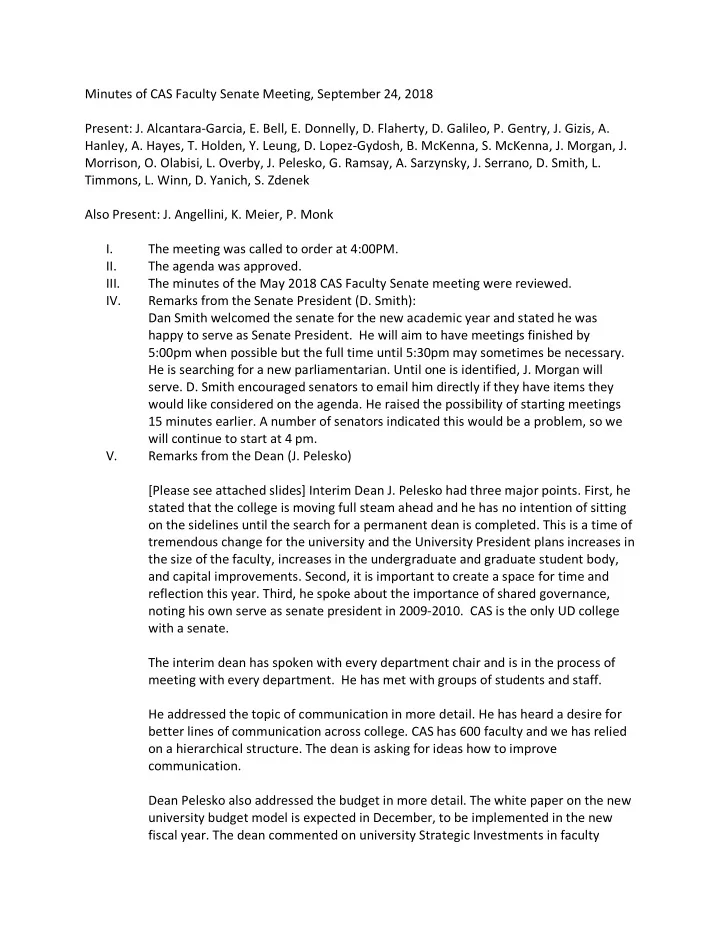
Minutes of CAS Faculty Senate Meeting, September 24, 2018 Present: J. Alcantara-Garcia, E. Bell, E. Donnelly, D. Flaherty, D. Galileo, P. Gentry, J. Gizis, A. Hanley, A. Hayes, T. Holden, Y. Leung, D. Lopez-Gydosh, B. McKenna, S. McKenna, J. Morgan, J. Morrison, O. Olabisi, L. Overby, J. Pelesko, G. Ramsay, A. Sarzynsky, J. Serrano, D. Smith, L. Timmons, L. Winn, D. Yanich, S. Zdenek Also Present: J. Angellini, K. Meier, P. Monk I. The meeting was called to order at 4:00PM. II. The agenda was approved. III. The minutes of the May 2018 CAS Faculty Senate meeting were reviewed. IV. Remarks from the Senate President (D. Smith): Dan Smith welcomed the senate for the new academic year and stated he was happy to serve as Senate President. He will aim to have meetings finished by 5:00pm when possible but the full time until 5:30pm may sometimes be necessary. He is searching for a new parliamentarian. Until one is identified, J. Morgan will

  • serve. D. Smith encouraged senators to email him directly if they have items they

would like considered on the agenda. He raised the possibility of starting meetings 15 minutes earlier. A number of senators indicated this would be a problem, so we will continue to start at 4 pm. V. Remarks from the Dean (J. Pelesko) [Please see attached slides] Interim Dean J. Pelesko had three major points. First, he stated that the college is moving full steam ahead and he has no intention of sitting

  • n the sidelines until the search for a permanent dean is completed. This is a time of

tremendous change for the university and the University President plans increases in the size of the faculty, increases in the undergraduate and graduate student body, and capital improvements. Second, it is important to create a space for time and reflection this year. Third, he spoke about the importance of shared governance, noting his own serve as senate president in 2009-2010. CAS is the only UD college with a senate. The interim dean has spoken with every department chair and is in the process of meeting with every department. He has met with groups of students and staff. He addressed the topic of communication in more detail. He has heard a desire for better lines of communication across college. CAS has 600 faculty and we has relied

  • n a hierarchical structure. The dean is asking for ideas how to improve

communication. Dean Pelesko also addressed the budget in more detail. The white paper on the new university budget model is expected in December, to be implemented in the new fiscal year. The dean commented on university Strategic Investments in faculty

slide-2
SLIDE 2

hiring, capital projects, deferred maintenance. Under RBB, there was not enough centrally held money to enable strategic spending by the University President. In the near term, investments will be in faculty hiring and capital projects. In order to get to a university increase of 250 faculty and keep up with retirements, UD will need to hire 500 new faculty. The dean noted that in the CAS FY19 budget, planned expenses were funded. The college can adjust as justified (such as adding an S-contract.) Reserves are not as necessary as in previous system, and have been mostly

  • allocated. Going forward, we will have less direct discretionary control as a college.

The dean then discussed operating in the post-RBB budget world. The budget will not be as flexible to add recurring expense, such as a staff member. For recurring expenses, the college will need to go to central administration. However, he says that hesitation about launching new programs and initiatives is not necessary. The faculty hiring procedure is different; additional faculty hiring requests will be made each year to central administration. "We need to articulate what we do and what we want to do. “ Topics addressed in question and answer: Building X status and department input: No major developments since August. Faculty startup and the new budget: This year nothing changes. The longer term is unknown Centralization and its implications for the role of CAS departments and senate: For hiring, need to make case to people in Hullihen Hall. Curriculum strongly resides in the hands of faculty. Question of emphasis on growing TT faculty given teaching needs and inadequate classrooms: The dean believe that arguments based on numbers are not enough, but arguments based on student quality and success are compelling. The President emphasizes enhancing student success. The Senate should consider inviting a speaker on the campus master plan. VI. Committee Report: Educational Affairs Committee (J. Angelini) The committee has had its first meeting and anticipates a lot of work this semester. The due date for Curriculog proposals is October 31. VII. Committee Report: COCAN (J. Morgan)

  • J. Morgan provided an overview of the committee staffing process. In February, he

sends email thanking current committee members and asking if they are willing to

  • continue. He then sends an email to all full-time members who are not

administrators seeking volunteers for vacancies. Typically, there is one volunteer per

  • vacancy. Staffing P&T is more difficult due to constraints on membership. For this

work, J. Morgan gets a list of faculty from the AAUP. It would be very helpful to have a well-maintained list from CAS.

slide-3
SLIDE 3

VIII. Presentation: Tenure-track commission report (L. Overby) [Please see attached slides.] L. Overby is Vice President of University Faculty Senate and a member of the university faculty tenure-track commission. She emphasized the expansion of the term scholarship to include research, teaching, and service, and asked for faculty from different CAS departments to join a committee to think about this expansion. She also discussed valuing community engagement. Questions and answers discussed the following topics: The perception that only service to the department is valued in some CAS departments, and not service to the college, university, or community of Newark. What kind of volunteering is needed and how will changes be implemented. It was noted that while the commission has made recommendations, the university senate has not yet voted on changes to the faculty handbook. The question for CAS is whether we can make these ideas work for our departments so that the university senate can approve them. IX. Unfinished business: None X. New business

  • J. Morgan argued that there was no mention of faculty involvement in the new

budget system but that when RBB was approved, there were town halls. He is also concerned that the other six deans outnumber our dean on committees. J. Pelesko replied that the working committees had broad representation from faculty. He does not know the plan for after the white paper is released in December but he assumes there is time for meetings. XI. Adjournment at 5:10pm

slide-4
SLIDE 4
slide-5
SLIDE 5

CAS Senate Meeting

September 24, 2018

slide-6
SLIDE 6

Emerging Themes – Visits with chairs, departments, staff, and students

  • Incredible strength and diversity of CAS
  • Communication
  • Budget
  • Space
  • Bureaucracy
  • Diversity
  • Vision & Planning
  • Interdisciplinarity
slide-7
SLIDE 7

Emerging Themes – Visits with chairs, departments, staff, and students

  • Incredible strength and diversity of CAS
  • Communication
  • Budget
  • Space
  • Bureaucracy
  • Diversity
  • Vision & Planning
  • Interdisciplinarity
slide-8
SLIDE 8

Emerging Themes – Visits with chairs, departments, staff, and students

  • Incredible strength and diversity of CAS
  • Communication
  • Budget
  • Space
  • Bureaucracy
  • Diversity
  • Vision & Planning
  • Interdisciplinarity
slide-9
SLIDE 9

The Budget

  • Budget model progress
  • Broad UD budget changes and implications
  • CAS budget for FY19
  • Life in a post-RBB world
slide-10
SLIDE 10

Budget model progress

  • Budget model by the end of December
  • Subcommittee work essentially done
  • Final plan hammered out by Deans, Provost,

VP for Strategic Planning and Analysis, Budget Office

slide-11
SLIDE 11

Broad UD Budget Changes and Implications

  • Strategic Investments (near term)

– Faculty hiring – Capital projects – Deferred maintenance

slide-12
SLIDE 12

CAS FY19 Budget

  • Planned expenses funded (salaries, GTA, S-

contract, S&E)

  • We can adjust as justified (e.g. S-contract)
  • Reserves mostly allocated
  • Less direct discretionary control
slide-13
SLIDE 13

Operating in a post-RBB world

  • College discretionary funding
  • Launching new programs/initiatives
  • Faculty hiring
  • Articulate value of what we do and what we

want to do

slide-14
SLIDE 14

Lynnette Young Overby Vice President, Faculty Senate

Scholarship and Community Engagement Across the Missions of Teaching, Research/Creative Activities and Service

slide-15
SLIDE 15

Faculty Handbook – P & T Mission

  • the University of Delaware has a strong tradition
  • f distinguished scholarship, which is

manifested in research and other creative activities, teaching, and service, and is grounded in a commitment to increasing and disseminating scientific, humanistic, artistic, and social knowledge for the benefit of the larger society.

2

slide-16
SLIDE 16

Recommendation – Expansion of the Term Scholarship

Scholarly

  • Teaching
  • Research/Creative Activities
  • Service

3

slide-17
SLIDE 17

What Do We Mean By Scholarship?

Diamond, R. (2002, Summer). Defining scholarship for the twenty-first century. New Directions for Teaching and Learning, No. 90., pp. 73-79. New York, NY: Wiley Periodicals.

1. Requires a high level of (multi)disciplinary expertise: problem and systems change focused 2. Conducted in a scholarly manner Clear goals Adequate preparation Appropriate methodology 3. Is appropriately and effectively documented and disseminated to (academic and community)

slide-18
SLIDE 18

What Do We Mean By Scholarship?

  • 4. Is judged to be significant and meritorious (product,

process, and/or results) by panel of peers

  • 5. Demonstrates consistently ethical practice, adhering

to codes of conduct in research, teaching, and the discipline

  • 6. Recognizes the dynamic relationship between tacit

and explicit knowledge

Diamond, R. (2002, Summer). Defining scholarship for the twenty-first century. New Directions for Teaching and Learning, No. 90., pp. 73-79. New York, NY: Wiley Periodicals.

slide-19
SLIDE 19

Expansion of the term Scholarship to include Community Engagement

  • Teaching
  • Research/Creative Activities
  • Service

6

slide-20
SLIDE 20

Community Engagement Definition

  • Community engagement describes the

between higher education institutions and the larger communities (local, regional/state, national and global) for the exchange of knowledge and resources in a context of and

7

slide-21
SLIDE 21

What Do We Mean by Engagement

Engagement is the partnership of university knowledge and resources with those of the public and private sectors to

  • enrich scholarship and research
  • enhance curricular content and

process

  • prepare citizen scholars
  • endorse democratic values and civic

responsibility

  • address critical societal issues
  • contribute to the public good

Fitzgerald, H E., Smith, P., Book, P., Rodin, K. (2005). Engaged Scholarship: A Resource Guide. Report submitted to the Committee on Institutional Cooperation.

slide-22
SLIDE 22

9

slide-23
SLIDE 23

10

slide-24
SLIDE 24

Martha Buell

Examples of scholarly service

Using information from state level evaluations, in addition to national research to support the state in developing child care quality policy

Invitation to join state team at the National Infant and Toddler Strategies Institute - Goal of Institute to work with State and Territory leaders and their partners to develop innovative early childhood (EC) policies and systems that support families and that optimize infant-toddler development

slide-25
SLIDE 25

Northern Delaware Early Head Start: An Interagency Approach to Supporting Children and Families By Hallam R.A., Buell M.J., Gamel-McCormick M. Chapter selected for:

slide-26
SLIDE 26

Engaged Service Scholarly Activities

Technical assistance Consulting Policy analysis Expert testimony Legal advice Diagnostic and clinical services Human and animal patient care Advisory boards and other disciplinary-related service to community organizations

slide-27
SLIDE 27

Engaged Research and Creative Activities

Engaged research and creative activities are associated with the discovery of new knowledge, the development of new insights, and the creation of new artistic

  • r literary performances and

expressions—in collaboration with community partners.

Doberneck, D. M., Glass, C.R., & Schweitzer, J. H. (2010). From rhetoric to reality: A typology of publicly engaged scholarship. Journal of Higher Education Outreach and Engagement 14(5), 5-35.

slide-28
SLIDE 28

For-Credit

  • Service-learning
  • Community engaged research as part of university classes
  • Study abroad programs with community engagement components
  • Online and off-campus education

Not-for-Credit

  • Pre-college programs for youth in K-12
  • Occupational short course, certificate, and licensure programs
  • Conferences, seminars, not-for-credit classes, and workshops
  • Educational enrichment programs for the public and alumni
  • Media interviews or “translational” writing for general public audiences
  • Materials made available to enhance public understanding
  • Self-directed, managed learning environments, such as museums, libraries,

gardens

Engaged Teaching/Learning Scholarly Activities

slide-29
SLIDE 29

Assessment of Community Engagement

  • Community Needs Identified
  • Measureable Impacts
  • Co-creation, co-implementation, co-

assessment, co-dissemination

slide-30
SLIDE 30

Recommendation Workload

  • Workload shall be assigned with the

expectation that the faculty member will have the opportunity to meet the criteria for satisfactory peer review, contract renewal, and promotion and tenure.

17

slide-31
SLIDE 31

https://provost.udel.edu/resources/reports/ Report of the Provost’s Commission on Tenure-Track Faculty

18

slide-32
SLIDE 32

Request

  • Faculty from different departments in

CAS to become a part of a committee designed to determine the feasibility of expanding the term scholarship and incorporating engaged scholarship into departmental/disciplinary documents.

19

slide-33
SLIDE 33

Contact Us

Chris Williams, President Faculty Senate ckwillia@udel.edu Lynnette Young Overby Vice President, Faculty Senate

  • verbyl@udel.edu

Martha Buell, Past President Faculty Senate mjbuell@udel.edu

www.udel.edu/engage