Minutes for University of Delaware CAS Faculty Senate meeting April - - PDF document

minutes for university of delaware cas faculty senate
SMART_READER_LITE
LIVE PREVIEW

Minutes for University of Delaware CAS Faculty Senate meeting April - - PDF document

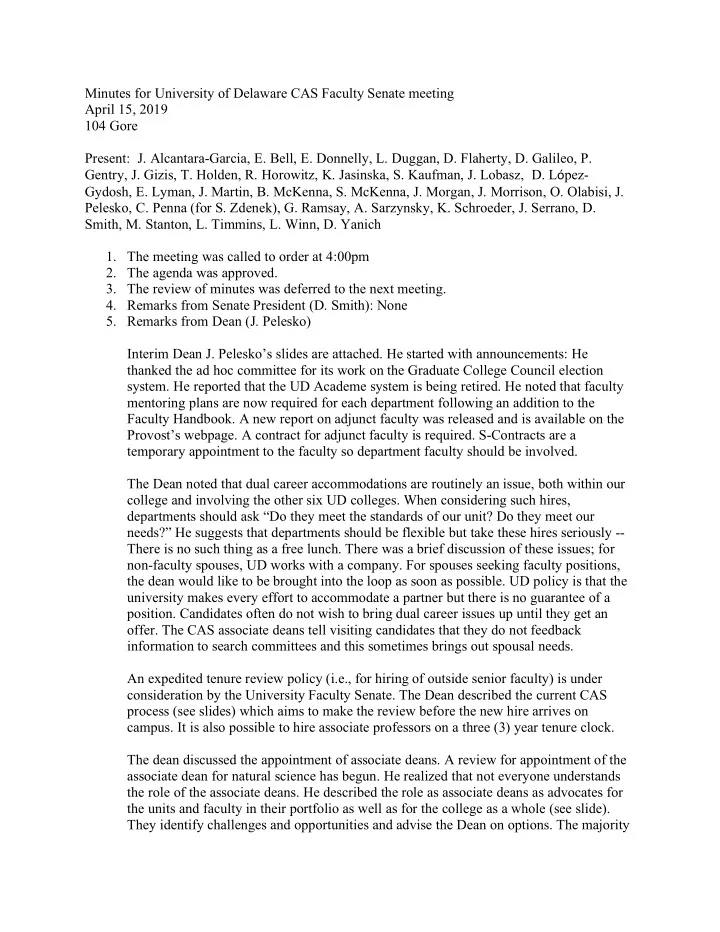
Minutes for University of Delaware CAS Faculty Senate meeting April 15, 2019 104 Gore Present: J. Alcantara-Garcia, E. Bell, E. Donnelly, L. Duggan, D. Flaherty, D. Galileo, P. Gentry, J. Gizis, T. Holden, R. Horowitz, K. Jasinska, S. Kaufman,


slide-1
SLIDE 1

Minutes for University of Delaware CAS Faculty Senate meeting April 15, 2019 104 Gore Present: J. Alcantara-Garcia, E. Bell, E. Donnelly, L. Duggan, D. Flaherty, D. Galileo, P. Gentry, J. Gizis, T. Holden, R. Horowitz, K. Jasinska, S. Kaufman, J. Lobasz, D. López- Gydosh, E. Lyman, J. Martin, B. McKenna, S. McKenna, J. Morgan, J. Morrison, O. Olabisi, J. Pelesko, C. Penna (for S. Zdenek), G. Ramsay, A. Sarzynsky, K. Schroeder, J. Serrano, D. Smith, M. Stanton, L. Timmins, L. Winn, D. Yanich

  • 1. The meeting was called to order at 4:00pm
  • 2. The agenda was approved.
  • 3. The review of minutes was deferred to the next meeting.
  • 4. Remarks from Senate President (D. Smith): None
  • 5. Remarks from Dean (J. Pelesko)

Interim Dean J. Pelesko’s slides are attached. He started with announcements: He thanked the ad hoc committee for its work on the Graduate College Council election

  • system. He reported that the UD Academe system is being retired. He noted that faculty

mentoring plans are now required for each department following an addition to the Faculty Handbook. A new report on adjunct faculty was released and is available on the Provost’s webpage. A contract for adjunct faculty is required. S-Contracts are a temporary appointment to the faculty so department faculty should be involved. The Dean noted that dual career accommodations are routinely an issue, both within our college and involving the other six UD colleges. When considering such hires, departments should ask “Do they meet the standards of our unit? Do they meet our needs?” He suggests that departments should be flexible but take these hires seriously -- There is no such thing as a free lunch. There was a brief discussion of these issues; for non-faculty spouses, UD works with a company. For spouses seeking faculty positions, the dean would like to be brought into the loop as soon as possible. UD policy is that the university makes every effort to accommodate a partner but there is no guarantee of a

  • position. Candidates often do not wish to bring dual career issues up until they get an
  • ffer. The CAS associate deans tell visiting candidates that they do not feedback

information to search committees and this sometimes brings out spousal needs. An expedited tenure review policy (i.e., for hiring of outside senior faculty) is under consideration by the University Faculty Senate. The Dean described the current CAS process (see slides) which aims to make the review before the new hire arrives on

  • campus. It is also possible to hire associate professors on a three (3) year tenure clock.

The dean discussed the appointment of associate deans. A review for appointment of the associate dean for natural science has begun. He realized that not everyone understands the role of the associate deans. He described the role as associate deans as advocates for the units and faculty in their portfolio as well as for the college as a whole (see slide). They identify challenges and opportunities and advise the Dean on options. The majority

slide-2
SLIDE 2
  • f their work is with Department Chairs, facilitating the business of the college. The

Dean took questions after his remarks. There was a discussion of the authority of associate deans. The risks of micromanagement were discussed. J. Pelesko discussed models (at other universities) in which associate deans address functional areas rather than portfolios; J. Pelesko would like to move towards a hybrid model. For example, adding an associate dean for student success. He has requested budget resources, and if they are approved, he will bring proposals to the September CAS Senate meeting. The role of the associate deans in the tenure and promotion process was discussed. They review dossiers in their portfolio and make recommendations to the Dean, but the Dean looks at every promotion dossier in the college and makes decisions. The Dean is the

  • nly person in the Dean’s office who looks at all the dossiers. He would like a second set
  • f eyes, such as a future associate dean for faculty affairs, to look at all of the dossiers.

There were questions about the procedures of appointing associate deans discussed at the previous meeting. The dean is open to having a fourth member of the search committee. On the review for appointment of interim associate deans, he finds himself in the position

  • f having interim associate deans in place, and having to navigate the transition from

having no system to the new system. The need for a job description was discussed; the Dean values experience as a department chair for associate deans but other experiences may set people up for success, and there are practical considerations. There should always be some associate deans with department chairs but it should not be an absolute

  • requirement. Senators expressed concern about administrative bloat. The Dean observed

that CAS is understaffed for our size compared to the other six colleges. In other issues, there is still no update on the budget system. Concern was expressed that faculty were always outspoken about how problematic UD Academe was, yet this negative response was not prioritized by the university. Is the university studying how this poor decision was made so that future poor decisions can be avoided? The Dean explained that the choice of the system was made by Institutional Research, which is not very in tune with the faculty. The responsibility has been shifted to the Provost’s office and he expects a better result.

  • 6. Educational Affairs Committee

The Consent Agenda consisted of six items:

  • a. Applied Music-Instrumental - Principal Instruments Concentration (BM) 2019-2020

Undergraduate Program Revision

  • b. Criminology (PhD) 2019-2020 Graduate Program Revision
  • c. Music Composition (BM) 2019-2020 Undergraduate Program Revision
  • d. Music History and Literature (BM) 2019-2020 Undergraduate Program Revision
  • e. Music Theory (BM) 2019-2020 Undergraduate Program Revision
  • f. Sociology (PhD) 2019-2020 Graduate Program Revision

The consent agenda was approved. Proposal for Individual Consideration:

slide-3
SLIDE 3

Department of Music - School of Music 2019-2020 Departmental Name Change The proposal to rename the department as the “School of Music” was discussed. They intend to search for a director and this will make the position more attractive. This change is based on comparison to similar units around the country. Functionally schools act like departments, so this should be seen as a name change. Structure and reporting do not

  • change. The name change was recommended by an external review committee in the last

academic program review. There was some confusion over whether the department has held a formal vote, but if they have not, they should have one before the University Senate meets. The name change was approved.

  • 7. Election of P&T committee member from Arts portfolio:

Noel Archambeault (Music) was elected by secret ballot with 31 votes.

  • 8. Ad Hoc Committee report amending CAS bylaws to provide for elections of graduate

councilors and alternates: The proposed system was presented by J. Morgan and S. Kaufman, who served as co- chairs of the ad hoc committee. The document is attached. A key feature of the system that in addition to the elected council members, alternates should also be elected and can attend meetings of the Graduate College Council. The distribution of seats for the portfolios (Natural Sciences – 5; Humanities – 4; Social Sciences – 3; Arts – 1 ) are based

  • n the numbers of faculty, but would be nearly the same if based on numbers of graduate
  • students. Some larger departments have their own representatives, and smaller

departments elect council members and alternates jointly. In addition, the committee proposed one seat for the English Language Institute (ELI) because it is heavily engaged in teaching English to graduate students from abroad. ELI is paired with the Associate in Arts program. Ranked Choice voting will be used for elections; the attached document “Hypothetical Crosstabulation of Ranked-Choice Votes” presents an example of how ranked choices voting works. There was a discussion of the system. In the initial elections, half the seats will be for the two normal two-year term and half will be a shorter one-year term; the committee felt that randomly assigning these terms was the least unfair way. Some senators and committee members expressed a desire to have each department represented, and they intend to request that change to the Graduate College Council in the future. Some seats are shared by departments. There was a discussion of whether it would be better to require the seat to be rotated amongst the departments. The committee had considered that but concluded rotation was potentially unfair as well, and preferred to leave the matter up to the elections.

slide-4
SLIDE 4

There was a discussion of what it meant to be actively involved in graduate education. This requirement came from the Graduate College Bylaws and not the ad hoc committee. The motion was passed with 27 in favor, 3 abstain.

  • 9. New Business: None.
  • 10. Unfinished Business: None
  • 11. Introduction of New Business: None
  • 12. The meeting was adjourned at 5:34PM.
slide-5
SLIDE 5

CAS Senate Meeting

April 15, 2019

slide-6
SLIDE 6

A few updates

  • Graduate College
  • UD Academe
  • Mentoring Plans
  • Adjunct Faculty
  • Dual Career Accommodations
  • Expedited Tenure Reviews
  • Roles of Associate Deans
slide-7
SLIDE 7

Expedited Tenure Reviews

For awareness, a resolution that will be going to the Faculty Senate: When a faculty hiring action includes the award of tenure, an expedited tenure review process is required. This expedited review process involves a minimum of three external review letters from distinguished scholars, selected by the departmental promotion & tenure Committee, in consultation with the department chair. The candidate must provide a dossier of work for review by the department and the external reviewers. This can be an abbreviated dossier, but it must include evidence of the quality of the candidate’s teaching, research, and service. After review by the department promotion & tenure committee, the dossier—including the external review letters—will be sent for review to the department chair, the dean, and the

  • provost. No appointment with tenure will be final until the candidate provides

a letter of resignation from their prior institution.

slide-8
SLIDE 8

Expedited Tenure Review – Our Process

  • Review by Department P&T Committee, Chair, Dean,

Provost

  • Use standards in your P&T document
  • Can be an abbreviated dossier
  • Three letters (not from job application/new pool)

required

  • Candidate (if already here at UD) should receive the

recommendation at each stage, retains full right to appeal

slide-9
SLIDE 9

Expedited Tenure Review

For awareness – we can hire at the rank of Associate Professor and put the person on a 3 year tenure clock. (Details in the Faculty Handbook, 4.4.12) Preferable if we cannot complete an expedited review prior to the person arriving on

  • campus. We should make every effort to complete

expedited reviews before the person arrives on campus.

slide-10
SLIDE 10

Dean’s Office

  • Appointment of Associate Deans
  • Faculty Handbook Section 2.6
  • Associate Dean
  • Change from Interim Associate Dean
  • Acting Associate Dean
slide-11
SLIDE 11

Roles of Associate Deans

Associate Deans serve as an advocate for units and faculty in their portfolio as well as for the college as a whole. Their principle role is to identify challenges and opportunities and advise the Dean on options for proceeding. The majority of their work is with Department Chairs, facilitating the business of the college.

slide-12
SLIDE 12

Resolution Amending the Bylaws of the College of Arts and Sciences Faculty and its Senate to Provide for Election of Representatives to the Graduate Council Proposed by the Ad-Hoc Committee on Elections to the Graduate Council Approved 27-0 at the College Senate Meeting on April 15, 2019 WHEREAS a Graduate College has been established to provide leadership to the various graduate programs being conducted at the University of Delaware; and WHEREAS the Bylaws of the Graduate College call for the creation of a Graduate College Council as the deliberative and representative body of the College; and WHEREAS the Bylaws of the Graduate College define all full-time faculty members of the University to be simultaneously members of the faculty of the Graduate College; and WHEREAS the Bylaws of the Graduate College require that “Council members of the academic colleges must be elected by secret ballot among eligible faculty members of a college consistent with their college bylaws;” and WHEREAS the Bylaws of the Graduate College further provide that Graduate Council members shall be “nominated and elected as the representatives of graduate programs within the academic colleges,” and that they “must be active in some aspect of graduate education;” and WHEREAS the number of Graduate Council seats allocated for election by the College of Arts and Sciences is substantially smaller than the number of departments in the College of Arts and Sciences; WHEREAS representatives on the Graduate Council are to serve staggered two-year terms, with half of the terms expiring each year; and WHEREAS College-wide and portfolio-wide elections have the disadvantage that candidates are frequently unknown to the voters; BE IT RESOLVED that the Bylaws of the College of Arts and Sciences Faculty and its Senate be hereby amended to include a new article entitled, “Election of Graduate Council members from the College.” The text of the amendment shall be as follows. At the beginning of Section III.4.A on the requirement that College Senators attend College Senate meetings, add the following sentence: “Because of the responsibility attendant upon membership in the College Senate, department chairpersons shall arrange teaching, research and extension schedules to permit attendance of Senators at regular meetings of the College Senate.” This new sentence will then be followed by the existing sentence: “Any Senator who has more than two unexcused absences from Senate meetings in any

  • ne semester shall forfeit the office.”

At the end of Section III.7 on the election of at-large CAS senators, add the following sentence: “Should a tie vote occur, it shall be resolved randomly, by flipping a coin or rolling a die

  • r drawing straws.”

At the end of Section III.12.B on the election of CAS Senate officers, add the following sentence:

slide-13
SLIDE 13

“Should a tie vote occur, it shall be resolved randomly, by flipping a coin or rolling a die

  • r drawing straws.”

After Section VI, add a new Section VII with the following text:

  • VII. Election of Graduate Councilors and Alternates for the Graduate Council of the Graduate College
  • 1. To promote breadth of representation, no department shall be represented by more than one Graduate

Councilor holding a primary appointment in that department.

  • 2. All Graduate Councilors and alternates shall interact frequently with the faculty members in the departments

they represent regarding the business of the Graduate Council. Graduate Councilors and alternates who are elected to represent more than a single department have a duty to represent fairly the concerns of the faculty members in all the departments which they represent.

  • 3. Because of the responsibility attendant upon membership in the Graduate Council, department chairpersons

shall arrange teaching, research and extension schedules to permit attendance of Graduate Councilors and alternates at regular meetings of the Graduate Council. Any Graduate Councilor who has more than two unexcused absences from Graduate Council meetings in any one semester shall forfeit the office and be replaced by an alternate.

  • 4. In the first round of elections to the Graduate Council (conducted in the spring of 2019), COCAN shall by random

selection designate half of the winning candidates to serve a one-year term, and the other half to serve a two- year term, to establish the system of staggered terms required by the Graduate College’s Bylaws.

  • 5. To provide strong connections of Graduate Councilors and alternates with the faculty members and programs

they represent, the seats for Graduate Councilors shall be distributed as follows: Natural Sciences Portfolio (5 total): Biological Sciences – 1 seat Chemistry & Biochemistry – 1 seat Mathematical Sciences – 1 seat Physics & Astronomy – 1 seat Psychological & Brain Sciences and Linguistics & Cognitive Science – 1 seat Humanities Portfolio (4 total): English – 1 seat Languages, Literatures & Cultures – 1 seat Africana Studies, Art Conservation, Art History, History, Philosophy – 2 seats Social Sciences Portfolio (3 total): Joseph R. Biden, Jr., School of Public Policy & Administration – 1 seat Communication, Political Science & International Relations, Women and Gender Studies – 1 seat Anthropology, Fashion & Apparel Studies, Sociology & Criminal Justice – 1 seat Arts Portfolio (1 seat): Art & Design, Music, and Theatre (1 seat) Nondepartmental Group (1 seat): English Language Institute and Associate in Arts Program – 1 seat

slide-14
SLIDE 14
  • 6. If a department has its own Graduate Councilor, the departmental faculty shall elect from among their

departmental colleagues a Graduate Councilor and one alternate by secret ballot of all full-time faculty members in a manner consistent with the department’s Bylaws, the College Bylaws, and the Graduate College’s

  • Bylaws. Each full-time faculty member shall have the right to propose an eligible faculty member for nomination

to be Graduate Councilor.

  • 7. The English Language Institute shall provide from among its full-time faculty who are engaged in graduate

education both a Graduate Councilor and an alternate, to be elected collectively by the full-time faculty members in the English Language Institute and the Associate in Arts Program.

  • 8. If a department shares a Graduate Councilor and an alternate with at least one other department, the following

procedures shall apply.

  • A. Each department that includes faculty members active in some aspect of graduate education shall have the

right to choose one faculty member as a candidate for election to be a Graduate Councilor. Each full-time faculty member shall have the right to propose a faculty member from their department for nomination to be a Graduate Councilor and to vote on the department’s nomination. Each department’s candidate shall be chosen in an election conducted by secret ballot consistent with the department’s Bylaws.

  • B. The College Faculty Senate’s Committee On Committees And Nominations (COCAN) shall designate an

election officer, if possible from among its members, to organize and conduct the elections for Graduate Councilors and alternates of departmental groups. Ballot materials shall include a short biographical statement, of 100 words or less, submitted by each candidate summarizing the candidate’s qualifications for the Graduate Council.

  • C. COCAN shall not accept a candidate nominated by a department if the election of that candidate would

result in more than one person holding a primary appointment in that department being a Graduate Councilor.

  • D. In elections among groups of departments to fill two seats, each eligible voter shall have the right to cast

two unranked votes. The two candidates receiving the most votes shall be the Graduate Councilors; all

  • ther candidates shall be alternates.
  • E. In elections among groups of departments in which more than two candidates are nominated to fill a single

seat, voters shall identify their preferences in rank order, designating their first choice, second choice and any subsequent choices. In such cases, if no candidate receives a majority of first-choice votes, the candidate receiving the fewest first-choice votes shall be eliminated. The ballots cast for that candidate shall be reviewed and reallocated to those voters’ second-choice candidates. This process shall be repeated, sequentially eliminating the last-place remaining candidate and reallocating each vote to the next chosen candidate in order of priority, until a candidate has received a majority of votes cast or until only two candidates remain. The candidate with the most votes shall be the Graduate Councilor; all other candidates shall be alternates.

  • F. Should a tie vote occur, it shall be resolved randomly, by flipping a coin or rolling a die or drawing straws.
  • 9. The apportionment of Graduate Councilors and alternates shall be reconsidered by the College Senate

whenever the number of Graduate Councilors assigned to the College changes or whenever a simple majority of the College Senate votes to reconsider the apportionment. Renumber the current Section VII (Amendments and implementation) as Section VIII.

slide-15
SLIDE 15

Hypothetical Crosstabulation of Ranked-Choice Votes First-Choice Vote Second-choice vote A B C A 6 1 B 5 8 C 6 4 Total 11 10 9 In this hypothetical case, first-choice votes are nearly tied, with candidate A in the lead will 11 votes, B with 10, and C with 9. Under the single transferrable vote system, candidate C is dropped from the running, and his/her votes are reassigned based on their second choices. Inspecting the crosstab, we find that among those who chose candidate C as their first choice, one gave their second-choice vote to A, and eight gave their second-choice votes to B. Therefore, the final vote tally is: A: 11 + 1 = 12 votes B: 10 + 8 = 18 votes The result in this hypothetical example is to give B and decisive victory over A, presumably because most

  • f those who voted for C as their first choice decided that B would better represent their interests than

A would.