SLIDE 1
Sustainable Grounds Management Lunch & Learn -- August 22, 2017
MINIMIZING WATER POLLUTION FROM LANDSCAPING RUNOFF
Preseted y: Lake Couty Sureyor’s Offie
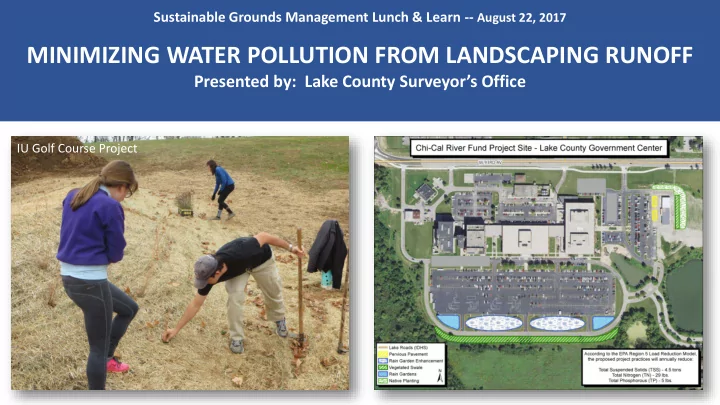
IU Golf Course Project
SLIDE 2 Sustainable Grounds Management Lunch & Learn -- August 22, 2017
MINIMIZING WATER POLLUTION FROM LANDSCAPING RUNOFF
Preseted y: Lake Couty Sureyor’s Offie Departets ithi the Sureyor’s Office:
- Surveying
- Drainage
- GIS
- MS4 (Municipal Separate Storm Sewer Systems)
Purpose: Implement 6 Mandated Control Measures
- 1. Public Education & Outreach
- 2. Public Participation & Involvement
- 3. Illicit Discharge Detection & Elimination
- 4. Construction Site Stormwater Run-Off
- 5. Post-Construction Stormwater Run-Off
- 6. Pollution Prevention & Good Housekeeping
Bill Emerson, Jr., PE
Lake County Surveyor
SLIDE 3
MINIMIZING WATER POLLUTION FROM LANDSCAPING RUNOFF
1. What we do really matters: The Water Cycle 2. What is in stormwater: Pollution? 3. Long-Term Precipitation Trends 4. Best Management Practices
SLIDE 4 The Water Cycle
Source: www.uwgb.edu/dutchs/GeolColBk/HydroCycle.htm
SLIDE 5 The Water Cycle
Source: www.uwgb.edu/dutchs/GeolColBk/HydroCycle.htm
What we do and how we build right here really matters.
SLIDE 6 The Water Cycle
Data Source: US EPA
The Water Cyle: Aual Preipitatio Distriutio for Pre-Settleet Coditio
(50%)
What we do and how we build right here really matters.
(50%)
SLIDE 7 Data Source: US EPA
The Water Cycle: Annual Precipitation Distribution for 30% to 50% Impervious Surface
The Water Cycle
What we do and how we build right here really matters.
(35%) (65%)
SLIDE 8 The Water Cyle: Copariso of Loalized Pre-Settleet to Post-Deelopet
Pre-Settleet Coditio Post-Deelopet at 30% to 50% Iperious Surfae
(50%) (50%) (35%) (65%)
SLIDE 9 The Water Cyle: Copariso of Loalized Pre-Settleet to Post-Deelopet
Pre-Settleet Coditio Post-Deelopet at 30% to 50% Iperious Surfae
(50%) (35%)
Minimizing Pollution from Stormwater Runoff
(50%)
SLIDE 10 Stormwater Runoff
The possible deleterious water quality effects of nonpoint sources in general, and urban runoff in particular, were recognized by the Water Pollution Control Act Amendments of 1972. Because of uncertainties about the true significance of urban runoff as a contributor to receiving water quality problems, Congress made treatment of separate stormwater discharges ineligible for Federal funding when it enacted the Clean Water Act in 1977. To obtain information that would help resolve these uncertainties, the Agency established the Nationwide Urban Runoff Program (NURP) in 1978. This five year program was designed to examine such issues as:
- The quality characteristics of urban runoff, and similarities or
differences at different urban locations;
- The extent to which urban runoff is a significant contributor to
- water quality problems across the nation; and
- The performance characteristics and the overall effectiveness and
utility of management practices for the control of pollutant loads from urban runoff. The interim NURP report, published in March 1982, presented preliminary findings of the program. This document (December 1983) is the final report covering the overall NURP program.
SLIDE 11 Pollutant Concentrations for Residential, Mixed, Commercial & Open/Non-Urban Land Uses
Median Event Mean Concentrations for Urban Land Uses
SLIDE 12 Pollutant Concentrations for Residential, Mixed, Commercial & Open/Non-Urban Land Uses
Median Event Mean Concentrations for Urban Land Uses Pollutants
(Biochemical Oxygen Demand) (Chemical Oxygen Demand) (Total Suspended Solids)
SLIDE 13 Pollutant Concentrations for Residential, Mixed, Commercial & Open/Non-Urban Land Uses
Median Event Mean Concentrations for Urban Land Uses Land use Pollutants
(Biochemical Oxygen Demand) (Chemical Oxygen Demand) (Total Suspended Solids)
SLIDE 14 Pollutant Concentrations for Residential, Mixed, Commercial & Open/Non-Urban Land Uses
Median Event Mean Concentrations for Urban Land Uses Land use Pollutants Pollutant Concentration (typ.)
(Biochemical Oxygen Demand) (Chemical Oxygen Demand) (Total Suspended Solids)
SLIDE 15 Chemical Oxygen Demand Total Suspended Solids Total Lead Total Kjeldahl Nitrogen (TKN) Nitrate + Nitrite Total Phosphorus
Median Event Mean Concentrations: Urban vs. Non-Urban
SLIDE 16 Median Event Mean Concentrations: Urban vs. Non-Urban
Total Suspended Solids (TSS) for Various Land Uses Total Phosphorus (TP) for Various Land Uses
SLIDE 17 Source: Indiana Department of Transportation Storm Water Management Guide
Construction Site Stormwater Runoff: Importance of Re-Vegetation
SLIDE 18 Source: Indiana Department of Transportation Storm Water Management Guide
Construction Site Stormwater Runoff: Strategy #1 – Minimize Land Disturbance
SLIDE 19 Source: Indiana Department of Transportation Storm Water Management Guide
Construction Site Stormwater Runoff: Strategy #2 – Protect the Disturbed Soil
SLIDE 20
Long-Term Precipitation Trends
SLIDE 21
Best Management Practices: Parking Lot Retrofit at Purdue University
SLIDE 22
Best Management Practices: Parking Lot Retrofit at Purdue University
SLIDE 23
Best Management Practices: Parking Lot Retrofit at Purdue University
SLIDE 24
Best Management Practices: Parking Lot Retrofit at Purdue University
SLIDE 25 Best Maageet Praties: Lo Mo Grass at Ball State Uiersity
Michael Planton, Associate Director for Landscape and Environmental Management
- Landscape Services responsible to mow approximately 135 acres of grass
- Current mowing scheduling:
- 130 acres are traditional grass and mowed once per week
- 5 ares are lo o grass ad oed oe per oth
- Arried at lo o seed i talkig to seed edors
- Usig seed i prepared Earth Carpet alled Care-Free ad supplied La Crosse Seed Wisosi
- Costs approximately $1 per pound less than typical Kentucky Bluegrass seed
- Curret ad future loatios of lo o grass:
- Outlying Areas
- Hard to Get to Areas
- New application: 5-acre remote radio tower located 3 miles from the Ball State Campus
- Potetial appliatio: oert parkig edias to lo o seed i
SLIDE 26
Best Maageet Praties: Lo Mo Grass at Ball State Uiersity
SLIDE 27
Best Management Practices: Golf Course Storm Water Quality at Indiana University
SLIDE 28 Best Management Practices: Golf Course Storm Water Quality at Indiana University
Overall Research Goal: What we learn here could have a positive impact on hundreds of golf courses and the surrounding neighborhoods and environment in how we manage storm ater, said Melissa Clark, director of the project and a member of the School
Public and Environmental Affairs faculty at IU
- Bloomington. We want to discover the best practices for steering
storm water quantity and quality.
SLIDE 29 Best Management Practices: Golf Course Storm Water Quality at Indiana University
Overall Research Goal: What we learn here could have a positive impact on hundreds of golf courses and the surrounding neighborhoods and environment in how we manage storm ater, said Melissa Clark, director of the project and a member of the School
Public and Environmental Affairs faculty at IU
- Bloomington. We want to discover the best practices for steering
storm water quantity and quality. Outcomes for Golf Course: Measured stormwater pollution reduction data and the development
a comprehensive stormwater runoff mitigation plan for the IU Championship Golf Course.
SLIDE 30 Best Management Practices: Golf Course Storm Water Quality at Indiana University
- The project is expected to start in September or October of 2017 and be completed around
September 2018.
- The renovation will provide play on new, challenging holes that take advantage of the existing
topography while using ecological and sustainable design and maintenance methods.
- "The golf course renovation will be handled with the utmost care and concern for the environmental
impact and sustainability of the course and surrounding landscape both now and in the future," said Thomas A. Morrison, IU vice president for capital planning and facilities. "We have the opportunity to reinvigorate the course while taking advantage of design and ecological methods that were not available when the course was constructed in the mid-1950s.
- I am most proud that the renovation will improve the environmental impact and sustainability of
the golf course, enhance its economic viability, and preserve its public aessiilit, Vice President and Director of Athletics Fred Glass said.
SLIDE 31
Best Management Practices: Golf Course Storm Water Quality at Indiana University
SLIDE 32
https://youtu.be/Y4nfKezcd5c
Best Management Practices: Golf Course Storm Water Quality at Indiana University
SLIDE 33 Best Management Practices: Elementary School Drainage Improvements West Elementary School, Mount Vernon, Indiana
Problem: The City of Mount Vernon suffered from localized flooding at the West Elementary School and the surrounding neighborhoods to the north and east. Despite improvements to address the issue, the its stormwater system was not large enough to alleviate the flooding, which would
- ccur with as little as 2 inches of rain. The school
and neighborhoods total about 34 acres. The flooding forced neighborhood children to walk to school in city streets instead
sidewalks, prevented to use of the shools playground, and negatively impacted hoeoers yards, residences, and personal property.
SLIDE 34 Best Management Practices: Parking Lot Retrofit at Purdue University
Solution: The city installed 22,500 square feet of bioretention areas that capture stormwater and slowly release it to the existing storm sewer
- system. The city chose the green alternative because the conventional,
grey alternatives were not feasible. First, a conventional detention basin was rejected because, such a waterbody, in the vicinity of a school, is considered an attratie uisae, thus making it an undesirable
- liability. Second, a connection to the storm sewer was not feasible due to
the required length of pipe and relative flatness of the terrain, which would have resulted in the pipe not having enough soil cover to meet the aufaturers installation requirements.
Social Benefits:
- Neighborhood children were provided a
safe route to school
- Improved aesthetics at the school
Environmental Benefits: Reduced flooding and improved water quality . Economic Benefits: The bioretention areas were the most cost-effective solution.
SLIDE 35 Best Management Practices: Parking Lot Retrofit at Purdue University
Solution: The city installed 22,500 square feet of bioretention areas that capture stormwater and slowly release it to the existing storm sewer
- system. The city chose the green alternative because the conventional,
grey alternatives were not feasible. First, a conventional detention basin was rejected because, such a waterbody, in the vicinity of a school, is considered an attratie uisae, thus making it an undesirable
- liability. Second, a connection to the storm sewer was not feasible due to
the required length of pipe and relative flatness of the terrain, which would have resulted in the pipe not having enough soil cover to meet the aufaturers installation requirements.
Social Benefits:
- Neighborhood children were provided a
safe route to school
- Improved aesthetics at the school
Environmental Benefits: Reduced flooding and improved water quality . Economic Benefits: The bioretention areas were the most cost-effective solution.
SLIDE 36 Best Management Practices: Parking Lot Retrofit at Purdue University
Solution: The city installed 22,500 square feet of bioretention areas that capture stormwater and slowly release it to the existing storm sewer
- system. The city chose the green alternative because the conventional,
grey alternatives were not feasible. First, a conventional detention basin was rejected because, such a waterbody, in the vicinity of a school, is considered an attratie uisae, thus making it an undesirable
- liability. Second, a connection to the storm sewer was not feasible due to
the required length of pipe and relative flatness of the terrain, which would have resulted in the pipe not having enough soil cover to meet the aufaturers installation requirements.
Social Benefits:
- Neighborhood children were provided a
safe route to school
- Improved aesthetics at the school
Environmental Benefits: Reduced flooding and improved water quality . Economic Benefits: The bioretention areas were the most cost-effective solution.
SLIDE 37
Best Management Practices: Future Project – Lake County Government Complex
SLIDE 38
Best Management Practices: Grass Clippings
SLIDE 39
Best Management Practices: Grass Clippings
SLIDE 40 Best Management Practices: Grass Clippings
Grass clippings discarded along bank of a Lake County waterway:
- This is a violation of the Lake County Stormwater Management
and Clean Water Regulations Ordinance.
- Subject to Violation Notice/Fines.
- Decaying yard debris such as grass clippings, branch cuttings
and leaves in waterways can release nutrients leading to weed and algae growth and use up oxygen leading to oxygen depletion. What Can You Do to Protect Water Quality?
- Do not dump, blow or sweep yard waste into a ditch, street, or
storm drain.
- Leave grass clippings on your lawn to act as a natural fertilizer
and soil conditioner.
- Compost leaves and grass clippings, producing a mulch for
flower beds and gardens.
- Bag or containerize waste for yard waste collection.
SLIDE 41
Best Management Practices: Cold Weather Considerations
SLIDE 42 Sustainable Grounds Management Lunch & Learn -- August 22, 2017
MINIMIZING WATER POLLUTION FROM LANDSCAPING RUNOFF
Preseted y: Lake Couty Sureyor’s Offie Departets ithi the Sureyor’s Office:
- Surveying
- Drainage
- GIS
- MS4 (Municipal Separate Storm Sewer Systems)
Purpose: Implement 6 Mandated Control Measures
- 1. Public Education & Outreach
- 2. Public Participation & Involvement
- 3. Illicit Discharge Detection & Elimination
- 4. Construction Site Stormwater Run-Off
- 5. Post-Construction Stormwater Run-Off
- 6. Pollution Prevention & Good Housekeeping
Bill Emerson, Jr., PE
Lake County Surveyor