Mine Hydrogen Power: Avancements, needs Presentation to the - - PowerPoint PPT Presentation

mine hydrogen power
SMART_READER_LITE
LIVE PREVIEW

Mine Hydrogen Power: Avancements, needs Presentation to the - - PowerPoint PPT Presentation

Mine Hydrogen Power: Avancements, needs Presentation to the Hydrogen Mine Power Seminar Marc Btournay CanmetMINING May 22nd, 2019 Drivers for Cleaner Energy Application Important Considerations for the Mining Industry Workplace health


slide-1
SLIDE 1

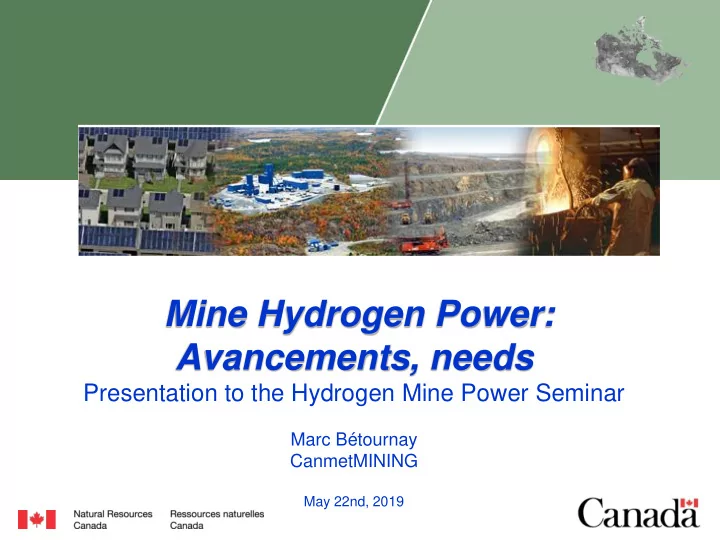
Mine Hydrogen Power: Avancements, needs

Presentation to the Hydrogen Mine Power Seminar

Marc Bétournay CanmetMINING

May 22nd, 2019
slide-2
SLIDE 2
  • Workplace health
  • New generation of diesel engines to meet cleaner air requirements (EPA Tier 4)
  • Considerations related to the 2012 WHO underground diesel power use health warning
  • Sought: alternative energy to eliminate all emissions, viable operational replacement
  • In some cases, e.g., fuel cells, significant reduction in noise generation, vehicle heat load in deep

mines

  • Rising oil prices
  • Replacing diesel
  • Economic opportunity for the industry through cost reductions
  • Reducing required ventilation
  • Diesel equipment, maintenance, downtime, automation vs electric motor lower maintenance costs,

higher reliability

  • Less loss-time due to diesel-related health issues
  • Automation, tele-remote operation improved
  • Keeping pace with surface vehicle clean energy drive
  • Clean Energy - Changing climatic conditions
  • GHG reduction

Important Considerations for the Mining Industry

Drivers for Cleaner Energy Application

slide-3
SLIDE 3

Hydrogen Mine Power Implementation 2000-2019

slide-4
SLIDE 4

Historical Developments

  • Fuel cells work in underground environments
  • Hydrogen leaks from infrastructure is very small, only man-made

accidents represent worse leak cases

  • Hydrogen behaves underground as per theory
  • 25-50% savings on ventilation ($500k-$1.5M/year)
  • 25% less GHGs
  • Mine production locomotive assembled, tested in mines
  • Mine production loader assembled, tested in mine
slide-5
SLIDE 5

H2

  • Design completed: standard on-site hydrogen

production, storage and distribution (average

mine, 1,200 kg/day, all mine vehicles)

  • Design completed: refueling installation

underground

  • Risk potential and evaluation methodology
  • Risk reduction through engineering and

administrative action (e.g. safety shut-down with

sensors; 3 sec hydrogen release max.; protection of pipeline; electric equipment zoning, spark-free fans, protocols)

  • Codes and standards exist for infrastructure

components

  • Towards CHIC for mines

Current Developments

slide-6
SLIDE 6

Risk is based on the two events

  • Leak occurring
  • Spark

Examples, sources of sparking that commonly occur underground

  • Contacts
  • Electric motors
  • Welding
  • Diesel engines

Credible leaks from infrastructure

  • 90-96% of all leaks
  • < 0.1-0.2 mm wide
  • 0.03%-0.1% of pipe cross-sectional area
  • Worst case scenario will be man-made

The ignition source must have sufficient energy, duration and position in the leak cloud concentration Try to remove some ignition sources, prevent man-made leaks

Leak Scenarios

slide-7
SLIDE 7
  • Mine hydrogen installations require supplementary considerations for an

installation code

  • Stringent mining regulations for safety in confined spaces
  • Underground atmosphere conditions (mineral dust mostly corrosive, dampness, diesel emission

gases)

  • Presence of other vehicle power systems that can represent source of ignition risks (diesel ICE,

lithium ion batteries)

  • Shock and vibration and impacts imposed to fuel cell vehicles
  • Stability of the underground rock mass periphery
  • Mine surface installations featuring industrial activities, heavy equipment, sources of ignition

Mining Context

slide-8
SLIDE 8

CHIC for Mining

  • For surface and underground, compliance with the jurisdiction’s

mine regulations adds additional considerations driven by risk and safety

  • Requirements for surface installation in general follows the CHIC
  • Underground distribution pipeline, dispenser, dispensing stations

and surrounding areas will follow the CHIC and additions given the enclosed, mining operation context

  • Main examples of underground considerations:
  • Spark free equipment and ignition avoidance
  • Protection of equipment from mining vehicles, mine fires and

falls of rock

  • Placement and design of dispensing stations and ventilation
  • Underground and surface emergency shut-down
  • Marking of underground equipment and of mine accessways
  • Dispensing station and surrounding entrance protocols
  • Sensors for mine conditions
slide-9
SLIDE 9

Current Developments

  • NRCan provides funding to “kick start” new CSA M424 code for

alternate energy mining vehicles, basis for mine regulation

  • CHIC development
  • CanmetMINING issues guidelines for the use
  • f hydrogen power in underground mining:
  • Mining companies
  • Mining equipment manufacturers
  • Regulatory agencies
  • Technology suppliers
  • CanmetMINING hosts major seminar for stakeholder

update and interaction

slide-10
SLIDE 10

Ventilation direction

  • CanmetMINING will participate in writing the new CSA M424
  • Completion of the CHIC for mines
  • Risk analysis for fuel cell vehicles and leaks located in hazardous mine areas
  • Mine project support
  • Mine regulations development support

Future Developments

slide-11
SLIDE 11

Questions?