Milling Milling is a basic machining process by which a surface is - - PowerPoint PPT Presentation

milling
SMART_READER_LITE
LIVE PREVIEW

Milling Milling is a basic machining process by which a surface is - - PowerPoint PPT Presentation

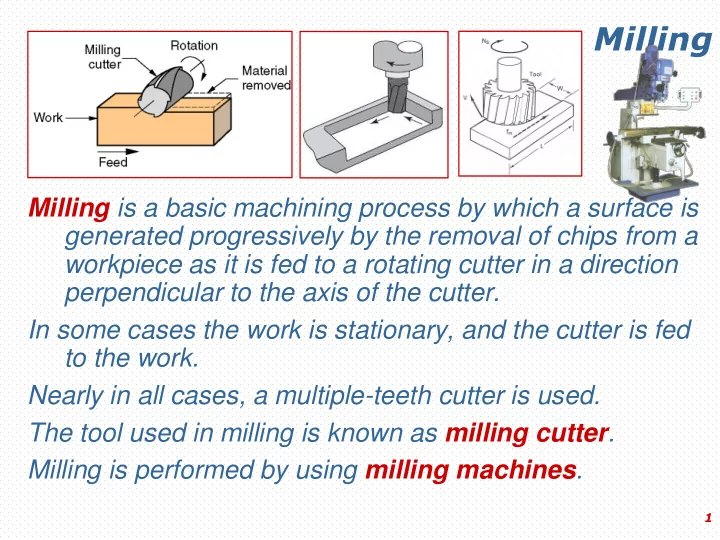
Milling Milling is a basic machining process by which a surface is generated progressively by the removal of chips from a workpiece as it is fed to a rotating cutter in a direction perpendicular to the axis of the cutter. In some cases the work


slide-1
SLIDE 1

1

Milling is a basic machining process by which a surface is generated progressively by the removal of chips from a workpiece as it is fed to a rotating cutter in a direction perpendicular to the axis of the cutter. In some cases the work is stationary, and the cutter is fed to the work. Nearly in all cases, a multiple-teeth cutter is used. The tool used in milling is known as milling cutter. Milling is performed by using milling machines.

Milling

slide-2
SLIDE 2

2

  • 1. Peripheral (Slab) Milling

A surface is generated by teeth located on the periphery of the cutter body. The surface produced is parallel to the axis

  • f rotation of the cutter (slab

milling).

  • 2. Face Milling

The surface is perpendicular to the cutter axis and the teeth located at the periphery and the face of the cutter removes the chip.

  • 3. End Milling

Types of Milling Operations

slide-3
SLIDE 3

3

Milling cutters can be classified according to the manner of mounting.

  • 1. Arbor cutters (malafalı frezeler)
  • 2. Shank cutters (saplı frezeler)
  • 3. Facing cutters (alın frezeler)

Milling Cutters

slide-4
SLIDE 4

4

Arbor cutters have a hole at their centers, so they can be mounted on an arbor.

Arbor Cutters

slide-5
SLIDE 5

5

Shank cutters have either a tapered or straight integral shank. Cutters with straight shanks are held in collets. Facing cutters are usually bolted to the end of a stub arbor.

Shank Cutters - Facing Cutters

slide-6
SLIDE 6

6

  • 1. Plain Milling Cutters

(silindirik frezeler) Used for milling flat surfaces (plain or slab milling). They are cylindrical or disk- shaped, have straight or helical teeth on the

  • periphery. Helical teeth are

preferred over straight teeth due to reduced shock and chattering during cutting action.

Arbor Type Milling Cutters

slide-7
SLIDE 7

7

  • 2. Side Milling Cutters (yan frezeler)

Similar to plain milling cutters except that the teeth extend radially part away across one or both ends of the cylinder towards the center. The teeth may be straight or helical. They are relatively narrow and disklike in shape. They can be used for milling the sides of workpieces and milling of slots.

Arbor Type Milling Cutters

Slotting

slide-8
SLIDE 8

8

  • 3. Staggered Tooth (çapraz dişli) Milling Cutters

Narrow cylindrical cutters having staggered teeth with alternate teeth having opposite helix angles. They are ground to cut only on the periphery, but each tool also has chip clearance ground on the protruding side. They have free cutting action particularly effective in milling of deep slots.

Arbor Type Milling Cutters

Staggered tooth Side

slide-9
SLIDE 9

9

  • 4. Slitting Saws (testere freze)

Thin, plain milling cutters which are 0.5 to 5 mm thick. Their sides are slightly "dished" to provide clearance and prevent binding. They usually have more teeth for unit of diameter than

  • rdinary plain milling cutters and are used for milling of

deep, narrow slots, and for cutting-off and slitting

  • perations.

Arbor Type Milling Cutters

Slotting Slitting

slide-10
SLIDE 10

10

  • 5. Angle Milling Cutters (açılı freze)

Used for milling slots of various angles or for milling the edges of workpieces to a desired angle. Single angle cutters have teeth on the conical surface, usually at an angle of 45° to 60° to the plane face. The V-angle usually is 45°, 60°, 90°.

Arbor Type Milling Cutters

with carbide tip HSS

slide-11
SLIDE 11

11

  • 6. Inserted-Tooth Milling Cutters (takma uçlu frezeler)

Larger-sized milling cutters are of inserted-tooth type in

  • rder to reduce the tool cost.

This method can be used for any type of cutter but most

  • ften is used with face mills.

Arbor Type Milling Cutters

slide-12
SLIDE 12

12

  • 7. Form Milling Cutters (biçim freze)

Have the teeth ground to a special shape to produce a surface having a desired transverse contour. Convex, concave, corner rounding and gear-tooth cutters are of this type.

Arbor Type Milling Cutters

slide-13
SLIDE 13

13

  • 8. Fly Cutters

Made by attaching a single point cutting tool to a special holder. The cutting edge can be made in any desired shape and, because it is a single-point tool, is very easy to grind.

Arbor Type Milling Cutters

slide-14
SLIDE 14

14

  • 1. End Mills (parmak frezeler)

Have teeth on the circumferential surface and one end. They can be used for facing, profiling and end milling. They may have straight or helical teeth, helical teeth being more common. Small ones have straight, larger ones have taper shanks.

Shank Type Milling Cutters

slide-15
SLIDE 15

15

Plain end mills have multiple teeth that extend only about halfway toward the center on the end. Used in milling of slots, profiling and facing narrow surfaces. Two-lip end mills have two straight or helical teeth that extend to the center. Thus they may be sunk into material, like a drill, and then fed lengthwise to form a groove.

End Mills

HSS Carbide

slide-16
SLIDE 16

16

Shell end mills are solid type multiple-teeth cutters, similar to plain end mills but without a shank. The center of the face is recessed to receive a screw head

  • r nut for mounting the cutter on a separate shank or a

stub arbor. They are used to reduce the tool cost. One shank may hold many different cutters. The back of the cutter contains driving slots that engage collar keys on the shank.

End Mills

slide-17
SLIDE 17

17

Hollow end mills are tubular in cross-section, with teeth

  • nly on the end but having internal clearance.

They are used primarily on automatic screw machines for sizing cylindrical stock, producing a short cylindrical surface of accurate diameter.

End Mills

slide-18
SLIDE 18

18

  • 2. T-Slot Cutters (T-kanal frezesi)

Integral-shank cutters with teeth on the periphery and both sides. Used for milling the wide groove of a T-slot. The vertical groove should be machined before, with a slotting mill, or an end mill to provide clearance for the shank. Cuts on five surfaces simultaneously.

Shank Type Milling Cutters

slide-19
SLIDE 19

19

  • 3. Woodruff Keyseat Cutters (kama yuva frezesi)

Used for milling of semi cylindrical seats for woodruff keys. Small ones have integral shanks, larger ones are mounted on arbors.

Shank Type Milling Cutters

slide-20
SLIDE 20

20

Facing cutters are usually bolted to the end of a stub arbor.

Facing Cutters

slide-21
SLIDE 21

21

  • 1. Column-and-Knee Type Milling

Machines (yatay/dikey freze tezgahı)

Most basic milling machines are of column- and-knee construction. They may have horizontal or/and vertical spindles. Column is the main supporting frame and contains the spindle with its drive mechanism. Knee (masa gövdesi) moves vertically on ways on the front of the column. Saddle (enine kızak) moves transversely on ways on the knee. Table (tabla) moves longitudinally on ways

  • n the saddle.

Milling Machines

slide-22
SLIDE 22

22

Column-and-Knee Type Milling Machines

Horizontal spindle Vertical spindle

slide-23
SLIDE 23

23

Milling machines having the three perpendicular table motions are called plain column-and- knee type milling machines. In universal column-and-knee type milling machines, the table is mounted on a housing that can be swiveled in a horizontal plane. This permits milling of helices, as found in twist drills, milling cutters, and helical gear teeth.

Column-and-Knee Type Milling Machines

slide-24
SLIDE 24

24

  • 2. Bed-Type Milling Machines

The table is mounted directly on the bed and has only longitudinal motion. Capable of making heavy cuts, therefore suitable for production manufacturing

  • perations, where time is

important. The spindle head can be moved vertically in order to set-up the machine for a given operation.

Milling Machines

slide-25
SLIDE 25

25

Simplex, duplex and triplex types, having one, two, and three spindles, respectively, are available.

Bed-Type Milling Machines

slide-26
SLIDE 26

26

  • 3. Planer-Type Milling Machines

Since single-point cutting tools are used, and a large table and a heavy workpiece cannot be reciprocated rapidly, planers are not productive machines, and have largely been replaced by planer-type milling machines. Several milling heads can be used.

Milling Machines

slide-27
SLIDE 27

27

Planer-Type Milling Machines

slide-28
SLIDE 28

28

Planer-Type Milling Machines

slide-29
SLIDE 29

29

  • 4. Rotary Table Milling Machines

Roughing and finishing cuts can be made in succession as the workpieces are moved past the several milling cutters while held in fixtures on the rotating table of the machine. The operator can load and unload the work without stopping the machine.

Milling Machines

slide-30
SLIDE 30

30

  • 5. Profilers and Duplicators (kopya freze tezgahları)

Profilers are milling machines that can reproduce external

  • r internal profiles in two dimensions.

Duplicators reproduce forms in three dimensions. They have been replaced by CNC (Computer Numerical Control) machine tools.

Milling Machines

slide-31
SLIDE 31

31

During their operation, a template is followed by means of tracing heads or probes, and the same motion is simultaneously transferred to the milling head.

Profilers and Duplicators

Profiler Key Copying Machine

slide-32
SLIDE 32

32

Profilers and Duplicators

Duplicator

slide-33
SLIDE 33

33

Workpiece Holding

In general, during milling

  • perations, workpieces are

either directly clamped to the table of the milling machine by making use T-slots,

  • r held in vises which are

attached to the table.

slide-34
SLIDE 34

*** MACHINING/milling (SME/Wiley’s video)***

34