Mike W. Hotchkiss 1 , Katherine Stevenson 2 , Tim B. Brenneman 2 , - - PowerPoint PPT Presentation

mike w hotchkiss 1 katherine stevenson 2 tim b brenneman
SMART_READER_LITE
LIVE PREVIEW

Mike W. Hotchkiss 1 , Katherine Stevenson 2 , Tim B. Brenneman 2 , - - PowerPoint PPT Presentation

Clive H. Bock 1 Mike W. Hotchkiss 1 , Katherine Stevenson 2 , Tim B. Brenneman 2 , Mike W. Smith 3 , Bill Goff 4 , Lenny Wells 5 and Bruce W. Wood 1 1 USDA-ARS-SEFTNRL, 21 Dunbar Rd., Byron, GA 31008; 2 Natural Products Laboratory, Department of


slide-1
SLIDE 1

Clive H. Bock1 Mike W. Hotchkiss1, Katherine Stevenson2, Tim B. Brenneman2, Mike

  • W. Smith3, Bill Goff4, Lenny Wells5 and Bruce W. Wood1

1USDA-ARS-SEFTNRL, 21 Dunbar Rd., Byron, GA 31008; 2Natural Products Laboratory, Department of Plant Pathology, 2360 Rainwater Road, Tifton, GA

31793; 3Horticulture and Landscape Architecture, 358 Agricultural Hall, Oklahoma State University, Stillwater, OK 74078; 4Department of Horticulture, 118 Extension Hall, Auburn University, Auburn, AL; 5Department of Horticulture, University of Georgia, 4604 Research Way, Tifton, GA 31793

slide-2
SLIDE 2

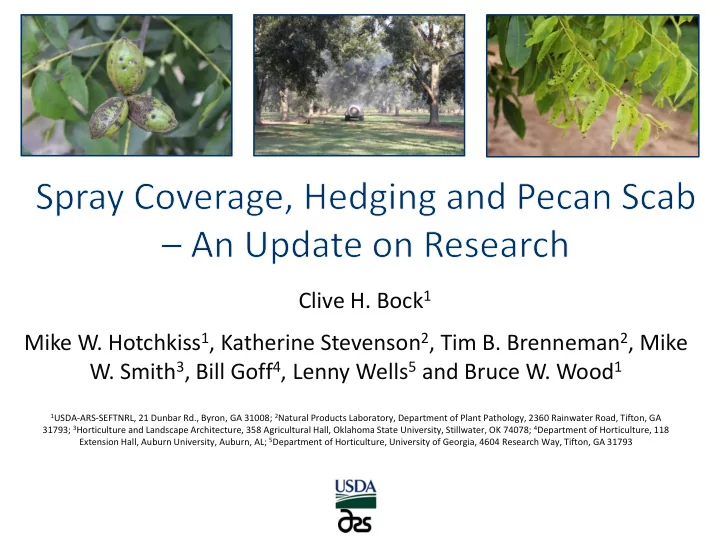
Pecan scab (Fusicladium effusum)

  • Lifecycle of Fusicladium effusum, cause of pecan scab

Autumn Winter Summer Spring

Fungus becomes dormant as stroma and

  • verwintering

conidia (twigs and shucks) Epidemics build up on young leaves (conidia) Overwinters as stroma and conidia Epidemics build up on fruit (conidia)

Polycyclic pathogen (rain and wind)

3-week old culture

  • f F. effusum on
  • atmeal agar
slide-3
SLIDE 3

Water sensitive cards placed in trees

  • Cv. Moneymaker ~25 m (~80 ft) tall
  • Water sensitive cards (Syngenta) placed at different

heights (up to 15 m) in the canopy of mature pecan trees

  • Inner and outer canopy locations
  • Sprayer: Durand-Wayland 3210A, 3.2 kph (2 mph), 935

L/ha [100 gpa]

  • Replicated three times (3 trees). Repeated experiment

twice.

  • Analyzed using generalized linear mixed modeling

Spray coverage in mature trees

Water sensitive cards

Three experiments (2012)

0 m [0 ft] 5 m [16 ft] 7.5 m [25 ft] 10 m [33 ft] 12.5 m [41 ft] 15 m [50 ft] 25 m [82 ft]

Card height in the trees

slide-4
SLIDE 4

Fungicide coverage in pecan trees

A A ABC ABCD BCD ABCD AB ABCD CD D

10 20 30 40 50 60 5.0 7.5 10.0 12.5 15.0

Inner Outer

Card area sprayed (%) Sample height (m)

A A ABC ABC C A AB ABC C BC

10 20 30 40 50 60 5.0 7.5 10.0 12.5 15.0 Card area sprayed (%) Sample height (m)

AB ABC AB BCD D A ABCD BCD BCD CD

10 20 30 40 50 60 5.0 7.5 10.0 12.5 15.0 Card area sprayed (%) Sample height (m)

Expt 1 28 September 2012 (PM) Expt 2 17 October 2012 (AM) Expt 3 17 October 2012 (PM)

  • Coverage declined with sample (tree) height in all three experiments
  • Was statistically similar to 10.0-12.5 m (33 – 41 ft)
  • At sample ≥12.5–15.0 m (41-50 ft) was most often significantly less compared to lower

in canopy (indicated by red arrow)

  • Coverage was numerically slightly higher in the inner canopy

Representative water sensitive cards 0 m [0 ft] Tree height 5 m [16 ft] 7.5 m [25 ft] 10 m [33 ft] 12.5 m [41 ft] 15 m [50 ft]

Range: 0.01-34.8% Range: 0.01-73.5% Range: 0.02-56.3%

5 m [16 ft] 7.5 m [25 ft] 10 m [33 ft] 12.5 m [41 ft] 15 m [50 ft]

Height F-value = 13.4, P-value = <0.0001 Position F-value = 4.0, P-value = 0.06 Height × Position F-value = 0.4, P-value = 0.8 Height F-value =17.5, P-value = <0.0001 Position F-value = 2.2, P-value = 0.2 Height × Position F-value = 1.5, P-value = 0.2 Height F-value = 12.7, P-value = <0.0001 Position F-value = 1.8, P-value = 0.2 Height × Position F-value = 3.5, P-value = 0.03
slide-5
SLIDE 5

Hedging effects on scab

  • Fresh growth produced throughout the season on hedged trees

is susceptible to scab (susceptible cultivars)

  • This could be more difficult to control in the southeast
  • Consequently, fruit on hedged trees may have more severe scab
  • However, an advantage may be hedged orchards are more open

(more air movement, therefore conditions less conducive to scab)

  • Managing scab may be easier in shorter trees (better fungicide

coverage)

Not hedged Hedged

slide-6
SLIDE 6

Hedging experiment – site 1, Weston, GA

  • No. Date

Fungicide Rate/A Method 1 9-Apr Sovran (kresoxim-methyl), Fungiphyte (phosphorous acid), Nickel CBM (Ni) 22 oz, 2.5 gal, 1 gal Ground 2 21-Apr Sovran (kresoxim-methyl), Fungiphyte (phosphorous acid), Nickel CBM (Ni) 22 oz, 2.5 gal, 1 gal Ground 3 8-May Topsin-M (thiophanate-methyl), Toledo (tebuconazole), Nickel CBM (Ni) 5 qts, 54 oz, 5 qts Ground 4 22-May AgriTin (TPTH), Fungiphite (phosphorous acid) 120 oz, 2.5 gal Ground 5 1-Jun AgriTin (TPTH), Elast (dodine) 120 oz, 3 gal Ground 6 12-Jun QuadrisTop (difenoconazole + azoxystrobin), Fungiphite (phosphorous acid) 1 gal, 2.5 gal Ground 7 23-Jun AgriTin (TPTH) 120 oz Ground 8 2-Jul QuadrisTop (difenoconazole + azoxystrobin), Fungiphite (phosphorous acid) 1 gal, 2.5 gal Ground 9 15-Jul Elast (dodine) 4 gal Ground 10 24-Jul QuadrisTop (difenoconazole + azoxystrobin), Fungiphite (phosphorous acid) 1 gal, 2.5 gal Ground 11 6-Aug AgriTin (TPTH), Elast (dodine) 120 oz, 3 gal Ground 12 21-Aug AgriTin (TPTH), Fungiphite (phosphorous acid) 120 oz, 2.5 gal Ground

  • Pawnee trees 14 m (46 ft) tall (planted 2000, 14 y old)
  • Received the same fungicide treatments (12 airblast sprayer applications)
  • But different tree hedging/tree removal management practice
  • Hedged to 12-14 m [40-45 ft] (and ~4 m [~12 ft] from trunk)
  • Sampled at 5, 8 and 11 m (15, 26 and 37 ft)

Fungicide treatments applied to Pawnee hedging experiment

slide-7
SLIDE 7

Hedging experiment – site 1, Weston, GA

Hedging and thinning treatments

Treatment East hedged Jan-Feb 2012 West hedged Jan-Feb 2012 North hedged Mar 2013 South hedged Mar 2013 East hedged Mar 2014 West hedged Mar 2014 Tops hedged 2012 Tops hedged 2013 Tops hedged 2014 May July May July May July

  • 1. No thinning or hedging (check)

No No No No No No No No No No No No

  • 2. Pattern thinned on diagonal

No No No No No No No No No No No No

  • 3. Selectively tree thinned (Dr. Bill

Goff’s method). Replanted with spaded trees of high scores No No No No No No No No No No No No

  • 4. Dormant hedged on 2 sides,

following year hedged on opposite 2

  • sides. Cuts 12 feet from trunk on

each side. Cut tops on hedged sides when height exceeds row width (started cutting tops in 2013). Repeat the pattern over 2-year periods Yes Yes Yes Yes Yes Yes No No No No No No

  • 5. Hedge one side of the tree each
  • year. Also cut tops on hedged sides

when height exceeds row width (started cutting tops in 2013) Yes No Yes No No Yes No No No No No No

  • 6. Repeat 4, except only on expected

“on year” No No Yes Yes Yes Yes No No No No No No

  • 7. Hedge tops mid May. Repeat July

every year. Hedge 2 sides July during “on year”. Opposite 2 sides next “on year” No No No No No No Yes Yes Yes Yes Yes Yes

slide-8
SLIDE 8

July 2014

Hedging experiment – site 1, Weston, GA

Scab severity (% area) on foliage

Data analyzed using generalized linear mixed modeling. Letters indicate significant differences based

  • n t-grouping (α =0.05). 95% Confidence Intervals are indicated.

Bock et al., (unpublished data)

  • A low severity on foliage on all treatments (mean severity <1.71% leaflet area

diseased on infected leaflets; range 1.54-1.71%)

  • More severe scab high in the canopy
  • A significant height effect

AB BC A A A C C

0.0 0.5 1.0 1.5 2.0 Control Thin diag Thin Goff Hedge dorm 2 Hedge 1 side Hedge on Hedge tops Treatment F=4.9, P<0.0001

Treatment effects

Treatment Severity per infected leaf (% area diseased)

A B C

0.0 0.5 1.0 1.5 2.0 2.5 5 8 11

Sample ht (m)

Height effects

Height F=54.7, P<0.0001

Severity (% area diseased) 15, 26 and 37 ft

slide-9
SLIDE 9

B BC D BC B C A 20 40 60 80

1 2 3 4 5 6 7 % fruit area scabbed

Sept 2014

Hedging experiment – site 1, Weston, GA

Scab severity (% area) on fruit

Data analyzed using generalized linear mixed modeling. Letters indicate significant differences based

  • n t-grouping (α =0.05). 95% Confidence Intervals are indicated.

Bock et al., (unpublished data)

  • Some difference among treatments (34.7% for the diagonally thinned, and

51.9% for the dormant hedged on two sides sequentially, control = 37.0%)

  • Differences in treatment effects compared to 2013 data
  • Scab was severe - more severe higher in the canopy
  • A pronounced height effect (6x more severe at 11 m [37 ft])

DE E B A C CD C

10 20 30 40 50 60 Control Thin diag Thin Goff Hedge dorm 2 Hedge 1 side Hedge on Hedge tops Treatment F=25.43, P<0.0001

Treatment effects

Treatment Severity per fruit (% area diseased)

A B C

10 20 30 40 50 60 70 80 5 8 11

Sample ht (m)

Height effects

Height F=11.3, P<0.0001

Severity (% area diseased) 15, 26 and 37 ft

Treatment

20 13 Treatment effects

slide-10
SLIDE 10

Hedging experiment – site 1, Weston, GA

Sept 2014

Height and the relationship between scab severity and fruit weight

Fruit weight (g) Severity per fruit (% area diseased)

  • There was no relationship between scab

severity on fruit and fruit weight at 5m (15 ft)

  • r 8 m (26 ft) above ground (despite more

severe disease at 8 m [26 ft])

  • At heights ≥11 m (≥37 ft) there is more severe

disease on the fruit

  • Despite this, there was only a very weak

relationship between scab and fruit weight at heights ≥11 m (≥37 ft)

  • Pawnee may be better able to tolerate scab

damage with less impact on yield; timing of infection in relation to fruit maturity may affect this

Bock et al., (unpublished data)

y = -0.09x + 25.7 R² = 0.02 10 20 30 40 50 60 20 40 60 80 100 y = -0.06x + 25.9 R² = 0.05 10 20 30 40 50 60 20 40 60 80 100 y = -0.10x + 28.6 R² = 0.15 10 20 30 40 50 60 20 40 60 80 100 5 m [15 ft] 8m [26 ft] 11 m [37 ft]

slide-11
SLIDE 11

Hedging experiment – site 2, Marshallville, GA

  • Desirable trees 14 m (~46 ft) and hedged to 12-14 m (39-46 ft)
  • Planted 1996, 18 y old
  • Hedged alternate rows - one side March 2013, other side March 2014

(sampled trees hedged on West in 2013, East in 2014)

  • All received the same fungicide treatments
  • Sampled at 7, 7-10 and >10 m (<21, 21-33 and >33 ft)

No. Date Fungicide Rate/A Method 1 8-Apr Abound (azoxystrobin) 9 oz. Ground 2 21-Apr Propicure (propiconazole) + Phostrol (phosphorous acid) 8 oz. + 1 qt. Ground 3 5-May Fitness (propiconazole) 8 oz. Ground 4 20-May Absolute (tebuconazole + trifloxystrobin) 6 oz. Ground 5 2-Jun Absolute (tebuconazole + trifloxystrobin) 6 oz. Ground 6 16-Jun AgTin (TPTH) + Elast 400 (dodine) 6 oz. + 25 oz. Ground 7 24-Jun AgTin (TPTH) + Topsin M (thiophanate methyl) 6 oz. + 16 oz. Air 8 1-Jul Topsin M + SuperTin (TPTH) 16 oz. + 12 oz. Ground 9 9-Jul SuperTin (TPTH) 12 oz. Air 10 14-Jul SuperTin (TPTH) 12 oz. Ground 11 29-Jul Absolute (tebuconazole + trifloxystrobin) 6 oz. Air 12 28-Jul SuperTin (TPTH) + Topsin M (thiophanate methyl) 12 oz. + 16 oz. Ground 13 11-Aug Abound (azoxystrobin) 12 oz. Ground

Hedged rows Not hedged

slide-12
SLIDE 12

July 2014

Hedging experiment – site 2, Marshallville, GA

Data analyzed using generalized linear mixed modeling. Letters indicate significant differences based

  • n t-grouping (α =0.05). 95% Confidence Intervals are indicated.

Bock et al., (unpublished data)

  • Scab severity was very low on foliage (0.58% and 0.55% leaflet area diseased on infected

leaflets on hedged and non-hedged trees, respectively)

  • No effect of hedging on severity on foliage
  • Nonetheless, a significant height effect
  • One-third more severe (but still low severity) in the upper canopy (highest sample height)

Scab severity (% area) on foliage

A A 0.0 0.2 0.4 0.6 0.8 Hedged Not hedged

Hedging

Hedging F=0.7, P=0.4

Severity (% area diseased) Treatment

A A B 0.0 0.2 0.4 0.6 0.8 <7 7 to 10 >10

Height

Height F=9.0, P=0.0002

Severity (% area diseased) Sample ht (m)

7 m [21 ft], 10 m [33 ft]

slide-13
SLIDE 13

Sept 2014

Hedging experiment – site 2, Marshallville, GA

Data analyzed using generalized linear mixed modeling. Letters indicate significant differences based

  • n t-grouping (α =0.05). 95% Confidence Intervals are indicated.

Bock et al., (unpublished data)

  • Scab severity was moderately low on fruit (mean of 6.32% and 5.88% area diseased on

hedged and non-hedged trees, respectively)

  • No significant different in scab severity between hedged versus non-hedged trees
  • However, significantly more severe scab at higher sample heights in the canopy (2x more

severe at ≥10 m [≥33 ft])

Scab severity (% area) on fruit

A A 0.0 2.0 4.0 6.0 8.0 Hedged Not hedged

Hedging

Hedging F=1.2, P=0.6

Severity (% area diseased) Treatment

C B A 0.0 2.0 4.0 6.0 8.0 10.0 12.0 <7 7 to 10 >10

Height

Height F=11.3, P<0.0001

Severity (% area diseased) Sample ht (m)

7 m [21 ft], 10 m [33 ft]

slide-14
SLIDE 14

Hedging experiment – site 2, Marshallville, GA

Sept 2014

Height and the relationship between scab severity and fruit weight

  • No discernible relationship between scab

severity and fruit weight at <7 m (21 ft)

  • A very weak relationship between scab

severity and fruit weight at >7 m (21 ft)

  • Overall, scab severity was only moderate in

this orchard, so the weak relationship is not surprising - at heights >7 m (21 ft) there is more severe disease on the fruit

  • The more severe disease at greater heights

results in a loss of fruit weight, and likely impacts other aspects of kernel quality

Bock et al., (unpublished data)

y = -0.16x + 22.4 R² = 0.10 5 10 15 20 25 30 35 20 40 60 80 y = -0.22x + 23.1 R² = 0.30 5 10 15 20 25 30 35 20 40 60 80 y = -0.12x + 21.6 R² = 0.21 5 10 15 20 25 30 35 20 40 60 80

Fruit weight (g) Severity per fruit (% area diseased)

<7 m [<21 ft] 7 to 10 m [21 to 33 ft] >10 m [>33 ft]

slide-15
SLIDE 15

Hedging experiment - site 3, Valdosta, GA

Not hedged (control) 18 m [60 ft] One side hedged 14 m [45 ft] 18 m [60 ft] Both sides hedged 14 m [45 ft]

  • No. Date

Fungicide Rate/A Method 1 9-Apr Elast (dodine) 50 oz Ground 2 21-Apr Sovran (kresoxim-methyl) + Topsin (thiophanate-methyl) 3.2 oz, 20 oz Ground 3 28-Apr QuadrisTop (difenoconazole + azoxystrobin) 14 oz Ground 4 5-May Sovran (kresoxim-methyl) + Topsin (thiophanate-methyl) 3.2 oz, 20 oz Ground 5 13-May SuperTin (TPTH) + Elast (dodine) + Prophyt (phosphorous acid) 9 oz, 38 oz, 1 qt Ground 6 23-May SuperTin (TPTH) + Elast (dodine) 9 oz, 38 oz Ground 7 4-Jun SuperTin (TPTH) + Elast (dodine) + Prophyt (phosphorous acid) 12.8 oz, 25 oz, 1 qt Ground 8 10-Jun SuperTin (TPTH) + Elast (dodine) + Prophyt (phosphorous acid) 9 oz, 38 oz, 1 qt Ground 9 21-Jun SuperTin (TPTH) + Elast (dodine) + Prophyt (phosphorous acid) 12.8 oz, 25 oz, 1 qt Ground 10 7-Jul SuperTin (TPTH) + Elast (dodine) + Prophyt (phosphorous acid) 9 oz, 38 oz, 1 qt Ground 11 14-Jul Elast (dodine) 50 oz Ground 12 21-Jul SuperTin (TPTH) + Elast (dodine) + Prophyt (phosphorous acid) 12.8 oz, 25 oz, 1 qt Ground 13 29-Jul SuperTin (TPTH) + Topsin (thiophanate-methyl) + Prophyt (phosphorous acid) 38 oz, 20 oz, 1 qt Ground 14 11-Aug SuperTin (TPTH) + Elast (dodine) + Prophyt (phosphorous acid) 9 oz, 38 oz, 1 qt Ground 15 25-Aug SuperTin (TPTH) + Prophyt (phosphorous acid) 12.8 oz, 1 qt Ground 16 8-Sep SuperTin (TPTH) + Prophyt (phosphorous acid) 12.8 oz, 1 qt Ground

  • Desirable trees 18 m (60 ft) Planted 1996, 18 y old
  • Treatments: trees were 1) hedged both sides March 2013, 2) hedged one

side 2013, other side 2014, and 3) not hedged

  • Hedging to 12-14 m (39-46 ft)
  • All received the same fungicide treatments (16 applications)
  • Sampled at = <7, 7-10, 10-14 and >14 m (<20, 20-30, 30-46, >46 ft)
slide-16
SLIDE 16

Hedging experiment – site 3, Valdosta, GA

  • Very low severity of foliar scab throughout canopy (0.06, 0.06 and 0.11% area of

infected leaflets on the hedged, half-hedged and non-hedged treatments)

  • Significantly more severe scab on non-hedged trees
  • There was a highly significant effect of height. Significantly more severe scab at 10-14

m (33-46 ft) and particularly so >14 m (46 ft) sample height in the trees

Data analyzed using generalized linear mixed modeling. Letters indicate significant differences based on t-grouping (α=0.05). 95% Confidence Intervals are indicated. Due to non-estimable values using the full model, a reduced model was used to calculate 95% Confidence Intervals and means separations for Height and Hedging effects. Bock et al., (unpublished data)

July 2014

Scab severity (% area) on foliage

B B A 0.00 0.05 0.10 0.15 0.20

Hedging effect

Hedging F=8.2, P=0.0003

Severity (% area diseased) Treatment

C C B A 0.00 0.05 0.10 0.15 0.20 0.25 0.30 0.35

Height effect

Height F=72.2, P<0.0001

Severity (% area diseased) Sample ht (m)

<21, 21-33, 33-46, and >46 ft

slide-17
SLIDE 17

Hedging experiment – site 3, Valdosta, GA

  • Fruit scab severity was low on hedged trees and moderate on non-hedged trees (0.6-

0.7% area diseased and 6.0% area diseased, respectively)

  • Significant effect of hedging (most severe disease on non-hedged trees)
  • Significant height effect - more severe scab on fruit at 10-14 m (33-46 ft) and particularly

>14 m (>46 ft) sample height in the trees

Data analyzed using generalized linear mixed modeling. Letters indicate significant differences based on t-grouping (α=0.05). 95% Confidence Intervals are indicated. Due to non-estimable values using the full model, a reduced model was used to calculate 95% Confidence Intervals and means separations for Height and Hedging effects. Bock et al., (unpublished data)

Sept 2014

Scab severity (% area) on fruit

B B A 1 2 3 4 5 6 7 8 9

Hedging effect

Hedging F=26.6, P<0.0001

Severity (% area diseased) Treatment

C C B A 5 10 15 20 25 30

Height effect

Height F=173.5, P<0.0001

Severity (% area diseased) Sample ht (m)

<21, 21-33, 33-46, and >46 ft

slide-18
SLIDE 18

y = 0.03x + 27.9 R² = 2E-05 10 20 30 40 50 20 40 60 80 100 y = -0.18x + 30.6 R² = 0.68 10 20 30 40 50 20 40 60 80 100 y = -0.31x + 29.0 R² = 0.01 10 20 30 40 50 20 40 60 80 100 y = -0.18x + 28.7 R² = 0.06 10 20 30 40 50 20 40 60 80 100

Fruit weight (g) Severity per fruit (% area diseased)

Height and the relationship between scab severity and fruit weight

  • Excellent scab control up to 10 m (33 ft)
  • At 10-14 m (33-46 ft) the quality of control is still good, but declining (no

discernible relationship with fruit weight)

  • At heights >14 m (46 ft) there was some severe disease and a robust relationship

between scab severity and fruit weight

Sept 2014

Hedging experiment – site 3, Valdosta, GA

<7 m (<21 ft) 7-10 m (20-33 ft) 10-14 m (33-46 ft) <14 m (>46 ft)

Bock et al., (unpublished data) Not hedged (control) 60 ft One side hedged 45 ft 60 ft Both sides hedged 45 ft

slide-19
SLIDE 19

Summary

  • There is a continuous decline in spray coverage with distance from

the sprayer

  • Ground based air blast sprayers provide statistically similar coverage

up to 10-12.5 m (33–41 ft) in pecan trees

  • At heights >12.5 m (41 ft), coverage was most often poor (often < 1%
  • f the card area)
  • Scab severity on foliage was consistently very low in all hedging

experiments (on both hedged and non-hedged trees)

  • Neither fruit nor foliage on hedged trees had more disease

compared to non-hedged trees (except at site 1 Pawnee in 2014)

  • If trees were taller than the hedging height of 12-14 m (39-46 ft), the

hedged trees had significantly less severe scab compared to the non- hedged trees

  • In all experiments there was a consistent effect of height
  • In trees >14 m (>46 ft) there was an increasing advantage to hedging

as more of the fruit are within reach of effective fungicide coverage

10-14 m (40-45 ft) 18 m (60 ft)

slide-20
SLIDE 20

We thank the GA Commodity Commission for Pecans for financial support for some of the work Growers: Buck Paulk, Mike Jaros and Richard Merritt for access to their

  • rchards, and for use of lift equipment, and Tom Stevenson for some of the

images Invaluable technical support from Wanda Evans and Minling Zhang, and summer help from Jason Shipp, Frank Wilson, Shad Stormant, Shirley Anderson, Andrew Hudgens, Jacob Werner and Kaylee Carlson at the USDA- ARS-SEFTNRL, Byron, GA

Acknowledgements

slide-21
SLIDE 21

Thank you, and any questions?