1
CSC 4304 - Systems Programming Fall 2008
Tevfik Koar
Louisiana State University
October 14th, 2008
Lecture - XII
Midterm Review
Parameter Passing in C
2
Parameter Passing in C
3
Pointer Arithmetic
4
Pointer Arithmetic
5
Pointer Arithmetic
6
Midterm Review Tevfik Ko ar Louisiana State University October 14 - - PDF document
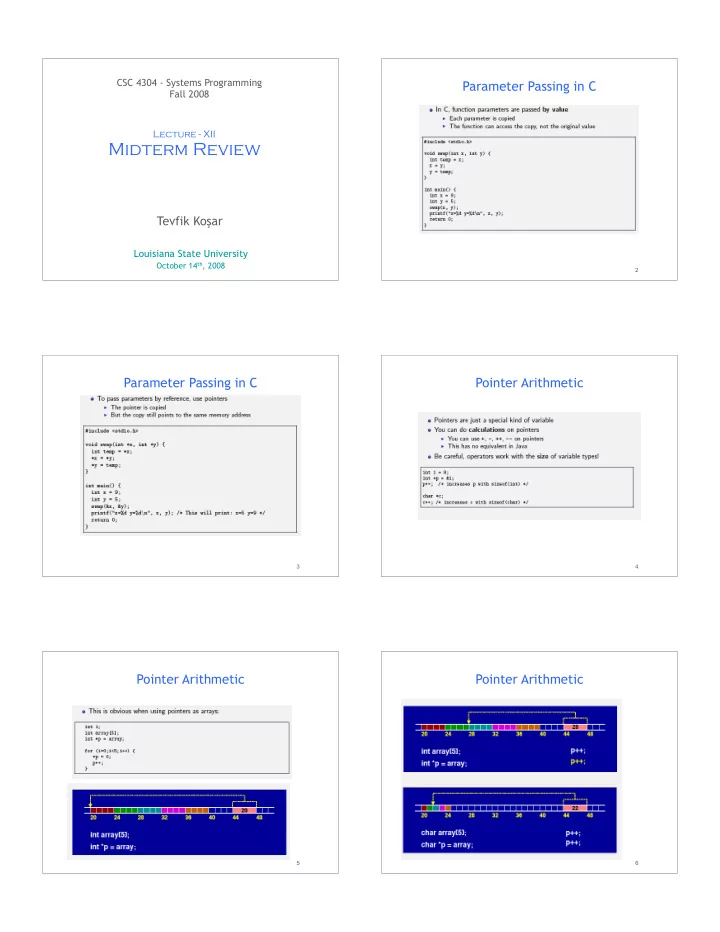
CSC 4304 - Systems Programming Parameter Passing in C Fall 2008 Lecture - XII Midterm Review Tevfik Ko ar Louisiana State University October 14 th , 2008 1 2 Parameter Passing in C Pointer Arithmetic 3 4 Pointer Arithmetic Pointer
1
October 14th, 2008
2
3
4
5
6
7
voidsum(inta,intb) {printf(“sum: %d\n”, a+b);} voiddif(inta,intb) {printf(“dif: %d\n”, a-b);} voidmul(inta,intb) {printf(“mul: %d\n”, a*b);} voiddiv(inta,intb) {printf(“div: %f\n”, a/b);} void(*p[4])(intx,inty); intmain(void) { intresult; inti=10,j=5,op; p[0]=sum;/*addressofsum()*/ p[1]=dif;/*addressofdif()*/ p[2]=mul;/*addressofmul()*/ p[3]=div;/*addressofdiv()*/ for (op=0;op<4;op++) (*p[op])(i,j); } 8
9 () [] -> . left to right primary expr.
10
11
12
13
14
int main () { int x = 11; int *p, *q; p = (int *) malloc(sizeof (int)); *p = 66; q = (int *) malloc(sizeof (int)); *q = *p - 11; free(p); printf ("%d %d %d\n", x, *p, *q); x = 77; p = q; q = (int *) malloc(sizeof (int)); *q = x + 11; printf ("%d %d %d\n", x, *p, *q); p = &x; p = (int *) malloc(sizeof (int)); *p = 99; printf ("%d %d %d\n", x, *p, *q); q = p; free(q); printf ("%d %d %d\n", x, *p, *q); }
The subroutine free() frees a block of memory so that it can be reused by malloc(). However, free() is passed only a pointer to the block to be freed. 1. How does free() know how big this block is?
15
16
what are the possible results of passing bad arguments to free()?
17
recognized). Discuss how this can be achieved.
– read, write, open, close, lseek
– standard I/O library written by Dennis Ritchie
18
19
total time kernel time
20
21
22
Which of the functions above will be more efficient if the file being read is large, and why?
23
Write a function file_to_dlist_3() which is functionally equivalent to these two functions, and is at least as efficient as the best of these two.
24
25
26
....
27
– representation with “dirlists (directory files)”
– directory has a link to the inode of the file
– directory has a link to the inode of the subdirectory
– “..” entry of the directory has a link to the inode of the parent directory
28
$ ls -iaR demodir 865 . 193 .. 277 a 520 c 491 y demodir/a: 277 . 865 .. 402 x demodir/c: 520 . 865 .. 651 d1 247 d2 demodir/c/d1: 651 . 520 .. 402 xlink demodir/c/d2: 247 . 520 .. 680 xcopy
29
30
cs4304_kos@classes:~> ls -l /etc/passwd
cs4304_kos@classes:~> ls -l /usr/bin/passwd
04000 : set user ID 02000 : set group ID 01000 : sticky bit - keep the program in swap device
31
32
Which lines are unsafe? Why?
33
– Parent and children share all resources – Children share subset of parent’s resources – Parent and child share no resources
– Parent and children execute concurrently – Parent waits until children terminate
34
– Child duplicate of parent – Child has a program loaded into it
– fork system call creates new process – exec system call used after a fork to replace the process’ memory space with a new program
35 36
int main() { Pid_t pid;
complete */
– child shares all memory with parent – parent is suspended until the child makes an exit or exec call
37
pid_t vfork(void);
38
main() { int ret, glob=10; printf("glob before fork: %d\n", glob);
ret = vfork();
if (ret == 0) { glob++; printf("child: glob after fork: %d\n", glob) ; exit(0); } if (ret > 0) { //if (waitpid(ret, NULL, 0) != ret) printf("Wait error!\n"); printf("parent: glob after fork: %d\n", glob) ; }
39
#include <stdio.h> #include <malloc.h> extern char **environ; main() { char ** ptr; for (ptr=environ; *ptr != 0; ptr++) printf("%s\n", *ptr); }
40
41
– (e.g. after fork)
– in the order of termination
– crashed processes – abnormal terminated processes
42
43
44
45
46
47
48
Write a program which blocks all of the other signals (except the ones which cannot be blocked) if a signal arrives (same one or different one) while your program is inside a signal handler. Hint use sigaction() function.
49
main() { struct sigaction newhandler; /* new settings */ sigset_t blocked; /* set of blocked sigs */ void inthandler(); /* the handler */ newhandler.sa_handler = inthandler; /* handler function */ sigfillset(&blocked); /* mask all signals */ newhandler.sa_mask = blocked; /* store blockmask */ int i; for (i=1; i<65;i++) if (i!=9 && i!=19 && i!=32 && i!=33)
printf("error with signal %d\n", i); while(1){} } 50
51
52