Process Control USER=cs4304_kos HOSTTYPE=x86_64 - - PDF document

process control
SMART_READER_LITE
LIVE PREVIEW

Process Control USER=cs4304_kos HOSTTYPE=x86_64 - - PDF document

CSC 4304 - Systems Programming Environment Variables Fall 2010 $ env HOSTNAME=classes Lecture - VIII TERM=xterm-color Process Control USER=cs4304_kos HOSTTYPE=x86_64 PATH=/usr/local/bin:/usr/bin:/opt/gnome/bin:/usr/lib/ mit/sbin:./


slide-1
SLIDE 1

1

CSC 4304 - Systems Programming Fall 2010

Tevfik Koar

Louisiana State University

September 16th, 2010

Lecture - VIII

Process Control

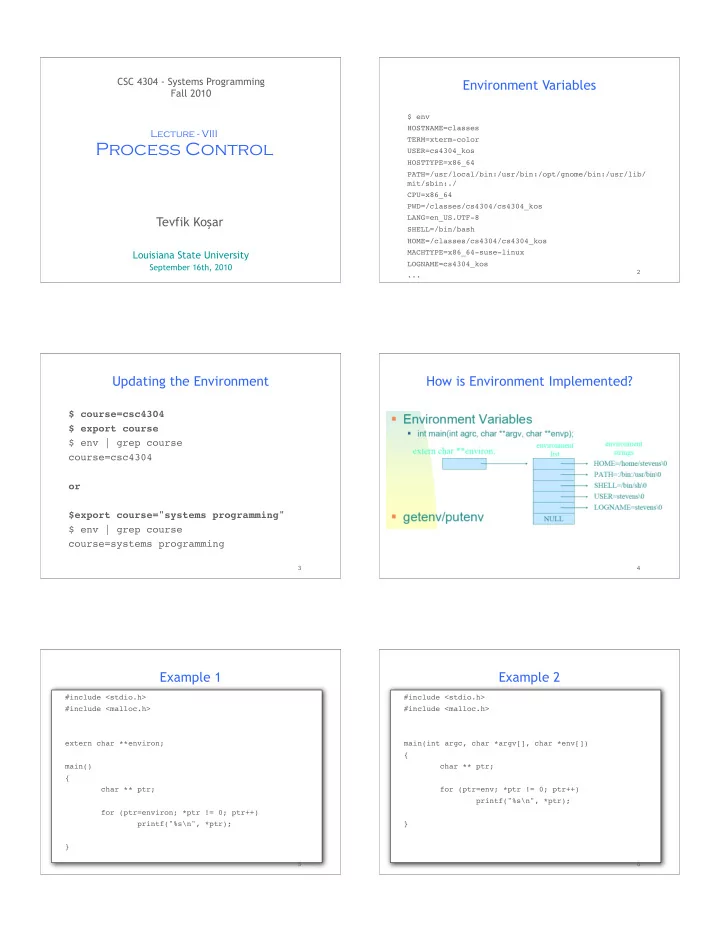
Environment Variables

$ env HOSTNAME=classes TERM=xterm-color USER=cs4304_kos HOSTTYPE=x86_64 PATH=/usr/local/bin:/usr/bin:/opt/gnome/bin:/usr/lib/ mit/sbin:./ CPU=x86_64 PWD=/classes/cs4304/cs4304_kos LANG=en_US.UTF-8 SHELL=/bin/bash HOME=/classes/cs4304/cs4304_kos MACHTYPE=x86_64-suse-linux LOGNAME=cs4304_kos ...

2

Updating the Environment

$ course=csc4304 $ export course $ env | grep course course=csc4304

  • r

$export course="systems programming" $ env | grep course course=systems programming

3

How is Environment Implemented?

4

Example 1

#include <stdio.h> #include <malloc.h> extern char **environ; main() { char ** ptr; for (ptr=environ; *ptr != 0; ptr++) printf("%s\n", *ptr); }

5

Example 2

#include <stdio.h> #include <malloc.h> main(int argc, char *argv[], char *env[]) { char ** ptr; for (ptr=env; *ptr != 0; ptr++) printf("%s\n", *ptr); }

6

slide-2
SLIDE 2

system function

  • used to execute command strings
  • e.g. system(“date > file”);
  • implemented using fork(), exec(), and waitpid()

7

int system(const char *command);

Example 3

#include <stdio.h> #include <unistd.h> extern char **environ; main() { char *newenv[5]; printf("The current environment is..\n"); system("env"); printf("***** Now Replacing Environment...\n"); getchar(); newenv[0] = "HOME=/on/the/range"; newenv[1] = "LOGNAME=nobody"; newenv[2] = "PATH=.:/bin:/usr/bin"; newenv[3] = "DAY=Wednesday"; newenv[4] = 0 ; environ = newenv; execlp("env", "env", NULL); }

8

Getting Environment Vars

9

#include <stdio.h> #include <stdlib.h> main() { printf("SHELL = %s\n", getenv("SHELL")); printf("HOST = %s\n", getenv("HOST")); } char * getenv(const char *name);

Setting Environment Vars

10

int putenv(const char *name); //name=value int setenv(const char *name, const char *value, int rw); void unsetenv(condt char *name); #include <stdio.h> #include <stdlib.h> main() { setenv("HOST", "new host name", 1); printf("HOST = %s\n", getenv("HOST")); }

vfork function

  • Similar to fork, but:

– child shares all memory with parent – parent is suspended until the child makes an exit or exec call

11

pid_t vfork(void);

fork example

12

main() { int ret, glob=10; printf("glob before fork: %d\n", glob);

ret = fork();

if (ret == 0) { glob++; printf("child: glob after fork: %d\n", glob) ; exit(0); } if (ret > 0) { if (waitpid(ret, NULL, 0) != ret) printf("Wait error!\n"); printf("parent: glob after fork: %d\n", glob) ; }

slide-3
SLIDE 3

vfork example

13

main() { int ret, glob=10; printf("glob before fork: %d\n", glob);

ret = vfork();

if (ret == 0) { glob++; printf("child: glob after fork: %d\n", glob) ; exit(0); } if (ret > 0) { //if (waitpid(ret, NULL, 0) != ret) printf("Wait error!\n"); printf("parent: glob after fork: %d\n", glob) ; }

Race Conditions

14

static void charatatime(char *str) { char *ptr; int c; setbuf(stdout, NULL); for (ptr=str;c=*ptr++;) putc(c,stdout); } main() { pid_t pid; if ((pid = fork())<0) printf("fork error!\n"); else if (pid ==0) charatatime("12345678901234567890\n"); else charatatime("abcdefghijklmnopqrstuvwxyz\n"); }

Output

$ fork3 12345678901234567890 abcdefghijklmnopqrstuvwxyz $ fork3 12a3bc4d5e6f78901g23hi4567jk890 lmnopqrstuvwxyz

15

Avoid Race Conditions

16

static void charatatime(char *str) { char *ptr; int c; setbuf(stdout, NULL); for (ptr=str;c=*ptr++;) putc(c,stdout); } main() { pid_t pid; TELL_WAIT(); if ((pid = fork())<0) printf("fork error!\n"); else if (pid ==0) {WAIT_PARENT(); charatatime("12345678901234567890\n");} else {charatatime("abcdefghijklmnopqrstuvwxyz\n"); TELL_CHILD();} }

Process Accounting

  • Kernel writes an accounting record each time a process

terminates

  • acct struct defined in <sys/acct.h>

17

Process Accounting

  • Data required for accounting record is kept in the

process table

  • Initialized when a new process is created

– (e.g. after fork)

  • Written into the accounting file (binary) when the

process terminates

– in the order of termination

  • No records for

– crashed processes – abnormal terminated processes

18

slide-4
SLIDE 4

Pipes

  • one-way data channel in the kernel
  • has a reading end and a writing end
  • e.g. who | sort or ps | grep ssh

19

Process Communication via Pipes

  • pipe creates a pair of file descriptors, pointing to a

pipe inode, and places them in the array pointed to by

  • filedes. filedes[0] is for reading filedes[1] is for writing

20

int pipe(int filedes[2]);

main(int ac, char *av[]) { int thepipe[2], newfd, pid;*/ if ( ac != 3 ){fprintf(stderr, "usage: pipe cmd1 cmd2\n");exit(1);} if (pipe(thepipe) == -1){perror( "cannot create pipe"); exit(1); } if ((pid = fork()) == -1){fprintf(stderr,"cannot fork\n"); exit(1);} /* * parent will read from reading end of pipe */ if ( pid > 0 ){ /* the child will be av[2] */ close(thepipe[1]); /* close writing end */ close(0); /* will read from pipe */ newfd=dup(thepipe[0]); /* so duplicate the reading end */ if ( newfd != 0 ){ /* if not the new stdin.. */ fprintf(stderr,"Dupe failed on reading end\n"); exit(1); } close(thepipe[0]); /* stdin is duped, close pipe */ execlp( av[2], av[2], NULL); exit(1); /* oops */ }

21

/* * child will write into writing end of pipe */ close(thepipe[0]); /* close reading end */ close(1); /* will write into pipe */ newfd=dup(thepipe[1]); /* so duplicate writing end */ if ( newfd != 1 ){ /* if not the new stdout.. */ fprintf(stderr,"Dupe failed on writing end\n"); exit(1); } close(thepipe[1]); /* stdout is duped, close pipe */ execlp( av[1], av[1], NULL); exit(1); /* oops */ }

22

Summary

  • Process Control

– Environment – Process Accounting – Pipes

  • Next Class: Signals

23

Hmm. .

24

Acknowledgments

  • Advanced Programming in the Unix Environment by R.

Stevens

  • The C Programming Language by B. Kernighan and D.

Ritchie

  • Understanding Unix/Linux Programming by B. Molay
  • Lecture notes from B. Molay (Harvard), T

. Kuo (UT- Austin), G. Pierre (Vrije), M. Matthews (SC), and B. Knicki (WPI).