Miami-Dade County Department of Regulatory and Economic Resources - - PowerPoint PPT Presentation

miami dade county
SMART_READER_LITE
LIVE PREVIEW

Miami-Dade County Department of Regulatory and Economic Resources - - PowerPoint PPT Presentation

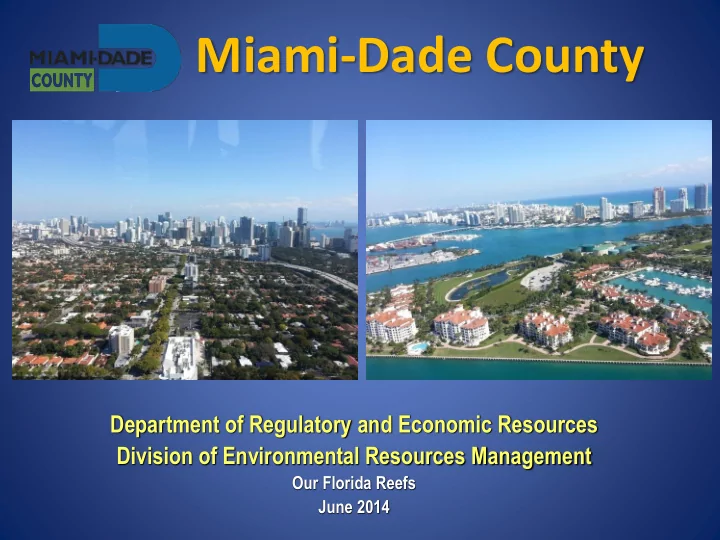
Miami-Dade County Department of Regulatory and Economic Resources Division of Environmental Resources Management Our Florida Reefs June 2014 Habitats Everglades WEST Biscayne Bay / Intra-coastal Mangroves, Seagrass bed, Artificial

slide-1
SLIDE 1

Miami-Dade County

Department of Regulatory and Economic Resources Division of Environmental Resources Management

Our Florida Reefs June 2014

slide-2
SLIDE 2

Habitats

  • Everglades
  • Biscayne Bay / Intra-coastal

– Mangroves, Seagrass bed, Artificial Reefs, etc…

  • Beaches / Dunes
  • Offshore

– Colonized hardbottom, natural reefs, artificial reefs, seagrass WEST EAST

slide-3
SLIDE 3
  • Runs entire length of the

county…

  • Biscayne National park
  • Biscayne Bay Aquatic

Preserve

  • Critical Wildlife Area
  • Between ~0.25 – 8 miles

wide and 35 miles long

  • North Bay
  • ~95% harden

shorelines/seawalls

  • Urban run-off
  • South
  • ~85% natural /

mangrove shoreline

  • agricultural runoff

Biscayne Bay…

slide-4
SLIDE 4

Biscayne Bay Habitats

Generally oligotrophic (low nutrients), relatively clear-water estuarine habitats

Seagrass & Macroalgae

  • Most abundant habitat throughout the Bay;

Turtle grass. Manatee grass, Shoal grass, Johnson’s seagrass (threatened species)

  • Macroalgal population (attached and drift

species). Important shrimp, invertebrate and juvenile fish species habitat Hardbottom

  • Thin veneer of sediment over limestone

common in central and south central Bay (i.e., Featherbed Banks).

  • Sponges, Sea fans/whips, hard and soft

corals, and sparse SAV Upland and Coastal Wetlands (Mangrove), including spoil islands

  • Red, Black , and White mangrove; Coastal

dune hammock; upland native hammock

  • Shore bird, reptile and mammal habitat

*Slide modifed from J. Serafy

Bare or Undetermined Mangrove Seagrass/Algae Hardbottom/Seagrass Coral Reef Homestead Coral Gables Miami Aventura

slide-5
SLIDE 5
slide-6
SLIDE 6

Beaches / Dunes…

Circa 1918 – 18th Street Circa 1930 Lummus Park

slide-7
SLIDE 7

Beaches / Dunes…

slide-8
SLIDE 8

Sunny Isles Submerged Breakwaters 32nd Street Attached Breakwaters

Beaches / Dunes…

slide-9
SLIDE 9

Offshore habitats…

  • Natural reefs and

hardbottom communities

  • Artificial Reefs
  • Mixed seagrass beds south
  • f Government Cut /

Offshore of Key Biscayne

slide-10
SLIDE 10

North Offshore habitats…

slide-11
SLIDE 11

Central Offshore habitats…

slide-12
SLIDE 12

South Offshore habitats…

Key Biscayne Special Management Zone

  • Established in 1990
  • No fish traps
  • No long lines
  • No spearfishing
slide-13
SLIDE 13
  • Water Quality / LBSP / Algae Blooms

Habitat Impacts…

Inshore / Bay Offshore

slide-14
SLIDE 14

Habitat Impacts…

  • Dredging
  • Miscellaneous construction
slide-15
SLIDE 15
  • Small Scale Physical Impacts

Habitat Impacts…

  • Lobster Traps
  • Marine Event Buoys
  • Recreational Vessels - Anchors
slide-16
SLIDE 16

Habitat Impacts…

  • Vessel Groundings
slide-17
SLIDE 17

Habitat Impacts…

  • Climate Change / Sea Level Rise / Ocean

acidification

  • Fisheries
slide-18
SLIDE 18

Initiatives to Reduce Impacts…

  • Stormwater management and infrastructure

improvements

  • Eliminate direct discharge of stormwater to surface water
  • Improve/increase grassy swale areas to enhance ‘pretreatment’

and infiltration

  • Retrofit existing outfalls
  • Installation of ‘regional’ stormwater treatment systems
  • Increase utilization of infiltration trenches for storm water

systems

  • Focusing on seagrass

restoration projects

  • Habitat restoration & Enhancement
  • 7 miles of shoreline have been stabilized since 1980
  • 36 public sites have been restored or enhanced
  • 17 Spoil islands enhanced
  • Over 560 acres of coastal wetlands and upland habitats have

been enhanced or restored

slide-19
SLIDE 19

Initiatives to Reduce Impacts…

  • Baynanza / U/W Cleanups / Education and Outreach
slide-20
SLIDE 20

Initiatives to Reduce Impacts…

  • Mooring Buoys
  • Program began in 2009
  • 42 buoys at 9 different sites

from Sunny Isles south to Key Biscayne

slide-21
SLIDE 21

Initiatives to Reduce Impacts…

http://gisweb.miamidade.gov/ArtificialReefs/

slide-22
SLIDE 22

Any Questions?

Steve Blair blairs@miamidade.gov Habitat Restoration: Josh Mahoney mahonj@miamidade.gov Natural & Artificial Reefs / Mooring Buoys: Sara Thanner thanns@miamidade.gov