SLIDE 1
Metagenomics
SLIDE 2 What is metagenomics
- Cloning genes from the environment, screening for
function
- 16S sequencing
- Random community genomics
- Eukaryotic metagenomics
SLIDE 3 Screening from the environment
- Random fragments of DNA
- Clone into a vector
– Low copy vectors – BACs – YACs
SLIDE 4
BACs
Science Creative Quarterly
SLIDE 5 Screening from the environment
- Random fragments of DNA
- Clone into a vector
– Low copy vectors – BACs – YACs
- Screen for a phenotype
- e.g. Diversa patents > 1,000 amylase genes
Why did Diversa sequence whale-falls?
SLIDE 6 Screening from the environment
- Expression host?
- Pathway or single gene?
- Get what you select
- But remember …
A selection is worth a thousand screens
SLIDE 7 16S sequencing
- Catalogs the bacteria that are present
- PCR amplify the 16S gene with standard
primers
- Sequence the primers
- Compare to known databases
SLIDE 8
Prokaryotic ribosome: Large subunit: 50S 5S and 23S rRNA Small subunit: 30S 16S rRNA
Ribosomes
Ribosomes are made of proteins and RNA
SLIDE 9
Blue: protein Orange: rRNA
30S Thermus aquaticus subunit
SLIDE 10
16S rRNA 16S rRNA secondary secondary structure structure
- Highly conserved
- Base pairs = stems
- No pairing = loops
SLIDE 11 Variable regions in Variable regions in the 16S rRNA. the 16S rRNA. Vn – 9 regions forward/rev primers
V1 V2 V3 V4 V5 V6 V7 V8 V9
16S rRNA 16S rRNA secondary secondary structure structure
SLIDE 12 16S Primers
- 27F – 1492R full length
- 967F – 1046R V6 region
- 1380F – 1510R V9 region
1,465 base pairs 130 base pairs 79 base pairs
SLIDE 13
Variable regions = Variable results!
V1-V3 V1-V3 V3-V5 V3-V5 V6-V9 V6-V9
SLIDE 14 16S databases
– http://greengenes.lbl.gov/ – Gary Andersen, Lawrence Berkeley National Laboratory
– http://www.arb-silva.de/ – Frank Oliver Glöckner, MPI, Bremen, Germany
– http://vamps.mbl.edu/ – Mitch Sogin, Woods Hole, USA
- Ribosomal Database Project (RDP)
– http://rdp.cme.msu.edu/ – James Cole, Michigan State University, USA
SLIDE 15 16S sequencing
- Cheap
- Easy
- Portable
- PCR bias
- Variable regions give
variable answers
- Only tells you which
- rganisms are present
& abundance
- Does not explain much
- f the variance of the
data
What does 16S sequencing actually tell you?
SLIDE 16
What does 16S sequencing tell you?
SLIDE 17
What does 16S sequencing tell you?
SLIDE 18 What is metagenomics
- Cloning genes from the environment, screening for
function
- 16S sequencing
- Random community genomics
- Eukaryotic metagenomics
SLIDE 19
16S sequencing is not good for functions
SLIDE 20 How much of the data?
Findley et al, Nature 2013 doi: 10.1038/nature12171
Topography of [fungi and] bacteria on the skin
Study = 5,000 taxa 14 skin sites 10 people 3 skin types 5,000 variables
They don't explain the meaning of j-q
The remainder of the variance (85.1%) is explained by a few taxa each Each dimension only adds marginal information
SLIDE 21
How much of the data?
Nine biomes paper Dinsdale et al., Nature 2008 doi:10.1038/nature06810 Variance: 1,040,665 reads total (from 45 samples) 30 subsystems 9 biomes 30 variables Fewer of the variables explain more of the data The variables are distinctive for each environment
SLIDE 22 Shotgun sequencing (HiSeq)
Movies courtesy Will Trimble, Argonne National Labs http://www.mcs.anl.gov/~trimble/flowcell/
SLIDE 23 16S sequencing (MiSeq)
Movies courtesy Will Trimble, Argonne National Labs http://www.mcs.anl.gov/~trimble/flowcell/
SLIDE 24 Shotgun + 16S (HiSeq)
Movies courtesy Will Trimble, Argonne National Labs http://www.mcs.anl.gov/~trimble/flowcell/
SLIDE 25
There is no 16S for viruses
Rohwer and Edwards, 2002. The phage proteomic tree. doi: 10.1128/JB.184.16.4529-4535.2002
SLIDE 26
200 liters water 5-500 g fresh fecal matter DNA/RNA LASL Sequence
Epifmuorescent Microscopy
Extract nucleic acids Concentrate and purify viruses or bacteria
Random community genomics
SLIDE 27
– Soil extraction kit – Water extraction kit
– LASLs – fosmids
How do you sequence the environment?
SLIDE 28 Hydroshear Blunt-ending Addition of Linkers Amplification of Fragments
H y d r
h e a r B l u n t
n d i n g A d d i t i
L i n k e r s A m p l i f i c a t i
F r a g me n t s
This method produces high coverage libraries of
from as little as 1 ng DNA
Soil Extraction Kit
David Mead -
Breitbart (2002) PNAS
Linker-Amplifjed Shotgun Libraries (LASLs)
SLIDE 29
- http://phage.sdsu.edu/~rob/cgi-bin/remoteblast.cgi
- Submit BLAST to local and remote databases
– Local (as fast as possible) – NCBI (one search every 3 seconds)
– One search versus 1,000 searches
- Parse data into tables for Excel
– Access to taxonomy etc
Early Attempts at a Metagenomics Platform
SLIDE 30
- More bacteria than somatic cells
by at least an order of magnitude
- More phages than bacteria by an
- rder of magnitude
- Sample the bacteria in the
intestine by sampling their phage
Human-associated viruses
SLIDE 31 Known 40% Unknown 60%
Breitbart (2003) J. Bacteriol.
Phages 94% Eukaryotic Viruses 6%
Most Viral DNA Sequences in Adult Human Feces are Unknown Phages
SLIDE 32
Abundance of viruses in twins
Reyes et al, Nature 2010
SLIDE 33
Microbial samples in guts don't change very much
Reyes et al, Nature 2010
Abundance of viruses in twins
SLIDE 34
Phage samples in guts change a lot
Reyes et al, Nature 2010
Abundance of viruses in twins
SLIDE 35
Microbial Phage
Reyes et al, Nature 2010
Abundance of viruses in twins
SLIDE 36 Known 92% Unknown 8% Pepper Mild Mottle Virus 65% Other Plant Viruses 9% Other 26%
Zhang (2006) PLoS Biology
Most Human RNA Viruses are Known
SLIDE 37
- ssRNA virus; ≈6 kb genome
- Related to T
- bacco Mosaic Virus
- Infects members of Capsicum family
- Widely distributed – spread through seeds
- Fruits are small, malformed, mottled
- Rod-shaped virions
TOBACCO MOSAIC VIRUS http://www.rothamsted.bbsrc.ac .uk/ppi/links/pplinks/virusems/
Viral particles in fecal sample
Pepper Mild Mottle Virus (PMMV)
SLIDE 38 S 1 S 2 S 3 S 4 S 5 S 6 S 7 S 8 S 9 PMM V
Fecal samples Extract total RNA RT-PCR for PMMV San Diego : 78% people are positive Singapore : 67% people are positive 10-50 fold increase in feces compared to food 106-109 PMMV copies per gram dry weight of feces
PMMV is common in Human Feces
SLIDE 39 Indian curry Pork noodle red chili Chicken rice Chinese food Hong Kong chili sauce Hong Kong green chili Vegetarian chili
Chili powder Chili sauces NOT FOUND IN FRESH PEPPERS
Which Foods Contain PMMV?
SLIDE 40 Rosario et al. AEM (2009)
PMMV is Present at High Concentrations in Raw Sewage and Treated Wastewater
SLIDE 41 0.1 Lib3 Contig[0064] Lib2 Contig[0070] AB084456.1 AB062049.1 AB062051.1 AF103778 AY632863.1 AB119482.1 AJ429088.1 AB062054.1 CoatProtein AB069853.1 AB062052.1 AB000709.2 M87827.1 AJ429087.1 AF525080.1 Lib2_2217 Lib3_Contig[0494] Lib3_Contig[1213] Lib2_Contig[0458] Lib2_Contig[1099] Lib3_65 Lib3_Contig[0273] Lib3_Contig[0078] Lib3_Contig[0863] AJ308228.1 AB062053.1 AJ429089.1 X72587.1 Lib2_1377 Lib2_2914 Lib1_2299 Lib3_928 Lib2_1656 Lib2_2549 Lib3_462 Lib2_492 Lib3_Contig[0655] Lib2_133 Lib1_Contig[0253] Lib1_Contig[0123] Lib1_Contig[0279] Lib1_Contig[0107 ] Lib1_Contig[0052 ] Lib1_Contig[0004 ] Lib2_Contig[0995] Lib1_Contig[0009] Lib1_Contig[0166] Lib1_Contig[0657] Lib1_1449 Lib1_2211 Lib1_Contig[0029] Lib1_1733 Lib1_Contig[0076] Lib1_1168 Lib1_Contig[0261] Lib1_2361 Lib2 1468 Lib2 Contig[0031] Lib2 Contig[1202] Lib1_Contig[0005] Lib1_Contig[0558] AF103776.1 AB062050.1
I II III IV V
0.1 Lib3 Contig[0064] Lib2 Contig[0070] AB084456.1 AB062049.1 AB062051.1 AF103778 AY632863.1 AB119482.1 AJ429088.1 AB062054.1 CoatProtein AB069853.1 AB062052.1 AB000709.2 M87827.1 AJ429087.1 AF525080.1 Lib2_2217 Lib3_Contig[0494] Lib3_Contig[1213] Lib2_Contig[0458] Lib2_Contig[1099] Lib3_65 Lib3_Contig[0273] Lib3_Contig[0078] Lib3_Contig[0863] AJ308228.1 AB062053.1 AJ429089.1 X72587.1 Lib2_1377 Lib2_2914 Lib1_2299 Lib3_928 Lib2_1656 Lib2_2549 Lib3_462 Lib2_492 Lib3_Contig[0655] Lib2_133 Lib1_Contig[0253] Lib1_Contig[0123] Lib1_Contig[0279] Lib1_Contig[0107 ] Lib1_Contig[0052 ] Lib1_Contig[0004 ] Lib2_Contig[0995] Lib1_Contig[0009] Lib1_Contig[0166] Lib1_Contig[0657] Lib1_1449 Lib1_2211 Lib1_Contig[0029] Lib1_1733 Lib1_Contig[0076] Lib1_1168 Lib1_Contig[0261] Lib1_2361 Lib2 1468 Lib2 Contig[0031] Lib2 Contig[1202] Lib1_Contig[0005] Lib1_Contig[0558] AF103776.1 AB062050.1
I II III IV V
Library 1 Library 2 Library 3 Same person 6 months apart
- Diverse populations
- Differences between individuals
and over time
Difgerent PMMV families
SLIDE 42 Infected leaf Control Fecal sample Total RNA PMMV RT-PCR Viral concentrate Plant leaf inoculation
- Spread of infection to Hungarian
wax pepper evident within 1 week
- Infected leaf was positive by
RT-PCR for PMMV
- Animals may serve as vectors
for plant viruses
Human-fecal borne PMMV can infect plants
SLIDE 43 Thesunmachine.net http://www.sweatnspice.com
Koch’s Postulates
SLIDE 44
Random community genomics
SLIDE 45 Eukaryotic metagenomics
– Internal transcribed spacer regions
– http://www.ncbi.nlm.nih.gov/pmc/articles/PMC4113289/
– Cox1
– Pull out ESTs and sequence
SLIDE 46
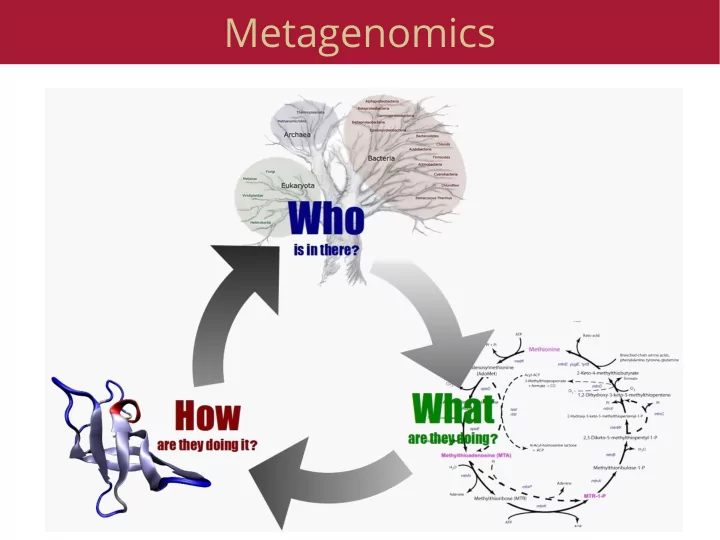
- What is there?
- How many are there?
- What are they doing?
- Experimental manipulations
- Diagnostics
Why Metagenomics?
SLIDE 47 Sequencing costs decreasing
http://genome.gov/sequencingcosts
SLIDE 48 First bacterial genome 100 bacterial genomes 1,000 bacterial genomes Number of known sequences Year Environmental sequencing
How much has been sequenced?
SLIDE 49 Everybody in San Diego Everybody in USA All cultured Bacteria 100 people One genome from every species Most major microbial environments Year
How much will be sequenced?
SLIDE 50
Most pipelines work the same way!
SLIDE 51 Metagenomics Processing
B i n n i n g r e a d s Contamination removal Contig Clustering Functional Assignments G e n e P r e d i c t i
M e r g e p a i r e d
n d r e a d s P r e p r
e s s i n g Taxonomic assignments
SLIDE 52 Metagenomics
Prinseq
– FOCUS – Real time
metagenomics
– mg-rast – Super FOCUS
– STAMP
– crAss – metabat – ContigClustering
SLIDE 53 Metagenomics Processing
AbundanceBin CompostBin concoct crAss tetra Contig clustering FragGeneScan GlimmerMG MetaGeneAnnotator MetaGeneMark MetaGun Orphelia Prodigal Gene Prediction FASTQC FastX Toolkit fjtGCP NGS QC Toolkit Non-pareil Prinseq QC-Chain Streaming Trim Preprocessing CARMA myTaxa FOCUS PhylopythiaS KRAKEN phymmbl LMAT RAIphy MEGAN TACOA Metaplan Taxy Taxonomic assignment CLAMS Sequedex DiScRIBinATE SORT-ITEMS genometa SPANNER GSMer SPHINX PPLACER TaxSOM RTMg Treephyler Functional assignment