Meniscus Meniscus ACL Evidence-based approach Collateral - - PowerPoint PPT Presentation

meniscus meniscus
SMART_READER_LITE
LIVE PREVIEW

Meniscus Meniscus ACL Evidence-based approach Collateral - - PowerPoint PPT Presentation

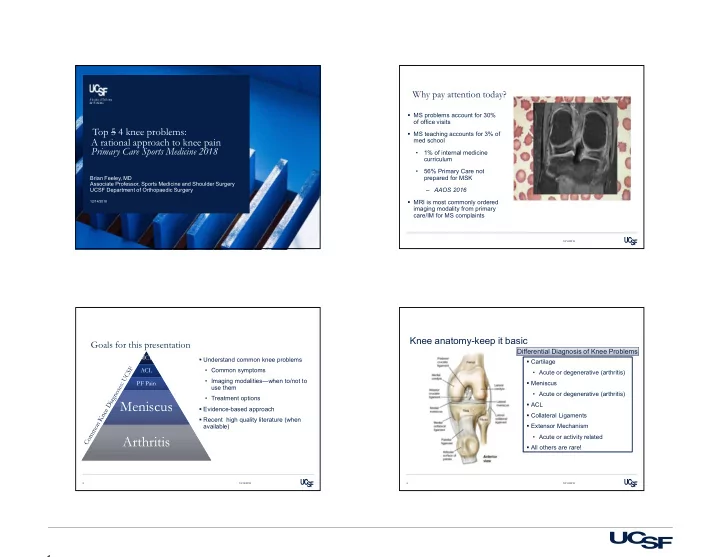
Why pay attention today? MS problems account for 30% of office visits Top 5 4 knee problems: MS teaching accounts for 3% of A rational approach to knee pain med school Primary Care Sports Medicine 2018 1% of internal medicine


slide-1
SLIDE 1

1

A rational approach to knee pain Primary Care Sports Medicine 2018

12/14/2018

Brian Feeley, MD Associate Professor, Sports Medicine and Shoulder Surgery UCSF Department of Orthopaedic Surgery

Top 5 4 knee problems:

12/14/2018

Why pay attention today?

  • MS problems account for 30%
  • f office visits
  • MS teaching accounts for 3% of

med school

  • 1% of internal medicine

curriculum

  • 56% Primary Care not

prepared for MSK ‒ AAOS 2016

  • MRI is most commonly ordered

imaging modality from primary care/IM for MS complaints

Goals for this presentation

  • Understand common knee problems
  • Common symptoms
  • Imaging modalities—when to/not to

use them

  • Treatment options
  • Evidence-based approach
  • Recent high quality literature (when

available)

12/14/2018 3

MCL MCL ACL ACL PF Pain PF Pain

Meniscus Meniscus Arthritis Arthritis

Knee anatomy-keep it basic

12/14/2018 4

  • Cartilage
  • Acute or degenerative (arthritis)
  • Meniscus
  • Acute or degenerative (arthritis)
  • ACL
  • Collateral Ligaments
  • Extensor Mechanism
  • Acute or activity related
  • All others are rare!

Differential Diagnosis of Knee Problems Differential Diagnosis of Knee Problems

slide-2
SLIDE 2

2

Case 1

56 year old male with a 7 month history of moderate knee pain, gradually worsening, and described as ‘achy’. He had a meniscus surgery 4 years ago which helped for a while. He used to run, now mainly biking and

  • swimming. Pain is medial, near the joint line. He says his knee

sometimes swells. What is his most likely diagnosis? A. Osteoarthritis B. Meniscus tear C. Patellofemoral pain D. Hip arthritis

12/14/2018 5

Osteoarthritis Meniscus tear Patellofemoral pain Hip arthritis

77% 1% 6% 16%

Arthritis is a big problem

12/14/2018 Source: CDC 6

  • ARTHRITIS is COMMON!
  • 33% of all adults have arthritis

‒ 70 million people with arthritis ‒ 50% over the age of 65 have arthritis

  • Arthritis is more common in women
  • Arthritis prevalence increases with age

Understanding Arthritis

Cartilage properties Normal Cartilage Arthritis Cartilage Few cells Super smooth Cannot make more cartilage No nerve endings Don’t feel joints move back and forth Don’t sense early damage to the cartilage

Understanding Arthritis

  • The articular changes found are IRREVERSIBLE (mostly)

Healthy cartilage Early Arthritis Advanced Arthritis Best way to explain arthritis to patients seems to be this tire analogy.

slide-3
SLIDE 3

3

History-Osteoarthritis

Symptoms of arthritis

  • Pain—’achy’
  • Swelling/effusion
  • Loss of range of motion
  • Deformity
  • Inability to exercise/perform daily activities/work
  • Weight gain
  • Depression

56 year old male with a 7 month history of moderate knee pain, gradually worsening, and described as ‘achy’. He had a meniscus surgery 4 years ago which helped for a while. He used to run, now mainly biking and swimming. Pain is medial, near the joint line. He says his knee sometimes swells.

Physical Exam-Osteoarthritis

  • Physical Exam findings
  • Deformity
  • Crepitus (grinding, popping)
  • Loss of range of motion
  • Tenderness along the joint line

Imaging-Osteoarthritis

Mild arthritis Moderate arthritis Severe arthritis Get STANDING weight bearing views, bilateral to compare

Imaging-Osteoarthritis

  • Do I need an MRI?
  • Advanced arthritis, in general no (get an Xray first and DON’T get an

MRI)

  • Early cartilage injuriesyes
  • Early arthritismaybe yes
slide-4
SLIDE 4

4

25% of knee visits resulted in MRI in ortho, 24% in Primary Care Orthopaedic surgeons ordered MRIs for patients who were more likely to benefit from arthroscopic intervention including patients who were younger (mean age, 45.1 years versus 56.5 years for those with PCP-ordered MRIs; p < 0.001) Surgeons were less likely than PCPs to order MRIs for patients with substantial osteoarthritis who subsequently underwent total knee arthroplasty (4.3% versus 9.2%; p = 0.048). Summary: both use MRI, possibly better used by Still use it too often for patients with advanced OA Summary: both use MRI, possibly better used by ortho Still use it too often for patients with advanced OA

Treatment options for arthritis

Bracing/Unloading

  • 1. Activity/Lifestyle changes

12/14/2018 15

  • 1. Activity/Lifestyle changes

12/14/2018 16

slide-5
SLIDE 5

5

  • 1. Activity/Lifestyle changes

The most important thing you Can tell patients is that losing weight Will improve symptoms Surgery does not lead to Weight loss (JBJS 2015) Weight loss DOES Lead to less knee pain

  • 1. Activity/Lifestyle changes

Markers of cartilage turnover And breakdown are decreased After Markers of cartilage turnover And breakdown are decreased After bariatic surgery

  • 1. Activity/Lifestyle changes
  • What about mild weight loss?

12/14/2018 19

IDEA Trial (NIH/NIA)

  • 2. Physical Therapy
  • Does physical therapy work for patients with knee
  • steoarthritis?

12/14/2018 20

No single PT intervention was best A Gimmicky things O Wang et al, AIM 2015 No single PT intervention was best…aerobic Aquatic, strengthening worked well Gimmicky things—didn’t work well (magnets, Orthotics, ultrasound) Wang et al, AIM 2015

slide-6
SLIDE 6

6

  • 2. Physical Therapy

 Ettinger, et al. JAMA. 1997  439 community ambulators >60 yo  Randomized to aerobic, resistive exercises vs. nothing  Outcomes with pain, daily function scores  Conclusion:  Significant improvement in daily outcome measurements and knee pain scores with either exercises.  Benefits were best in those with mild to moderate OA

12/14/2018 Ettinger, et al. JAMA 1997. 21

  • 3. Orthotics for Osteoarthritis

12/14/2018 AAOS Clinical Guidelines 2013 22

  • 4. Injections for Osteoarthritis

12/14/2018 23

  • 4. Corticosteroid Injections
  • Risks:
  • Can kill cartilage cells

‒ Lidocaine and steroid

  • Transiently increase blood

sugar

  • Not Risks:
  • Will not turn you into this:

Cartilage cells After lidocaine Healthy cartilage cells UCSF Orthopaedic Research

slide-7
SLIDE 7

7

  • 4. Corticosteroid Injections

12/14/2018 25

Summary: Favors Steroid

  • 4. Viscosupplementation
  • 4. Viscosupplementation
  • Viscosupplementation (Synvisc, Euflexxa)
  • Lubricates and cushions joint
  • Made from a natural substance similar to healthy joint fluid
  • Improves viscosity
  • Increases molecular weight and quantity of synovial

fluid synthesized by the synovium

  • Decrease pain (mechanism uncertain)
  • Decreases inflammatory mediators?
  • 4. Viscosupplementation
  • Who does it work for?
  • Mild to moderate arthritis
  • Already on an exercise/weight loss program but with continued pain
  • Low to moderate demand activities

‒ Limit high impact sports (running)

slide-8
SLIDE 8

8

  • 4. Injections
  • “The expert achieved unanimous agreement in favor of

the following statements: VS is an effective treatment for mild to moderate knee OA; VS is not an alternative to surgery in advanced hip OA; VS is a well-tolerated treatment of knee and other joints OA”

12/14/2018 29

  • 4. Injections

NEJM-2015

  • In this clinical setting of a prevalent disabling disease, for which the therapy

in question has, at best, modest efficacy for relief of pain, the tolerance for treatment expense and adverse events is limited. Therefore, the current evidence base would not advocate the use of intraarticular hyaluronate for the management of knee osteoarthritis.

12/14/2018 30

Conclusions mild benefit, often less than MCID May be worth trying in younger people with OA, mild disease Conclusions— mild benefit, often less than MCID May be worth trying in younger people with OA, mild disease

  • 4. Injections—What’s next?

12/14/2018 Arthroscopy, 2015 31

3 meta-analyses Works better for people with less arthritis Higher rate of side effects Limited data, mildly promising

12/14/2018 32

AJSM 2017 No difference in WOMAC Pain No difference in WOMAC Pain

slide-9
SLIDE 9

9

12/14/2018 33

AJSM 2017

Mild OA, lower BMI worked better lowers pro Conclusion: “significant improvements were seen in

  • ther patient

results favoring PRP over HA.” Mild OA, lower BMI worked better lowers pro-inflammatory cytokines. Conclusion: “significant improvements were seen in

  • ther patient-reported outcome measures, with

results favoring PRP over HA.”

Improved IKDC Scores 6-12 Months with PRP Inflammatory markers

12/14/2018 34

Systematic Reviews of Level 1 and Level 2 evidence Riboh et al AJSM 2015 Khoshbin et al Arthrosc 2013 Chang et al APMR 2014 Studies favor PRP with modest effect No evaluation of alteration of natural history Studies favor PRP with modest effect No evaluation of alteration of natural history

  • 5. Surgery
  • Surgery to debride meniscus/cartilage is not effective in the setting of

arthritis

  • Kirkley et al NEJM 2007
  • Moseley et al NEJM 2002

12/14/2018 35

Knee Replacement

  • Final common pathway for all people with moderate to severe arthritis
slide-10
SLIDE 10

10

Knee Replacement

  • How does it work?
  • Designed cuts in the knee joint to remove injured cartilage
  • Replacement of cartilage surface with metal and plastic (Polyethylene)

surface

Knee Replacement Knee Replacement

  • Excellent procedure for low to moderate demand patients
  • Pain relief immediate (no more injured cartilage)
  • Good range of motion
  • 90-95% good to excellent results at 10-15 years

Knee Surgery 6 weeks ‘50% better’ 3 months ‘75% better’ 6 months ‘90% better’ 1 year ‘98% better’

CASE 2

A 35 year-old recreational basketball player makes a rapid pivot on his fixed leg and feels a tearing sensation in his knee. He tries to continue playing but has a moderate amount of discomfort in his knee along the medial (inner) joint line. His knee swells a moderate amount over the next few days. He notes pain along the joint line with squatting and climbing up and down stairs. The most likely diagnosis is:

  • A. Meniscus tear
  • B. Patellar tendon rupture
  • C. Chondromalacia patella/patella maltracking
  • D. Anterior Cruciate Ligament Tear

M e n i s c u s t e a r P a t e l l a r t e n d

  • n

. . . C h

  • n

d r

  • m

a l a c i a . . . A n t e r i

  • r

C r u c i a t e . . .

92% 8% 0% 0%

slide-11
SLIDE 11

11

History--Meniscal Tears

  • Classic descriptions
  • Swelling after event, usually able to continue
  • Pain with activity
  • Joint line soreness
  • Lower level of activity
  • Able to pinpoint pain

Physical Exam—Meniscus Tears

Rational exam steps

  • 1. Joint line tenderness
  • 2.Thessaly (or apley) test
  • 3. Deep squat
  • 4. Duck walk

12/14/2018 42

Imaging-Meniscal Injury Treatment options for meniscus tear

12/14/2018 44

Acute vs Chronic Active, younger person Refer for surgical evaluation Active, older person Sedentary, older person OA on Xray imaging PT, activity modification

slide-12
SLIDE 12

12

Non operative management for degenerative meniscus tears

12/14/2018 45

54 years, no difference in functional or clinical outcomes at 2 years In the intention-to-treat analysis, we did not find significant differences between the study groups in functional improvement 6 months after randomization; however, 30% of the patients who were assigned to physical therapy alone underwent surgery within 6 months.

Management of degenerative meniscus tears

12/14/2018 2013 NEJM 46

“No differences at 1 year in the intent to treat group”

Meniscus Tear Treatment

  • Treatment based on mechanical symptoms
  • f patient
  • If meniscal tear disrupts mechanics of

knee and patient does not respond to physical therapy, surgery is indicated

  • Surgical options: Debridement (remove as

little as possible) vs Repair

  • Older patients with arthritis (cartilage

wear) often are treated with physical therapy and injections

Outcomes of meniscus debridement

12/14/2018 48

  • Excellent procedure for higher demand patients who fail non op
  • Pain relief immediate (no more injured cartilage)
  • Good range of motion
  • 90-95% good to excellent results at 10-15 years (Syndgard KSSTA 2013)

Knee Surgery 1 week ‘50% better’ 6 weeks ‘75% better’ 12 weeks‘90% better’ 1 year ‘98% better’

slide-13
SLIDE 13

13

Meniscus tears—what not to miss

Bucket handle tears

  • Locked knee
  • Often with ACL tear
  • Younger (<40) more active
  • Crutches, refer immediately

Meniscus root tears

  • Older patient (50-65)
  • Often prodromal period
  • Acute worsening with swelling
  • Protected weight bearing, refer to
  • rtho immediately

49

Case #3

A 41 year-old, 210 pound male presents complaining of bilateral knee pain, L>R. He complains of anterior knee pain with stair climbing, long walks, and after sitting for long periods. Sometimes his legs feel weak, as if they might “give out” on him while walking down the stairs. He has faint swelling on

  • ccasion. The most likely diagnosis is:

A. Meniscus tear

  • B. Anterior Cruciate Ligament tear
  • C. Patello-femoral maltracking/pain
  • D. Patellar dislocation

M e n i s c u s t e a r A n t e r i

  • r

C r u c i a t e . . . P a t e l l

  • f

e m

  • r

a l . . . P a t e l l a r d i s l

  • c

a t i

  • n

3% 3% 83% 11%

History of patellofemoral problems

  • Often bilateral pain
  • Anterior/anteromedial pain
  • Pain with down stairs/hills
  • Can be associated with

changes in activity

  • No specific injury mechanism

12/14/2018 52

Physical Examination

  • Normal body habitus / + ligament laxity
  • Squat 90 deg-pain anterior
  • No specific tenderness
  • Can have quad atrophy
  • Possible mild effusion
  • Pronated feet
  • tight hamstrings and IT band
  • Poor Core stability

If exam is not reliable, how to I test? SLS Video

slide-14
SLIDE 14

14

Etiology of Patellofemoral pain

  • Valgus knees (exam)
  • Trochlea hypoplasia (x-ray)
  • Foot Pronation

Non-modifiable risk factors

  • Weight
  • Core stability
  • Flexibility
  • Activities
  • Shoe wear (shoe fit)
  • Biking (bike fit)

12/14/2018 54

Modifiable risk factors

Radiographs? MRI?

Useful to rule out other factors, but usually negative.

  • -I would recommend start with PT with no swelling
  • -MRI if patients fail PT, have swelling

Chondromalacia very common Does not usually change treatment options initially

Does PT work for patellofemoral pain?

720 patients Both groups did better overall PT works better and faster with hip/CORE stability Improvement at 6 weeks

Does PT work for patellofemoral pain?

28 people randomized to hip strengthening vs control-8 week program Pain, health status, and bilateral hip strength improved in the exercise group Improvements in pain and health status were sustained at 6- month follow-up in the exercise group. Rx for patellofemoral pain What do I write? Knee ROM Hip/CORE stability exercises Modalities OK Return to sports Assess with single leg squat Rx for patellofemoral pain What do I write? Knee ROM Hip/CORE stability exercises Modalities OK Return to sports Assess with single leg squat

slide-15
SLIDE 15

15

Winter Sports

58

CASE

A 42 year-old financial advisor who is an advanced skier comes in one day after an injury at Boreal. He caught an edge and had a ‘grinding’ feeling and fell. He tried to ski but couldn’t. He was tobogganed down and his knee swelled up on the way home. What is his most likely diagnosis?

  • A. Meniscus tear
  • B. Patellar tendon rupture
  • C. Chondromalacia patella/patella maltracking
  • D. Anterior Cruciate Ligament Tear

E. Pathologic liar-expert skiers don’t go to Boreal

M e n i s c u s t e a r P a t e l l a r t e n d

  • n

. . . C h

  • n

d r

  • m

a l a c i a . . . A n t e r i

  • r

C r u c i a t e . . . P a t h

  • l
  • g

i c l i a r

  • .

. . 6% 2% 4% 88% 1%

ACL Injury

  • Add nml and inj MRI

History--ACL injuries

  • History
  • Non contact, twisting
  • 70% hear a pop
  • Swelling within 1 hr
  • Do not return to play
  • Often doing well when they come into
  • ffice (if more than 1-2 weeks out)
slide-16
SLIDE 16

16

Physical Exam-ACL tear—Dr. Allen’s and Hands on Talks

  • Swollen
  • Lack ROM
  • Lateral Tenderness
  • Unstable on exam

Lachman Test

X-ray

Usually non-diagnostic Can help rule in or out injuries Segond fracture – avulsion over lateral tibial plateau

ACL—MRI findings ACL Tears—Treatment options

  • Treatment options
  • Non-operative

‒ Low Demand People

  • Activity modification
  • Bracing for activity
  • Cartilage injuries
  • Medial meniscus

Operative Indication Cutting and pivoting sports High demand jobs Young people Treatment of associated injuries Lateral meniscus

slide-17
SLIDE 17

17

Outcomes of ACL injury in older athletes

12/14/2018 67

Swedish ACL registry Over 40, skiing most common cause Outcomes (KOOS score) similar in younger and older patients 52 years avg age 90% return to sport, 88% satisfied Summary: In higher level older patients Reasonable to consider ACL reconstruction Summary: In higher level older patients Reasonable to consider ACL reconstruction Tell your patients this is STILL a bad idea

Summary

  • Know the 4 most common knee problems with treatment options
  • Arthritis—5 good treatment options
  • Meniscus—know who will benefit from surgery
  • ACL—know how to diagnose, understand expanding indications
  • PF pain—normal exam, anterior pain, treat with PT

12/14/2018 68

slide-18
SLIDE 18

18

Bonus Slides Extra-Other Knee Problems

  • MCL Sprain
  • Pes bursitis
  • Pre-patellar bursitis
  • Hamstring Injuries
  • ITB friction syndrome

What else can go wrong in the knee?

MCL Injury MCL Injury

  • Mechanisms:
  • Hit on outside of knee
  • May be associated with tears of the ACL and the

medial meniscus, or patella dislocation, but is often an isolated injury

  • A contusion/ fx due to impact of the lateral femoral

condyle or lateral tibial plateau is common (bone bruise with lateral pain)

MCL injury is the most common Ligament injury in the knee

MCL--History

  • Patients will have medial sided pain
  • Pain when foot gets caught in covers, lifting knee
  • Tenderness usually along the femoral attachment
  • Swelling not as common

12/14/2018 73

slide-19
SLIDE 19

19

MCL Injury

MCL-Exam

  • A Valgus stress is applied both in full extension and in 20-30 ° of

flexion

  • Test in 20-30 ° flexion evaluates MCL
  • Grading of Injury based on Jt. Space opening and endpoint feel

Treatment: Brace, non weight bearing or WB in extension PT for ROM and strength Usually 6-12 weeks back to sports (long time if older)

Patellar Tendinitis

  • Pain at tendon insertion into kneecap
  • Due to eccentric load in running

(running down hills), repetitive jumping (basketball), weight lifting

  • Pain with squat, stair climbing
  • Pain with palpation of tendon
  • Tight hamstrings

Iliotibial Band Tendinitis

  • Pain and snapping over
  • uter aspect of knee
  • Very common in runners
  • Due to overtraining, tight

IT band. Hip adduction & internal rotation, and knee extension during running tighten IT band and accentuate snapping

slide-20
SLIDE 20

20

Iliotibial Band Tendinitis Treatment:

  • IT band stretching
  • Ice
  • NSAIDS
  • Cortisone injection (rare)
  • Orthotics
  • Address

biomechanics/PT

12/14/2018 79

Pes Bursitis

Pain at hamstring insertion Often with swelling at attachment Treatment ice massage Hamstring stretching Avoid offending activity

12/14/2018 80

Other locations for pain: Treatment with rest/PT