
SLIDE 1
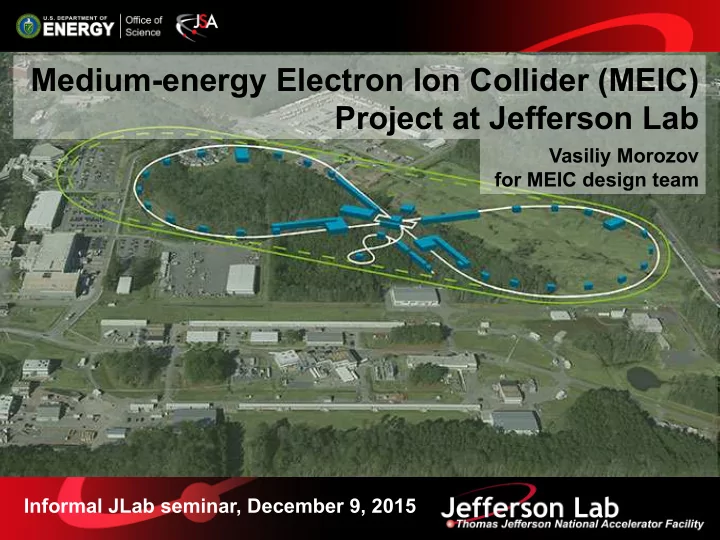
Medium-energy Electron Ion Collider (MEIC) Project at Jefferson Lab - - PowerPoint PPT Presentation
Medium-energy Electron Ion Collider (MEIC) Project at Jefferson Lab Vasiliy Morozov for MEIC design team Informal JLab seminar, December 9, 2015 Outline Introduction EIC purpose JLabs approach to the design MEIC design overview
2 2
IPAC’15, Richmond, May 5, 2015 2
2
Informal JLab seminar, December 9, 2015 2
3 3
IPAC’15, Richmond, May 5, 2015 3
3
Informal JLab seminar, December 9, 2015 3
Suleiman, A. Sy, C. Tennant, H. Wang, S. Wang, C. Weiss, H. Zhang, Y. Zhang, Z. Zhao – JLab, Newport News, VA D.P. Barber – Deutsches Elektronen-Synchrotron (DESY), Hamburg, Germany
4 4
IPAC’15, Richmond, May 5, 2015 4
4
Informal JLab seminar, December 9, 2015 4
Recommendations in NSAC LRP 2015:
1. Continue existing projects: CEBAF, FRIB, RHIC. 2. “…a U.S.-led ton-scale neutrinoless double beta decay experiment” 3. “…a high-energy high-luminosity polarized EIC as the highest priority for new facility construction following the completion of FRIB” 4. “…small-scale and mid-scale projects and initiatives that enable forefront research at universities and laboratories”
EIC Community White Paper arXiv:1212.1701
5 5
IPAC’15, Richmond, May 5, 2015 5
5
Informal JLab seminar, December 9, 2015 5
– 3D structure of nucleons
§ How do gluons and quarks bind into 3D hadrons?
– Role of orbital motion and gluon dynamics in the proton spin
§ Why do quarks contribute only ~30%?
– Gluons in nuclei (splitting/recombining)
§ Does the gluon density saturate at small x?
6 6
IPAC’15, Richmond, May 5, 2015 6
6
Informal JLab seminar, December 9, 2015 6
continue throughout the construction period
(this) NSAC Long Range Plan (came true)
select process done around 2016/17
procurements can start, we think this is FY20 at the earliest.
year of operations ($117M/yr in FY15$) would be of similar cost as the CEBAF 4-6 GeV life cycle costs: $3.24B vs. $2.98B.
suggested a TPC of $1,500M for a generic EIC including detector
for reduction of the TPC below this
technical risk of the MEIC design requires
in pre-R&D
Year 4 ~ CD3 FY20? Year 12 ~ CD4 FY28?
7 7
IPAC’15, Richmond, May 5, 2015 7
7
Informal JLab seminar, December 9, 2015 7
– Full coverage of √s from 15 to 65 GeV – Electrons 3 -10 GeV, protons 20 -100 GeV, ions 12 - 40 GeV/u
– Polarized light ions: p, d, 3He, and possibly Li – Un-polarized light to heavy ions up to A above 200 (Au, Pb)
– Full acceptance is critical for the primary detector
– 1033 to 1034 cm-2s-1 per IP in a broad CM energy range
– At IP: longitudinal for electrons, longitudinal or transverse for ions – All polarizations >70%
– 250 GeV proton, and 100 GeV/u ion
8 8
IPAC’15, Richmond, May 5, 2015 8
8
Informal JLab seminar, December 9, 2015 8
The MEIC design concept for high luminosity is based on high bunch
Beam Design
IR Design
Damping
radiation
1 2 1 2 *
x y y
∗ ∗
KEK-B already reached above 2x1034 /cm2/s Linac-Ring colliders
electron beam
current
9 9
IPAC’15, Richmond, May 5, 2015 9
9
Informal JLab seminar, December 9, 2015 9
Warm Electron Collider Ring (3 to 10 GeV) Cold Ion Collider Ring (8 to 100 GeV)
One has a new detector, fully instrumented Second is a straight-through, minor additional magnets needed to turn into IP
Minimize synchrotron radiation – IP far from arc where electrons exit – Electron beam bending minimized in the straight before the IP Minimize hadronic background – IP close to arc where protons/ions exit
10 10
IPAC’15, Richmond, May 5, 2015 10
10
Informal JLab seminar, December 9, 2015 10
~2.2 km circumference E-ring from PEP-II Ion-ring with 3 T super-ferric magnets Tunnel consistent with a 250+ GeV upgrade
11 11
IPAC’15, Richmond, May 5, 2015 11
11
Informal JLab seminar, December 9, 2015 11
new 5 cryomodules new 5 cryomodules
CEBAF fixed target program
– 5-pass recirculating SRF linac – Exciting science program beyond 2025 – Can be operated concurrently with the MEIC
CEBAF will provide for MEIC
– Up to 12 GeV electron beam – High repetition rate (up to 1497 MHz) – High polarization (>85%) – Good beam quality up to the mA level
12 12
IPAC’15, Richmond, May 5, 2015 12
12
Informal JLab seminar, December 9, 2015 12
e-
Arc, 261.7°
81.7° Forward e- detection
IP
Future 2nd IP Electron collider ring w/ major machine components
13 13
IPAC’15, Richmond, May 5, 2015 13
13
Informal JLab seminar, December 9, 2015 13
IP Dx(m) βx(m), βy(m) Electron Collider Ring Optics
CEBAF provides up to 12 GeV, high repetition rate and high polarization (>85%) electron beams, no further upgrade needed beyond the 12 GeV CEBAF upgrade Electron collider ring design
– Meets design requirements – Circumference of 2154.28 m = 2 x 754.84 m arcs + 2 x 322.3 m straights – Provides longitudinal electron polarization at IP(s) – Incorporates forward electron detection – Accommodates up to two detectors – Incorporates correction of beam nonlinearity – Reuses PEP-II magnets, vacuum chambers and RF
Beam characteristics
– 3A beam current up to 6.95 GeV – Normalized emittance 1093 um @ 10 GeV – Synchrotron radiation power density 10kW/m – Total power 10 MW @ 10 GeV
CEBAF and electron collider provide the required electron beams for the MEIC
14 14
IPAC’15, Richmond, May 5, 2015 14
14
Informal JLab seminar, December 9, 2015 14
Electron injection bunch pattern (@6 GeV) from CEBAF with
– fring/ fcebaf = 476.3MHz/1497MHz = 7/22 – Two polarization states injection – Existing CEBAF source gun
Transfer line 333.25m utilizes PEP-II LER dipoles (156) and quads (68) Injection scheme starts with PEP-II-like design
– Dispersion free injection insertion – Septum + DC + RF kickers – Vertical injection because of greater dynamic aperture, absence
3416*10.5turns/476.3MHz=75.3ms
14.69 ns, 68.05 MHz (7 ring buckets)
220 bunches, 3.233µs (Iave= 0.9mA @6GeV CEBAF) Bunch train, up polarization
……
Bunch train, down polarization
Waiting for 72.07µs
Mid-cycle 1, inject the 1st of every 7 buckets in the ring
13 pC bunch ……
Waiting for damping 12-700ms
2ns, 476.3 MHz(ring freq.)
12-700ms, ~2× e-ring damping time at different energy
Injection Time and Beam Current vs. Energy
nominal Synchrotron power limit Impedance limit
15 15
IPAC’15, Richmond, May 5, 2015 15
15
Informal JLab seminar, December 9, 2015 15
Comprehensive electron polarization strategies:
– Vertically-injected polarized electron beam from CEBAF – Vertical polarization in the arcs (to avoid spin diffusion) and longitudinal at collision points – Spin rotator for the polarization rotation – Spin flipping through changing the source polarization – Polarization configuration with figure-8 geometry removes electron spin tune energy dependence – Compton polarimeter has been integrated to the interaction region design and is considered to measure the electron polarization – Spin matching in some key regions is considered to further improve polarization lifetime
IP
e-
Magnetic field Polarization Half Sol. Half Sol.
Solenoid decoupling
νc Laser + Fabry Perot cavity e- beam Low-Q2 tagger for low-energy electrons Low-Q2 tagger for high- energy electrons Electron tracking detector Photon calorimeter
IP
Energy (GeV) 3 5 7 9 10 Estimated Pol. Lifetime (hours) 66 5.2 2.2 1.3 0.8
16 16
IPAC’15, Richmond, May 5, 2015 16
16
Informal JLab seminar, December 9, 2015 16
– ABPIS for polarized or unpolarized light ions, EBIS and/or ECR for unpolarized heavy ions – Design for an SRF linac based on the ANL linac for FRIB – 8 GeV Booster design to avoid transition for all ion species and based on super-ferric magnet technology – Injection/extraction lines to/from Booster are designed
Ion Sources SRF Linac (285 MeV) Booster (8 GeV) (accumulation)
DC e-cooling
17 17
IPAC’15, Richmond, May 5, 2015 17
17
Informal JLab seminar, December 9, 2015 17
Optimum lead stripping energy: 13 MeV/u 10 cryostats 4 cryostats 2 Ion Sources
QWR QWR HWR IH RFQ MEBT
10 cryos 4 cryos
2 cryos Ion species: p to Pb Ion species for the reference design
208Pb
Kinetic energy (p, Pb) 285 MeV 100 MeV/u Maximum pulse current: Light ions (A/Q<3) Heavy ions (A/Q>3) 2 mA 0.5 mA Pulse repetition rate up to 10 Hz Pulse length: Light ions (A/Q<3) Heavy ions (A/Q>3) 0.50 ms 0.25 ms Maximum beam pulsed power 680 kW Fundamental frequency 115 MHz Total length 121 m
Linac design based on the ANL linac for FRIB. Pulsed linac capably of accelerating multiple charge ion species (H- to Pb67+) – Warm Linac sections (115 MHz)
– Cold Linac sections
18 18
IPAC’15, Richmond, May 5, 2015 18
18
Informal JLab seminar, December 9, 2015 18
Straight
(2550) Straight (RF + extraction) Arc (2550)
=
56
273 M cm
272.306 70 6
BETA_X&Y[m] DISP_X&Y[m] BETA_X BETA_Y DISP_X DISP_Y
extraction
RF cavity
Crossing angle: 75 deg.
Ekin = 285 MeV – 8 GeV
injection
8 GeV Booster serves for
– Accumulation of ions injected from Linac – Cooling – Acceleration of ions – Extraction and transfer of ions to the collider ring
Injection: multi-turn 6D painting
– 0.22 – 0.25 ms long pulses ~180 turns – Proton single pulse charge stripping at 285 MeV – Ion 28-pulse drag-and-cool stacking at 100MeV/u – Ion energies scaled by mass-to-charge ratio to preserve magnetic rigidity
Design
– Circumference of 273 m – Super-ferric magnets – No transition energy crossing – Figure-8 shape for preserving ion polarization
19 19
IPAC’15, Richmond, May 5, 2015 19
19
Informal JLab seminar, December 9, 2015 19
R = 155.5 m Arc, 261.7°
IP ions
81.7°
future 2nd IP
Polarimeter
20 20
IPAC’15, Richmond, May 5, 2015 20
20
Informal JLab seminar, December 9, 2015 20
~2.2 km circumference to match the geometry of PEP-II-component-based electron ring Use Super-ferric magnets
– ~3 T maximum field for maximum proton momentum of 100 GeV/c, 4.2 K operating temperature – Cost effective construction and operation (factor of ~2 cheaper to operate, GSI)
Ion collider ring design
– Has an arc FODO cell § length of 22.8 m (1.5 x PEP-II FODO cell) § optimized for an 8m long SF dipole magnet – Provides high polarization adjustable to any
– Incorporates forward ion detection – Accommodates up to two detectors – Incorporates correction of beam nonlinearity
Ion collider ring design meets the design requirements
βx(m), βy(m) Ion Collider Ring Optics IP Dx(m)
21 21
IPAC’15, Richmond, May 5, 2015 21
21
Informal JLab seminar, December 9, 2015 21
2 x 4 long dipole 3 T Correction sextupole Common cryostat Rutherford-based design CIC-based design
22 22
IPAC’15, Richmond, May 5, 2015 22
22
Informal JLab seminar, December 9, 2015 22
Compensation of momentum dependence of betatron tunes (primarily due to strong focusing at IP) using properly-phased sextupole families
– FFB focusing is momentum dependent – Sextupole focusing is transverse position dependent – Create momentum-correlated transverse position inside sextupoles, i.e. dispersion – Use additional sextupoles to compensate effect on the non-correlated position component
Distributed sextupole compensation strategy
– Build-up chromatic β wave in the arcs to cancel FFB’s chromatic kick
§ Two sextupole families, each with an even number of magnets § π phase advance between individual sextupoles of each family § nπ+π/2 phase advance from the last sextupole of each family to IP
– Compensation of 1/6 residual linear chromaticity
§ Two sextupole families, each with a multiple of 4 magnets
FFB IP FFB
nπ nπ π π π/2 π/2 … … … …
nπ+ π/2 nπ+ π/2
23 23
IPAC’15, Richmond, May 5, 2015 23
23
Informal JLab seminar, December 9, 2015 23
–I sextupoles pairs in the arcs Compensate momentum dependence of the beam size (~ to W function) at the IP (equivalent to compensating the momentum-dependent FFB focusing) Control the global dependence of the betatron tunes on momentum (chromaticities) with additional sextupoles
IP
24 24
IPAC’15, Richmond, May 5, 2015 24
24
Informal JLab seminar, December 9, 2015 24
Dependence of the betatron tunes on momentum Dynamic aperture: region of stable motion in the transverse plane
(- 8σΔp/p , + 13σΔp/p)
Δp/p = 0 Δp/p = 0.3% Δp/p = -0.3%
> (±70σ) in x & y
at IP
25 25
IPAC’15, Richmond, May 5, 2015 25
25
Informal JLab seminar, December 9, 2015 25
Dipole Quadrupole [FFQ] Sextupole BPM noise Corrector σx (mm) 0.3 0.3 [0.03] 0.3 0.02
0.3 0.3 [0.03] 0.3 0.02
0.3 0.3 [0.05] 0.3
σs (mm) 0.3 0.3 [0.03] 0.3
0.1 0.2 [0.03] 0.2
26 26
IPAC’15, Richmond, May 5, 2015 26
26
Informal JLab seminar, December 9, 2015 26
Thread the beam through, find closed orbit and minimize distortion using BPMs and correctors
5×10⁻⁶ 5×10⁻⁶ < 4×10⁻⁴ < 1×10⁻⁴
27 27
IPAC’15, Richmond, May 5, 2015 27
27
Informal JLab seminar, December 9, 2015 27
Correct: orbit, beta-beat, tune, chromaticity, and coupling
Δp/p = 0 Δp/p = 0.3% Δp/p = -0.3%
> (±70σ) in x & y at IP Before ~(±50σ) in x & y at IP
Δp/p = 0 different seeds
After
28 28
IPAC’15, Richmond, May 5, 2015 28
28
Informal JLab seminar, December 9, 2015 28
Nominal systematic multipoles of super-ferric arc dipoles Apply them to all dipoles in the ion ring
Multipole errors of super-ferric dipole at radius 20 mm (unit: 10^-4) multipole type systematic
Random
Without multipoles With multipoles
Δp/p = 0 Δp/p = 0.3% Δp/p = -0.3%
29 29
IPAC’15, Richmond, May 5, 2015 29
29
Informal JLab seminar, December 9, 2015 29
Different categories of magnets Different specifications for different categories
D Q S ALL 133 205 75 IR area, β > 1 km 2 6 β > 200 m 21 19 8
> (±20σ) in x & y
~ (±50σ) in x & y
30 30
IPAC’15, Richmond, May 5, 2015 30
30
Informal JLab seminar, December 9, 2015 30
Time between collisions:
i i e e i e i i i e
Ions Electrons
31 31
IPAC’15, Richmond, May 5, 2015 31
31
Informal JLab seminar, December 9, 2015 31
Issue: energy-dependence of ion velocity desynchronizes ions with electrons Suppose ion energy set significantly lower:
i i e e i e i i i e
Ions Electrons
i i
32 32
IPAC’15, Richmond, May 5, 2015 32
32
Informal JLab seminar, December 9, 2015 32
Ion path length change such that
i i e e i i e i i i e
Ions Electrons
i i i i
33 33
IPAC’15, Richmond, May 5, 2015 33
33
Informal JLab seminar, December 9, 2015 33
Harmonic jump such that
i i e e i e i i i i e
Ions Electrons
i i i i
34 34
IPAC’15, Richmond, May 5, 2015 34
34
Informal JLab seminar, December 9, 2015 34
100 GeV/c protons: L = 2153.78 m, f = 476.3 MHz, h = 3422 (bunch spacing = 62.94 cm) Observations – A path-length chicane probably not practical without harmonic jump for the whole momentum range – When moving whole arcs without harmonic jump § Maximum transverse shift ΔR = ΔL / θ = 24.9 cm where θ = 523.4° § With ~256 gaps between arc dipoles and quadrupoles, max gap change = 8.9 mm – When moving whole arcs with harmonic jump § ΔR = (bunch spacing) / θ = 69 mm § Max gap change = 2.5 mm
p (GeV/c) β Without harmonic jump With harmonic jump h Δl (m) Δf (MHz) h Δl (m) Δf (MHz) 100 0.999956 3422 0.0000 0.0000 3422 0.0000 0.0000 90 0.999946 3422
3422
80 0.999931 3422
3422
70 0.99991 3422
3422
60 0.999878 3422
3422
50 0.999824 3422
3422
40 0.999725 3422
3423 0.1317 0.0291 30 0.999511 3422
3424 0.3004 0.0664 20 0.998901 3422
3426 0.2434 0.0538
35 35
IPAC’15, Richmond, May 5, 2015 35
35
Informal JLab seminar, December 9, 2015 35
Synchronization – highly desirable – Smaller magnet movement: ±(bunch spacing)/2 – Smaller RF adjustment Detection and polarimetry – highly desirable – Cancellation of systematic effects associated with bunch charge and polarization variation – great reduction of systematic errors, sometimes more important than statistics – Simplified electron polarimetry – only need average polarization, much easier than bunch-by-bunch measurement Dynamics – question – Possibility of an instability – needs to be studied Luminosity reduction by about twice the beam gap size (instead of one)
36 36
IPAC’15, Richmond, May 5, 2015 36
36
Informal JLab seminar, December 9, 2015 36
Raising number of bunches in linear simulation quickly produced instabilities – as low as N=(10,11)! – A verification but of course many details left out
ξ1,2 = 0.003
37 37
IPAC’15, Richmond, May 5, 2015 37
37
Informal JLab seminar, December 9, 2015 37
Linear model doesn’t look good BUT – MEIC is strong focusing (transverse and longitudinal, e and p) – Landau damping may damp instabilities faster than even the pessimistic growth rates § Typical damping times are o(1/σQ) (chromatic dominates nonlinear) § Hadron rebunching should be performed without e- beam § Nonlinear beam-beam tune spread may help Many dynamical effects were not included in H/L/P paper – Nonlinear beam transport – 6D effects (e.g. chromatic tune spread, tune modulation) – Higher order moment instabilities – Assumed only round beams
38 38
IPAC’15, Richmond, May 5, 2015 38
38
Informal JLab seminar, December 9, 2015 38
More realistic simulation needed by challenging
– In case of MEIC, 1 turn = ~3000 beam-beam interactions + non-linear dynamics – Non of the existing codes seem adequate
Developing a new code GHOST in collaboration with ODU
– Accuracy: high-order transfer map, symplecticity, bunch slicing – Speed: Bassetti-Erskine solution for each pair of slices, single-term map, GPU
GHOST & BeamBeam3D, 10 cm bunch 40k particles
39 39
IPAC’15, Richmond, May 5, 2015 39
39
Informal JLab seminar, December 9, 2015 39
Magnets are connected rigidly in each half of the chicane, each half is rotated about the respective chicane end point, path length is adjusted by changing the spacing between the two central dipoles Maximum path-length change with five FODO cells is 29.0 cm Change in distance between the central dipoles 2×14.5 cm Maximum radial shift is 1.48 m
1.48 m +29 cm
40 40
IPAC’15, Richmond, May 5, 2015 40
40
Informal JLab seminar, December 9, 2015 40
DC cooling for emittance reduction BBC cooling for emittance preservation
ion sources ion linac Booster (0.285 to 8 GeV) collider ring (8 to 100 GeV) BB cooler DC cooler
Ring Cooler Function Ion energy Electron energy
GeV/u MeV Booster ring DC Injection/accumulation of positive ions 0.11 ~ 0.19 (injection) 0.062 ~ 0.1 Emittance reduction 2 1.1 Collider ring Bunched Beam Cooling (BBC) Maintain emittance during stacking 7.9 (injection) 4.3 Maintain emittance Up to 100 Up to 55
d z cool 4 2
~ ε σ γ γ γ τ Δ
41 41
IPAC’15, Richmond, May 5, 2015 41
41
Informal JLab seminar, December 9, 2015 41
Baseline cooling requirements
– Emittance 0.5 to 1 mm-mrad -> reduce IBS effect – Magnetized beam, up to 55 MeV energy, 200 mA current – Linac for acceleration – Must utilize energy-recovery-linac (beam power is 11 MW)
Solution : cooling by a bunched electron beam
ion bunch electron bunch Cooling section solenoid SRF Linac dump injector energy recovery Electron energy MeV up to 55 Current and bunch charge A / nC 0.2 / 0.42 Bunch repetition MHz 476 Cooling section length m 60 RMS Bunch length cm 3 Electron energy spread 10-4 3 Cooling section solenoid field T 2 Beam radius in solenoid/cathode mm ~1 / 3 Solenoid field at cathode KG 2
42 42
IPAC’15, Richmond, May 5, 2015 42
42
Informal JLab seminar, December 9, 2015 42
s p d
s d p
s y
s x y s
43 43
IPAC’15, Richmond, May 5, 2015 43
43
Informal JLab seminar, December 9, 2015 43
– Protons
§ ~13 imperfection resonances § ~26 intrinsic resonances
– Deuterons
§ 0 imperfection resonances § 1 or 2 intrinsic resonances
– Protons
§ ~175 imperfection resonances § ~350 intrinsic resonances
– Deuterons
§ 7 imperfection resonances § ~12 intrinsic resonances
44 44
IPAC’15, Richmond, May 5, 2015 44
44
Informal JLab seminar, December 9, 2015 44
– A “full” Siberian snake rotates the spin by 180° – Overcomes all imperfection and most intrinsic resonances
1
s s
− ⎡
|| ||
⊥ ⊥
45 45
IPAC’15, Richmond, May 5, 2015 45
45
Informal JLab seminar, December 9, 2015 45
– Spin precession in one arc is exactly cancelled in the other – Zero spin tune independent of energy – Spin control and stabilization with small solenoids or other compact spin rotators
– Efficient preservation of ion polarization during acceleration
§ Energy-independent spin tune § High polarization of all light ions
– Ease of spin manipulation
§ Any desired polarization orientation at the IP § Spin flip
– A simple way to accommodate polarized deuterons
§ Particles with small anomalous magnetic moment
– Spin control without affecting the beam dynamics
46 46
IPAC’15, Richmond, May 5, 2015 46
46
Informal JLab seminar, December 9, 2015 46
– 0.7 Tm at 9 GeV/c – νd / νp = 0.003 / 0.01
beam from Linac
to Collider Ring BIIL
47 47
IPAC’15, Richmond, May 5, 2015 47
47
Informal JLab seminar, December 9, 2015 47
y
ϕ
1 z
ϕ
z y x
n n n S , , =
spin component Control of vertical (ny) spin component Control of longitudinal (nz) spin component
y
ϕ 2 −
y
ϕ
1 z
ϕ −
2
1 z
ϕ − 2
1 z
ϕ
x
ϕ −
2 z
ϕ
x
ϕ 2
x
ϕ −
2 z
ϕ −
2
2 z
ϕ − 2
2 z
ϕ
3
2
z
ϕ
1
sin
x z y
n ϕ πν ϕ =
2
sin
y z x
n ϕ πν ϕ =
3 z z
n ϕ πν =
48 48
IPAC’15, Richmond, May 5, 2015 48
48
Informal JLab seminar, December 9, 2015 48
– Seamless integration into virtually any lattice
IP
Spin-control solenoids Vertical-field dipoles Radial-field dipoles Lattice quadrupoles
, 4
x y z x y z p d
−
49 49
IPAC’15, Richmond, May 5, 2015 49
49
Informal JLab seminar, December 9, 2015 49
using Zgoubi in collaboration with F. Meot
50 50
IPAC’15, Richmond, May 5, 2015 50
50
Informal JLab seminar, December 9, 2015 50
51 51
IPAC’15, Richmond, May 5, 2015 51
51
Informal JLab seminar, December 9, 2015 51
52 52
IPAC’15, Richmond, May 5, 2015 52
52
Informal JLab seminar, December 9, 2015 52
– Improved detection, no parasitic collisions, fast beam separation
– Endcap – Small dipole covering angles up to a few degrees – Far forward, up to one degree, for particles passing through accelerator quads
– Small-angle electron detection
53 53
IPAC’15, Richmond, May 5, 2015 53
53
Informal JLab seminar, December 9, 2015 53
– Detector requirements: full acceptance and high resolution – Beam dynamics requirements: consistent with non-linear dynamics requirements – Geometric constraints: matched collider ring footprints
far forward hadron detection low-Q2 electron detection large-aperture electron quads small-diameter electron quads central detector with endcaps ion quads 50 mrad beam (crab) crossing angle
n, γ e p p
small angle hadron detection ~60 mrad bend
(from GEANT4)
2 Tm dipole Endcap Ion quadrupoles Electron quadrupoles 1 m
1 m IP FP Roman pots Thin exit windows Fixed trackers Trackers and “donut” calorimeter
RICH + TORCH? dual-solenoid in common cryostat 4 m coil barrel DIRC + TOF EM calorimeter EM calorimeter
Tracking
EM calorimeter e/π threshold Cherenkov
54 54
IPAC’15, Richmond, May 5, 2015 54
54
Informal JLab seminar, December 9, 2015 54
Large crossing angle (50 mrad)
– Moves spot of poor resolution along solenoid axis into the periphery – Minimizes shadow from electron FFQs
Dipole before quadrupoles
– Further improves resolution in the few-degree range
Low-gradient quadrupoles
– Allow large apertures for detection of all ion fragments
89 T/m, 9.0 T, 1.2 m 51 T/m, 9.0 T, 2.4 m 36 T/m, 7.0 T, 1.2 m
Permanent magnets
34 T/m 46 T/m 38 T/m 2 x 15 T/m e 5 T, 4 m dipole
Ion quadrupoles: gradient, peak field, length
2 T dipole Endcap detectors Electron quadrupoles
Tracking Calorimetry
1 m 1 m
7 m from IP to first ion quad
Crossing angle
55 55
IPAC’15, Richmond, May 5, 2015 55
55
Informal JLab seminar, December 9, 2015 55
Good acceptance for ion fragments
– Large downstream magnet apertures/ small downstream magnet gradients
Good acceptance for low-pT recoil baryons
– Small beam size at second focus – Large dispersion
Good momentum and angular resolution
– Large dispersion – No contribution from Dʹ to angular spread at IP – Long instrumented magnet-free drift space
Sufficient separation between the beam lines
e p (n, γ)
20 Tm dipole (in) 2 Tm dipole (out)
solenoid
Roman pots at focal point Thin exit windows Aperture-free drift space ZDC S-shaped dipole configuration
50 mrad crossing angle
Ions x IP FP βx* = 10-20 cm βy* = 2 cm D* = D'* = 0 βFP < 1 m DFP ~ 1 m
Asymmetric IR (minimizes chromaticity)
56 56
IPAC’15, Richmond, May 5, 2015 56
56
Informal JLab seminar, December 9, 2015 56
Δp/p = -0.5 Δp/p = 0.0 Δp/p = 0.5
(protons rich fragments) (exclusive / diffractive recoil protons) (tritons from N=Z nuclei) (spectator protons from deuterium) (neutron rich fragments)
57 57
IPAC’15, Richmond, May 5, 2015 57
57
Informal JLab seminar, December 9, 2015 57
Transmission of particles with initial angular and Δp/p spread vs peak field
– Quad apertures = B max / (fixed field gradient @ 100 GeV/c) – Uniform particle distribution of ±0.7 in Δp/p and ±1° in horizontal angle originating at IP – Transmitted particles are indicated in blue (the box outlines acceptance of interest)
← electron beam
58 58
IPAC’15, Richmond, May 5, 2015 58
58
Informal JLab seminar, December 9, 2015 58
– Protons with Δp/p spread are launched at different angles to nominal trajectory – Resulting deflection is observed at the second focal point – Particles with large deflections can be detected closer to the dipole
← electron beam
±10σ @ 60 GeV/ c
|Δp/p| > 0.005 @ θx,y = 0
59 59
IPAC’15, Richmond, May 5, 2015 59
59
Informal JLab seminar, December 9, 2015 59
Dipole chicane for high-resolution detection of low-Q2 electrons Compton polarimetry has been integrated to the interaction region design
– non-invasive, same polarization as at the IP due to zero net bend
e- ions
IP
forward ion detection forward e- detection Compton polarimetry
local crab cavities local crab cavities local crab cavities
Laser + Fabry Perot cavity e- beam from IP Low-Q2 tagger for low-energy electrons Low-Q2 tagger for high- energy electrons Compton electron tracking detector Compton photon calorimeter Compton- and low-Q2 electrons are kinematically separated! Photons from IP e- beam to spin rotator Luminosity monitor
T
Reverse-current winding kills fringe field at the location of the electron beam.
electron beam
m
Window-frame C-geometry dipole configured as a Lambertson septum to suppress fringe field at electron beam.
electron beam T
T
ion beam beam
T
63 63
IPAC’15, Richmond, May 5, 2015 63
63
Informal JLab seminar, December 9, 2015 63
̶ Dynamic effect
§ Coupling resonances § Rotates beam planes at the IP
̶ Spin effect
§ Breaks figure 8 symmetry
̶ Crab crossing
§ Complicates the design if crab cavities are installed in a coupled region
64 64
IPAC’15, Richmond, May 5, 2015 64
64
Informal JLab seminar, December 9, 2015 64
The simplest way to compensate coupling of a solenoid is to put an anti-solenoid (a solenoid with a field integral equal in magnitude and opposite in sign) next to it:
This does not work if the anti-solenoid is separated from the solenoid by some non- trivial optics that does not commute with a rotation Let us rotate the insert by The resulting matrix is decoupled.
.
( ) ( ) ( ) ( ) ( ( ) ( ) ( ) )
a sol sol uncpl uncpl uncpl uncpl
M KL R KL R KL KL M KL M KL M KL KL M M − − = − − =
.
( ) ( ) ( ) ( ) ( ) ( ) ( ) ( ) ( ) ( )
a sol ins sol uncpl ins uncpl ins ins ins
M KL R KL M R KL KL R KL M R KL M M KL M M KL R KL K M R L M − = − − − ≠ − = ) ( ) : (
ins ins
R KL M R KL M KL − = − %
.
( ) ( ) ( ) ( ) ( ) ( ) ( ) ( ) ( ( ) ( ) ( ) )
a sol ins sol uncpl ins uncpl ins ins ins
M KL R KL M R KL KL R KL R KL R KL R KL M M R KL R KL M M KL M KL M M − − − = − − = − = % % %
65 65
IPAC’15, Richmond, May 5, 2015 65
65
Informal JLab seminar, December 9, 2015 65
No solenoid
66 66
IPAC’15, Richmond, May 5, 2015 66
66
Informal JLab seminar, December 9, 2015 66
3 T solenoid at 8 GeV/c
IP
67 67
IPAC’15, Richmond, May 5, 2015 67
67
Informal JLab seminar, December 9, 2015 67
Of course, do not want to physically rotate the quads each time; each FF quad is “rotated” by placement of 10 cm skew quads before and after Skew quad fields are almost independent of energy Maximum skew quad strength < 17 T/m
skew quads
68 68
IPAC’15, Richmond, May 5, 2015 68
68
Informal JLab seminar, December 9, 2015 68
π/2 3π/2
Location of crab cavities
Effective head-on bunch collisions restored with 50 mrad crossing angle Local crab scheme Two cavities are placed at (n+1)π/2 phase advance relative to IP Optimal βx at locations of crab cavities for minimizing the required kicking voltage Deflective crabbing using transverse electric field of SRF cavities (as at KEK-B)
− Design and analysis completed − Prototype fabricated and characterized − Final testing with promising results
Multipole Tailoring Beam Dynamics Studies
69 69
IPAC’15, Richmond, May 5, 2015 69
69
Informal JLab seminar, December 9, 2015 69
First crab cavity generates a (z-x') correlation Phase advance transforms it into a (z-x) correlation at the IP Further phase advance transforms it back into a (z-x') correlation The second crab cavity compensates the (z-x') correlation
incoming after 1st crab at IP before 2nd crab after 2nd crab
70 70
IPAC’15, Richmond, May 5, 2015 70
70
Informal JLab seminar, December 9, 2015 70
The baseline performance requires a ERL bunched beam cooler but NO circulator cooler 2 4 6 8 10 12 20 30 40 50 60 70
(baseline)
1034 1033
Design point (CM) p energy (GeV) e- energy (GeV) Main luminosity limitation low 30 4 space charge medium 100 5 beam beam high 100 10 synchrotron radiation
71 71
IPAC’15, Richmond, May 5, 2015 71
71
Informal JLab seminar, December 9, 2015 71
72 72
IPAC’15, Richmond, May 5, 2015 72
72
Informal JLab seminar, December 9, 2015 72
73 73
IPAC’15, Richmond, May 5, 2015 73
73
Informal JLab seminar, December 9, 2015 73
Initial configuration:
– 3-10 GeV on 20-100 GeV ep/eA collider – Optimized for high ion beam polarization: § polarized deuterons – Luminosity: § up to few × 1034 e-nucleons cm-2 s-1
Low technical risk Upgradable to higher energies
– 20 GeV electrons & 250 GeV protons
Flexible timeframe for construction
– consistent with running 12 GeV CEBAF
Thorough cost estimate completed
– presented to NSAC EIC Review
Cost effective operation
" Fulfills the White Paper Requirements
74 74
IPAC’15, Richmond, May 5, 2015 74
74
Informal JLab seminar, December 9, 2015 74
– Spin precession in one arc is exactly cancelled in the other – Zero spin tune independent of energy – Spin control and stabilization with small solenoids or other compact spin rotators
– Energy-independent spin tune – High polarization of all light ions
– Any desired polarization orientation at the IP – Spin flip
– Particles with small anomalous magnetic moment
75 75
IPAC’15, Richmond, May 5, 2015 75
75
Informal JLab seminar, December 9, 2015 75
– A circumference of ~2.2 km will allow:
§ Re-use of the PEP-II machine component for the electron ring and transfer lines § Use of super-ferric magnets for the ion ring instead of cosθ super-conducting magnets
– Only one booster needed, accelerating from 285 MeV to 8 GeV
76 76
IPAC’15, Richmond, May 5, 2015 76
76
Informal JLab seminar, December 9, 2015 76
– Number of events per second per unit cross section
2 2 2 2
2 ( )( )
x x y y
N N P σ π σ σ σ σ
+ − ∗ ∗ ∗ ∗ + − + −
= + + 4
c x y
N N f dN L dt σ σ πσ σ
+ − ∗ ∗
= = 4
c x y
N N f L πσ σ
+ − ∗ ∗
=
77 77
IPAC’15, Richmond, May 5, 2015 77
77
Informal JLab seminar, December 9, 2015 77
– Focusing of one bunch by the other
– Necessary but not sufficient for a self-consistent design – Valid for linac-ring and ring-ring colliders
– stored current – aspect ratio – β* (beta function value at the interaction point)
§ Must still be greater than or equal to the bunch length to avoid the hour-glass effect
(1 ) (1 ) 2 2
c y y y y y x y x
f N I L r er ξ γ σ ξ γ σ β σ β σ
∗ ∗ ± ± ± ± ± ± ∗ ∗ ∗ ∗ ± ± ± ±
= + = + 2 ( )
y y y x y
r N β ξ πγ σ σ σ
∗ ± ± ± ∗ ∗ ∗ ±
= +
m m m m
78 78
IPAC’15, Richmond, May 5, 2015 78
78
Informal JLab seminar, December 9, 2015 78
– Collider rings’ circumference ~2.2 km – CEBAF – Electron collider ring and transfer lines: PEP-II magnets, RF (476 MHz) system and vacuum chambers – ABPIS and EBIS and/or ECR sources – SRF ion linac – Booster ring: super-ferric magnets – Ion collider ring: super-ferric magnets + FFQs cosθ superconducting magnets
– Electron: 3 to 10 GeV – Proton: 20 to 100 GeV – Lead ions: up to 40 GeV/u
Design point (CM) p energy (GeV) e- energy (GeV) Main luminosity limitation low 30 4 space charge medium 100 5 beam beam high 100 10 synchrotron radiation
79 79
IPAC’15, Richmond, May 5, 2015 79
79
Informal JLab seminar, December 9, 2015 79
Electron beam momentum GeV/c 10 Circumference m 2154.28 Arc/straight length m 754.84/322.3 RF frequency MHz 476 Bunch length cm 1.2 Beta stars at IP β*
x,y
cm 10 / 2 Detector space m
Maximum horizontal / vertical β functions βx,y m 949/692 Maximum horizontal / vertical dispersion Dx,y m 1.9 / 0 Horizontal / vertical betatron tunes νx,y 45.(89) / 43.(61) Horizontal / vertical chromaticities ξx,y
Momentum compaction factor α 2.2 ×10⁻³ Transition energy γtr 21.6 Horizontal / vertical normalized emittance εx,y µm rad 1093 / 378 Maximum horizontal / vertical rms beam size σx,y mm 7.3 / 2.1
80 80
IPAC’15, Richmond, May 5, 2015 80
80
Informal JLab seminar, December 9, 2015 80
Electron collider ring --- reuse proven PEP-II RF stations
– 476 MHz HOM damped 1-cell cavities, 34 cavities available – 1.2 MW klystrons including power supplies etc., 13 available – Current limited by synch. radiation power at high energy, impedance at low energy
Synchrotron power limited Impedance limited nominal
952.6 MHz single cell 4-seater CM (~4.3m flange to flange) New HOM damped cavity concept
Ion collider ring --- design 952.6 MHz HOM damped 1- cell cavities
– Modular Jlab type cryomodule – High frequency/high voltage for short bunch (re-bucket at energy) – Lower power couples, no synch. radiation power – Tunable within one harmonic (harmonic jumps for path length changes with energy) – Current limited by space charge (limits charge per bunch) – Impedance is still a concern so HOM damping is needed
81 81
IPAC’15, Richmond, May 5, 2015 81
81
Informal JLab seminar, December 9, 2015 81
Schematic drawing and lattice of USR
IP Arc
S
Half Sol.
Solenoid decoupling
1st Sol. + Dec. Quads Dipole set 2nd Sol. + Dec. Quads Dipole Set
Electron polarization configuration to achieve: two polarization states simultaneously in the ring with 70% (or above) longitudinal polarizations at IPs
Electron polarization direction Universal Spin Rotator Spin tuning solenoid
Energy (GeV) Estimated Pol. Lifetime (hours) 3 66 5 5.2 7 2.2 9 1.3 10 0.86
82 82
IPAC’15, Richmond, May 5, 2015 82
82
Informal JLab seminar, December 9, 2015 82
Electron-Cyclotron Resonance Ion Source (ECR) Universal Atomic Beam Polarized Ion Sources (ABPIS) Electron-Cyclotron Resonance Ion Source (ECR) Polarized light Ions Non-Polarized Ions
Ions Source Type Pulse Width (µs) Rep. Rate (Hz) Pulsed current (mA) Ions/pulse (1010) Polarization (Pz) Emittance (90%) (π·mm·mrad) Note H-/D- ABPIS 500 5 4 (10) 1000 >90% (95) 1.0 / 1.8 (1.2) H-/D- ABPIS 500 5 150 / 60 40000/15000 1.8
3He++
ABPIS-RX 500 5 1 200 70% 1
3He++
EBIS 10 to 40 5 1 5 (1) 70% 1 BNL
6Li+++
ABPIS 500 5 0.1 20 70% 1 Pb30+ EBIS 10 5 1.3 (1.6) 0.3 (0.5) 1 BNL Au32+ EBIS 10 to 40 5 1.4 (1.7) 0.27 (0.34) 1 BNL Pb30+ ECR 500 5 0.5 0.5 (1) 1 Au32+ ECR 500 5 10.5 0.4 (0.6) 1
83 83
IPAC’15, Richmond, May 5, 2015 83
83
Informal JLab seminar, December 9, 2015 83
Circumference m 2153.89 Straights’ crossing angle deg 81.7 Horizontal / vertical beta functions at IP β*
x,y
cm 10 / 2 Maximum horizontal / vertical beta functions βx,y max m ~2500 Maximum horizontal dispersion Dx m 3.28 Horizontal / vertical betatron tunes νx,y 24(.38) / 24(.28) Horizontal / vertical natural chromaticities ξx,y
Momentum compaction factor α 6.45 × 10⁻³ Transition energy γtr 12.46 Normalized horizontal / vertical emittance εx,y µm rad 0.35 / 0.07 Horizontal / vertical rms beam size at IP σ*
x,y
µm ~20 / ~4 Maximum horizontal / vertical rms beam size σx,y mm 2.8 / 1.3
Proton energy range GeV 20(8)-100 Polarization % > 70 Detector space m
Luminosity cm-2s-1 > 1033
84 84
IPAC’15, Richmond, May 5, 2015 84
84
Informal JLab seminar, December 9, 2015 84
̶ Shaped to provide 50 mrad crossing angle at the IP
̶ Shaped to provide 1.5 m separation from the electron beam
ions IP
20 m 5 m
ions
10 m 2 m
85 85
IPAC’15, Richmond, May 5, 2015 85
85
Informal JLab seminar, December 9, 2015 85
Arc quads ~ 50 T/m SF Matching quads ~ 80 T/m SF FF quads cosθ
86 86
IPAC’15, Richmond, May 5, 2015 86
86
Informal JLab seminar, December 9, 2015 86
Linear optics without solenoid Linear optics with solenoid Betatron tune shift
( )
2 , || || , 2 ||
( ) 1 const 16
x y x y
B L L B β ν π ρ Δ = =
4 ,
10 2
−
× ≈ Δ
y x
ν
87 87
IPAC’15, Richmond, May 5, 2015 87
87
Informal JLab seminar, December 9, 2015 87
nx ny nz
88 88
IPAC’15, Richmond, May 5, 2015 88
88
Informal JLab seminar, December 9, 2015 88
The universal 3D spin rotator can be used to flip the polarization Consider e.g. longitudinal polarization at the IP at 100 GeV/c Polarization is flipped by reversing the fields of the solenoids in the radial and longitudinal spin control modules Polarization is preserved if – The spin tune is kept constant § No resonant depolarization – The rate of change of the polarization direction is slow compared to the spin precession rate § >0.1 ms for protons and >3 ms for deuterons
, const
spin spin c
dn dt ν Ω Ω Ω = = r =
89 89
IPAC’15, Richmond, May 5, 2015 89
89
Informal JLab seminar, December 9, 2015 89
Transmission of neutrals with initial x and y angular spread vs peak field
– Quad apertures = B max / (fixed field gradient @ 100 GeV/c) – Uniform neutral particle distribution of ±1° in x and y angles around proton beam at IP – Transmitted particles are indicated in blue (the circle outlines ±0.5° cone)
6 T max 9 T max 12 T max ← electron beam
90 90
IPAC’15, Richmond, May 5, 2015 90
90
Informal JLab seminar, December 9, 2015 90
Transmission of particles with initial angular and Δp/p spread
– 5 GeV/c e-, uniform spreads: -0.5/0 in Δp/p and ±25 mrad in horizontal/vertical angle – Apertures: Quads = 6, 6, 3 T / (∂By /∂x @ 11 GeV/c), Dipoles = ±20 × ±20 cm
ion beam →