Mediterranean Sea Rugged, Irregular Coastlinegreat for Pick ONE. - - PDF document

mediterranean sea
SMART_READER_LITE
LIVE PREVIEW

Mediterranean Sea Rugged, Irregular Coastlinegreat for Pick ONE. - - PDF document

5/30/2017 Mediterranean Sea Rugged, Irregular Coastlinegreat for Pick ONE. Slides or Fill ins? trade & travel Connects Europe, Asia, Africa Review Checkpoint #1 is today. I will be taking your folder. Europe Part 1 Review


slide-1
SLIDE 1

5/30/2017 1

Pick ONE.

  • Slides or Fill ins?

Review Checkpoint #1 is today. I will be taking your folder.

Europe

Review

Europe Part 1 Review

Europe

Review We will finish Europe Part 1 Review. Please have all your review material (pg. 1‐5) on your desk for Progress Check #1.

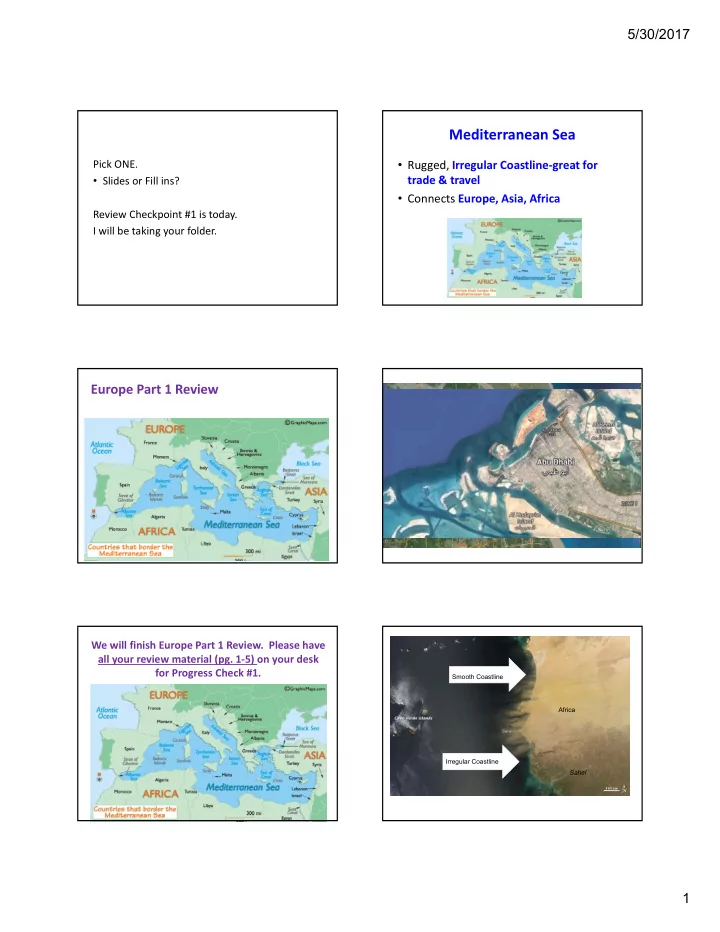
Mediterranean Sea

  • Rugged, Irregular Coastline‐great for

trade & travel

  • Connects Europe, Asia, Africa

Irregular Coastline

  • An irregular coastline has multiple natural harbors

along it. This feature has both positive and negative effects. An example of a positive effect would be in the case

  • f the British Islands which have natural harbors all

along their coast. This feature allowed them to develop a strong Navy, trade and created a culturally diffuse population. A negative effect can be seen in the case of both North & South America, both of which have lots

  • f natural harbors. This provided easy access to the

land for Europeans who would explore and ultimately conquer both of the continents.

Smooth Coastline Irregular Coastline Africa Sahel

slide-2
SLIDE 2

5/30/2017 2

Regular (Smooth) Coastline

  • Regular coastlines have few to

no natural harbors. This is a barrier effect with both positive and negative

  • consequences. Africa has a

regular coastline. A positive effect of this was that it was difficult to invade Africa by

  • sea. A negative effect was that

Sub‐Saharan Africa remained isolated from the rest

  • f the world for many centuries.

Ancient Greece

1750‐133 B.C.E.

Geography

  • Mountainous
  • Isolated valleys
  • Small islands
  • Prevented Greeks from

building a large, unified empire.

  • City‐states were formed.

We are like frogs who live on the side of a pond…

The Rise of Greek City‐States

  • Polis‐ A Greek city‐state with two parts:
  • Hilltop acropolis with marble temples to the

gods and the main city, within the wall.

  • This area includes the marketplace, theater,

public areas and homes.

Sparta

  • Warrior society.
  • Monarchy with two kings.
  • Trade and travel not allowed.
  • Boys trained from early age for the military.
  • Girls physically fit to have healthy babies.
  • Women can own property.
  • Lie, Cheat and Steal, but don’t get caught.

Athens

  • Pericles‐wise ruler
  • Direct democracy‐ free men voted and took

part in government.

  • Education for boys only.
  • Traded with other city‐states.
  • Loved the arts, philosophy, science, etc…
  • Women were inferior

Athens & Sparta

  • Common Greek language.
  • Shared heroes.
  • Olympic games.
  • Same gods.
slide-3
SLIDE 3

5/30/2017 3 Alexander the Great and the Hellenistic Age

  • Great conqueror who built an empire from

Greece, Egypt, Persia and India (PIGE).

  • Spread Greek culture and a new Hellenistic

culture arose that blended Greek, Egyptian, Persian and Indian life.

Greek & Hellenistic Contributions

  • Philosophers: “Lovers of Wisdom”
  • Olympics
  • Homer wrote The Iliad and The Odyssey
  • Pythagorean Theory & Geometry
  • Hippocratic Oath for doctors
  • Parthenon
  • Columns

Greek Philosophers (SPA)

Believed people learned through reason Divided society into three classes: workers, philosophers, and soldiers Governm ent put him to death for his beliefs-hemlock! Believed one strong and good leader should rule Believed government should control lives

  • f people

Developed Socratic m ethod: learning about beliefs and ideas by asking questions.

Aristotle Plato Socrates

Rome

Geography

  • Rome is located near the center of Italy.
  • Italy is a peninsula located in the

Mediterranean.

  • Italy’s geography helped its people unite.
  • The low Apennine Mountains were not a

natural barrier.

  • Fertile plains helped increase the population.

Rome

~509 B.C.E. – 476 C.E.

  • The Romans established a new form of

government called a Republic, officials chosen by the people.

  • The Senate was a powerful governing body.
  • Veto
  • Senators were members of the landholding

upper class called patricians.

  • The plebeians‐farmers, merchants, artisans

and traders‐ had little power.

Senate

slide-4
SLIDE 4

5/30/2017 4

Rome Expands

  • Rome conquered Italy, Carthage, Macedonia,

Greece and parts of Asia Minor.

  • Corruption led to civil wars. Julius Caesar

came to power in 48 B.C.E. and made new conquests and reforms. He was killed on the “Ides of March” by the Senators for trying to take away their power.

Roman Empire

  • Augustus Caesar ruled with absolute power

and ended the Roman Republic.

  • Pax Romana‐ Roman Peace for 200 years.

Roman Contributions

  • Law‐ system of laws that applied to all people.

Innocent until proven guilty and equality under the law.

  • Laws of the Twelve Tables‐ inscribed Roman

laws on 12 tablets & displayed in the marketplace…. Give plebeians more rights.

Roman Contributions

  • Latin language
  • Roads‐ to help soldiers unify the empire.
  • Aqueducts‐ carried water from the hills to the

cities.

  • Archways and domes.

Reasons for the Fall of Rome

  • Military Causes‐ Germanic invaders from the

north‐Attila the Hun

  • Economic Causes‐Heavy taxes, slave labor.
  • Political Causes‐ Corrupt officials & weak,

divided Empire.

  • Social Causes‐ Population decline due to

disease and war, lazy and selfish people.

  • Bread and Circuses

Byzantine Empire

  • As the western half of the Roman Empire

declined, the eastern half was strong for another 1,000 years

  • Emperor Constantine built a new capital in

Constantinople, a peninsula. Its central location became a key trading route to link Europe and Asia.

slide-5
SLIDE 5

5/30/2017 5

Justinian’s Code of Law

  • Emperor Justinian had a team of scholars

gather and organize the ancient laws of Rome.

  • By the 1,100’s, the Law Code had reached

Western Europe, where it became the basis of law for the Roman Catholic Church and medieval rulers, and international law today.

Byzantine Contributions

  • Hagia Sophia‐ church of “Holy Wisdom”
  • Mosaics‐ pictures or designs formed by small

pieces of stone.

  • Eastern Orthodox Church‐ formed due to the

schism (permanent split) with the R.C.C.

  • Cyrillic Alphabet
  • Onion dome architecture

The Fall of the Byzantine Empire

  • In 1453, the Ottoman’s captured

Constantinople and overthrew the Byzantine Empire.

  • The Ottoman’s changed the city’s name to

Istanbul and made it the capital of their Muslim empire.

Russia & Eastern Europe

  • The Byzantines influenced Russia & Eastern

Europe:

  • Cyrillic Alphabet
  • Russian Orthodox Church
  • Autocratic Ruler = Czar/ Tsar (Caesar)
  • Onion Dome Architecture

Medieval Europe

~500 – 1,400 C.E.

  • The Germanic people who invaded the Roman

empire were warriors, farmers and herders.

  • The Franks emerged as the most powerful

warrior tribes in Gaul, or present‐day France.

  • During the 800’s, Charlemagne, a Frankish

king, built an empire that stretched from France, Germany and part of Italy.

Charlemagne

  • Charles the Great
  • Crowned the Holy Roman Emperor by the

Pope of the R.C.C.

  • Bright Light in a Dark Age
  • Set up schools and libraries
  • Empire fell apart when he died.
slide-6
SLIDE 6

5/30/2017 6

Feudalism & Medieval Society

  • During the early part of the Middle Ages, kings

were too weak to keep invaders out of their kingdoms.

  • People began to leave towns and band

together in the countryside for protection and survival.

  • Everyone had a well‐defined place in society

that they were born in to.

Feudalism

  • A loosely structured political system in which

powerful lords (nobles) owned large sections of land.

  • They divided their land into estates called fiefs,

which were given to lesser lords called vassals.

  • Vassals pledged their loyalty and military support

to their lords in return for land.

  • Knights, or mounted warriors, were bound by a

code of chivalry.

Manorialism

  • Economic system based on the lord’s manor,
  • r estate. They are self‐sufficient and

everyone knew their place and responsibilities.

  • Serf, or peasants, were bound to the land.

The Roman Catholic Church

  • During the Middle Ages, the R.C.C. had two

roles, secular (worldly) and religious.

  • The Church was the largest landholder in

Europe and gained wealth through tithe (10%

  • f income tax). It had a court system and

could excommunicate (kick out) anyone from the R.C.C. (even Kings!)

Jews in Medieval Europe

  • Many Jewish communities existed throughout

Europe (diaspora). Most Christians persecuted Jews.

  • The Church barred Jews from owning land,

blamed the Jews for the death of Jesus, disease, etc. until the Jews became the scapegoats for all misfortune.

  • Anti‐Semitism‐ prejudice against Jews.

Gothic Architecture

  • Pointed arches and flying buttresses, stone

supports that stood outside the cathedral.

  • Huge stained glass windows with Bible stories

for the illiterate people.

slide-7
SLIDE 7

5/30/2017 7

Crusades

Holy Wars

  • Pope Urban II called for a Holy War to regain

Palestine (Holy Land) from the Seljuk Turks (Muslims).

  • Reasons: increase the Popes power, Christians

sins will be forgiven, gain wealth, travel and excitement and serfs want to escape.

  • Results: The Christians never regained the Holy

Land, Cultural Diffusion and religious hatred.

The Black Death

Bubonic Plague

  • Epidemic, or outbreak of a highly contagious

disease spread by fleas on rats on trade routes from China to Europe.

  • Result: 1/3 of the population died, economic

decline, authority of R.C.C. questioned, feudalism ended as peasants who lived revolted against landowners and demanded a higher wage.

Commercial Revolution

  • New “middle class”.
  • Merchants and craftspeople formed guilds

(unions) to keep prices & quality high.

  • Capitalism (money for investment), supply

and demand, profit or loss.

  • Banking and money lending at interest.
  • Insurance

Renaissance‐Rebirth

  • Humanism‐ a new way of thinking, worldly

subjects, reason and individual achievements.

  • Leonardo da Vinci‐ Mona Lisa, Last Supper
  • Michelangelo‐ painted Bible scenes on the

ceiling of the Sistine Chapel, David

  • Machiavelli‐ The Prince, “the ends justify the

means”. “better to be feared than loved”.

Printing Press

  • Johann Gutenburg invented the printing

press.

  • The Bible
  • Books became cheaper & easier to make.
  • Literacy increased.
  • Ideas spread rapidly.

Protestant Reformation

  • Causes: Humanism & corruption in the R.C.C.
  • Martin Luther, a German monk, posted the 95

Theses (complaints) against the R.C.C. on church door.

  • Sale of Indulgences
  • Salvation through faith and good acts.
  • Translated Bible into German.
  • Ended Christian unity, started new Protestant

church‐ Lutheran

slide-8
SLIDE 8

5/30/2017 8

Age of Absolutism

  • Absolutism‐ autocratic rulers had complete

authority over the government and the lives

  • f the people in their nation.
  • King Philip II of Spain believed in…
  • Divine Right‐ The right to rule comes from

God.

Age of Absolutism

  • King Louis XIV (14) of France‐ “The Sun King”, built

Palace of Versailles, strongest army in Europe, persecuted the Protestant Huguenots, put France in debt…led to French Revolution.

  • Czar Peter the Great of Russia‐ westernized and

modernized, beard tax, co‐ed dance parties, built St. Petersburg as “Window to the West” on a swamp.

  • Czarina Catherine the Great of Russia‐ Enlightened

Despot, gained warm‐water port on the Black Sea

Great Britain

  • Magna Carta‐ 1215 limited the king’s power.
  • English Bill of Rights 1689‐ Parliament has

more power than the king.

  • Result:
  • Limited Monarchy‐ government where a

legislative body limits the monarch’s power.

Enlightenment Philosophers

  • John Locke‐ people have natural rights that

include life, liberty & property.

  • Baron de Montesquieu‐ 3 branches of

government; judicial, legislative & executive. Checks and balances

  • Voltaire‐ Freedom of Speech
  • Influenced the American, French & Latin

American Revolutions.

French Revolution

  • Causes:
  • Inequalities of the 3 Estates.
  • 3rd Estate paid all the taxes and had No power.
  • Absolute monarchy of Louis XVI (16).
  • Huge Debt from foreign wars and Palace of

Versailles.

  • Harsh winter led to bad wheat harvest and bread

was too expensive.

French Revolution Effects

  • Tennis Court Oath‐ National Assembly writes

a new Constitution, the Declaration of the Rights of Man and the Citizen.

  • Reign of Terror & Robespierre‐ King Louis XVI

killed by the guillotine, Radical group the Jacobins use “terror” to kill enemies of the Revolution.

  • Napoleon overthrew the government with a

coup d’etat.

slide-9
SLIDE 9

5/30/2017 9

Napoleon

  • Napoleon declared himself Emperor
  • He tried to take over all of Europe.
  • Napoleonic Codes‐ legal equality of

citizens & religious toleration. Napoleon invaded Russia

  • The Russian Winter (cold) destroyed his

army

Napoleon

  • Scorched Earth Policy. French army retreated

and lost 500,000 soldiers.

  • Napoleon exiled, escaped, defeated at the

Battle of Waterloo, exiled a second time.

  • Congress of Vienna‐ put legitimate monarchs

back in power and establish a favorable balance of power.