Medical Complex. female patients from INMOL Cancer Hospital and Sir - - PDF document

medical complex
SMART_READER_LITE
LIVE PREVIEW

Medical Complex. female patients from INMOL Cancer Hospital and Sir - - PDF document

Proceeding S.Z.P.G.M.I. Vol: 31(2): pp. 111-119, 2017 Pattern and Socio-Demographic Determinants of presentation of Breast Cancer Muhammad Zaeem Khalid 1 , Maria Azim 1 , Noor Haroon 1 , Aneeza Irfan 1 , Mohammad Hamza Khan 1 , Mehro Mashhadi 1 ,


slide-1
SLIDE 1

Proceeding S.Z.P.G.M.I. Vol: 31(2): pp. 111-119, 2017

Pattern and Socio-Demographic Determinants of presentation of Breast Cancer

Muhammad Zaeem Khalid1, Maria Azim1, Noor Haroon1, Aneeza Irfan1, Mohammad Hamza Khan1, Mehro Mashhadi1, Muhammad Imran Anwar2, Ayesha Humayun1

1 Department of Public Health and Community Medicine, Shaikh Khalifa Bin Zayed Al-Nahyan Medical and

Dental College, Shaikh Zayed Post Graduate Medical Institute, Shaikh Zayed Medical Complex, Lahore.

2 Department of Surgery, Shaikh Khalifa Bin Zayed Al-Nahyan Medical and Dental College, Shaikh Zayed

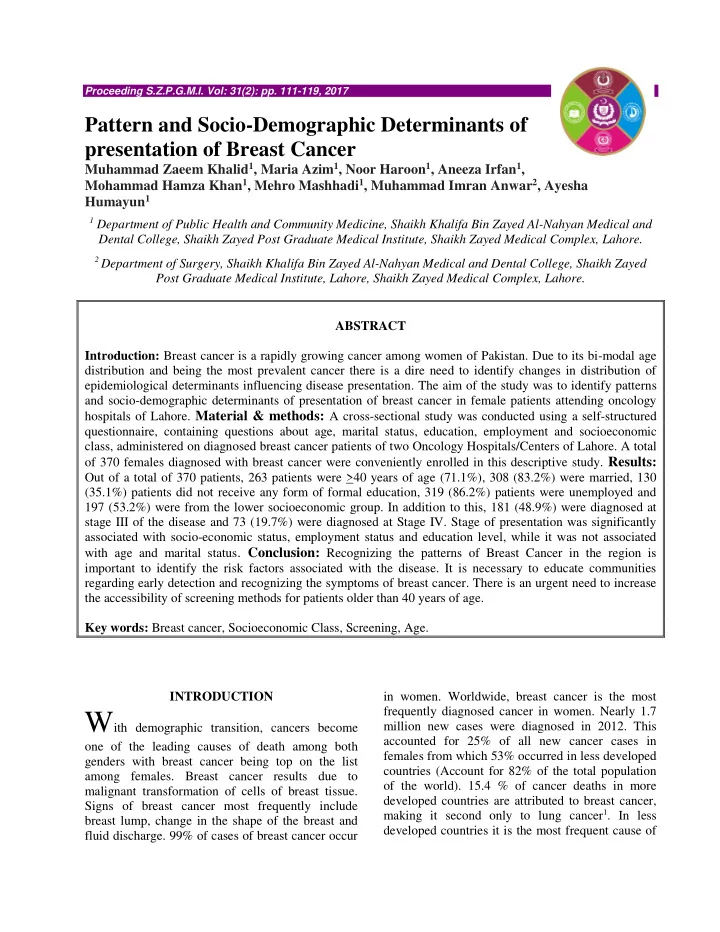
Post Graduate Medical Institute, Lahore, Shaikh Zayed Medical Complex, Lahore. ABSTRACT Introduction: Breast cancer is a rapidly growing cancer among women of Pakistan. Due to its bi-modal age distribution and being the most prevalent cancer there is a dire need to identify changes in distribution of epidemiological determinants influencing disease presentation. The aim of the study was to identify patterns and socio-demographic determinants of presentation of breast cancer in female patients attending oncology hospitals of Lahore. Material & methods: A cross-sectional study was conducted using a self-structured questionnaire, containing questions about age, marital status, education, employment and socioeconomic class, administered on diagnosed breast cancer patients of two Oncology Hospitals/Centers of Lahore. A total

  • f 370 females diagnosed with breast cancer were conveniently enrolled in this descriptive study. Results:

Out of a total of 370 patients, 263 patients were >40 years of age (71.1%), 308 (83.2%) were married, 130 (35.1%) patients did not receive any form of formal education, 319 (86.2%) patients were unemployed and 197 (53.2%) were from the lower socioeconomic group. In addition to this, 181 (48.9%) were diagnosed at stage III of the disease and 73 (19.7%) were diagnosed at Stage IV. Stage of presentation was significantly associated with socio-economic status, employment status and education level, while it was not associated with age and marital status. Conclusion: Recognizing the patterns of Breast Cancer in the region is important to identify the risk factors associated with the disease. It is necessary to educate communities regarding early detection and recognizing the symptoms of breast cancer. There is an urgent need to increase the accessibility of screening methods for patients older than 40 years of age. Key words: Breast cancer, Socioeconomic Class, Screening, Age. INTRODUCTION

With demographic transition, cancers become

  • ne of the leading causes of death among both

genders with breast cancer being top on the list among females. Breast cancer results due to malignant transformation of cells of breast tissue. Signs of breast cancer most frequently include breast lump, change in the shape of the breast and fluid discharge. 99% of cases of breast cancer occur in women. Worldwide, breast cancer is the most frequently diagnosed cancer in women. Nearly 1.7 million new cases were diagnosed in 2012. This accounted for 25% of all new cancer cases in females from which 53% occurred in less developed countries (Account for 82% of the total population

  • f the world). 15.4 % of cancer deaths in more

developed countries are attributed to breast cancer, making it second only to lung cancer1. In less developed countries it is the most frequent cause of

slide-2
SLIDE 2

Muhammad Zaeem Khalid et al.

112 death in women constituting 14.3% of the total2. In the developing regions of the world, the incidence

  • f breast cancer is on the rise owing to various

factors such as improved screening, rising obesity, sedentary lifestyles and smoking, older age at first birth, shorter duration of breastfeeding and a lot more3,4. Only 5-10% of all breast cancer cases are due to inherited gene defects including BRCA1 and

  • BRCA25. There is no National Cancer Registry in

Pakistan and most of the available epidemiological data on cancer is provincial. The Punjab Cancer Registry (PCR) reports that Breast cancer is the most common cancer among women in the province, accounting for 43.9% of all cancers reported in 20146. 36% of cancer related deaths in females in Lahore are attributed to breast cancer7. The average age at presentation in Pakistan is 47+12

  • years8. In the US, fewer than 5% cases of breast

cancer occur in women younger than 40 years of

  • age9. Previous studies in Pakistan have reported a

link between lower socioeconomic status and lower education levels with diagnosis of breast cancer at an advanced stage10,11. In the US, 61.4% of cases are diagnosed at localized stage (stage 1) and only 2% cases present with metastatic disease (stage 4)12. This is in contrast to many studies done in Pakistan in which metastatic disease can account for up to 36% of breast cancer cases at presentation8,13,14,. Pakistan is one of the high burden countries for breast cancer and showed a changing epidemiology

  • ver the last decades. The objective of this study is

to describe the pattern and socio-demographic determinants of breast cancer presentation in the female patients from INMOL Cancer Hospital and Sir Ganga Ram Cancer Hospital, Lahore, Pakistan. MATERIAL AND METHODS This is a cross-sectional epidemiological study conducted at the outpatient departments and

  • ncology ward of INMOL Cancer Hospital and Sir

Ganga Ram Hospital, Lahore over a period of 6 months between February to July 2016. All histologically diagnosed breast cancer female patients attending OPDs or indoors of the oncology centers were our study population. Out of these females, we enrolled 370 through simple random sampling (draw method) after making a sampling frame from each day's OPD registers and indoor admission registers. Eligible females were enrolled after taking written informed consent. Sample size was calculated using sample size calculators for single proportion. Pregnant patients and those patients whose diagnoses were concealed from them by their family were excluded from the study. A self-constructed, structured questionnaire containing questions about Age, Marital Status, Education, Employment and Socioeconomic class was first translated into Urdu and then back to English to ensure coherency, understanding and validity. The final Urdu version was used in the interview process. As reported in Government of Pakistan Economic Survey of Pakistan-2001-2, Islamabad, Ministry of Finance, June (2002): Socioeconomic status is a function of annual household income, with US$<500 = Low, US$500-1000 = Middle, US$>1000=High)11. The TNM stage at which cancer was diagnosed was recorded from the patient’s file. Staging of breast cancer was based on AJCC TNM system of

  • classification. Advanced stage breast cancer was

defined as cancer of stages 2b, 2c, 2d, 3 and 415. All

  • ther stages were taken as early stage breast cancer.

Ethical issues were considered and addressed. Written informed consent obtained along with permission from INMOL and Sir Ganga Ram Hospital to conduct the study, maintaining confidentiality of data and patient information. Forms were kept anonymous. Formal ethical clearance was taken from IRB of Shaikh Zayed Medical Complex. Statistical analysis Statistical Package of Social Sciences Version 23 was used for data analysis and compilation.. All data input was carried out by the authors themselves and the data was double checked for consistency

slide-3
SLIDE 3

Pattern and Socio-Demographic Determinants of Presentation of Breast Cancer

Category Groups N % Age <40 107 28.9 >40 263 71.1 Marital Status Married 318 85.9 Unmarried 16 4.3 Divorced 4 1.1 Widowed 32 8.6 Level of Education Uneducated 130 35.1 Primary Level (Less than 5 years) 36 9.7 Middle (Less than 9 years) 37 10 Matric / O levels 64 17.3 F.A / F.S.c 32 8.6 University 71 19.2 Employment Status Employed 45 12.2 Unemployed 319 86.2 Retired 6 1.6 Socio-economic Status Upper Class 20 5.4 Middle Class 153 41.4 Lower Class 197 53.2

Table 1: Distribution of socio-demographic factors among breast cancer females RESULTS Out of the total of 370 patients, 107 were <40 years (28.9%) and the remaining 263 patients were diagnosed at >40 years of age (71.1%). 308 (83.2%) were married, 16 (4.3%) were unmarried, 32 (8.6%) were widowed and only 4 (1.1%) were divorced. Education level of patients showed an interesting trend with 130 (35.1%) patients being uneducated, 36 (9.7%) women had an education till the primary level, 37 (10.0%) studied till less than 9 years, 64 (17.3%) of them till Matric/O levels, 32 (8.6%) patients till F.A/FSc and 71 were graduates from a university (19.2%). 319 (86.2%) patients were unemployed, only 45 (12.2%) of them were employed and 6 (1.6%) patients had retired from their jobs. 197 (53.2%), a considerable majority of patients were from the lower SEC, 153 (41.4%) patients were from the middle class while only 20 (5.4%) of them were from the upper class. Socio- demographics of breast cancer are also given in Table 1. Only 9 (2.4%) patients interviewed were diagnosed at stage 1 of the disease with the largest number of people being diagnosed at stage 3 (181/370 - 48.9%)

  • f the disease. A detailed description of the stage at

diagnosis is given in Table 2. In summary, 280 patients (75.7%) were diagnosed at an advanced stage (2b, 2c, 2d, 3 and 4) while the remaining, only 90 patients, (24.3%) were diagnosed at an early stage of the disease. Refer to Diagram 1 for a breakdown of stage-wise presentation.

Staging N %age 1A 5 1.4 1B 4 1.1 IIA 81 21.9 IIB 26 7 IIIA 64 17.3 IIIB 82 22.2 IIIC 35 9.5 IV 73 19.7 Total 370 100

Table 2: Stage-wise presentation of breast cancer at the time of diagnosis Distribution of different socio-demographic factors with TNM staging at the time of diagnosis in breast cancer females is given in Table 3. Association of socio-demographic factors with early and advanced stage of presentation at the time of diagnosis in breast cancer females is given in Table 4. Stage of presentation was significantly associated with socio-

slide-4
SLIDE 4

Muhammad Zaeem Khalid et al.

Category Groups 1A 1B IIA IIB IIIA IIIB IIIC IV Total Age <40 25 5 23 19 7 28 107 >40 5 4 56 21 41 63 28 45 263 Total 5 4 81 26 64 82 35 73 370 Marital Status Married 5 76 22 57 66 32 60 318 Unmarried 4 1 3 8 16 Divorced 1 2 1 4 Widowed 4 1 2 2 8 2 13 32 Total 5 4 81 26 64 82 35 73 370 Level of Education Uneducated 20 2 24 32 13 39 130 Primary Level (Less than 5 years) 3 5 9 9 5 5 36 Middle (Less than 9 years) 6 5 9 6 4 7 37 Matric / O levels 5 4 9 3 9 8 5 21 64 F.A / F.S.c 6 2 3 13 8 32 University 37 9 10 12 2 1 71 Total 5 4 81 26 64 80 37 73 370 Employment Status Employed 19 5 8 8 2 3 45 Unemployed 5 4 60 21 56 70 33 70 319 Retired 2 4 6 Total 5 4 81 26 64 82 35 73 370 Socio- economic Status Upper Class 9 3 3 1 1 3 20 Middle Class 5 49 12 24 34 15 14 153 Lower Class 4 23 11 37 47 19 56 197 Total 5 4 81 26 64 82 35 73 370

Table 3: Socio-demographic factors with TNM staging at the time of diagnosis in breast cancer females

slide-5
SLIDE 5

Pattern and Socio-Demographic Determinants of Presentation of Breast Cancer 115

Category Groups Early stage presentation Advanced stage presentation P-value Age <40 25(23.4%) 82(76.6%) 0.387 >40 65(24.7%) 198(75.3%) Total 90(24.3%) 280(75.7%) 370 Marital Status Married 81(25.5%) 237(74.5%) 0.831 Unmarried 4(25%) 12(75%) Divorced 0(0.0%) 4(100%) Widowed 5(15.6%) 27(84.4%) Total 90(24.3%) 280(75.7%) 370 Level of Education Uneducated 20(15.4%) 110(84.6%) 0.000 Primary Level (Less than 5 years) 3(8.3%) 33(91.6%) Middle (Less than 9 years) 6(16.2%) 31(83.8%) Matric / O levels 18(28.1%) 46(71.9%) F.A/ / F.Sc 6(18.8%) 26(81.3%) University 37(52.1%) 34(47.9%) Total 90(24.3%) 280(75.7%) 361 Employment Status Employed 19(42.2%) 26(57.8%) 0.042 Unemployed 69(21.6%) 250(78.4%) Retired 2(33.3%) 4(66.7%) Total 90(24.3%) 280(75.7%) 370 Socio- economic Status Upper Class 9(45.0%) 11(55.0%) 0.000 Middle Class 54(35.3%) 99(64.7%) Lower Class 27(13.7%) 170(86.3%) Total 90(24.3%) 280(75.7%) 370

Table 4: Association of socio-demographic factors with early and advanced stage of presentation at the time of diagnosis in breast cancer females

slide-6
SLIDE 6

Muhammad Zaeem Khalid et al.

economic status, employment status and education level, while it was not associated with age and marital status. It was found that low socioeconomic group, unemployed and illiterate females presented with advanced stage significantly more than others. Figure 1: Stage-wise presentation of breast cancer at the time of diagnosis Figure 2: Age comparison of breast cancer patients in Pakistan and the UK Source: Breast cancer statistics [Internet]. Cancer Research UK. 2015 [cited 14 August 2016].

Figure 3: Comparison of stages at presentation in Pakistan and the UK Source: Breast cancer statistics [Internet]. Cancer Research UK. 2015 [cited 14 August 2016].

DISCUSSION In their cross-sectional study

  • f

cancer epidemiology in Lahore, Badar F, Mahmood S, Yusuf MA, et al reported that breast cancer has the highest Age-Standardized Incidence Rates (ASIRs) among women at 47.6%, followed by cancer of the

  • vary at 4.9%7.

In women belonging to the Lahore district, the ASIR of breast cancer ranked the highest of all the cancers at 47.6%, and was higher than that for Delhi (31.6%), but relatively low compared to that reported for the Israeli Jews (89.4%)6. The average age at presentation in Pakistan is 47 + 12 years8. In this study, 71.1% of participants were >40 while in the UK 96% of female patients of Breast Cancer were >40 at presentation (See Diagram 2). In the US, fewer than 5% cases of breast cancer occur in women younger than 40 years

  • f age9. In more developed countries, 58% of newly

diagnosed cancer cases occur at >65 years of age, while this age group comprises only 40% of new cases in developing countries. This is due in part to the fact that developing countries have a greater proportion

  • f

younger individuals in their

  • population1. 76.6% of women who were <40

presented with advanced stage disease (Refer to Table 4). This may be due to social stigmas associated with breast cancer, and fear of neglecting

slide-7
SLIDE 7

Pattern and Socio-Demographic Determinants of Presentation of Breast Cancer 117

family responsibilities due to treatment that many women harbor. It is important to note that most of the cases of breast cancer in Pakistani females present with advanced stage disease. 19.7% percent of the cases in our study presented with metastatic cancer, at Stage 4. This is in wide contrast to the trend in the US, where metastatic disease accounts for only 2%

  • f cases at presentation, and the UK where it

accounts for 5% of cases at presentation16 (Refer to Diagram 3). This is largely because of the emphasis

  • n early screening in western healthcare systems,

given that it is a part of routine medical check-ups for women above 40 years of age to have an annual mammography done to detect cancer in its early stages along with breast clinical and self- examination. As a result, most women are diagnosed incidentally

  • r because they immediately go to the doctor upon

detection of a lump. Here in Pakistan, there is hesitancy among women to discuss breast-related symptoms, and many women harbor breast lumps in silence and are only inclined to visit the doctor if and when a close relative or friend supports them. 53.2% of patients who presented belonged to the lower SEC, out of these 170 (60.7%) presented with advanced disease, suggesting a positive association between lower SEC and advanced disease (Refer to Table 4). This is not surprising as nearly one-third

  • f the population in Pakistan is below the poverty
  • line17. Many Pakistanis cannot afford the basic

necessities of food, housing and clothes and the quality of healthcare available to most is subpar. According to UNESCO, Pakistan has one of the lowest literacy rates in the world at 55%, while only 26% of girls and 12% of women are literate18. 34.9% of the participants of the study were thus uneducated and 10.3 % had received education till the primary level while 19.2% had university level

  • education. 84.6% of the uneducated patients who

presented had advanced disease in contrast to only 47.9% people who had received university level education presenting late. CONCLUSION The incidence of breast cancer in Pakistan has seen an alarming rising trend over the years. Though this could simply be attributed to more hospitals and a slowly but surely improving healthcare system, it is important to recognize the risk factors associated with Breast Cancer in our region and educate communities regarding early detection and recognizing the symptoms. There is a need to increase awareness of basic cancer screening and make mammography available and affordable to women from all strata of society for earlier detection

  • f cases. There is a need to establish a National

Cancer Registry to follow the epidemiological trends of breast cancer and assess the disease burden in our region and compare it with other regions of the world. It is only after an accurate estimate of this data is reached that the Public Health Sector can move towards catering to the needs of breast cancer patients in an effective and efficient manner REFERENCES 1. Global Cancer Facts & Figures [Internet]. 3rd

  • ed. Atlanta, Georgia: American Cancer

Society; 2015 [cited 14 August 2016]. Available from: http://www.cancer.org/acs/groups/content/@r esearch/documents/document/acspc- 044738.pdf 2. GLOBOCAN Cancer Fact Sheets: Breast cancer [Internet]. Globocan.iarc.fr. 2016 [cited 14 August 2016]. Available from: http://globocan.iarc.fr/old/FactSheets/cancers/ breast-new.asp 3. Key, T. J., et al. "Epidemiology of breast cancer." The Lancet Oncology 2(3): 133-140. 4. Jemal A, Center M, DeSantis C, Ward E. Global Patterns of Cancer Incidence and Mortality Rates and Trends. Cancer Epidemiology Biomarkers & Prevention. 2010;19(8):1893-1907. 5. "BRCA1 & BRCA2: Cancer Risk & Genetic Testing". National Cancer Institute. N.p.,

  • 2016. Web. 14 Aug. 2016

6. Punjab Cancer Registry Report 2-2014 [Internet]. 1st ed. Lahore: Central Office at SKMCH and Research Centre; 2016 [cited 14 August 2016]. Available from: http://www.punjabcancerregistry.org.pk/repor ts/PCR2_2014.pdf

slide-8
SLIDE 8

Muhammad Zaeem Khalid et al.

118 7. Badar F, Mahmood S, Yusuf MA, et al. Epidemiology of cancers in Lahore, Pakistan, 2010– 2012: a cross-sectional study. BMJ Open 2016;6: e011828. doi:10.1136/ bmjopen-2016-011828 8. Khokher S, Qureshi MU, Riaz M, Akhtar N, Saleem A. Clinicopathologic profile of breast cancer patients in Pakistan: ten years data of a local cancer hospital. Asian Pacific Journal of Cancer Prevention. 2012;13(2):693-8. 9. American Cancer Society. Breast Cancer Facts and Figures 2015-2016. Atlanta, GA: American Cancer Society, 2015 [cited 14 August 2016]. Available from: http://www.cancer.org/acs/groups/content/@r esearch/documents/document/acspc- 046381.pdf 10. Siegel R, et al. "Cancer Statistics, 2011: The Impact Of Eliminating Socioeconomic And Racial Disparities On Premature Cancer

  • Deaths. - Pubmed - NCBI". Ncbi.nlm.nih.gov.

N.p., 2016. Web. 14 Aug. 2016. 11. Aziz Z, Sana S, Akram M, Saeed A. Socioeconomic status and breast cancer survival in Pakistani women. J Pak Med

  • Assoc. 2004 Sep;54(9):448-53.

12. "Cancer Of The Breast (Female) - SEER Stat Fact Sheets". Seer.cancer.gov. N.p., 2016.

  • Web. 14 Aug. 2016.

13. Khokher S, Qureshi MU, Mahmood S, Sadiq

  • S. Determinants of Advanced Stage at Initial

Diagnosis of Breast Cancer in Pakistan: Adverse Tumor Biology vs Delay in

  • Diagnosis. Asian Pacific Journal of Cancer
  • Prevention. 2016;17(2):759-65.

14. Shaheen G, Arshad M, Shamim T, Shah SM, Ansari KA, Asif HM, Akram M, Mohiuddin E, Ayaz S. Prevalence of breast cancer in

  • punjab. The Internet Journal of Public Health.

2010;1(1). 15. Lannin DR, Mathews HF, Mitchell J, Swanson MS, Swanson FH, Edwards MS. Influence of Socioeconomic and Cultural Factors on Racial Differences in Late-Stage Presentation of Breast Cancer. JAMA. 1998;279(22):1801-1807. doi:10.1001/jama.279.22.1801. 16. Cancer Research UK, http://www.cancerresearchuk.org/health- professional/cancer-statistics/statistics-by- cancer-type/breast-cancer/incidence-invasive, Accessed 8 2016

17.

Poverty and Social Safety nets [Internet]. 1st

  • ed. Islamabad: Pakistan Economic Survey;

2015 [cited 14 August 2016]. Available from: http://finance.gov.pk/survey/chapters_14/15_ Poverty_Social_Safety_Nets.pdf

18.

Latif A. UNESCO - Education for All - Knowledge sharing - Grassroots stories - Pakistan [Internet]. Unesco.org. [cited 14 August 2016]. Available from: http://www.unesco.org/education/efa/know_s haring/grassroots_stories/pakistan_2.shtml The Authors:

Muhammad Zaeem Khalid

Department of Public Health and Community Medicine, Shaikh Khalifa Bin Zayed Al-Nahyan Medical and Dental College, Shaikh Zayed Post Graduate Medical Institute, Lahore, Shaikh Zayed Medical Complex, Lahore.

Maria Azim

Department of Public Health and Community Medicine, Shaikh Khalifa Bin Zayed Al-Nahyan Medical and Dental College, Shaikh Zayed Post Graduate Medical Institute, Lahore, Shaikh Zayed Medical Complex, Lahore.

Noor Haroon

Department of Public Health and Community Medicine, Shaikh Khalifa Bin Zayed Al-Nahyan Medical and Dental College, Shaikh Zayed Post Graduate Medical Institute, Lahore, Shaikh Zayed Medical Complex, Lahore.

Aneeza Irfan

Department of Public Health and Community Medicine, Shaikh Khalifa Bin Zayed Al-Nahyan Medical and Dental College, Shaikh Zayed Post Graduate Medical Institute, Lahore, Shaikh Zayed Medical Complex, Lahore.

slide-9
SLIDE 9

Pattern and Socio-Demographic Determinants of Presentation of Breast Cancer 119

Muhammad Hamza Khan

Department of Public Health and Community Medicine, Shaikh Khalifa Bin Zayed Al-Nahyan Medical and Dental College, Shaikh Zayed Post Graduate Medical Institute, Lahore, Shaikh Zayed Medical Complex, Lahore.

Mehro Mashhadi

Department of Public Health and Community Medicine, Shaikh Khalifa Bin Zayed Al-Nahyan Medical and Dental College, Shaikh Zayed Post Graduate Medical Institute, Lahore, Shaikh Zayed Medical Complex, Lahore.

  • Dr. Muhammad Imran Anwar

Associate Professor

Department of Surgery, Shaikh Khalifa Bin Zayed Al-Nahyan Medical and Dental College, Shaikh Zayed Post Graduate Medical Institute, Lahore, Shaikh Zayed Medical Complex, Lahore

  • Dr. Ayesha Humayun

Professor and Head of Department of Public Health and Community Medicine, Shaikh Khalifa Bin Zayed Al-Nahyan Medical and Dental College, Shaikh Zayed Post Graduate Medical Institute, Lahore, Shaikh Zayed Medical Complex, Lahore Corresponding Author:

Muhammad Zaeem Khalid1

Department of Public Health and Community Medicine, Shaikh Khalifa Bin Zayed Al-Nahyan Medical and Dental College, Shaikh Zayed Post Graduate Medical Institute, Lahore, Shaikh Zayed Medical Complex, Lahore Email: m.zaeemkhalid@gmail.com