Measuring Program Effectiveness: Hewson J, Lackeyram D, Lissemore K. - - PDF document

measuring program effectiveness
SMART_READER_LITE
LIVE PREVIEW

Measuring Program Effectiveness: Hewson J, Lackeyram D, Lissemore K. - - PDF document

Measuring Program Effectiveness: Hewson J, Lackeyram D, Lissemore K. Transforming Program Learning Outcomes Ontario Veterinary College, University of Guelph (PLOs) into a practical measurement tool Measuring Program Effectiveness:


slide-1
SLIDE 1

“Measuring Program Effectiveness: Transforming Program Learning Outcomes (PLOs) into a practical measurement tool”

Hewson J, Lackeyram D, Lissemore K. Ontario Veterinary College, University of Guelph

Learning Outcomes: A Toolkit for Assessment Conference Toronto, Ontario October 16, 2014 1

Measuring Program Effectiveness: Transforming Program Learning Outcomes (PLOs) into a practical measurement tool

Joanne Hewson, Clinical Faculty Dale Lackeyram, Curriculum Specialist Kerry Lissemore, Associate Dean Academic Ontario Veterinary College, University of Guelph

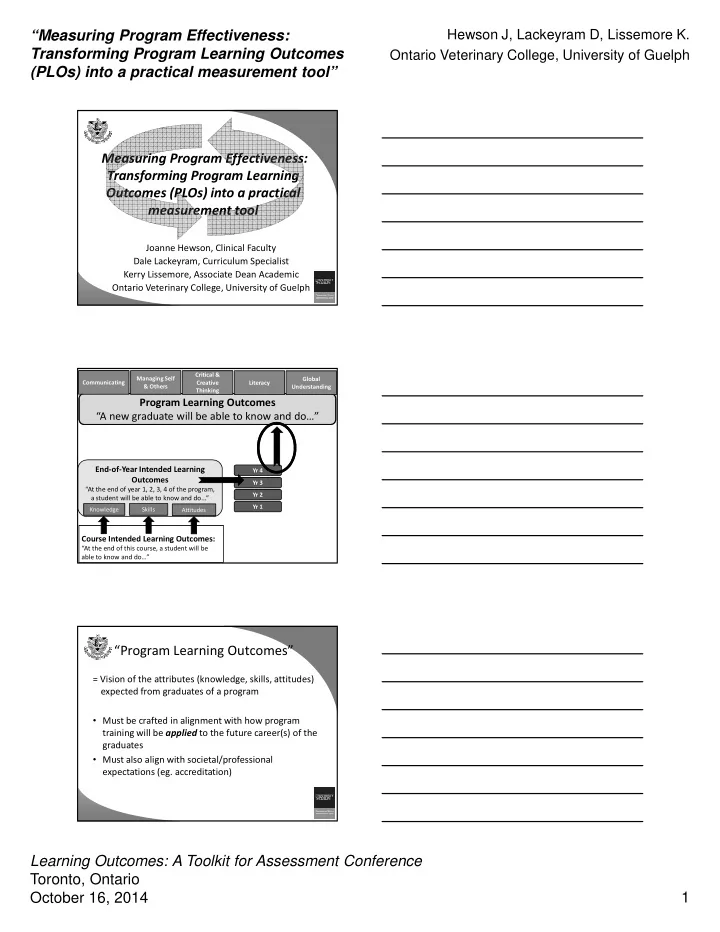
End-of-Year Intended Learning Outcomes

“At the end of year 1, 2, 3, 4 of the program, a student will be able to know and do...”

Yr 4 Yr 3 Yr 2 Yr 1

Course Intended Learning Outcomes:

“At the end of this course, a student will be able to know and do…”

Program Learning Outcomes “A new graduate will be able to know and do…”

Knowledge Skills Attitudes Communicating Managing Self & Others Critical & Creative Thinking Literacy Global Understanding

“Program Learning Outcomes”

= Vision of the attributes (knowledge, skills, attitudes) expected from graduates of a program

  • Must be crafted in alignment with how program

training will be applied to the future career(s) of the graduates

  • Must also align with societal/professional

expectations (eg. accreditation)

slide-2
SLIDE 2

“Measuring Program Effectiveness: Transforming Program Learning Outcomes (PLOs) into a practical measurement tool”

Hewson J, Lackeyram D, Lissemore K. Ontario Veterinary College, University of Guelph

Learning Outcomes: A Toolkit for Assessment Conference Toronto, Ontario October 16, 2014 2

Program Learning Outcomes (PLOs)

Learners Instructors Accreditors Profession Community University Government Administrators

Need to show EVIDENCE of effectively achieving the PLOs

Our plan for today…

  • Introduce the process of creating a behaviorally-

based Universal Assessment Rubric derived from Program Learning Outcomes (PLOs)

  • Discuss how data from this consistent assessment

tool can be used by:

– Learners – Educators – Administrators

Workshop Learning Objectives:

By the end of this workshop, participants will be able to:

  • Adapt existing PLOs into specific competency

statements for assessment

  • Develop behavioral descriptors for an identified

competency

  • Identify a plan for how to integrate a Global

Assessment Rubric tool into student assessment within their program or discipline

slide-3
SLIDE 3

“Measuring Program Effectiveness: Transforming Program Learning Outcomes (PLOs) into a practical measurement tool”

Hewson J, Lackeyram D, Lissemore K. Ontario Veterinary College, University of Guelph

Learning Outcomes: A Toolkit for Assessment Conference Toronto, Ontario October 16, 2014 3

Desirable PLO attributes

(Adapted from Albanese et al, Med Ed. 2008)

The Program Learning Outcomes should:

  • focus on performance throughout, and at the completion of,

the curriculum.

  • reflect the ability to apply what is learned in the program.
  • be stated in terms of measurable behaviour.
  • use a standard for judging competence that is not dependent

upon the performance of other learners.

  • inform learners and other stakeholders about the program

expectations.

Step 1: (Activity)

Create a Program Learning Outcome…

  • On your worksheet, write down an intended PLO

(Program Learning Outcome) for your specific discipline. “At the end of this program, a student will be able to…” (Example: “At the end of this program, a student will be able to communicate effectively.”)

Step 2: (Activity)

Expand your PLO in response to the following questions:

  • When is this outcome used in your discipline?
  • How is it used? (What would that look like?)

Example: “At the end of this program, a student will be able to:

– communicate effectively with clients – communicate effectively with colleagues, and – communicate effectively in written form as medical documentation.”

slide-4
SLIDE 4

“Measuring Program Effectiveness: Transforming Program Learning Outcomes (PLOs) into a practical measurement tool”

Hewson J, Lackeyram D, Lissemore K. Ontario Veterinary College, University of Guelph

Learning Outcomes: A Toolkit for Assessment Conference Toronto, Ontario October 16, 2014 4

Step 3: (Activity)

Select one of your modified outcome statements…

  • List ALL behaviors (sub-skills) that would need to be

demonstrated to perform that outcome statement “At the end of this program, a student will be able to communicate effectively in written form as medical documentation.”

  • Generate complete and accurate documents
  • Document case information systematically
  • Utilize professional language and style
  • Adhere to legislative guidelines for medical records
  • Produce written communications in a timely manner

Step 4: (Activity)

Select one of your sub-skills…

  • Write a sentence describing what a student needs

to demonstrate in order to indicate that they have achieved this sub-skill to the expectations of the program.

Meets graduating entry-level expectations “The student documents case information systematically and logically.”

Step 4: (Activity)

Also…

  • Share this sentence with the person beside you… do

they think they can visualize what that behavior actually looks like based on your choice of words? (Modify the sentence as needed.)

Meets graduating entry-level expectations “The student documents case information systematically and logically using a problem-oriented medical approach.”

slide-5
SLIDE 5

“Measuring Program Effectiveness: Transforming Program Learning Outcomes (PLOs) into a practical measurement tool”

Hewson J, Lackeyram D, Lissemore K. Ontario Veterinary College, University of Guelph

Learning Outcomes: A Toolkit for Assessment Conference Toronto, Ontario October 16, 2014 5

Step 5: (Activity)

For the same sub-skill…

  • Now write a sentence describing what a student

would demonstrate indicating that they have NOT achieved this sub-skill.

Does NOT meets graduating entry-level expectations “The student documents case information but lacks a systematic presentation of the information. The logic is difficult to determine despite questions posed for clarification.“

Step 6: (Activity)

Establish a scale/range of performance…

  • What levels of performance do you want to assess?

Yes, AND Yes Yes, BUT No, BUT No Yes, AND Yes Yes, BUT No Exceeds graduating entry-level expectations Meets graduating entry-level expectations Approaching graduating entry-level expectations Significant improvement needed

Step 7: (Activity)

Complete descriptions for the remaining columns…

  • Ensure that the wording clearly differs

Exceeds graduating entry-level expectations Meets graduating entry-level expectations Approaching graduating entry-level expectations Significant improvement needed

The student documents case information systematically and logically using a problem-oriented medical approach, and conclusions are supported by concise, well

  • rganized

information. The student documents case information systematically and logically using a problem-oriented medical approach. The student documents case information but lacks a systematic presentation of the information. The student documents case information but lacks a systematic presentation of the information. The logic is difficult to determine despite questions posed for clarification.

slide-6
SLIDE 6

“Measuring Program Effectiveness: Transforming Program Learning Outcomes (PLOs) into a practical measurement tool”

Hewson J, Lackeyram D, Lissemore K. Ontario Veterinary College, University of Guelph

Learning Outcomes: A Toolkit for Assessment Conference Toronto, Ontario October 16, 2014 6

Step 8:

  • Repeat the

process until you have generated a row of descriptors for each sub-skill… for each PLO of your program.

Some helpful tips…

ENGAGE your End-Users! … …to help break apart each competency statement (PLO) into the skills required to master that competency

– Based on their expertise in the field of study

…to describe the skills in terms of what they see in the learning environment

– Which behaviors define graduating-level competency? – Which behaviors are common errors? Or indicate excellence?

…to build language that applies across the program What do you anticipate would be the benefits of a Universal Assessment Rubric for:

  • The Learner?
  • The Faculty?
  • The Program?

Benefits of Aligning PLOs and Assessment Rubric

slide-7
SLIDE 7

“Measuring Program Effectiveness: Transforming Program Learning Outcomes (PLOs) into a practical measurement tool”

Hewson J, Lackeyram D, Lissemore K. Ontario Veterinary College, University of Guelph

Learning Outcomes: A Toolkit for Assessment Conference Toronto, Ontario October 16, 2014 7

Benefits to the learner:

  • Makes the educational process truly learner-centred
  • Assessment becomes a more formative experience
  • Assessment criteria are directly relevant to the discipline
  • Assessment criteria are transparent (removes the

“mystery” from grading)

  • Rubric standards are uniform across sections
  • Standards give students something to rise to
  • Assessment is based on abilities/behaviors and not on

existing relationships

Benefits of Aligning PLOs and Assessment Rubric

Benefits to faculty:

  • Empowerment to effect change
  • Ownership in the assessment tool
  • Gain a holistic perspective of the program

– How does each activity contribute to achieving the PLOs? – Clarify what the specific LOs are for each activity – Adopt the sense of being part of the bigger picture

  • Allows for the timely and informed use of evidence

about learning on an ongoing basis

  • Professional development – peers’ standards

Benefits of Aligning PLOs and Assessment Rubric

Benefits to the Program

  • Contributes to internal quality assurance processes
  • Track student performance over time
  • How is each student doing?
  • How is the program doing in delivering the PLOs?
  • Strategic curriculum reform to optimize efficacy and

efficiency

  • Enables reporting on the PLOs to internal and

external stakeholders

  • Aligns the expectations of multiple stakeholders with

how they are achieved in the program

Benefits of Aligning PLOs and Assessment Rubric

slide-8
SLIDE 8

“Measuring Program Effectiveness: Transforming Program Learning Outcomes (PLOs) into a practical measurement tool”

Hewson J, Lackeyram D, Lissemore K. Ontario Veterinary College, University of Guelph

Learning Outcomes: A Toolkit for Assessment Conference Toronto, Ontario October 16, 2014 8

Benefits of Aligning PLOs and Assessment Rubric

  • Assessment criteria and

descriptions can permeate across the curriculum

Graduate Survey Exit Survey Externship Survey (student and employer) Year 4 Rotation Universal Assessment Rubric Year 1 Year 2 Year 3

Final activity…

In what ways can you envision using a Global Assessment Rubric in your program/discipline?

  • On your worksheet, list ways that you could use this

tool to advance…

– Your teaching – Learning by your students – Understanding the effectiveness of your program

Thank you!

jhewson@uoguelph.ca dlackeyr@uoguelph.ca klissemo@uoguelph.ca