McKee NP Stage 1 Background Research Report Executive Council - - PowerPoint PPT Presentation

mckee np stage 1 background research report
SMART_READER_LITE
LIVE PREVIEW

McKee NP Stage 1 Background Research Report Executive Council - - PowerPoint PPT Presentation

McKee NP Stage 1 Background Research Report Executive Council Meeting July 20 th , 2020 1 1 1 Agenda Purpose Summary of the Issue Context Discussion Next Steps Recommendations 2 2 1 2 Purpose To report


slide-1
SLIDE 1

11

1

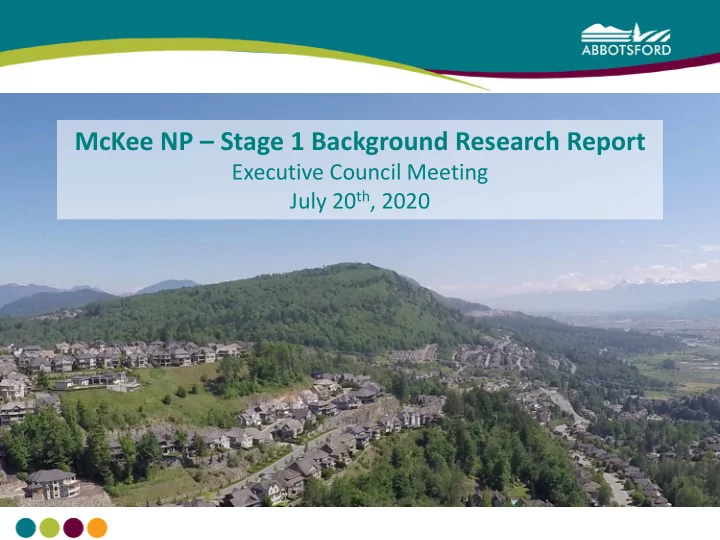
McKee NP – Stage 1 Background Research Report

Executive Council Meeting July 20th, 2020

slide-2
SLIDE 2

22

2

  • Purpose
  • Summary of the Issue
  • Context
  • Discussion
  • Next Steps
  • Recommendations

Agenda

1

slide-3
SLIDE 3

33

3

  • To report the findings of Stage 1 (Background Research) and request

authorization to proceed with Stage 2 (Concept).

Purpose

2

slide-4
SLIDE 4

44

4

Summary of the Issue

  • Staff have prepared the McKee NP Background

Research Report

  • Conclusion of Stage 1
  • Request authorization to proceed with Stage 2

3

slide-5
SLIDE 5

55

5

4

Context

Neighbourhood Plan Process

We are here

slide-6
SLIDE 6

66

6

Context

Official Community Plan

5

slide-7
SLIDE 7

77

7

  • Plan area – approximately 1900 ac. /

769 ha.

  • Based on natural and man-made

features (i.e. topography, catchments, roads)

  • Added – Clayburn Creek Ravine area
  • Removed – Vicarro lands west of

Whatcom Road 6

Context

Defining a Boundary

slide-8
SLIDE 8

88

8

Schools

  • Elementary - Auguston Traditional
  • Middle - Clayburn (outside plan area)
  • Secondary - Robert Bateman (outside

plan area) Parks 5 - Neighbourhood Parks

  • Atwood, Callaghan, Mathers,

McKinley and Shadbolt Trails

  • City trails in Clayburn Creek Ravine
  • Informal trails on McKee Peak

analyzed in Stage 2 7

Context

Existing Schools, Parks, and Trails

slide-9
SLIDE 9

99

9

  • Current Population – 4,000
  • Dwellings – 1,193
  • Household size – 3.3

8

Context

People and Households

slide-10
SLIDE 10

10

10

10

  • 1,193 landowners with existing dwellings
  • 38 landowners (including the City)
  • 6 different categories for land within the planning

process

  • Property will be treated differently due to OCP

policy

Context

9

Planning Process Status

slide-11
SLIDE 11

11

11

11

Context

10

Planning Process Status

Built City owned land Urban Zoning & Subdivision Urban Zoning Transitional Policy Applications Neighbourhood Planning Process

slide-12
SLIDE 12

12

12

12

Context

Planning Process Status

Built City owned land Urban Zoning & Subdivision Urban Zoning Transitional Policy Applications Neighbourhood Planning Process

10

slide-13
SLIDE 13

13

13

13

Context

Planning Process Status

Built City owned land Urban Zoning & Subdivision Urban Zoning Transitional Policy Applications Neighbourhood Planning Process

10

slide-14
SLIDE 14

14

14

14

Context

Planning Process Status

Built City owned land Urban Zoning & Subdivision Urban Zoning Transitional Policy Applications Neighbourhood Planning Process

10

slide-15
SLIDE 15

15

15

15

Context

Planning Process Status

Built City owned land Urban Zoning & Subdivision Urban Zoning Transitional Policy Applications Neighbourhood Planning Process

10

slide-16
SLIDE 16

16

16

16

Context

Planning Process Status

Built City owned land Urban Zoning & Subdivision Urban Zoning Transitional Policy Applications Neighbourhood Planning Process

10

slide-17
SLIDE 17

17

17

17

  • Access to properties for Stage 1 assessment
  • Field studies conducted for the following:
  • Geotechnical (WSP)
  • Watercourses and Riparian Areas (ENKON)
  • Species at Risk ENKON
  • Archaeological and Cultural Heritage (Inlailawatash)
  • Archaeological and Cultural Heritage assessment conducted in 2 phases

11

Context

Property Assessment

slide-18
SLIDE 18

18

18

18

12

Context

Property Assessment

Not Required City owned land Did not grant property access Granted property access for AOA only Granted property access

slide-19
SLIDE 19

19

19

19

Context

Property Assessment

Not Required City owned land Did not grant property access Granted property access for AOA only Granted property access

12

slide-20
SLIDE 20

20

20

20

Context

Property Assessment

Not Required City owned land Did not grant property access Granted property access for AOA only Granted property access

12

slide-21
SLIDE 21

21

21

21

Context

Property Assessment

Not Required City owned land Did not grant property access Granted property access for AOA only Granted property access

12

slide-22
SLIDE 22

22

22

22

Context

Property Assessment

Not Required City owned land Did not grant property access Granted property access for AOA only Granted property access

12

slide-23
SLIDE 23

23

23

23

  • Based on OCP Policy and Senior

Government legislation

  • Examined:
  • Geotechnical
  • Watercourses and Riparian Areas
  • Species at Risk
  • At a neighbourhood planning scale
  • Determine protected from developable

lands

Discussion

Environmental

13

slide-24
SLIDE 24

24

24

24

  • WSP field conducted an overview study

using desk top (LIDAR) and field checking methods Red (Unstable) - High occurrence rating/likelihood of a landslide is probable (non-developable) Yellow (Potentially Unstable) – Moderate

  • ccurrence rating/likelihood of a landslide is

possible (detailed further assessment to develop)

  • Setbacks are meant to protect future

development from landslides, rockfall etc.

  • Setbacks could be reduced through further

geotechnical study

Discussion

Geotechnical

14

slide-25
SLIDE 25

25

25

25

  • Field review and GIS based

assessment of watercourses ponds and wetlands

  • Classifications and setbacks are based
  • n the Water Sustainability Act and

the Streamside Protection Bylaw

Discussion

Watercourses and Riparian Areas

15

slide-26
SLIDE 26

26

26

26

  • Federal Government and Province

require protection of critical habitat for Species at Risk

  • 10 Species at Risk reside within the

plan boundary (e.g. Mountain Beaver and Red Legged Frog)

  • ENKON identified 7 ‘Habitat Hubs’
  • Located in steep slope and riparian

areas

Discussion

Species at Risk / Wildlife

16

slide-27
SLIDE 27

27

27

27

  • Connect core ‘Habitat Hubs’ and

allow Species at Risk to migrate safely through future development areas using linkages / corridors

  • Used pragmatic approach to

connect critical habitat by predominantly using steep slopes and SPEA’s

Discussion

Wildlife Linkages / Corridors

17

slide-28
SLIDE 28

28

28

28

  • The McKee NP is located within the asserted traditional territories of the

Sumas (Sema:th), Leq’a:mel, and Matsqui First Nations of the Sto:lo Nation.

  • Part of the ‘greenfield’ analysis is identifying any lands that have

archaeological or cultural significance.

  • To ensure work was conducted under the terms and conditions of the

Heritage Conservation Act (HCA), the City hired a consultant who also applied for a Sto:lo Heritage Investigation Permit.

Discussion

Archaeological and Cultural Heritage

18

slide-29
SLIDE 29

29

29

29

  • Conducted Archaeological Overview

Assessment (AOA)

  • Identified 52 areas with

archaeological potential and 4 Culturally Modified Trees (CMT’s)

  • All 4 CMT’s are located with SPEA

setbacks

Discussion

Archaeological Overview Assessment Results

19

slide-30
SLIDE 30

30

30

30

  • All of the environmental and archaeological preliminary findings have be

layered through GIS modeling

  • Result illustrates developable and protected lands
  • Net Area are lands that will be used for future development and are comprised
  • f:
  • Unconstrained areas
  • Potentially unstable areas
  • Geotechnical risk areas
  • Development areas with archaeological potential

Discussion

Net Area

20

slide-31
SLIDE 31

31

31

31

21

Discussion

Net Area

In-Stream development City parcels Non-Developable area Unconstrained areas Potentially unstable areas Geotechnical risk areas Development areas with archaeological potential

slide-32
SLIDE 32

32

32

32

Discussion

Net Area

21

In-Stream development City parcels Non-Developable area Unconstrained areas Potentially unstable areas Geotechnical risk areas Development areas with archaeological potential

slide-33
SLIDE 33

33

33

33

Discussion

Net Area

21

In-Stream development City parcels Non-Developable area Unconstrained areas Potentially unstable areas Geotechnical risk areas Development areas with archaeological potential

slide-34
SLIDE 34

34

34

34

Discussion

Net Area

21

In-Stream development City parcels Non-Developable area Unconstrained areas Potentially unstable areas Geotechnical risk areas Development areas with archaeological potential

slide-35
SLIDE 35

35

35

35

Discussion

Net Area

21

In-Stream development City parcels Non-Developable area Unconstrained areas Potentially unstable areas Geotechnical risk areas Development areas with archaeological potential

slide-36
SLIDE 36

36

36

36

Discussion

Net Area

21

In-Stream development City parcels Non-Developable area Unconstrained areas Potentially unstable areas Geotechnical risk areas Development areas with archaeological potential

slide-37
SLIDE 37

37

37

37

Discussion

Net Area

21

In-Stream development City parcels Non-Developable area Unconstrained areas Potentially unstable areas Geotechnical risk areas Development areas with archaeological potential

slide-38
SLIDE 38

38

38

38

In-Stream development City parcels Non-Developable area Unconstrained areas Potentially unstable areas Geotechnical risk areas Development areas with archaeological potential

Discussion

Net Area

21

slide-39
SLIDE 39

39

39

39

22

Discussion

Net Area Analysis

slide-40
SLIDE 40

40

40

40

23

Discussion

Existing Infrastructure

Engineering consultant examined existing conditions for the following infrastructure: Stormwater Transportation Wastewater Water

slide-41
SLIDE 41

41

41

41

24

Discussion

Engagement Strategy

Who we will Engage:

  • General Public
  • Government and Government Agencies
  • City of Abbotsford
  • Key Organizations

Stage 2 Engagement

  • Online
  • Popup Event or Open House
  • Design Charrettes
  • City Committee Workshop
  • Mail-out
  • Social Media and Website
  • Letter to Agencies
slide-42
SLIDE 42

42

42

42

  • Community engagement
  • Begin process of creating concept
  • ptions
  • Engage Infrastructure consultant to

begin preliminary technical analysis of Infrastructure needs

Next Steps

25

Stage 2

slide-43
SLIDE 43

43

43

43

  • 1. THAT Council receive the McKee Neighbourhood Plan Background

Research Report for information;

  • 2. THAT Council direct staff to proceed with Stage 2 of the McKee

Neighbourhood Plan, including engagement, as outlined in the report from the Senior Planner; and

  • 3. THAT Council endorse the public engagement strategy, as outlined in the

report from the Senior Planner, pursuant to Section 475 of the Local Government Act.

Recommendations

26