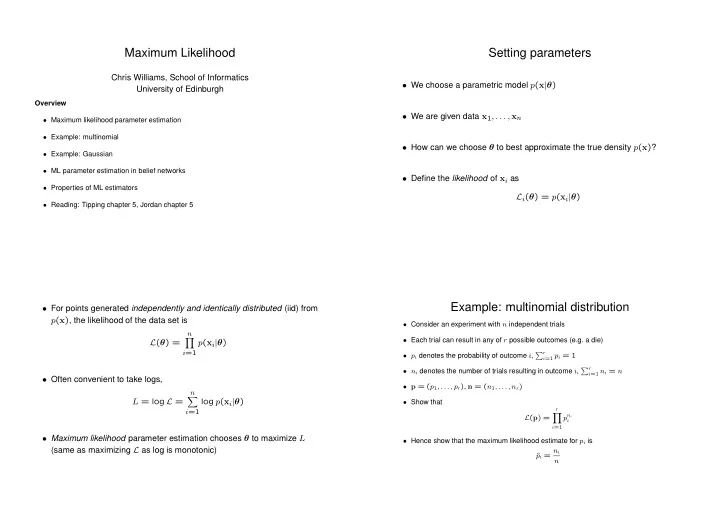

SLIDE 1
Maximum Likelihood
Chris Williams, School of Informatics University of Edinburgh
Overview
- Maximum likelihood parameter estimation
- Example: multinomial
- Example: Gaussian
- ML parameter estimation in belief networks
- Properties of ML estimators
- Reading: Tipping chapter 5, Jordan chapter 5
Setting parameters
- We choose a parametric model p(x|θ)
- We are given data x1, . . . , xn
- How can we choose θ to best approximate the true density p(x)?
- Define the likelihood of xi as
Li(θ) = p(xi|θ)
- For points generated independently and identically distributed (iid) from
p(x), the likelihood of the data set is L(θ) =
n
- i=1
p(xi|θ)
- Often convenient to take logs,
L = log L =
n
- i=1
log p(xi|θ)
- Maximum likelihood parameter estimation chooses θ to maximize L
(same as maximizing L as log is monotonic)
Example: multinomial distribution
- Consider an experiment with n independent trials
- Each trial can result in any of r possible outcomes (e.g. a die)
- pi denotes the probability of outcome i, r
i=1 pi = 1
- ni denotes the number of trials resulting in outcome i, r
i=1 ni = n
- p = (p1, . . . , pr), n = (n1, . . . , nr)
- Show that
L(p) =
r
- i=1
pni
i
- Hence show that the maximum likelihood estimate for pi is